
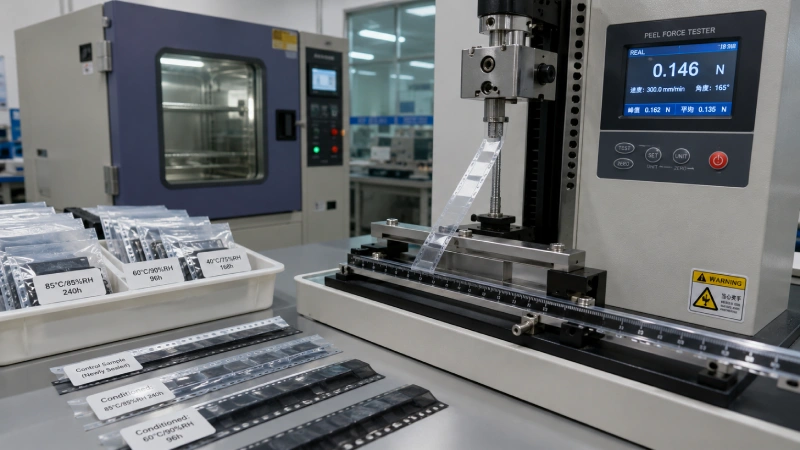
Temperature and humidity are often blamed when cover tape begins to lift, peel-force readings drift, or an SMT feeder becomes unstable. However, an environmental change does not act on the cover tape alone. The measured result comes from the complete sealed system: cover tape, adhesive, carrier tape material, sealing or application process, reel configuration, exposure history, recovery conditions, and peel-test method.
This distinction matters when a lot passes initial inspection but behaves differently after warehouse storage, international shipment, environmental conditioning, or seasonal changes on the production floor.
A higher or lower peel-force result does not automatically prove that the cover tape is defective. Before changing materials or process settings, engineers should establish a controlled comparison between the original sample and the environmentally exposed sample. Buyers evaluating cover tape solutions for tape-and-reel packaging should therefore request test data that identifies the complete material combination and every relevant condition.
Define the Sample State Before Comparing Peel Force
Environmental test results cannot be interpreted correctly unless the sample state is clearly defined.
An unused cover tape roll, a freshly sealed carrier tape strip, and a component-loaded reel after environmental exposure are three different test objects.
Unused Cover Tape Rolls
For unused material, the primary questions involve:
- Manufacturing date and lot number
- Original packaging condition
- Whether the roll has been opened
- Storage temperature and relative humidity
- Exposure to direct sunlight, contamination, or condensation
- Time since the roll was removed from controlled storage
These questions belong mainly to inventory control. For detailed guidance on unopened rolls, opened materials, aging, isolation, and retesting, refer to Jiushuo’s cover tape storage and shelf-life control guide.
Storage limits should come from product-specific technical documentation rather than a universal rule. A supplier’s storage recommendation applies to the identified product and packaging condition; it should not be transferred to another adhesive system without verification.
Freshly Sealed Carrier Tape
A freshly sealed sample reflects the initial application process. Its record should identify:
- Cover tape and carrier tape lots
- Carrier tape material
- Sealing-machine or application-equipment model
- Heat, pressure, dwell time, and line speed for heat-activated systems
- Roller or shoe pressure and application speed for pressure-sensitive systems
- Time between sealing and peel testing
- Test-room temperature and relative humidity
If the initial bond was not produced under controlled conditions, later environmental testing may only reveal an unstable starting process.
Environmentally Exposed Sealed Reels
An environmentally exposed sample evaluates the full sealed package. Engineers should record whether the sample was:
- A flat laboratory strip
- An empty sealed carrier tape
- A component-loaded tape
- Wound onto a production-size reel
- Stored under winding tension
- Protected by a bag, carton, or moisture barrier
A wound reel can respond differently from a short flat strip because curvature, winding tension, reel diameter, and component loading may affect the sealed system.
Separate Application, Exposure, and Test Conditions
Three groups of conditions must be kept separate in every report.
Application Conditions Form the Initial Bond
Heat-activated adhesive cover tape forms its seal through a controlled combination of heat, pressure, and time. Pressure-sensitive adhesive cover tape relies mainly on controlled pressure, adhesive contact, alignment, and surface condition, normally without heat activation.
For heat-activated systems, a displayed machine temperature alone is not enough. Actual sealing-head behavior, rail geometry, dwell time, pressure distribution, line speed, and carrier tape response can all affect the initial seal.
Jiushuo’s guide to the heat-activated sealing process window explains why temperature, pressure, dwell time, and speed must be validated together rather than adjusted independently.
For PSA materials, surface cleanliness, tape alignment, application pressure, roller condition, and the time allowed for adhesive contact should be documented. These controls are covered in the guide to pressure-sensitive cover tape application.
Exposure Conditions Act on the Sealed System
An environmental record should identify:
- Temperature
- Relative humidity
- Exposure duration
- Number of cycles
- Whether condensation occurred
- Whether the sample was wound or flat
- Packaging condition
- Whether components were loaded
- Whether the reel remained under tension
Relative humidity must always be reported together with temperature. A statement such as “tested under high humidity” is not sufficient for technical comparison.
Test Conditions Affect the Reported Result
After exposure, the reported peel force can still be influenced by:
- Time between chamber removal and testing
- Recovery or stabilization conditions
- Test-room temperature and humidity
- Peel angle
- Pull speed
- Sample length
- Fixture alignment
- Data-sampling and averaging method
- Tester calibration
Two laboratories can obtain different results from apparently similar materials when their recovery time, fixtures, peel geometry, or data processing are not identical. Exposure conditions and test conditions must therefore be reported separately.
Why Temperature and Humidity Do Not Produce One Universal Trend
It is inaccurate to state that high humidity always reduces adhesion or that high temperature always increases peel force.
The direction and size of the change depend on the complete material system.
Temperature may influence:
- Adhesive response
- Cover film flexibility
- Stress transfer during peeling
- Carrier tape flange stability
- Existing residual stress from sealing
- Adhesion development over time
- Tape stretching during the test
Humidity may interact with:
- The adhesive interface
- Carrier tape surface condition
- Conductive or antistatic additives
- Contamination on the sealing flange
- Packaging integrity
- Condensation during temperature transitions
The carrier tape material name alone is not enough to predict the result. Two tapes both described as polycarbonate or polystyrene may use different resin grades, surface treatments, additives, forming processes, or conductive layers.
For this reason, environmental qualification should begin with a confirmed carrier tape and cover tape compatibility combination.
Supplier aging curves can help engineers design a test, but the results apply only to the specific cover tape, carrier material, sealing settings, environmental condition, and test method stated in the document. They should not be presented as a universal response for all cover tapes.
Heat-Activated and PSA Systems Require Different Records
Heat-activated and pressure-sensitive cover tapes can be evaluated through a similar environmental test framework, but their initial application records should not be identical.
Heat-Activated Cover Tape
Before environmental exposure, record:
- Verified sealing temperature
- Pressure
- Dwell time
- Line speed
- Seal-rail width and geometry
- Number of sealing strikes
- Machine model
- Carrier tape material
- Cooling time before winding
Environmental aging cannot correct an uncontrolled initial seal. If the original process produced incomplete seal bands, excessive carrier deformation, or uneven pressure, later peel-force drift should not be diagnosed only as a humidity problem.
Pressure-Sensitive Cover Tape
For PSA materials, record:
- Carrier flange cleanliness
- Adhesive stripe alignment
- Roller or application-shoe configuration
- Applied pressure
- Number of passes
- Application speed
- Ambient temperature and humidity during application
- Time between application and exposure
- Time between application and initial testing
Pressure-sensitive does not mean environmentally insensitive. The adhesive is not normally activated by heat, but the sealed system can still respond to temperature, humidity, time, substrate condition, and test temperature.
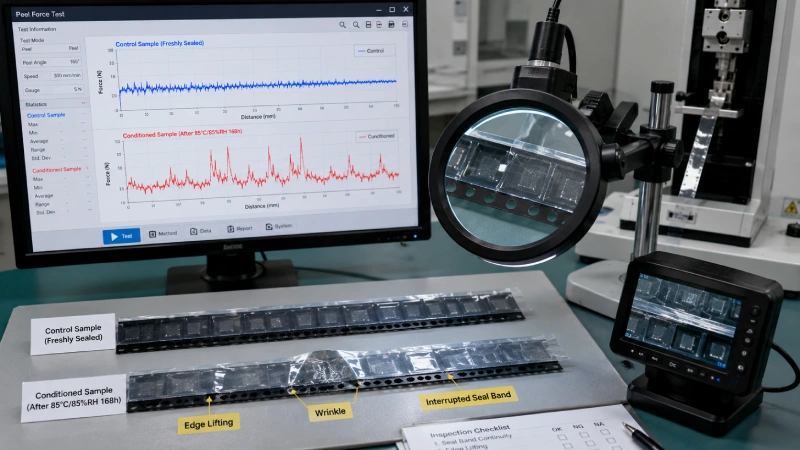
Measure More Than Average Peel Force
An average peel-force value can hide local defects and unstable peeling.
A useful comparison should include:
- Minimum force
- Maximum force
- Average force
- Force range
- Standard deviation
- Abnormal peaks
- Position of peaks along the test length
- Failure mode
- Seal-band appearance
The complete curve can reveal information that a single average cannot.
A smooth but gradually rising curve may indicate a different issue from repeated sharp peaks. A stable average combined with a wider range may show that local sealing uniformity has deteriorated even though the overall value remains within an acceptance boundary.
Engineers should also inspect both seal bands for:
- Edge lifting
- Interrupted adhesion
- Wrinkles
- Adhesive transfer
- Film tearing
- Carrier flange deformation
- Uneven seal width
- Contamination
Minimum, maximum, mean, range, and curve behavior should be reviewed together. Data copied from another supplier may demonstrate a reporting method, but it cannot be used as Jiushuo performance data or as a universal specification.
Build a Controlled Environmental Qualification Matrix
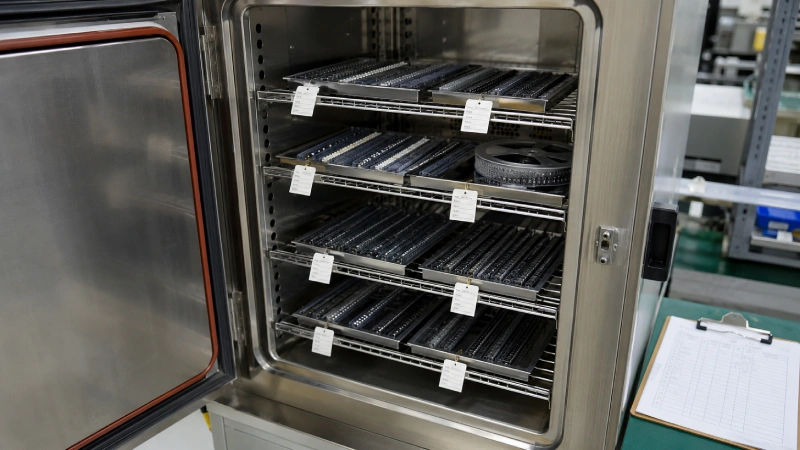
The most reliable method is to compare an environmentally exposed group with a controlled baseline group.
The baseline and conditioned samples should use:
- The same cover tape lot
- The same carrier tape lot
- The same sealing or application equipment
- The same process settings
- The same sample configuration
- The same peel-test method
- The same data-analysis rules
A practical test matrix may include the following fields:
| Condition | Sample State | Temperature | Relative Humidity | Exposure Time | Recovery Condition | Test Timing | Sample Quantity |
|---|---|---|---|---|---|---|---|
| Baseline | Freshly sealed | Project-defined | Project-defined | Initial | Defined room condition | Defined interval | Defined by test plan |
| Condition A | Sealed reel | Customer-defined | Customer-defined | Defined duration | Immediate or stabilized | Recorded | Defined by test plan |
| Condition B | Sealed reel | Supplier- or risk-defined | Supplier- or risk-defined | Defined duration | Immediate or stabilized | Recorded | Defined by test plan |
The table should not be filled with generic temperature or humidity values copied from another manufacturer. Exposure cells should come from:
- Customer qualification requirements
- Supplier recommendations for the specific product
- Expected shipping and warehouse risks
- Internal reliability plans
- Previous failure history
The test plan should also define whether samples are tested immediately after chamber removal, after a controlled recovery period, or at both stages.
For the detailed fixture setup, peel direction, test speed, curve review, and reporting process, use Jiushuo’s EIA-481 cover tape peel-force test method.
Separate EIA-481 Requirements from Environmental Qualification
EIA-481 covers tape-and-reel packaging requirements for surface-mount components used in automatic handling. The applicable revision and customer requirements should be reviewed directly from the authorized standard source.
However, three different types of limits must not be confused:
- Requirements or test conditions from the applicable industry standard
- Typical data published by a material supplier
- Internal control limits established by a customer or packaging manufacturer
A supplier data sheet may show environmental aging at a particular temperature, humidity, and duration. That does not automatically make the aging profile an EIA-481 requirement.
Likewise, an internal production control range may be narrower than an external acceptance boundary because the manufacturer is controlling variation before it creates feeder problems.
For broader context, Jiushuo’s EIA-481 tape-and-reel requirements guide explains how cover tape, carrier tape, reels, component orientation, and automated feeding must work together.
Diagnose Peel-Force Drift by the Observed Pattern
| Observed Result | Variables to Check First |
|---|---|
| Average peel force increases | Initial process, test temperature, recovery time, adhesive transfer, film stretching, carrier deformation |
| Average peel force decreases | Seal continuity, contamination, condensation, initial low adhesion, material compatibility |
| Force range becomes wider | Uneven pressure, flange variation, wrinkles, intermittent seal bands, test-fixture instability |
| Repeated peaks appear | Local seal defects, tape tracking, adhesive buildup, carrier dimensional variation |
| Edge lifting develops | Surface condition, alignment, insufficient initial application, incompatible tape pair |
| Average passes but feeder is unstable | Actual feeder angle, peeling speed, take-up tension, component fit, trampolining |
A laboratory pass does not guarantee stable production feeding. The actual feeder introduces its own peel angle, speed, take-up tension, vibration, and component dynamics.
When the curve appears acceptable but components jump, shift, or expose unevenly, review the relationship between cover tape peel-force stability and SMT feeding.
Turn Test Results into a Release Decision
Environmental qualification should lead to a documented decision.
A lot may be approved when:
- The sample and material lots are traceable
- Exposure and test conditions are complete
- Results meet the applicable acceptance criteria
- Peel-force variation remains controlled
- No significant lifting, tearing, residue, or seal interruption is found
- Feeder validation is acceptable when required
Retesting may be appropriate when:
- Recovery time was inconsistent
- Equipment calibration is uncertain
- Sample quantity was insufficient
- Baseline and aged samples used different lots
- One abnormal result cannot be reproduced
- Test geometry or speed was not documented
The material should be quarantined for investigation when:
- Peel-force drift is systematic
- Curve variation expands significantly
- Edge lifting or adhesive transfer appears
- Tape tearing occurs
- Exposure history is unknown
- Packaging has been damaged
- The result fails customer or internal requirements
Temperature and humidity should therefore be treated as controlled qualification variables, not as convenient explanations for every cover tape problem.
To evaluate a specific application, provide Jiushuo with the carrier tape material and width, component drawing or sample, cover tape information, sealing or application settings, environmental profile, peel-force curve, defect photos, and customer acceptance criteria.
Jiushuo can then evaluate the actual tape pair and prepare a sample-validation plan through its cover tape product and technical support page.
FAQ
Does high humidity always increase cover tape peel force?
No. Peel force may increase, decrease, remain stable, or become more variable depending on the adhesive system, carrier tape, initial process, exposure duration, recovery method, and test conditions.
Should peel force be tested immediately after environmental exposure?
The test plan should define this in advance. Immediate testing evaluates the sample in its post-exposure state, while testing after controlled stabilization may better represent later production use. Some projects require both.
Can heat-activated and pressure-sensitive cover tapes use the same aging conditions?
They can be included in the same environmental framework when the project requires comparison, but their sample-preparation records must reflect their different bonding mechanisms. Exposure conditions should come from the customer requirement or a validated qualification plan.
Does EIA-481 define one universal temperature and humidity aging profile?
A supplier’s environmental-aging condition should not be presented as a universal EIA-481 requirement. The applicable standard, customer specification, supplier data sheet, and internal control plan should be identified separately.
Is average peel force enough to approve an aged reel?
No. The review should also include minimum, maximum, range, curve stability, visible seal condition, residue, lifting, tape tearing, material traceability, and feeder performance where applicable.