
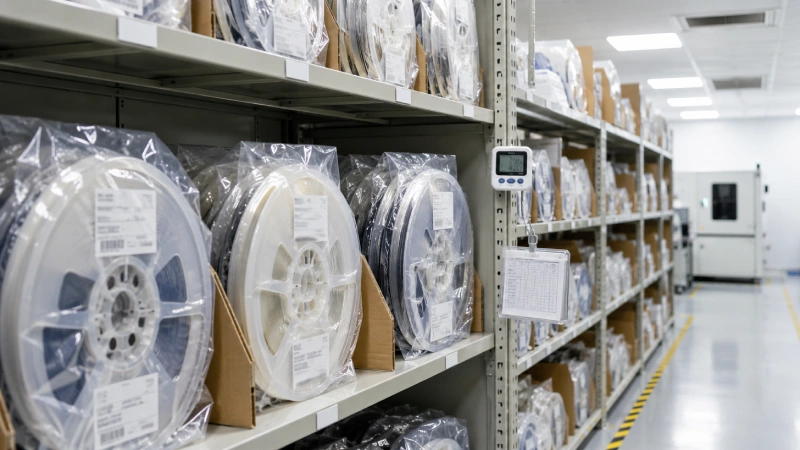
Cover tape does not have one shelf-life value that applies to every adhesive system, film construction, carrier tape material, and supplier. A valid storage decision must consider the specific product label, manufacturing date, technical data sheet, packaging condition, storage history, and intended production process.
An unopened roll that has remained in its original packaging presents a different risk from a partially used roll exposed to the production environment. Both are different again from components that have already been sealed in carrier tape.
When cover tape is expired, close to expiry, or exposed to uncontrolled conditions, it should not be released for mass production based only on its appearance. It should be quarantined, reviewed, and tested with the intended carrier tape and sealing process.
For product selection and application support, review Jiushuo’s cover tape solutions for tape-and-reel packaging.
Separate Unopened Rolls, Opened Rolls, and Sealed Reels
The first step in storage control is identifying what is actually being evaluated.
Unopened Cover Tape Rolls
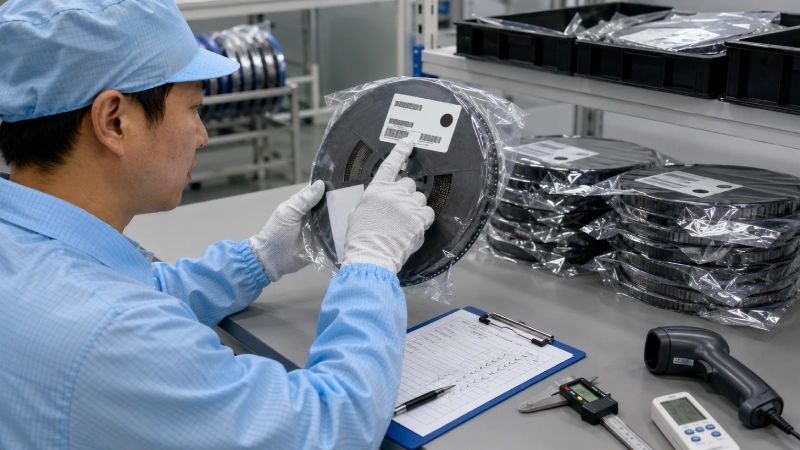
For unopened rolls, verify that the original bag, carton, end protection, core, and identification label remain intact. The label should allow the user to confirm the product designation, lot number, manufacturing date, and any supplier-defined use-by date.
“Unopened” does not automatically mean “acceptable.” A sealed roll may still require evaluation if:
- Its storage history is unavailable.
- Its packaging is punctured or damaged.
- It has experienced uncontrolled heat or humidity.
- The core or tape edges are deformed.
- The product identity or date code cannot be confirmed.
Shelf life is normally linked to conditions stated in the product-specific technical documentation. The receiving date should not automatically replace the manufacturing date as the starting point.
Opened or Partially Used Rolls
Once a roll has been opened, the original protection against dust, oil, handling contamination, light, and humidity may no longer be complete.
Opened-roll control should include:
- The date and time of opening.
- The remaining roll length.
- The line or machine on which it was used.
- The method used to reseal and protect the roll.
- Any visible edge damage, looseness, blocking, or contamination.
- The applicable supplier recommendation for opened materials.
Do not assign an arbitrary opened-roll life unless it is supported by the supplier’s documentation or an approved internal validation study.
Components Already Sealed in Tape and Reel
The shelf life of an unused cover tape roll is not the same as the storage life of components already sealed in carrier tape.
After sealing, performance depends on the complete packaging system, including the cover tape, carrier tape material, sealing conditions, winding tension, reel configuration, storage environment, and component characteristics.
Component moisture sensitivity, solderability, oxidation, and moisture-barrier packaging should be managed under the applicable component-handling procedures. They should not be confused with the storage requirements of unused cover tape.
Why Cover Tape Has No Universal Shelf Life
Official supplier documents demonstrate why a single temperature, humidity, or shelf-life value should not be applied across all cover tapes.
For example, one 3M heat-activated cover tape data sheet specifies storage below a defined temperature, limits relative humidity, and calculates shelf life from the manufacturing date. A 3M pressure-sensitive product uses a different controlled temperature range and humidity limit. Advantek’s HUE heat-activated series provides another storage window, recommends use within a defined period, and specifies room-temperature stabilization before use.
These are product-specific instructions, not universal industry limits. Buyers should refer to the relevant official documents, such as the 3M 2690 technical data sheet, the 3M 2668 technical data sheet, and the Advantek HUE-series data sheet.
| Product-document example | Adhesive category | Published storage guidance | Published shelf-life basis |
|---|---|---|---|
| 3M Cover Tape 2690 | Heat activated | Original packaging and a controlled indoor environment within the stated limits | From date of manufacture |
| 3M Cover Tape 2668 | Pressure sensitive | Original packaging and a controlled indoor environment within the stated limits | From date of manufacture |
| Advantek HUE Series | Heat activated | Original packaging, climate-controlled storage, and protection from excessive exposure | From date of manufacture |
These examples should only be used to understand how manufacturers document storage requirements. They must not be presented as Jiushuo specifications or as mandatory values for unrelated cover tapes.
For a purchased lot, the correct information hierarchy is normally:
- Approved customer specification.
- Product label and lot identification.
- Current supplier technical data sheet.
- Lot-specific Certificate of Analysis.
- Written supplier recommendation.
- Validated internal test data.
The manufacturing date, shipping date, receiving date, and opening date are separate records and should not be used interchangeably.
How Temperature, Humidity, and Handling Create Risk
Storage conditions matter because cover tape is a functional packaging material, not simply a roll of plastic film. The adhesive layer, backing film, antistatic treatment, roll geometry, and eventual carrier-tape interface must all remain suitable for processing.
Temperature Excursions
When a temperature excursion occurs, record the maximum and minimum temperatures, the exposure duration, whether the roll remained sealed, and whether repeated hot-cold cycling occurred.
Potential concerns include:
- Roll deformation.
- Blocking between adjacent tape layers.
- Changes in unwind behavior.
- Adhesive transfer.
- Film shrinkage or distortion.
- Altered sealing or peel-force behavior.
A roll moved from a cold warehouse to a warm production area may also require stabilization before opening or use. The required stabilization period must come from the specific product documentation or a validated internal procedure. A conditioning time published for one supplier’s product should not be treated as a rule for every cover tape.
Humidity and Condensation
High relative humidity and visible condensation are related but different risks. Rapidly moving a cold roll into a warmer, humid environment can create moisture on the packaging or material surface.
If condensation is suspected, do not immediately open the packaging or start sealing. Isolate the material, allow it to stabilize under the approved procedure, and inspect it before use.
The storage record should show more than the phrase “room temperature.” A controlled warehouse should use traceable temperature and humidity monitoring, with documented responses to excursions.
Light, Dust, Oil, and Physical Damage
Cover tape should be protected from direct sunlight, uncontrolled heat sources, dust, oil, silicone contamination, crushing, and bending. Several official supplier data sheets specifically require protection from direct sunlight and storage in the original packaging.
Physical inspection should cover:
- Damaged tape edges.
- Creasing or wrinkling.
- Loose winding.
- Telescoping.
- Crushed or distorted cores.
- Contamination on the sealing area.
- Visible delamination.
- Damaged cartons or inner bags.
Heat-Activated and Pressure-Sensitive Cover Tape Require Different Controls
Storage inspection can follow a common framework, but the sealing and retesting methods must reflect the adhesive system.
Heat-Activated Cover Tape
Heat activated cover tape forms its seal through a controlled combination of heat, pressure, and contact time. Line speed also affects the effective dwell time.
After long storage or abnormal environmental exposure, validation should confirm:
- Seal-band continuity.
- Sealing-window stability.
- Peel-force consistency.
- Delayed edge lifting.
- Film distortion.
- Adhesive transfer or residue.
The trial must record the actual temperature, pressure, dwell time, line speed, sealing-head geometry, carrier tape material, and test environment. Parameters published for another manufacturer’s cover tape must not be copied as Jiushuo operating limits.
Pressure-Sensitive Cover Tape
Pressure sensitive cover tape primarily bonds through controlled pressure rather than heat activation.
For stored or opened PSA rolls, particular attention should be given to:
- Exposed adhesive areas.
- Dust or oil contamination.
- Blocking.
- Adhesive transfer.
- Roller-pressure consistency.
- Carrier tape surface condition.
- Unwind and alignment behavior.
A 3M technical data sheet for one PSA cover tape specifically states that applying heat to seal that product is not recommended. This illustrates why the sealing method must follow the product construction rather than a generic cover-tape procedure.
Build a Traceable Storage and Inventory Procedure
An effective procedure should cover the complete material lifecycle.
| Lifecycle stage | Minimum control | Quarantine trigger |
|---|---|---|
| Receiving | Verify product, lot, manufacturing date, packaging, quantity, and documents | Damaged packaging, missing label, or inconsistent product information |
| Storage | Monitor approved temperature and humidity conditions | Excursion or missing environmental records |
| Opening | Record opening date and production line | Unknown opening date or contamination |
| Return to storage | Reseal, protect edges, and identify remaining material | Loose roll, damaged edge, or unsuitable packaging |
| Pre-production | Confirm status and complete required inspection | Expired, exposed, damaged, or untraceable stock |
| Release | Document test results and approval authority | Results outside approved limits |
For dated materials, first-expired-first-out may provide better risk control than relying only on first-in-first-out. Lots approaching the end of their approved shelf life should be identified before they are issued to long production runs.
When Cover Tape Should Be Quarantined
Cover tape should be placed on hold when any of the following conditions apply:
- It is beyond the supplier-defined shelf life.
- Its manufacturing date or lot number cannot be identified.
- Storage records are missing.
- The roll experienced a temperature or humidity excursion.
- The packaging was opened but not properly resealed.
- The tape edge, core, or winding is damaged.
- Contamination, blocking, delamination, or adhesive transfer is visible.
- The carrier tape material or supplier has changed.
- The sealing equipment or process parameters have changed.
- Production has reported lifting, tearing, residue, wrinkles, or unstable peeling.
Quarantine does not automatically mean that the material must be discarded. It means the lot should not be used until the risk has been evaluated and the required tests are completed.
A Practical Retesting Workflow
1. Confirm Identity and History
Collect the product designation, lot number, manufacturing date, opening date, storage records, excursion history, intended carrier tape, sealing method, equipment, and previous approval data.
Any Jiushuo model-to-adhesive classification used in the final report should be confirmed by the Jiushuo technical team.
2. Establish a Reference and Sampling Plan
Where possible, compare the aged material with an approved production lot or retained reference sample.
Take samples from meaningful positions rather than testing only the easily accessible roll end. The sampling quantity and locations should reflect the lot size, storage risk, customer requirement, and internal quality plan.
3. Inspect the Roll
Check dimensions, tape edges, core condition, surface cleanliness, winding, blocking, delamination, wrinkles, and unwind behavior.
PSA cover tape should also be checked for contamination or damage in the adhesive areas.
4. Seal to the Intended Carrier Tape
Retesting should use the actual carrier tape or an approved equivalent. Cover tape behavior can change with the carrier tape material, surface condition, flange geometry, and sealing process.
For more detail, review the guide to carrier tape and cover tape compatibility.
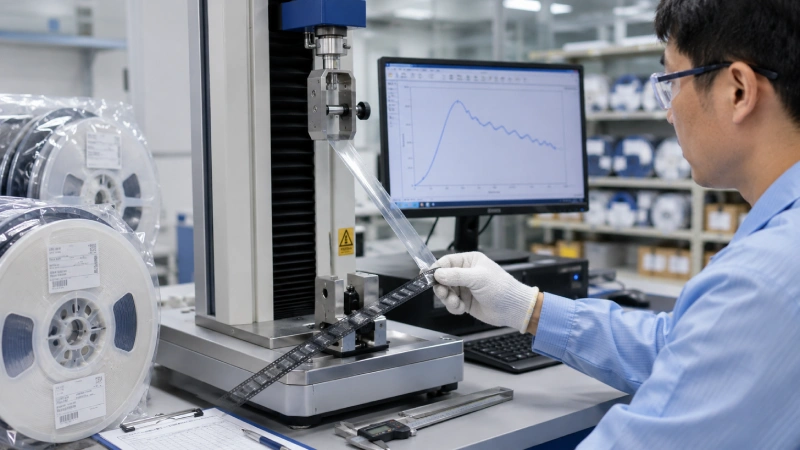
5. Measure Peel Force Under Documented Conditions
A peel-force result is meaningful only when its test conditions are recorded. Document:
- Test method and revision.
- Peel angle.
- Test speed.
- Sample width.
- Equipment and calibration status.
- Test temperature and humidity.
- Sealing parameters.
- Carrier tape material.
- Average, range, peaks, and curve stability.
- Source of the acceptance limits.
Jiushuo’s guide to cover tape peel force and SMT feeding stability explains why an acceptable average value may still hide unstable peaks or variation.
ANSI/EIA-481-F-2021 covers embossed and punched carrier taping of surface-mount components for automatic handling. Its scope supports standardized tape-and-reel evaluation, but it does not establish one universal shelf life for every supplier’s cover tape. Shelf-life limits should therefore come from the specific product documentation and validation data.
For additional background, see the EIA-481 tape-and-reel requirements guide and the ANSI standards notice for EIA-481-F.
6. Inspect the Sealed Samples
After sealing, examine:
- Continuity of both seal bands.
- Edge lifting.
- Adhesive residue.
- Tape tearing or delamination.
- Flange contamination.
- Delayed changes after an approved waiting period.
A supplier aging chart is only useful when the carrier tape, environment, sealing parameters, and test duration are stated. The 3M 2690 data sheet, for example, presents aging results together with the carrier material and exposure conditions and identifies the results as representative rather than specification values.
7. Run a Short Production or Feeder Trial
For higher-risk applications, laboratory testing should be followed by a controlled line trial.
Confirm:
- Tape tracking.
- Seal-band stability.
- Winding behavior.
- Cover tape peeling.
- Component movement.
- Tearing.
- Feeder interruptions.
- Continuous operation at the intended line speed.
Release, Conditional Use, or Reject
A lot should be released only against an approved acceptance source, such as a customer specification, supplier specification, validated internal control range, or approved reference sample.
Conditional use may restrict the material to:
- A specified carrier tape.
- A specified machine.
- A defined sealing window.
- One customer order.
- A limited production quantity.
- Increased in-process inspection.
- A shortened authorized use period.
Passing one peel-force test does not automatically create a new full shelf-life period. The result represents the tested samples under the recorded conditions. Any extension should be lot-specific, documented, and approved by the responsible technical and quality personnel.
Material with unknown identity, severe contamination, delamination, major deformation, or unreliable traceability should not be released solely because one measured value is acceptable.
What Buyers Should Request from a Cover Tape Supplier
Before approving a cover tape, buyers should request:
- A product-specific storage statement.
- The shelf-life date basis.
- Unopened and opened-roll handling requirements.
- Current TDS and COA information.
- Lot traceability.
- Peel-test conditions and acceptance limits.
- Aging or stability data with full test conditions.
- Carrier tape compatibility information.
- A process for evaluating expired or environmentally exposed lots.
FAQ
Does EIA-481 define a universal shelf life for cover tape?
No universal cover-tape shelf life should be inferred from EIA-481. The standard addresses tape-and-reel packaging for automatic handling, while product shelf life should be confirmed through the supplier’s product-specific documentation and approved quality requirements.
Can expired cover tape be used if it passes a peel-force test?
Possibly, but peel force alone is not sufficient. The review should also cover traceability, storage history, roll condition, seal continuity, residue, edge lift, unwind behavior, carrier tape compatibility, and production-line performance.
Should opened cover tape rolls be controlled differently from unopened rolls?
Yes. Opening the original packaging introduces additional risks from contamination, humidity, physical damage, and handling. Record the opening date and follow the supplier-approved resealing and use procedure.
How long should cover tape stabilize before use?
There is no universal stabilization time. Follow the product-specific technical data sheet or an internally validated procedure rather than copying a conditioning time from an unrelated product.
What should be retested after a temperature or humidity excursion?
Depending on the risk, retesting may include visual inspection, roll condition, sealing trials, peel-force curves, edge lift, residue, unwind behavior, ESD properties, and a short feeder trial.
Can the same retest method be used for heat-activated and pressure-sensitive cover tape?
The inspection and traceability steps may be similar, but the sealing trials must be different. Heat-activated tape requires controlled heat, pressure, and time, while pressure-sensitive tape primarily requires controlled pressure.
Should aged cover tape be tested on the actual carrier tape material?
Yes, whenever practical. Carrier tape material, surface condition, width, flange geometry, and sealing parameters can all affect the final bond and peel behavior.
Need to Validate Stored or Aged Cover Tape?
Before releasing aged, expired, or environmentally exposed material, prepare the cover tape label, lot information, manufacturing date, storage history, carrier tape material, sealing conditions, and any available peel-force curves or defect photos.
Contact Jiushuo’s packaging team to discuss sample matching, storage-risk evaluation, and a retesting plan for your tape-and-reel application.