
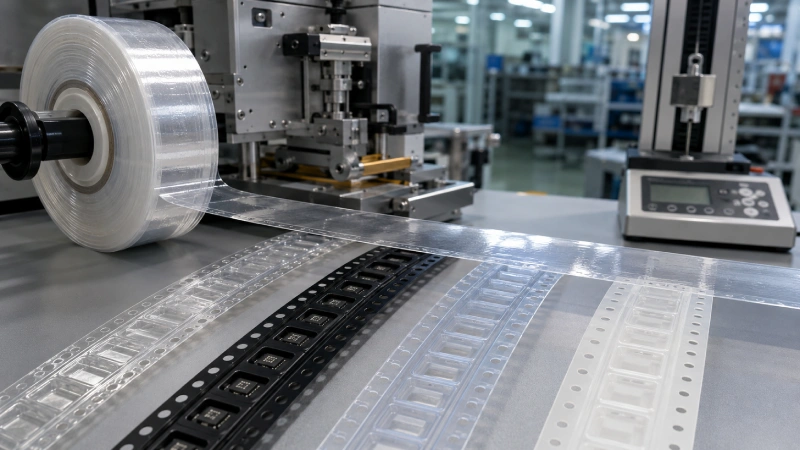
Selecting cover tape by carrier tape material may appear straightforward: identify whether the carrier is PS, PC, PET, or PVC, then choose a compatible tape. In practice, material compatibility is not a simple resin-to-resin matching exercise.
A stable tape-and-reel package depends on the interaction between the cover tape adhesive, the carrier tape sealing surface, the application process, storage conditions, peel-test method, and SMT feeder setup. Two carrier tapes described as “PS” may produce different peel results when they use different resin grades, conductive additives, surface treatments, or forming processes.
For this reason, compatibility should be confirmed using the actual carrier tape and controlled test conditions before mass production.
First Confirm What PS, PC, PET, and PVC Refer To
In this guide, PS, PC, PET, and PVC primarily refer to carrier tape substrate materials:
- PS: Polystyrene
- PC: Polycarbonate
- PET or A-PET: Polyethylene terephthalate or amorphous PET
- PVC: Polyvinyl chloride
These names should not be confused with the backing film used in the cover tape.
A cover tape is normally a multilayer construction. Depending on the product, it may include a polyester backing film, an adhesive or sealant layer, an anti-static treatment, and additional functional layers. A cover tape with a PET or polyester backing is not automatically compatible with a PET carrier tape.
The critical interface is the contact area between the cover tape adhesive and the sealing flange of the carrier tape.
This distinction can be seen in manufacturer documentation. For example, 3M describes certain cover tapes as polyester-backed products, but each product still has a defined carrier tape application range. A backing material description therefore cannot replace an adhesive compatibility test.
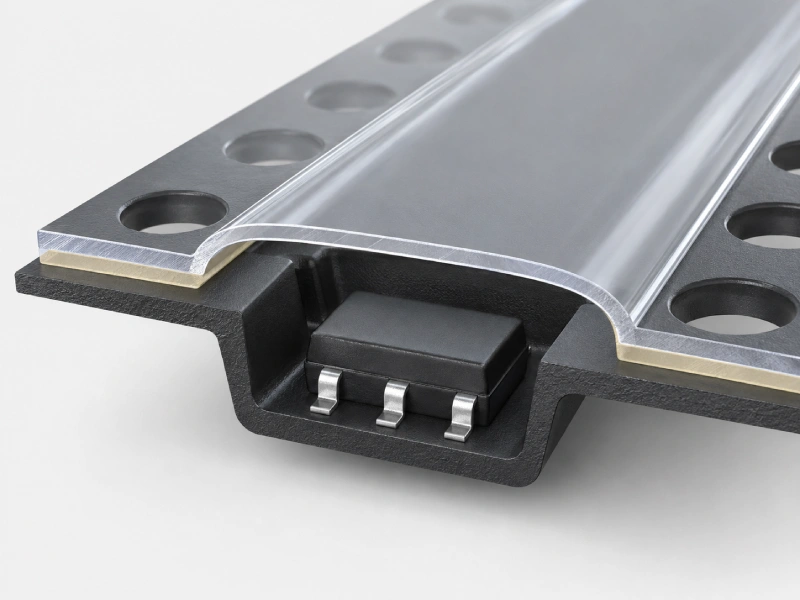
Compatibility Depends on the Complete Sealing Interface
The carrier tape resin is an important starting point, but it is only one part of the qualification process.
Carrier Tape Grade and Surface Condition
Carrier tapes made from the same nominal polymer may differ in:
- Resin formulation and supplier grade
- Clear, black, conductive, or static-dissipative construction
- Carbon or other functional additives
- Surface coating or treatment
- Forming process
- Flange flatness
- Surface contamination
- Tape thickness and stiffness
These differences can change how an adhesive contacts, wets, and releases from the sealing surface.
Dust, oil, forming residue, scratches, or an uneven flange may also create intermittent seal bands. A material combination that works in a laboratory test may become unstable if production samples have inconsistent surfaces.
Width and seal-lane geometry must also be checked. Correct material chemistry cannot compensate for cover tape that is too wide, too narrow, or incorrectly aligned. See Jiushuo’s cover tape width matching guide for carrier tape for the dimensional factors that should be reviewed separately.
Adhesive Construction
Cover tapes with similar product descriptions may still use different adhesive formulations. “Heat activated” and “pressure sensitive” describe the general bonding method, not one universal adhesive chemistry.
A heat-activated adhesive requires controlled heat, pressure, and contact time to form a seal. A pressure-sensitive adhesive bonds primarily through applied pressure and normally does not require heat to activate the adhesive.
Neither category is automatically compatible with every PS, PC, PET, or PVC carrier tape.
Application and Storage Conditions
Compatibility can also be affected by:
- Sealing temperature
- Sealing pressure
- Dwell time
- Line speed
- Seal-rail geometry
- Roller pressure
- Adhesive-zone alignment
- Storage time
- Temperature and humidity exposure
- Winding tension
- Peel angle and peel speed
Manufacturer data sheets frequently report results obtained under specified laboratory or reference conditions. These values should not be treated as universal operating parameters or copied directly into another supplier’s production specification.
Evaluating Cover Tape for PS Carrier Tape
Polystyrene is widely used for embossed carrier tape, but “PS carrier tape” is not a complete material specification.
Before selecting a cover tape, confirm whether the carrier is clear, black, conductive, static-dissipative, single-layer, or laminated. The material supplier and grade should also be recorded whenever possible.
Both heat-activated and pressure-sensitive cover tapes may be available for PS carrier tape. Advantek, for example, identifies specific products for use with its PS and PC carrier tapes. However, this product data is tied to particular tape constructions and test conditions; it does not prove that every cover tape in the same adhesive category will work with every PS carrier.
For heat sealing, qualification should record the machine, sealing-head design, temperature, pressure, dwell time, and line speed. The seal band should then be inspected for continuity, edge lifting, distortion, and left-to-right consistency.
For a pressure-sensitive system, review the roller or pressure shoe, application pressure, speed, and adhesive-zone alignment. A clean and flat flange is especially important because the adhesive must maintain consistent contact along both sides of the pocket.
Where room-temperature application is required, review Jiushuo’s pressure sensitive cover tape for SMT carrier tape. Final compatibility and product-model selection must still be confirmed by Jiushuo’s technical team using the customer’s actual material.
Evaluating Cover Tape for PC Carrier Tape
Polycarbonate carrier tape is used in applications that require defined mechanical, forming, or ESD performance. As with PS, the exact PC grade and surface construction matter.
Several official cover tape data sheets are written for particular PC carrier systems. For example, 3M states that specific cover tapes were designed for its polycarbonate carriers and may also work with certain other embossed carrier tapes. The wording is important: it describes a product-specific qualification, not unlimited compatibility with all PC materials.
Before production approval, a PC combination should be checked for:
- Continuous and balanced seal bands
- Stable peel-force profile
- Adhesive transfer
- Carrier tape deformation
- Edge lifting after storage
- Component movement during peeling
- Performance in the intended feeder
Heat input should be evaluated carefully when a heat-activated product is used. Excessive or poorly controlled heat may affect carrier tape geometry, while insufficient activation can create weak or intermittent sealing.
For applications with controlled sealing equipment, review Jiushuo’s heat activated cover tape for controlled tape-and-reel sealing. Recommended parameters must be established for the actual cover tape and PC carrier tape combination rather than taken from an unrelated data sheet.
Evaluating Cover Tape for PET or A-PET Carrier Tape
PET cover tape backing and PET carrier tape compatibility are two separate subjects.
A polyester-backed cover tape may be designed for PC, PS, PET, or another carrier material, depending on its adhesive layer. The backing alone does not establish compatibility.
For PET or A-PET carrier tape, buyers should provide:
- The exact material designation
- Resin supplier and grade, if available
- ESD classification
- Color and construction
- Surface coating information
- Carrier tape samples
- Current cover tape and sealing conditions
- Initial and aged peel-force requirements
Some manufacturers offer specific multi-material cover tapes that list PET among their intended carrier substrates. Denka, for example, publishes product information for cover tape grades intended for PS, PC, PET, and PVC carrier materials. Its documentation also advises users to perform advance testing, reinforcing the need for application-specific validation.
A supplier declaration is useful screening evidence, but it should be followed by testing with the customer’s PET carrier tape lot.
Evaluating Cover Tape for PVC Carrier Tape
PVC should be treated as a product-specific qualification case rather than assumed to be compatible or incompatible with an entire adhesive category.
The exact PVC formulation may contain additives or surface characteristics that influence adhesion, peel behavior, residue, and aging. Buyers should therefore avoid requesting only “cover tape for PVC” without providing additional information.
A useful PVC evaluation package includes:
- Carrier tape supplier and grade
- ESD or conductivity requirement
- Tape width and thickness
- Actual carrier tape samples
- Existing cover tape information
- Storage conditions
- Photos of lifting or residue
- Required application method
- Feeder information
Official multi-material products exist that identify PVC as an intended carrier tape material, but that evidence applies to those particular products. It does not demonstrate that every heat-activated or pressure-sensitive cover tape is suitable for PVC.
Testing should include initial seal appearance, peel-force consistency, edge lifting, adhesive transfer, residue, environmental conditioning, and a feeder trial.
Heat-Activated or Pressure-Sensitive: Which Path Should You Use?
Carrier tape material alone should not determine the adhesive system.
A heat-activated system may be appropriate when the packaging line has controlled sealing equipment and the process can manage heat, pressure, dwell time, and speed. It allows engineers to develop a sealing process window, but that window must be established for the actual material combination.
A pressure-sensitive system may be appropriate when bonding must be formed primarily through controlled pressure without heat activation. The qualification should focus on roller contact, surface cleanliness, adhesive-zone position, alignment, and pressure consistency.
The decision should also account for:
- Existing packaging equipment
- Component sensitivity
- ESD requirements
- Storage and shipping conditions
- Target peel behavior
- Residue risk
- Production speed
- Feeder configuration
Jiushuo provides multiple cover tape solutions for carrier tape materials, but the final recommendation should be based on actual samples and application conditions. Jiushuo model names and their adhesive classifications must be confirmed by its technical team before being included in an approved customer specification.
Build a Qualification Matrix Before Approval
A compatibility matrix should not use only “Yes” and “No.” It should show the evidence behind each material pairing.
| Qualification Item | Information to Record | Why It Matters |
|---|---|---|
| Carrier tape | Material, grade, supplier, color, ESD construction, and lot | Prevents different materials from being grouped under one abbreviation |
| Cover tape | Product model, lot, width, and adhesive system | Maintains traceability |
| Application process | Machine, temperature, pressure, dwell time, speed, or roller settings | Connects test results to actual production conditions |
| Visual inspection | Seal continuity, wrinkles, lifting, distortion, and alignment | Identifies defects not visible in an average peel value |
| Peel test | Angle, speed, conditioning, and complete result profile | Makes results reproducible and comparable |
| Aging check | Storage condition, duration, peel change, and edge condition | Detects delayed compatibility problems |
| Residue inspection | Adhesive transfer and contamination after peeling | Protects components and feeder operation |
| Feeder trial | Peel stability, component movement, and pickup behavior | Confirms production usability |
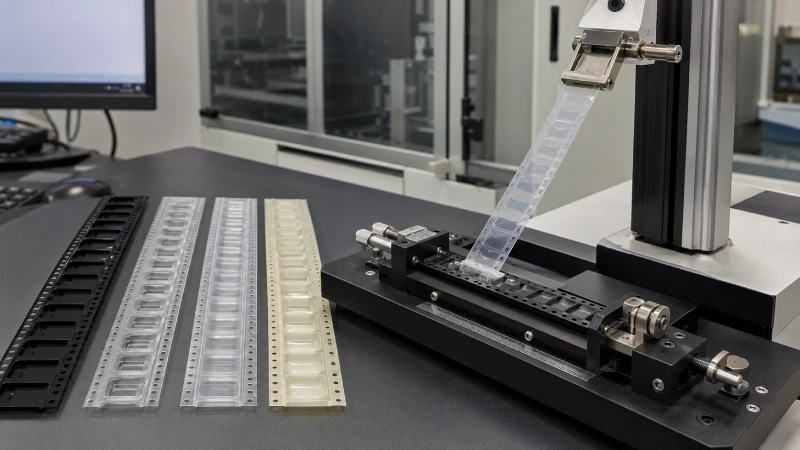
Peel-force testing should be evaluated as a profile rather than a single average number. Spikes, left-right imbalance, or intermittent peaks may disturb components even when the calculated average appears acceptable.
For a more detailed explanation, see how cover tape peel force affects SMT feeding stability.
What EIA-481 Can—and Cannot—Confirm
EIA-481 provides important tape-and-reel requirements for the automatic handling of surface-mount components. It supports consistent dimensions, packaging geometry, and defined test practices.
However, a statement that a product is manufactured to EIA-481 requirements does not prove that one cover tape is compatible with every PS, PC, PET, or PVC carrier tape.
Three categories of information should remain separate:
- Standard requirements: Conditions or requirements defined by the applicable standard.
- Supplier recommendations: Reference settings or expected performance for a particular supplier’s product.
- Measured results: Data obtained from the actual Jiushuo cover tape, customer carrier tape, and agreed test method.
The applicable standard version, peel angle, speed, conditioning, and acceptance criteria should be identified in the test report. Jiushuo’s EIA-481 tape-and-reel standards guide provides additional context for buyers reviewing packaging requirements.
Troubleshooting Material-Pairing Problems
Compatibility failures often appear as production symptoms rather than a visible material defect.
| Symptom | Possible Factors to Check |
|---|---|
| Weak or intermittent sealing | Surface contamination, insufficient adhesive activation, poor roller contact, uneven flange, or misalignment |
| Excessive peel force | Incorrect process settings, unsuitable adhesive interface, aging, or inconsistent seal width |
| Uneven peel force | Left-right sealing imbalance, warped flange, machine variation, or inconsistent surface condition |
| Edge lifting after storage | Weak initial contact, winding stress, environmental exposure, or material mismatch |
| Adhesive residue | Adhesive construction, excessive application pressure, aging, or carrier surface interaction |
| Carrier tape distortion | Excessive heat, pressure, dwell time, unsupported flange, or unsuitable process window |
| Components jumping during peeling | Peel-force spikes, pocket fit, peeling geometry, or feeder setup |
Do not change several variables simultaneously. Record the original condition, adjust one controlled factor, repeat the test, and compare both the seal appearance and peel-force curve.
What to Send for a Reliable Compatibility Recommendation
A supplier can provide a more reliable recommendation when the inquiry includes:
- Carrier tape material and grade
- Carrier tape drawing
- Actual carrier tape samples
- Tape and cover tape widths
- Component drawing or sample
- ESD requirement
- Current cover tape information
- Heat-sealing or pressure-application equipment
- Existing process settings
- Required peel-test method
- Storage and shipping conditions
- Defect photos or feeder video
Without the actual carrier material and process information, any recommendation remains preliminary.
For a complete system review, buyers may also consult Jiushuo’s carrier tape, cover tape and reel compatibility guide.
Confirm Compatibility Before Mass Production
PS, PC, PET, and PVC are useful material categories, but they are not enough to approve a cover tape. Reliable packaging requires the specific carrier tape, adhesive construction, process settings, storage conditions, and peel-test method to be evaluated together.
Jiushuo can review customer material information, prepare matched samples, and support peel-force validation before bulk production.
Submit the carrier tape material, tape width, sealing method, component information, and available samples through the Jiushuo cover tape product page to begin a compatibility review.
FAQ
Can one cover tape be used with PS, PC, PET, and PVC carrier tape?
Some specific multi-material cover tapes may be qualified for several carrier materials. Compatibility must still be confirmed for the actual carrier tape grade, surface construction, application process, and required peel behavior.
Is PET-backed cover tape automatically suitable for PET carrier tape?
No. PET or polyester may describe the cover tape backing film. Compatibility depends mainly on the adhesive or sealant layer that contacts the carrier tape flange.
Does EIA-481 compliance guarantee material compatibility?
No. EIA-481 supports standardized tape-and-reel requirements and test practices, but it does not replace product-specific adhesive and carrier tape qualification.
Should PC carrier tape always use heat-activated cover tape?
Not necessarily. Heat-activated and pressure-sensitive products may both be available for particular PC systems. The correct choice depends on the approved product range, equipment, ESD requirement, storage conditions, and test results.
Why can peel force change after storage?
Possible causes include adhesive aging, environmental exposure, winding stress, material interaction, initial sealing variation, and differences in test conditioning.
What samples are needed for compatibility testing?
The supplier normally needs the actual carrier tape, material information, required cover tape width, application conditions, and preferably the component or component drawing. The required sample quantity should be confirmed before shipment.
Can carrier tape material be identified from its color?
Color alone is not reliable. Black and clear carrier tapes may use different polymers, conductive systems, or surface treatments. Obtain the material declaration or grade from the carrier tape supplier whenever possible.