

In SMT assembly, small packaging details can create big production differences. One of these details is cover tape peel force. It may seem like a minor factor compared with carrier tape pocket design or component accuracy, but in real tape and reel packaging, peel force directly affects how smoothly components are exposed before pick-and-place.
If the cover tape peels too tightly, the feeder may experience extra tension. If it peels too loosely, the sealing may not protect the components well enough during transport and handling. If the peel force is inconsistent, the SMT line may face random feeding interruptions, unstable component position, or even flying parts.
For buyers, component suppliers, and quality control teams, understanding cover tape peel force is not about becoming a laboratory testing expert. It is about knowing how cover tape, carrier tape, sealing quality, and component fit work together to support stable production. This article explains why peel force matters, what common problems may happen, and what buyers should confirm before mass production.
For a complete packaging view, it is helpful to look at peel force as part of the whole tape and reel packaging system, not only as a cover tape issue.
What Is Cover Tape Peel Force?
Cover tape peel force refers to the force needed to remove the cover tape from the carrier tape. During SMT feeding, the feeder peels the cover tape away so that each component can be picked from the pocket by the pick-and-place machine.
The purpose of cover tape is simple: it keeps components inside the carrier tape pockets during storage, shipment, and machine feeding. However, good cover tape performance is not only about strong sealing. It also needs controlled opening.
If the sealing is too strong, peeling may become rough or unstable. If the sealing is too weak, the cover tape may lift during shipping or reel handling. A suitable peel force helps create a balance between protection and feeding reliability.
This is why the selection of cover tape should always be considered together with the carrier tape material, pocket design, component type, and final SMT feeding conditions.
Why Peel Force Matters for SMT Feeding Stability
SMT feeding stability depends on whether components can stay in a predictable position before pick-up. When the feeder pulls the cover tape away, the action should be smooth, stable, and repeatable. If the peel force suddenly changes, the tape may vibrate, the components may move inside the pockets, or the feeder may stop.
This is especially important for small, lightweight, or sensitive components. A slight vibration or sudden pull can cause chips, sensors, LEDs, miniature connectors, or precision stamped parts to shift from their original position. Once the component is not presented correctly, the pick-and-place nozzle may miss the part, pick it at the wrong angle, or trigger a machine alarm.
Peel force also affects production rhythm. Even if the issue does not damage the component, unstable peeling can slow down the line. Operators may need to adjust feeder tension, check reels, remove jammed tape, or restart the machine. These interruptions may look small, but they can reduce the efficiency of high-volume SMT production.
That is why buyers should not treat peel force as a separate material specification. It should be reviewed together with embossed carrier tape pocket design, sealing area, cover tape type, reel winding, and component fit.
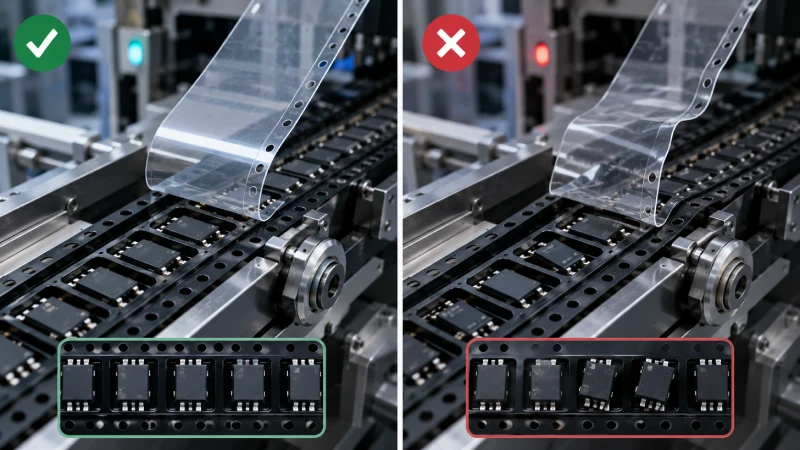
Common Peel Force Issues and Possible Production Impact
| Peel Force Issue | What May Happen During SMT Feeding | Possible Production Impact |
|---|---|---|
| Peel force too high | Cover tape opens with excessive resistance | Feeder stoppage, component vibration, unstable pick-up |
| Peel force too low | Cover tape may not hold components securely | Loose sealing, component movement, transport risk |
| Inconsistent peel force | Peeling changes from one section to another | Random feeder interruptions, difficult troubleshooting |
| Poor sealing quality | Cover tape lifts, wrinkles, or separates unevenly | Component exposure, packaging rejection, contamination risk |
| Cover tape does not match carrier tape | Sealing may become too weak or too strong | Higher defect rate during packaging or assembly |
| Poor reel winding tension | Tape may peel unevenly during unwinding | Feeder alarms, unstable component presentation |
This table shows why peel force should be judged from a production perspective. The issue is not only whether the cover tape can be peeled. The real question is whether it can be peeled smoothly and consistently during automated feeding.
What Happens When Peel Force Is Too High?
When cover tape peel force is too high, the feeder needs more force to open the tape. This can create extra tension in the tape path. In some cases, the carrier tape may shake slightly when the cover tape is pulled away. For components that are light, thin, or not deeply seated in the pocket, this movement may cause the part to jump, rotate, or shift.
High peel force can also create feeder interruptions. The machine may detect abnormal tension or feeding resistance. Operators may need to pause the line, inspect the reel, adjust the feeder, or replace the material. For buyers, this means higher production risk and more communication between the packaging supplier and the assembly factory.
In real production, high peel force problems may appear as unstable pick-up, missing components, feeder alarms, or components found outside the pocket area. These problems are not always caused by the cover tape alone. Sometimes they are related to sealing temperature, carrier tape material, pocket depth, pocket clearance, or winding condition.
For example, a component may fit well inside the pocket when the reel is still, but it may move when the cover tape is peeled with too much resistance. This is why cover tape selection should be checked together with pocket design and actual feeding requirements.
What Happens When Peel Force Is Too Low?
Low peel force may look convenient because the cover tape is easy to open. However, if the sealing is too weak, the package may fail before it reaches the SMT feeder.
During transport, reels may experience vibration, compression, temperature changes, or repeated handling. If the cover tape is not sealed firmly enough, it may lift from the carrier tape. Once this happens, components may move out of position, become exposed to dust, or even fall out of the pocket.
Low peel force is also risky for components that require stable orientation. If the cover tape does not hold the components securely, parts may rotate or move before they reach the pick-and-place machine. The SMT line may then experience inaccurate picking, misalignment, or quality complaints.
For component suppliers and distributors, weak sealing can also affect customer confidence. Even if the components themselves are good, poor packaging presentation can make buyers question the overall quality control process.
The goal is not to make peel force as low as possible. The goal is to create a stable sealing condition that protects components during storage and shipping while still allowing smooth peeling during SMT feeding.
How Cover Tape and Carrier Tape Should Be Matched
Cover tape should not be selected separately from the carrier tape. A suitable cover tape must match the carrier tape material, width, sealing surface, pocket structure, and component requirements.
Different carrier tape materials may require different cover tape and sealing conditions. The same cover tape may work well with one material but create weak sealing or excessive peeling resistance with another. This is why carrier tape and cover tape compatibility should be reviewed before mass production.
The pocket design is also important. In embossed carrier tape for SMT packaging, the pocket shape, depth, and clearance help control how the component sits inside the tape. If the pocket is too loose, the component may move during peeling. If the pocket is too tight, loading and pick-up may become unstable. Cover tape peel force cannot solve poor pocket design by itself.
Cover tape width must also match the carrier tape width and sealing area. If the cover tape is not aligned well, sealing may become uneven. If the sealing area is too narrow or inconsistent, peel force may change during feeding. This may lead to sudden tension changes and unstable component exposure.
Sealing conditions also matter. Temperature, pressure, and sealing speed should be suitable for the tape combination. Buyers do not need to manage every technical detail, but they should confirm that the supplier has experience matching cover tape with the selected carrier tape material.
Jiushuo can support cover tape matching together with custom embossed carrier tape. By reviewing component samples, drawings, pocket requirements, and packaging needs, Jiushuo helps buyers choose a tape combination that supports both protection and SMT feeding stability.
Peel Force Is Not Only a Cover Tape Problem
A common mistake is to treat peel force problems as cover tape problems only. In reality, stable SMT feeding depends on the whole packaging system.
Carrier tape pocket design affects how much the component can move. Cover tape affects sealing and peeling behavior. Reel winding affects tension during feeding. Component weight, shape, and surface condition affect how easily the part shifts inside the pocket. Even packaging storage and transport conditions can influence final feeding performance.
For example, flying components may be related to high peel force, but they may also be caused by pockets that are too shallow or too loose. Unstable peeling may be caused by the cover tape, but it may also be related to uneven sealing or poor reel winding. Feeder interruptions may come from peel force, tape deformation, reel damage, or incorrect packaging direction.
This is why buyers should evaluate tape and reel packaging solutions as a complete system. A good supplier should not only provide separate materials. They should understand how carrier tape, cover tape, reel, sealing, and component fit work together in production.
What Buyers Should Confirm Before Production
Before mass production, buyers should confirm several practical details with the packaging supplier.
First, provide accurate component information. This includes component size, shape, height, weight, material, surface sensitivity, and orientation requirements. If the component is irregular, fragile, tall, thin, or very light, the packaging design should be reviewed more carefully.
Second, confirm the carrier tape design. The supplier should understand the required tape width, pocket dimensions, pocket depth, pitch, and component position. For non-standard parts, using a standard pocket without review may increase feeding risk.
Third, confirm the cover tape type and width. Cover tape should match the carrier tape material and sealing area. If ESD protection is required, anti-static or conductive requirements should also be discussed.
Fourth, confirm sealing quality and peeling consistency. Buyers do not need to request complex laboratory reports for every project, but they should ask whether the tape combination has been checked for stable sealing and smooth peeling.
Fifth, confirm sampling and trial production. For new components or new packaging designs, sample reels are very useful. They allow buyers or assembly partners to check real feeding performance before committing to larger production.
Sixth, confirm reel size, winding direction, packaging quantity, and delivery requirements. Poor reel matching or winding direction mistakes can create feeding problems even when the tape materials are suitable.
Finally, buyers should confirm whether the supplier can support both carrier tape and cover tape matching. Working with one supplier that understands both sides can reduce communication gaps and improve packaging reliability.
How Jiushuo Supports Stable Tape and Reel Packaging
Jiushuo provides custom carrier tape and related tape and reel packaging support for electronic components, connectors, LEDs, sensors, stamped parts, and other SMT-related products. Instead of looking at carrier tape and cover tape as separate items, Jiushuo focuses on practical packaging performance.
For custom projects, Jiushuo can review component samples or drawings and recommend a suitable embossed pocket design. The team can also help match cover tape based on carrier tape material, sealing needs, and feeding expectations. This helps buyers reduce risks such as loose sealing, flying parts, component movement, unstable peeling, and feeder interruption.
Jiushuo’s support is especially useful when components are small, sensitive, irregular, or difficult to feed. In these cases, packaging details matter more. A small change in pocket fit, sealing area, or cover tape choice can improve the final feeding result.
For buyers who need a more reliable packaging solution, combining custom embossed carrier tape with suitable cover tape matching can help improve both protection and SMT assembly efficiency.
Need Better Cover Tape and Carrier Tape Matching?
If your components face unstable feeding, loose sealing, flying parts, or frequent feeder interruptions, the issue may not come from the component alone. It may be related to the cover tape, carrier tape pocket design, sealing quality, or overall tape and reel packaging setup.
Jiushuo can help review your packaging requirements and recommend a suitable solution based on your component drawings, samples, reel requirements, and SMT feeding needs. Whether you need cover tape matching, embossed carrier tape design, or complete tape and reel packaging support, Jiushuo can help you build a more stable packaging process before mass production.
FAQ
What is cover tape peel force?
Cover tape peel force is the force needed to remove the cover tape from the carrier tape. It affects how smoothly the cover tape opens during SMT feeding before the component is picked by the machine.
Why does peel force affect SMT feeding stability?
If peel force is too high, too low, or inconsistent, the cover tape may peel unevenly. This can cause component movement, unstable pick-up, feeder alarms, or production interruptions.
Is higher peel force always better?
No. Higher peel force may make the sealing stronger, but it can also create excessive tension during feeding. The best result is stable and controlled peeling, not simply stronger sealing.
What happens if peel force is too low?
If peel force is too low, the cover tape may not seal the carrier tape securely enough. This can cause cover tape lifting, component movement, contamination risk, or poor protection during transport.
Should cover tape be selected together with carrier tape?
Yes. Cover tape should be matched with the carrier tape material, tape width, sealing area, pocket design, component type, and SMT feeding requirements.
Can Jiushuo help with cover tape and carrier tape matching?
Yes. Jiushuo can support cover tape matching together with embossed carrier tape design, helping buyers improve sealing quality, peel stability, and SMT feeding reliability.