

Choosing the right cover tape width may look like a small packaging detail, but it has a direct impact on sealing stability, peel force, component protection, and SMT feeding reliability. For SMT packaging buyers, electronic component suppliers, distributors, and OEM quality teams, cover tape should never be treated as a separate material from carrier tape. It is part of a complete tape-and-reel packaging system.
A suitable cover tape width must match the carrier tape width, pocket design, component size, sealing area, and reel requirements. If the width is too narrow, the sealing area may not be stable enough. If it is too wide, the tape may affect peeling performance or feeder operation. This is why buyers should confirm cover tape width together with the actual carrier tape design rather than selecting it only by a general size label.
Jiushuo supports complete matching for cover tape, carrier tape, embossed carrier tape, and reels, helping buyers build a more reliable tape and reel packaging solution for electronic components.
Why Cover Tape Width Matters in Tape-and-Reel Packaging
Cover tape is used to seal components inside carrier tape pockets. During storage, transportation, and SMT assembly, it helps keep components in position and protects them from falling out, shifting, or being exposed to handling damage.
However, cover tape does more than simply cover the pocket opening. It must seal evenly on both sides of the carrier tape pocket while allowing smooth peeling during SMT feeding. A good width match supports consistent peel force, stable sealing, and reliable machine operation.
If the cover tape width is not suitable, the packaging may appear acceptable at first but create problems later. For example, the tape may lift during winding, peel unevenly in the feeder, or fail to hold the component securely during transport. These issues can lead to missing components, tilted components, feeding interruptions, and quality complaints.
For buyers, the key point is simple: cover tape width should support both protection and process reliability. It should not be selected only because it “looks wide enough” to cover the pocket.
How Cover Tape Width Relates to Carrier Tape Width
Carrier tape width provides the base structure for the full packaging design. Common carrier tape widths may include narrow tapes for small passive components, medium-width tapes for ICs and connectors, and wider tapes for larger or taller components. But the carrier tape width alone does not fully determine the correct cover tape width.
The actual matching depends on several details: pocket opening size, pocket depth, component height, pocket layout, edge distance, and available sealing lanes. The sealing area must be wide enough to create stable bonding on both sides of the pocket, but it must also avoid interfering with sprocket holes, tape edges, or feeder peeling.
This is especially important for embossed carrier tape, where pocket depth and component profile can vary significantly. A tall component may need enough cover clearance, while a delicate component may require careful pocket support and stable sealing to avoid movement.
Buyers should avoid assuming that one cover tape width can work for all carrier tapes of the same nominal width. Two carrier tapes may have the same overall width but very different pocket designs and sealing requirements.
Carrier Tape Width and Cover Tape Matching Considerations
The following table provides practical matching considerations for buyers. It is not a universal engineering rule, but a useful checklist for evaluating cover tape width together with carrier tape structure.
| Carrier Tape Width / Type | Cover Tape Matching Consideration | Buyer Checkpoint |
|---|---|---|
| Narrow carrier tape | Requires accurate alignment and stable side sealing | Confirm pocket opening, tape edge distance, and available sealing lane |
| Medium carrier tape | Common for passive components, small ICs, sensors, and connectors | Check peel force consistency and component retention during handling |
| Wide carrier tape | Often used for larger, wider, or taller components | Confirm enough sealing area without affecting peeling or winding |
| Deep-pocket embossed carrier tape | Cover tape must seal securely without pressing or restricting the component | Check pocket depth, component height, and cover clearance |
| Custom carrier tape | Cover tape width should be confirmed during the design stage | Request carrier tape, cover tape, and reel matching as one packaging set |
This table shows why cover tape width for carrier tape should be evaluated through the actual packaging design. The correct width depends on how the carrier tape, pocket, component, sealing area, and reel will work together.
For standard components, existing matching experience may help speed up selection. For custom components, irregular shapes, taller parts, or sensitive surfaces, it is safer to confirm cover tape width using component drawings and carrier tape samples before mass production.
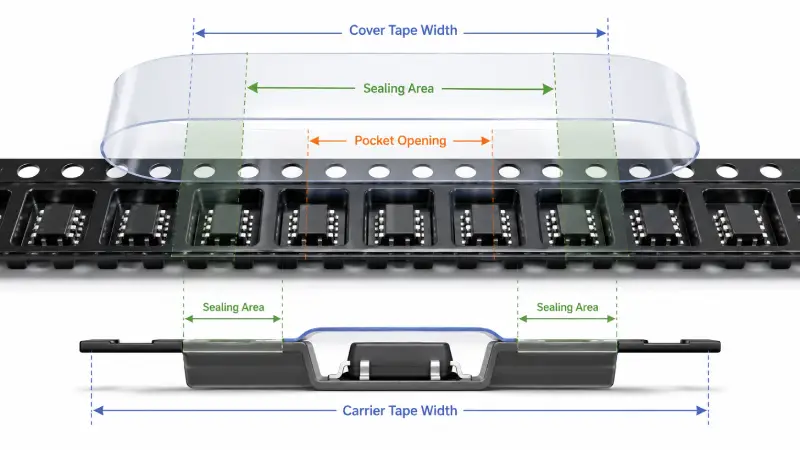
Sealing Area, Peel Force, and Component Protection Should Be Considered Together
A reliable carrier tape cover tape matching decision should balance three major factors: sealing area, peel force, and component protection.
The sealing area is the part of the carrier tape where the cover tape bonds to the surface. If the sealing area is too small or uneven, the cover tape may lift or peel unexpectedly. If the sealing area is too aggressive or poorly positioned, the peel force may become unstable during SMT feeding.
Peel force is important because the cover tape must open smoothly in the feeder. If the peel force is too weak, the cover tape may separate before feeding. If it is too strong, the feeder may experience pulling resistance, uneven peeling, or component disturbance. The buyer’s goal is not maximum adhesion, but controlled and repeatable peeling.
Component protection also depends on the relationship between the pocket and the cover tape. The pocket should hold the component correctly, while the cover tape helps keep it inside the pocket. A good match reduces the risk of component movement, flipping, or contact damage.
This is why cover tape width should not be selected in isolation. The buyer should always check how the cover tape works with the carrier tape, component pocket, and reel winding condition.
Common Issues Caused by Incorrect Cover Tape Width
Incorrect cover tape width can create several packaging and SMT process issues. Some problems appear during sealing, while others only become visible during storage, transport, or machine feeding.
Common issues include:
- Cover tape lifting during winding, storage, or transportation
- Uneven sealing on the left and right sides of the pocket
- Unstable peel force during SMT feeding
- Components shifting inside the pocket
- Components jumping, tilting, or flipping when the cover tape is peeled
- Cover tape interfering with feeder peeling
- Reduced component protection during handling
- Inconsistent packaging quality between production batches
- Higher risk of missing components during automated assembly
These problems are often blamed on cover tape material alone, but the root cause may be poor matching between cover tape width, carrier tape width, pocket design, and sealing conditions. For example, a cover tape may perform well on one carrier tape but fail on another because the sealing lane or pocket layout is different.
For quality and sourcing teams, this means that cover tape selection should be reviewed together with the full tape-and-reel packaging structure. A small mismatch at the material selection stage can create much larger costs during SMT production.
What to Confirm Before Ordering Cover Tape
Before placing an order for cover tape, buyers should confirm more than just the tape width. A complete review helps reduce the risk of mismatched packaging materials and unexpected production issues.
Important details to confirm include:
- Carrier tape width
- Carrier tape material
- Pocket length, width, and depth
- Component dimensions and height
- Component weight and sensitivity
- Pocket opening and available sealing area
- Required peel force range
- Cover tape material type
- Heat sealing or pressure-sensitive sealing requirements
- SMT feeder compatibility
- Reel size and winding direction
- Quantity per reel
- Storage and transportation conditions
- Sample testing requirements before mass packaging
If buyers already have a carrier tape drawing, component drawing, or sample, these should be shared with the supplier before confirming cover tape. For custom carrier tape, it is better to confirm the cover tape during the design stage instead of after the carrier tape has already been produced.
Jiushuo can help buyers review component size, carrier tape structure, cover tape width, and reel requirements together. This helps avoid a common problem in tape-and-reel packaging: purchasing materials from different sources that do not work well together.
Why Buyers Should Match Carrier Tape, Cover Tape, and Reel Together
Tape-and-reel packaging is a system. The carrier tape holds the component, the cover tape seals and protects it, and the reel supports winding, storage, shipment, and SMT feeding. If one material is selected without considering the others, the final packaging performance may be affected.
For example, a suitable cover tape width may still cause issues if the reel winding tension is not stable. A well-designed carrier tape may still create feeding problems if the cover tape peel force is inconsistent. A good reel may not solve problems caused by poor pocket fit or weak sealing.
This is why buyers should consider a complete packaging match instead of ordering carrier tape, cover tape, and reels separately without technical review. For electronic component suppliers and distributors, this approach can help improve delivery quality and reduce customer complaints during assembly.
Jiushuo provides cover tape, carrier tape, embossed carrier tape, and reel matching support for different electronic component packaging needs. By reviewing all materials together, buyers can achieve more stable sealing, better component protection, and smoother SMT feeding.
Practical Buyer Tips for Cover Tape Width Matching
When evaluating cover tape width, buyers can use several practical rules of thinking, without relying on fixed universal formulas.
First, check whether the cover tape can provide stable sealing on both sides of the pocket. The tape should not only cover the component area, but also create reliable contact with the carrier tape surface.
Second, review the pocket layout. If the pocket is close to the tape edge or sprocket area, there may be limited sealing space. In this case, cover tape width and alignment become more important.
Third, consider the component height. Taller components may require deeper pockets and enough cover clearance. The cover tape should not press the component in a way that affects appearance, function, or feeding.
Fourth, confirm peeling performance. A cover tape that seals well but peels poorly may still create SMT problems. Stable peel force is a key part of reliable packaging.
Finally, request sample confirmation when the component is new, custom, high-value, fragile, or unusually shaped. A short trial can help identify sealing or feeding issues before mass production.
Need Help Matching Cover Tape Width with Carrier Tape?
If you are unsure which cover tape width is suitable for your carrier tape, Jiushuo can help review your packaging requirements before production.
Share your component drawing, carrier tape width, pocket dimensions, component height, reel requirements, and SMT feeding needs. Jiushuo can support matching for carrier tape, embossed carrier tape, cover tape, and reels as a complete tape and reel packaging solution.
For SMT packaging buyers, electronic component suppliers, distributors, and OEM quality teams, the right cover tape matching decision can help improve sealing stability, reduce handling risk, and support more reliable automated assembly.
FAQ
How do I choose the correct cover tape width for carrier tape?
The correct cover tape width depends on carrier tape width, pocket design, component size, sealing area, and SMT feeding requirements. Buyers should confirm the actual carrier tape drawing and component dimensions instead of relying only on a standard width label.
Can the same cover tape width be used for all carrier tapes?
Not always. Even if two carrier tapes have the same nominal width, their pocket size, pocket depth, sealing lane, and component height may be different. These differences can affect the suitable cover tape width.
What happens if the cover tape is too narrow?
If the cover tape is too narrow, the sealing area may not be stable enough. This can cause cover tape lifting, weak sealing, exposed pocket areas, or component movement during transportation and SMT feeding.
What happens if the cover tape is too wide?
If the cover tape is too wide, it may interfere with peeling, feeder operation, tape edge handling, or winding stability. Wider cover tape is not always better. The width must match the full carrier tape design.
Should cover tape be selected before or after carrier tape design?
For custom packaging, cover tape should be confirmed during the carrier tape design stage. This is especially important for deep-pocket embossed carrier tape, taller components, irregular shapes, or components with strict feeding requirements.
Can Jiushuo help match carrier tape and cover tape together?
Yes. Jiushuo can support carrier tape, cover tape, embossed carrier tape, and reel matching for electronic component tape-and-reel packaging. Buyers can provide component drawings, carrier tape specifications, and packaging requirements for matching support.