

In the electronics manufacturing industry, consistency is critical. Whether components are being produced in China, assembled in Germany, or integrated into products in the United States, manufacturers need a common packaging standard that ensures compatibility across automated SMT assembly lines.
This is where the EIA-481 standard comes into play.
EIA-481 defines the requirements for tape-and-reel packaging used for electronic components. It establishes dimensional standards for carrier tapes, cover tapes, reels, sprocket holes, component orientation, and packaging tolerances. By following EIA-481, component manufacturers and EMS providers can ensure seamless feeding, pick-and-place accuracy, and reliable production performance.
In this guide, we’ll explain what EIA-481 is, why it matters, and how it influences modern SMT packaging solutions.
What Is EIA-481?
EIA-481 is an industry-standard specification originally developed by the Electronic Industries Alliance (EIA) to standardize tape-and-reel packaging for surface-mount devices (SMDs).
The standard covers:
- Carrier tape dimensions
- Pocket design requirements
- Sprocket hole positioning
- Cover tape specifications
- Reel dimensions
- Component orientation
- Packaging tolerances
- Labeling and identification requirements
The primary objective is to ensure that electronic components can be automatically handled by SMT pick-and-place equipment regardless of their manufacturer.
Without EIA-481, each supplier might package components differently, causing feeder compatibility issues, production delays, and increased assembly costs.
Why EIA-481 Matters in SMT Manufacturing
Modern SMT production lines operate at extremely high speeds, often placing tens of thousands of components per hour.
Even minor packaging inconsistencies can lead to:
- Component misfeeds
- Pick-and-place errors
- Tape jams
- Downtime
- Increased scrap rates
EIA-481 helps prevent these issues by creating a universal packaging language across the electronics supply chain.
Key benefits include:
Improved Automation Compatibility
Most feeder systems are designed around EIA-481 dimensions.
Standardized packaging allows:
- Faster machine setup
- Easier feeder changes
- Reduced machine calibration
Reduced Assembly Errors
Consistent pocket spacing and component orientation ensure reliable pickup by SMT nozzles.
Simplified Global Sourcing
Manufacturers can source components from multiple suppliers while maintaining packaging compatibility.
Better Inventory Management
Uniform reel formats make storage, transportation, and handling more efficient.
Core Elements Covered by EIA-481
The standard defines several packaging components that work together to protect and deliver electronic parts during automated assembly.
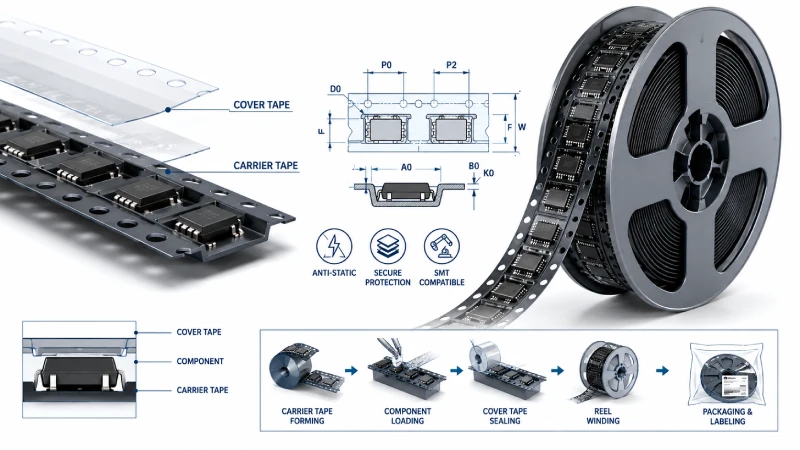
Carrier Tape
The carrier tape serves as the primary component holding electronic devices during transportation and assembly.
Carrier tape contains formed pockets that securely retain components while allowing automated feeding.
Common carrier tape widths include:
| Tape Width | Typical Components |
|---|---|
| 8 mm | Resistors, capacitors |
| 12 mm | ICs, connectors |
| 16 mm | Larger ICs |
| 24 mm | Power devices |
| 32 mm+ | Large electronic components |
EIA-481 specifies:
- Pocket dimensions
- Pocket spacing
- Pocket depth
- Sprocket hole location
- Tape width tolerances
These specifications ensure compatibility across SMT feeders worldwide.
Cover Tape
The cover tape seals components inside the carrier tape pockets.
EIA-481 defines:
- Cover tape width
- Sealing area dimensions
- Peel strength requirements
- Material compatibility
Proper cover tape performance is critical because excessive adhesion may damage components during peeling, while insufficient adhesion can cause component loss during transportation.
The standard helps maintain a balance between secure retention and easy removal.
Plastic Reel
After sealing, the carrier tape is wound onto a plastic reel for transportation and machine feeding.
EIA-481 standardizes:
- Reel diameters
- Hub dimensions
- Arbor hole size
- Tape winding direction
- Flange specifications
Common reel sizes include:
- 7-inch (178 mm)
- 13-inch (330 mm)
These reel dimensions ensure compatibility with feeder systems used throughout the electronics industry.
Tape and Reel Packaging System
Together, carrier tape, cover tape, and reels form a complete tape reel packaging solution.
The integrated system provides:
- Component protection
- ESD management
- Efficient transportation
- Automated assembly compatibility
- Reduced handling damage
Understanding EIA-481 Tape Dimensions
One of the most important aspects of EIA-481 is dimensional consistency.
Tape Width
The standard defines multiple tape widths:
| Width | Common Usage |
|---|---|
| 8 mm | Passive components |
| 12 mm | Small ICs |
| 16 mm | Medium ICs |
| 24 mm | Connectors |
| 32 mm | Power modules |
| 44 mm+ | Large assemblies |
Manufacturers must maintain strict tolerances to ensure feeder compatibility.
Sprocket Holes
Sprocket holes are used to advance the tape through automated feeders.
EIA-481 defines:
- Hole diameter
- Hole pitch
- Hole-to-pocket distance
- Position tolerance
Accurate sprocket hole placement is essential because feeders rely on these holes for indexing.
Misaligned holes can lead to:
- Placement inaccuracies
- Component skips
- Feeder jams
Pocket Design
Pocket dimensions are determined by component size.
Requirements include:
- Length
- Width
- Depth
- Component clearance
The standard specifies acceptable tolerances to prevent excessive movement while avoiding component damage.
Proper pocket design helps maintain:
- Accurate positioning
- Reliable pickup
- Reduced vibration damage
Component Orientation Requirements
EIA-481 does more than define dimensions.
It also standardizes component orientation inside the carrier tape.
This ensures:
- Correct pick-and-place recognition
- Consistent polarity alignment
- Reduced programming complexity
For polarized components such as:
- Diodes
- LEDs
- Electrolytic capacitors
- Integrated circuits
orientation requirements are particularly important.
Consistent orientation reduces production errors and improves manufacturing efficiency.
Cover Tape Peel Strength Requirements
One of the most critical quality metrics in EIA-481 is peel strength.
The standard establishes acceptable force ranges when removing cover tape from carrier tape.
If peel force is too low:
- Components may escape pockets
- Shipping damage increases
If peel force is too high:
- Components may shift
- Feeder performance suffers
- Machine stoppages increase
Manufacturers typically perform peel tests under controlled conditions to verify compliance.
Anti-Static and ESD Considerations
Many electronic devices are highly sensitive to electrostatic discharge (ESD).
Although EIA-481 focuses primarily on mechanical dimensions and packaging requirements, many compliant packaging systems also incorporate:
- Anti-static materials
- Conductive additives
- Static-dissipative layers
These features help protect:
- ICs
- Microcontrollers
- Sensors
- Memory devices
during transportation and assembly.
EIA-481 Compliance Testing
Packaging suppliers often conduct extensive testing to ensure compliance.
Common tests include:
Dimensional Inspection
Verification of:
- Pocket dimensions
- Tape width
- Hole spacing
- Reel dimensions
Peel Strength Testing
Measurement of cover tape removal force.
Feeding Performance Testing
Simulation on automated feeder equipment.
Transportation Testing
Evaluation under:
- Vibration
- Shock
- Environmental conditions
ESD Testing
Verification of static-dissipative performance where required.
Common EIA-481 Compliance Issues
Even experienced manufacturers can encounter packaging problems.
Incorrect Pocket Dimensions
Oversized pockets may allow movement.
Undersized pockets may damage components.
Poor Cover Tape Adhesion
Improper sealing can cause component loss.
Reel Compatibility Problems
Non-standard reel dimensions may not fit feeder systems.
Orientation Errors
Incorrect component orientation can cause assembly defects.
Sprocket Hole Misalignment
Poor indexing leads to feeder interruptions.
Routine inspection and process control are essential to avoid these issues.
How to Select an EIA-481-Compliant Packaging Supplier
When evaluating packaging providers, consider:
Engineering Capabilities
Look for suppliers that can design custom pockets according to component geometry.
Precision Manufacturing
Tight dimensional control is essential for compliance.
Testing Capabilities
Verify that the supplier performs:
- Peel force testing
- Dimensional inspection
- Feeding trials
Material Expertise
A qualified supplier should understand:
- PS materials
- PET materials
- PC materials
- Anti-static formulations
Custom Packaging Support
Many electronic components require customized packaging designs while still maintaining EIA-481 compliance.
Future Trends in EIA-481 Packaging
As electronic components become smaller and more sophisticated, packaging technology continues to evolve.
Emerging trends include:
- Ultra-fine pitch carrier tapes
- Advanced anti-static materials
- Automated inspection systems
- AI-driven quality control
- High-speed reel packaging automation
Despite these advancements, EIA-481 remains the foundation that ensures interoperability throughout the electronics manufacturing ecosystem.
Conclusion
EIA-481 is the backbone of modern SMT tape-and-reel packaging. By defining standardized requirements for carrier tape, cover tape, reel dimensions, component orientation, and packaging tolerances, the standard enables reliable automated assembly across the global electronics industry.
Whether you are sourcing packaging materials, designing new electronic components, or optimizing SMT production lines, understanding EIA-481 helps ensure compatibility, efficiency, and product quality.
Companies that follow EIA-481 standards benefit from fewer feeding issues, lower production costs, higher assembly yields, and smoother integration across international supply chains.
As electronics manufacturing continues to advance, EIA-481 will remain an essential reference for ensuring consistent and reliable tape-and-reel packaging performance worldwide.