
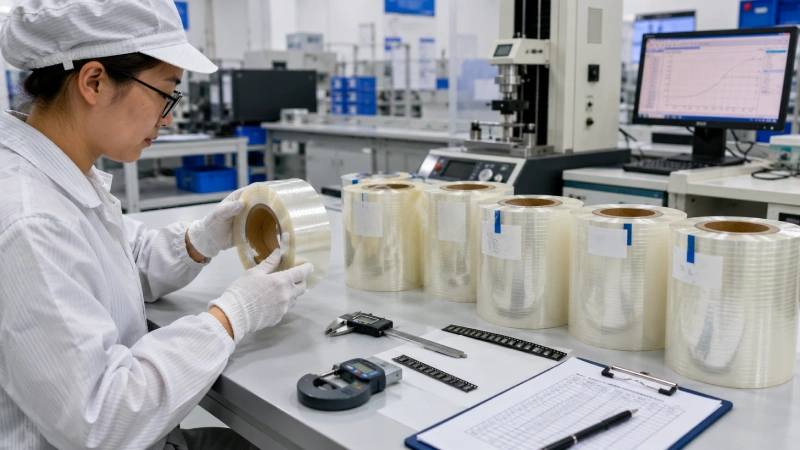
Incoming cover tape inspection should do more than confirm roll width and quantity. A roll may have the correct label but still present damaged edges, incorrect winding orientation, unstable adhesion, contamination, or a sealing response that does not match the intended carrier tape.
For SMT packaging buyers, the purpose of incoming inspection is not to prove that a cover tape is universally suitable. It is to determine whether a specific incoming lot conforms to the approved purchasing specification and performs consistently under the buyer’s actual packaging conditions.
The following checklist provides a practical workflow for receiving, inspecting, testing, and releasing cover tape before mass production.
Establish the Acceptance Basis Before Opening the Lot
Incoming inspection must begin with approved documents rather than a visual judgment of the roll.
The receiving team should identify which document defines acceptance. Depending on the project, this may include:
- A customer-specific packaging requirement
- An approved cover tape specification
- A purchase order or material drawing
- A supplier technical data sheet
- A qualification report or approved sample
- A lot-specific certificate of analysis
- Internal IQC acceptance criteria
These documents serve different purposes. A technical data sheet normally describes product construction, typical properties, and recommended processing conditions. A certificate of analysis should identify the incoming lot and report the batch-specific tests required by the agreed specification.
Public technical data should not automatically be treated as the buyer’s acceptance limit. For example, the 3M heat-activated cover tape technical data sheet distinguishes representative technical information from final product specifications and COA test methods. The same principle should be applied when reviewing any supplier’s data.
Before inspection begins, define what constitutes one inspection lot. Rolls from different manufacturing, coating, slitting, or packing batches should not be treated as one lot unless the supplier’s traceability system and the buyer’s quality procedure permit it.
For projects that have not yet established an approved material, review the available cover tape solutions for tape-and-reel packaging before creating the incoming inspection specification.
Step 1: Verify Product Identity and Lot Traceability
Compare the purchase order, outer-carton label, individual roll label, specification, and COA.
The following information should be consistent:
- Supplier name
- Buyer or customer part number
- Supplier product designation
- Cover tape sealing type
- Nominal width and roll length
- Quantity
- Lot or batch number
- Manufacturing date
- Supplier-defined expiry or use-by date
- ESD classification, when specified
- COA or inspection report number
- Specification revision
Do not release a roll simply because the width is correct. A heat-activated adhesive cover tape and a pressure sensitive adhesive cover tape may have similar visual appearances while requiring fundamentally different application processes.
The buyer should also verify that different lots have not been mixed without clear identification. If a roll cannot be linked to a manufacturing or slitting batch, place it on hold until the supplier restores traceability.
Jiushuo model names such as JSRF and JSLF should only be assigned to specific adhesive categories after confirmation by the Jiushuo technical team. Product names or translated model descriptions should not be used as the sole basis for incoming acceptance.
Step 2: Inspect Packaging, Cores, and Roll Condition
Inspect the shipping carton and protective packaging before opening them. Look for punctures, crushed corners, moisture, oil contamination, improper resealing, missing labels, or evidence of unusual heat exposure.
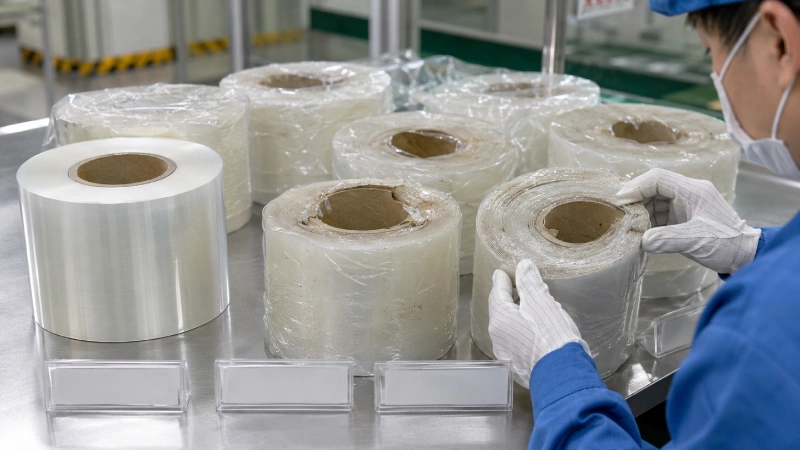
After opening the package, inspect each sampled roll for:
- A crushed or deformed core
- Telescoping
- Loose or uneven winding
- Dented or cut roll edges
- Wrinkles and folds
- Tape blocking between layers
- Dust, oil, or foreign particles
- Visible coating irregularities
- Incorrect winding orientation
- Unidentified opened or partially used rolls
Roll-edge damage should not be treated as a purely cosmetic issue. A damaged edge may affect tracking, alignment, smooth unwinding, or the ability of the tape to pass through an application mechanism.
Materials with damaged packaging, uncertain storage history, or unclear manufacturing dates should be quarantined before functional testing. More detailed guidance is available in Jiushuo’s article on cover tape storage and shelf-life control.
Step 3: Confirm Dimensions and Functional Construction
Measure the characteristics defined in the approved specification. These may include:
- Cover tape width
- Film thickness
- Core inner diameter
- Roll outer diameter
- Roll length
- Edge straightness
- Adhesive-zone position
- Adhesive exposure width
- Coated or treated side
- Winding direction
- Splice restrictions
Measurements should be taken from more than one position when the inspection procedure requires confirmation of consistency across the roll.
The inspector should use calibrated tools suitable for the tolerance being checked. A caliper may be appropriate for certain dimensions, while film thickness may require a suitable micrometer or another approved method.
Width acceptance must be based on the purchased product specification. If the material is still being qualified, refer to the cover tape width matching guide for carrier tape rather than selecting a cover tape from carrier tape width alone.
For pressure sensitive products, verify that the adhesive zones are positioned correctly and are free from contamination. For heat-activated products, confirm the sealing side, coating continuity, and winding orientation.
Optical properties such as transmission, haze, clarity, or opaque particles should only be inspected when they are included in the purchasing specification or qualification plan.
Step 4: Use a Risk-Based Sampling Plan
A large shipment does not necessarily require every roll to undergo every test. However, inspecting only the first roll from the first carton may fail to detect mixed lots or localized defects.
Sampling depth should reflect risk factors such as:
- A new supplier
- A new cover tape product
- A first production lot
- A material or process change
- A customer complaint
- Abnormal transportation conditions
- Missing documentation
- A previously unstable supplier lot
- A routine lot with established performance history
Visual defects and label conformity are attribute results: the condition is acceptable or unacceptable. Width, thickness, peel force, and surface resistance are variable measurements.
The buyer may use an established quality system such as ANSI/ASQ Z1.4 and Z1.9 sampling procedures, but the inspection level, AQL, sample size, and switching rules must be selected by the buyer’s quality team. There is no single sampling plan appropriate for every cover tape project.
Samples should be taken from different cartons and roll positions. First lots, changed lots, and complaint-containment lots normally require more extensive validation than routine lots from an approved supplier.
Step 5: Perform a Controlled Visual and Unwind Inspection
A stationary roll can appear acceptable while developing problems during unwinding. Unwind a defined length under controlled conditions and record the inspected roll number and length.
Look for:
- Blocking or abnormal release between layers
- Edge waviness
- Curling
- Wrinkles or creases
- Scratches
- Tears
- Foreign particles
- Adhesive transfer
- Coating discontinuity
- Periodic appearance defects
- Unexpected splices
- Incorrect treated-side orientation
Periodic defects should be recorded by roll position or approximate distance. Do not record only “visual inspection passed.” A useful inspection record identifies what was inspected, how much material was unwound, and whether any defect repeated at regular intervals.
When a defect is found on one sampled roll, determine whether it is isolated or related to the broader slitting or coating batch before releasing the remaining shipment.
Step 6: Seal the Sample to the Intended Carrier Tape
Roll appearance and dimensional inspection cannot confirm functional compatibility. Before mass production, apply the cover tape to the intended carrier tape and evaluate the sealed combination.
Whenever possible, the test should use:
- The actual production carrier tape
- The intended carrier tape material and grade
- The approved carrier tape width
- The actual sealing flanges
- Production or equivalent application equipment
- Recorded environmental and conditioning conditions
The polyester backing of a cover tape does not by itself establish whether it is compatible with PS, PC, PET, PVC, or another carrier tape. Adhesive chemistry, carrier surface, sealing conditions, and geometry all influence performance. Buyers evaluating multiple substrates should review cover tape compatibility with PS, PC, PET, and PVC carrier tape.
Heat-Activated Cover Tape Validation
Heat-activated adhesive cover tape forms its seal through a controlled combination of heat, pressure, and contact time.
Record:
- Cover tape and carrier tape lots
- Sealing equipment
- Sealing-head or roller configuration
- Temperature
- Pressure
- Dwell time or line speed
- Seal-rail width
- Number of passes, when applicable
- Conditioning time before testing
There is no universal sealing temperature for every product. Equipment design, carrier material, pressure distribution, dwell time, and line speed may all change the result.
When evaluating a heat-seal application, use the supplier-approved process window for the specific product rather than a general industry range. Jiushuo can review projects requiring heat-activated cover tape for controlled heat-and-pressure sealing.
Pressure Sensitive Cover Tape Validation
Pressure sensitive adhesive cover tape bonds mainly through applied pressure and normally does not require heat to activate the adhesive.
Record:
- Application mechanism
- Roller or shoe configuration
- Applied pressure
- Application speed
- Ambient conditions
- Carrier tape surface condition
- Cover tape alignment
- Time between application and peel testing
The 3M pressure sensitive cover tape technical data sheet illustrates why the application mechanism matters: different pressure-distribution methods may produce different adhesion results.
Do not apply heat-sealing parameters to a PSA product unless the material supplier has specifically approved that process. Projects using room-temperature application can be reviewed through Jiushuo’s pressure sensitive cover tape for room-temperature pressure sealing page.
Step 7: Verify Peel Performance Under Defined Conditions
A peel-force result has limited value unless the test conditions are recorded.
The inspection report should identify:
- Cover tape and carrier tape products
- Both lot numbers
- Application settings
- Conditioning period
- Peel angle
- Peel speed
- Test length
- Test equipment
- Calibration status
- Ambient temperature and humidity
- Number of specimens
- Average, minimum, and maximum force
- Failure mode
- Residue or adhesive transfer
The acceptance limit must come from the approved buyer specification, customer requirement, or qualified supplier specification. EIA-481 requirements, supplier-recommended values, and internal process-control limits should not be presented as though they are interchangeable.
For a detailed test setup and reporting procedure, see Jiushuo’s guide to the EIA-481 cover tape peel force test.
Do not evaluate only the average value. Review the curve for initial peaks, abrupt spikes, periodic fluctuation, increasing or decreasing trends, and differences between seal lanes. Also inspect the sample for tape tearing, edge lifting, adhesive residue, and uneven peel.
An acceptable average can still hide unstable behavior that may disturb component exposure. Jiushuo’s guide explains in more detail how cover tape peel force affects SMT feeding stability.

Step 8: Verify ESD and Optical Properties When Required
Not every incoming lot needs the same ESD or optical tests. Include them when required by the purchase specification, component sensitivity, customer packaging standard, supplier COA, or qualification plan.
For ESD measurements, confirm:
- Whether the requirement is surface resistance or resistivity
- Which side is tested
- Whether treatment is single-sided or double-sided
- The test method
- Electrode configuration
- Test voltage
- Conditioning environment
- Units and acceptance limits
Do not mix surface resistance, surface resistivity, ohms, and ohms per square without confirming the specified method.
Optical inspection may include transmission, haze, clarity, scratches, foreign particles, or local coating variation. The method and limits must match the approved specification.
Step 9: Decide Accept, Hold, Re-Test, or Reject
A practical incoming inspection system should provide four possible dispositions.
Accept the lot when documentation, identity, packaging, dimensions, visual condition, sealing performance, peel behavior, and required ESD or optical results meet the approved criteria.
Hold the lot when documents are missing, labels conflict, traceability is incomplete, packaging is damaged, test conditions are uncertain, or an abnormality requires further investigation.
Re-test when the wrong carrier tape was used, equipment calibration is unclear, conditioning was incorrect, the sample was too small, or additional cartons and roll positions must be checked.
Reject the lot when the wrong product was supplied, traceability cannot be restored, critical dimensions fail, serious contamination or blocking is repeated, or functional validation fails under the correct approved conditions.
The disposition record should include the inspector, date, lot number, test report, retain-sample identification, quarantine location, and supplier corrective-action reference.
Cover Tape Incoming Inspection Checklist
| Inspection Stage | What to Verify | Recommended Evidence |
|---|---|---|
| Documentation | Specification, PO, TDS, COA, and revision | Document review record |
| Identification | Product, width, sealing type, and lot | Carton and roll-label photos |
| Traceability | Manufacturing date and batch relationship | COA and supplier lot record |
| Packaging | Carton, bag, core, and roll protection | Incoming-condition photos |
| Dimensions | Width, thickness, core, and adhesive zone | Calibrated measurement record |
| Appearance | Edges, winding, contamination, and coating | Visual and unwind inspection |
| Application | Correct carrier tape and process settings | Sealing setup record |
| Peel test | Angle, speed, curve, and failure mode | Raw curve and test report |
| ESD or optics | Required property and test method | COA or verification result |
| Disposition | Accept, Hold, Re-test, or Reject | Signed IQC release record |
What to Send Jiushuo for Technical Review
When an incoming cover tape lot shows unstable sealing, lifting, residue, tearing, wrinkles, or uneven peel, provide enough evidence to reproduce the condition.
Useful project information includes:
- Carrier tape material and width
- Carrier tape drawing or physical sample
- Current cover tape sample and lot number
- Sealing or pressure-application equipment
- Temperature, pressure, dwell time, or line speed
- Peel angle and speed
- Peel-force curve
- Defect photographs
- Residue samples
- Unwind or feeder video
- Storage and transportation history
- Customer-specific acceptance requirements
A repeatable incoming inspection procedure helps prevent an unsuitable lot from reaching mass production. Submit the actual carrier tape, application conditions, inspection requirements, and defect evidence to Jiushuo for matched sample validation and a technical review of your cover tape application.
FAQ
Can a supplier COA replace incoming peel-force testing?
Not automatically. The decision depends on supplier approval status, customer requirements, lot risk, historical performance, and the buyer’s quality system. New products, supplier changes, damaged shipments, and complaint-related lots may require additional verification.
Should heat-activated and pressure sensitive cover tapes use the same inspection procedure?
They can share documentation, packaging, dimensional, and visual checks. Functional application testing must be different because heat-activated materials depend on controlled heat, pressure, and time, while PSA materials mainly depend on pressure.
Which carrier tape should be used for incoming validation?
Use the actual production carrier tape whenever possible. Carrier material, grade, width, flange surface, and manufacturing lot may influence sealing and peeling performance.
What if the average peel force passes but the curve contains spikes?
Place the material on hold for further review. Examine minimum and maximum values, periodic variation, failure mode, residue, tape tearing, and feeder behavior rather than releasing the lot based only on the average.
When should an incoming cover tape lot be quarantined?
Typical reasons include damaged packaging, missing traceability, inconsistent labels, uncertain storage history, material changes, contamination, blocking, abnormal roll edges, residue, or functional-test failure.
How should rolls be sampled from a large shipment?
Use the sampling procedure approved by the buyer’s quality team. Samples should represent different cartons and roll positions. New, changed, or complaint-related lots normally require deeper inspection than established routine lots.