
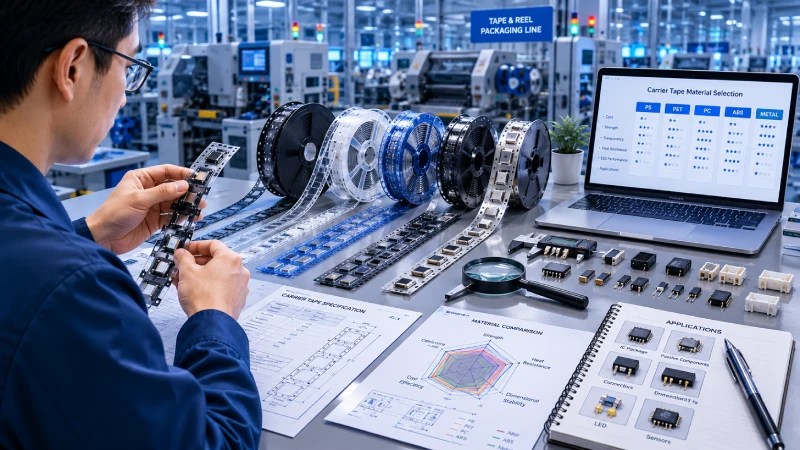
In electronic component packaging, the carrier tape material plays a critical role in protecting parts during transportation, storage, and automated assembly processes. Choosing the wrong material can lead to component damage, static discharge, dimensional instability, or feeding failures on SMT production lines.
This comprehensive carrier tape materials guide explains the most common materials used in carrier tape manufacturing, their characteristics, applications, and how to select the right material based on your product requirements.
If you’re new to electronic packaging, it’s helpful to first understand the fundamentals of Carrier Tape and its role in tape-and-reel packaging systems.
Why Carrier Tape Material Selection Matters
Modern electronic components are becoming increasingly smaller, lighter, and more sensitive to environmental conditions. As a result, carrier tape material selection directly affects:
- Component protection
- Dimensional accuracy
- Feeding reliability
- ESD performance
- Packaging cost
- Production efficiency
Different industries require different carrier tape properties. For example:
| Industry | Typical Requirements |
|---|---|
| Semiconductor | High precision, ESD protection |
| LED Packaging | Transparency, dimensional stability |
| Automotive Electronics | Heat resistance, durability |
| Passive Components | Cost efficiency |
| Medical Electronics | High cleanliness standards |
The material chosen determines whether the tape can maintain pocket shape consistency and ensure reliable automated assembly.
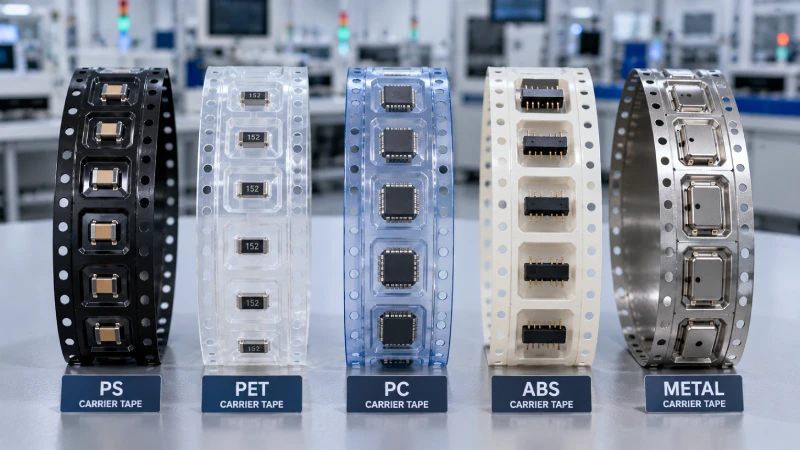
Common Carrier Tape Materials Overview
The most widely used carrier tape materials include:
- Polystyrene (PS)
- Polyethylene Terephthalate (PET)
- Polycarbonate (PC)
- Acrylonitrile Butadiene Styrene (ABS)
- Metal Carrier Tape Materials
Each material offers unique advantages depending on component type and manufacturing requirements.
PS Carrier Tape Materials
One of the most common materials used in electronic packaging is PS Carrier Tape.
Key Characteristics
- Low material cost
- Easy thermoforming
- Good rigidity
- Suitable for high-volume production
- Available in conductive and antistatic grades
Typical Applications
PS carrier tape is widely used for:
- Chip resistors
- Ceramic capacitors
- Diodes
- Small passive components
Advantages
- Economical solution
- High production efficiency
- Good pocket shape retention
Limitations
- Moderate impact resistance
- Lower temperature resistance than PET or PC
- Less suitable for sensitive high-value components
For most standard SMT components, PS remains the preferred material due to its balance of performance and affordability.
PET Carrier Tape Materials
For applications requiring greater durability and environmental resistance, manufacturers often choose PET Carrier Tape Materials.
Key Characteristics
- Excellent mechanical strength
- High dimensional stability
- Good transparency
- Moisture resistance
- Recyclable material
Typical Applications
PET carrier tapes are frequently used for:
- Optical devices
- LED components
- Sensors
- Precision electronic parts
Advantages
- Superior toughness
- Reduced pocket deformation
- Excellent transportation performance
Limitations
- Higher material cost than PS
- More demanding forming process
PET is often selected when long-distance transportation or enhanced protection is required.
PC Carrier Tape Materials
When packaging highly sensitive or high-value components, many manufacturers choose PC Carrier Tape Materials.
Key Characteristics
- Outstanding impact resistance
- Excellent transparency
- Superior dimensional accuracy
- High temperature resistance
Typical Applications
PC carrier tape is commonly used for:
- IC packages
- BGA devices
- Optical modules
- Automotive electronics
Advantages
- Exceptional durability
- Tight dimensional tolerances
- High-end packaging performance
Limitations
- Higher manufacturing cost
- More complex processing requirements
PC is often regarded as a premium material option for demanding packaging environments.
ABS Carrier Tape Materials
Another material frequently used for specialized packaging applications is ABS Carrier Tape Materials.
Key Characteristics
- High toughness
- Good impact resistance
- Excellent machinability
- Stable pocket formation
Typical Applications
ABS carrier tapes are suitable for:
- Connectors
- Electronic modules
- Industrial components
- Mechanical parts
Advantages
- Strong structural integrity
- Reliable handling performance
- Good dimensional consistency
Limitations
- Less transparent than PET or PC
- Moderate heat resistance
ABS is often selected when mechanical strength is more important than optical clarity.
Metal Carrier Tape Materials
For extreme environments and highly specialized applications, manufacturers may utilize Metal Carrier Tape Materials.
Key Characteristics
- Exceptional strength
- High temperature resistance
- Outstanding dimensional stability
- Excellent shielding performance
Typical Applications
Metal carrier tapes are commonly used for:
- Semiconductor wafers
- Power devices
- Precision connectors
- Aerospace electronics
Advantages
- Maximum protection
- Superior durability
- Resistance to harsh environments
Limitations
- High production cost
- Increased package weight
- More complex manufacturing processes
Metal carrier tapes are typically reserved for applications where plastic materials cannot meet performance requirements.
Embossed Carrier Tape and Material Compatibility
Material selection is closely related to the manufacturing process used to create the tape pockets.
Most modern electronic packaging utilizes Embossed Carrier Tape, which forms component pockets through thermoforming technology.
Different materials exhibit different forming behaviors:
| Material | Formability | Pocket Precision | Durability |
|---|---|---|---|
| PS | Excellent | Good | Medium |
| PET | Good | Excellent | High |
| PC | Good | Excellent | Very High |
| ABS | Excellent | Good | High |
| Metal | Specialized | Extremely High | Maximum |
Selecting the right material helps ensure consistent pocket geometry and reliable component retention.
How to Choose the Right Carrier Tape Material
Consider Component Weight
Lightweight passive components generally perform well with PS carrier tape.
Heavier components may require PET, ABS, or PC for better structural support.
Evaluate Environmental Conditions
For high-temperature environments:
- PC performs exceptionally well.
- Metal materials provide the highest resistance.
For humid environments:
- PET offers excellent moisture resistance.
Review ESD Requirements
Sensitive electronic devices often require:
- Conductive materials
- Antistatic materials
- Controlled surface resistance
Many PS, PET, ABS, and PC carrier tapes are available in ESD-safe formulations.
Analyze Budget Constraints
If cost is a primary concern:
- PS usually provides the lowest overall packaging cost.
If reliability is the priority:
- PET or PC may offer better long-term value.
Future Trends in Carrier Tape Materials
The electronic packaging industry continues to evolve toward:
- Smaller component sizes
- Higher packaging density
- Increased automation
- Sustainable manufacturing
Future carrier tape materials are expected to focus on:
- Recyclable plastics
- Enhanced ESD performance
- Greater dimensional stability
- Improved environmental sustainability
Manufacturers are also investing in advanced material formulations that combine the advantages of multiple polymer types while reducing production costs.
Conclusion
Selecting the right carrier tape material is essential for ensuring component protection, feeding reliability, and production efficiency.
While PS remains the most widely used option due to its affordability, PET, PC, ABS, and metal materials each offer unique benefits for specialized applications. The best choice depends on your component characteristics, environmental requirements, automation needs, and budget considerations.
By understanding the strengths and limitations of each material, engineers and procurement teams can make informed decisions that improve packaging performance and reduce manufacturing risks.