
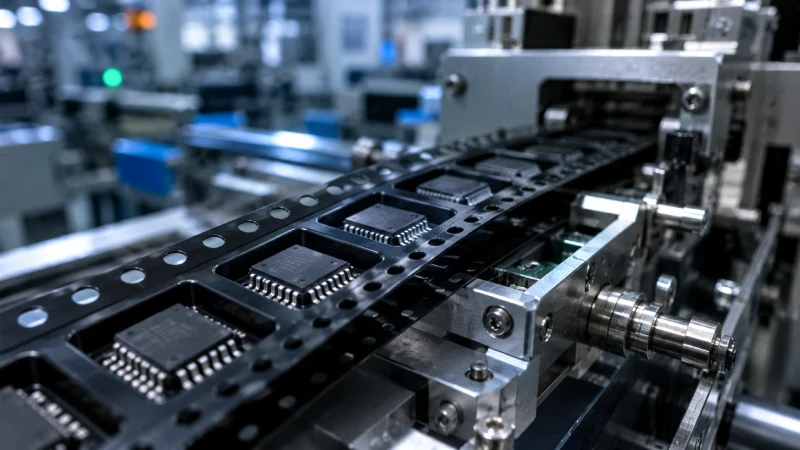
In modern SMT packaging, choosing the right carrier tape material directly affects component protection, feeding stability, packaging efficiency, and long-term production reliability. Among the various options available, ABS carrier tape materials are widely used for electronic components that require higher mechanical strength and better impact resistance.
ABS carrier tape is especially popular in industries where components are heavier, more delicate, or exposed to demanding transportation and automated assembly environments. Compared with standard PS carrier tape materials, ABS provides improved durability, dimensional stability, and crack resistance, making it suitable for high-speed tape and reel packaging operations.
As SMT components continue becoming smaller, more sensitive, and more expensive, manufacturers increasingly focus on selecting carrier tape materials that minimize feeding errors, static damage, and pocket deformation. This is why ABS embossed carrier tape remains an important solution in modern electronic packaging applications.
What Is ABS Carrier Tape Material?
ABS carrier tape material refers to embossed carrier tape manufactured from Acrylonitrile Butadiene Styrene (ABS) plastic. ABS is a thermoplastic polymer known for its excellent toughness, impact resistance, and forming performance.
In SMT packaging, ABS sheets are thermoformed into embossed pockets designed to securely hold electronic components during transportation, storage, and automated pick-and-place assembly.
Unlike some lower-strength materials, ABS can maintain stable pocket structures even when handling larger or heavier components. This makes it suitable for various industrial electronic packaging applications.
Basic Structure of ABS Plastic
ABS combines three important monomers:
- Acrylonitrile for chemical resistance
- Butadiene for toughness and impact resistance
- Styrene for rigidity and dimensional stability
This balanced composition gives ABS excellent mechanical properties while still allowing efficient thermoforming during carrier tape production.
Why ABS Is Popular in SMT Packaging
ABS carrier tape materials are commonly selected because they offer:
- Strong pocket durability
- Stable feeding performance
- Good dimensional consistency
- ESD-safe conductive options
- Better crack resistance than PS materials
For manufacturers operating high-speed SMT lines, stable component feeding is critical. ABS helps reduce production interruptions caused by damaged pockets or inconsistent tape dimensions.
Key Properties of ABS Carrier Tape Materials
The popularity of ABS embossed carrier tape comes from its combination of strength, processing stability, and ESD compatibility.
Excellent Impact Resistance
One of the biggest advantages of ABS carrier tape is its impact resistance. During shipping and automated handling, carrier tapes may experience vibration, pressure, or sudden movement. ABS helps protect components from damage by maintaining pocket integrity under stress.
This is especially important for:
- IC packages
- Connectors
- Automotive electronic parts
- Precision industrial components
Compared with brittle materials, ABS significantly reduces the risk of pocket cracking.
Good Thermoforming Performance
ABS materials are highly suitable for thermoforming processes used in embossed carrier tape production.
The material can form:
- Precise pocket geometries
- Smooth cavity surfaces
- Stable dimensions
- Consistent pocket depth
This improves feeding reliability during high-speed SMT assembly.
Manufacturers using advanced carrier tape packaging machines often prefer ABS for applications requiring accurate pocket structures and stable automation performance.
Anti-Static & Conductive Options
Modern SMT packaging environments require ESD protection to prevent electrostatic damage to sensitive electronic components.
ABS carrier tape materials are available in:
- Anti-static grades
- Conductive grades
- Static dissipative formulations
Conductive ABS carrier tape helps safely dissipate electrostatic charges while maintaining mechanical strength.
This makes ABS particularly suitable for semiconductor and precision electronic packaging.
Dimensional Stability
Consistent dimensions are critical in automated SMT production.
ABS offers excellent dimensional stability, helping maintain:
- Accurate sprocket hole spacing
- Consistent pocket positioning
- Stable tape width tolerance
- Reliable cover tape sealing
These factors directly influence pick-and-place accuracy.
High Mechanical Strength
ABS carrier tape materials are stronger than many standard PS tapes, making them suitable for larger or heavier components that require additional support during transport and feeding.
Common Applications of ABS Carrier Tape
ABS carrier tape is used across many electronic manufacturing industries.
Integrated Circuits (ICs)
IC packaging often requires stable pocket structures and ESD-safe materials. ABS helps protect delicate chips during automated reel handling.
Connectors
Electronic connectors are typically heavier and mechanically sensitive. ABS carrier tape provides better support and durability than thinner materials.
Automotive Electronics
Automotive SMT components must meet higher reliability standards. ABS carrier tape is commonly used because of its strength and dimensional consistency.
LED Components
Certain LED packages require stable positioning and anti-static protection. Conductive ABS tape helps reduce handling risks during packaging and assembly.
Industrial Electronic Parts
Industrial sensors, modules, and control components often use ABS embossed tape because of its mechanical stability during transportation and automated production.
Many manufacturers combine ABS carrier tape with fully automated tape reel packaging systems to improve packaging speed and reduce labor costs.
ABS vs PS vs PET vs PC Carrier Tape Materials
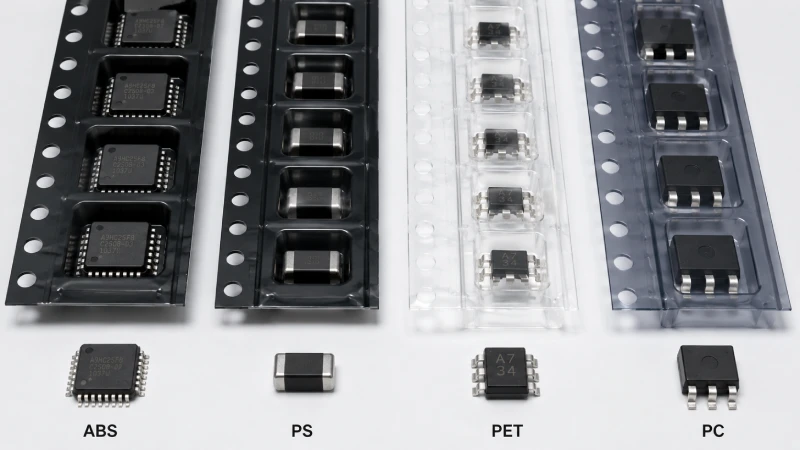
Different carrier tape materials offer different advantages. Understanding these differences helps manufacturers select the most suitable solution.
| Material | Strength | Transparency | ESD Performance | Cost | Typical Applications |
|---|---|---|---|---|---|
| ABS | High | Low | Excellent | Medium | ICs, connectors, automotive electronics |
| PS | Medium | Medium | Good | Low | Standard passive components |
| PET | Medium-High | High | Good | Medium | Heat-resistant packaging |
| PC | Very High | High | Excellent | High | Precision/high-end electronic components |
ABS vs PS Carrier Tape
PS carrier tape is widely used because of its lower cost. However, ABS offers several advantages:
- Better impact resistance
- Higher toughness
- Reduced cracking risk
- Better support for heavier components
While PS works well for lightweight passive components, ABS is often preferred when higher durability is required.
ABS vs PET Carrier Tape
PET materials provide excellent transparency and heat resistance. However, ABS generally offers:
- Better forming stability
- Stronger pocket structures
- Improved mechanical toughness
PET is often selected for applications requiring optical clarity, while ABS is chosen for structural durability.
ABS vs PC Carrier Tape
PC carrier tape materials provide exceptional strength and transparency but are significantly more expensive.
ABS offers a strong balance between:
- Performance
- Cost
- Formability
- Production efficiency
For many SMT applications, ABS delivers sufficient durability without the higher material costs associated with PC.
How ABS Carrier Tape Is Manufactured
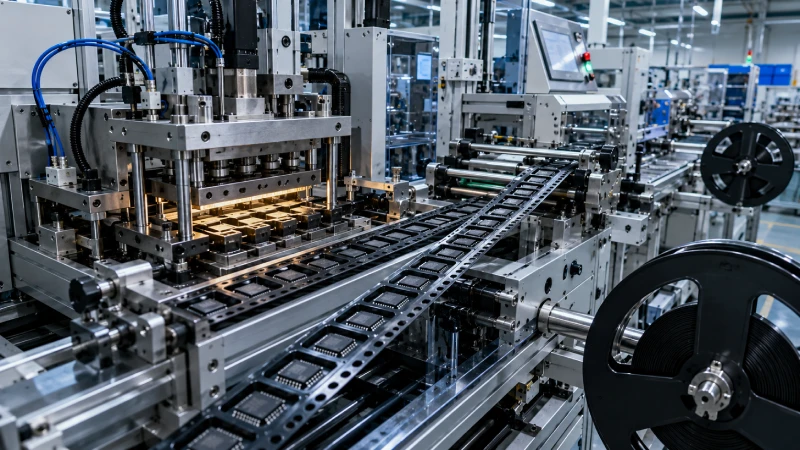
ABS carrier tape production involves multiple precision manufacturing steps.
Raw Material Preparation
ABS resin is mixed with conductive or anti-static additives depending on packaging requirements.
Sheet Extrusion
The material is extruded into plastic sheets with controlled thickness and surface quality.
Thermoforming / Embossing
The ABS sheet is heated and formed into embossed pockets using precision molds.
Modern carrier tape forming machines can achieve highly accurate pocket geometries suitable for automated SMT assembly.
Punching & Sprocket Hole Formation
Sprocket holes are punched with strict dimensional accuracy to ensure stable feeding performance.
Conductive Treatment
For ESD-safe applications, conductive formulations or coatings help dissipate static electricity during handling and assembly.
Advanced automation systems often integrate:
- visual inspection
- defect detection
- automatic reel winding
- sealing inspection
to improve packaging quality consistency.
How to Choose the Right ABS Carrier Tape Material
Selecting the right ABS carrier tape depends on multiple production factors.
Consider Component Weight
Heavier components require stronger pocket support. ABS is ideal for applications where standard PS materials may deform or crack.
Evaluate ESD Requirements
Sensitive semiconductor devices require conductive or anti-static carrier tape materials to reduce electrostatic risks.
Always confirm:
- surface resistance range
- ESD compliance
- environmental stability
before selecting materials.
Check Feeding Stability
Poor feeding stability can cause:
- production downtime
- pick-and-place errors
- component loss
ABS materials with stable dimensions help improve feeding accuracy during high-speed SMT assembly.
Consider Pocket Precision
Complex or irregular component shapes require highly accurate pocket dimensions.
ABS materials provide good forming consistency for precision cavity production.
Match SMT Production Speed
High-speed SMT lines place greater stress on carrier tapes.
Manufacturers operating advanced automated packaging lines should prioritize:
- dimensional stability
- tensile strength
- sprocket hole precision
- consistent sealing performance
Working with experienced packaging equipment suppliers can help optimize both material selection and overall packaging efficiency.
Common Problems with ABS Carrier Tape Materials
Although ABS provides many advantages, manufacturers may still encounter certain challenges.
Warping After Forming
Improper cooling or material thickness control may cause tape warping.
Stable processing parameters and precision molds help reduce deformation risks.
Static Electricity Issues
If conductive formulations are inconsistent, electrostatic buildup may occur during production or transportation.
Proper ESD material control is essential for semiconductor packaging applications.
Pocket Cracking
Low-quality ABS formulations or incorrect forming temperatures can lead to pocket cracking.
Using high-quality ABS materials and optimized thermoforming conditions helps improve durability.
Cover Tape Sealing Problems
Poor surface consistency may affect sealing strength between carrier tape and cover tape.
Precision manufacturing and stable material quality are important for reliable sealing performance.
Future Trends in ABS Carrier Tape Materials
As electronic components become smaller and more advanced, carrier tape materials continue evolving.
Future ABS carrier tape development trends include:
- thinner material structures
- improved conductive formulations
- recyclable ABS materials
- higher precision thermoforming
- AI visual inspection compatibility
Industries such as:
- EV electronics
- automotive semiconductors
- industrial automation
- advanced communication devices
are driving demand for more reliable SMT packaging materials.
Manufacturers are also focusing on improving compatibility with ultra-high-speed automated packaging systems.
Conclusion
ABS carrier tape materials remain one of the most reliable solutions for SMT electronic packaging applications that require strong mechanical performance, dimensional stability, and ESD protection.
Compared with standard PS materials, ABS offers better impact resistance, reduced cracking risk, and improved feeding stability for demanding automated production environments.
As SMT manufacturing continues advancing toward higher speeds and greater precision, selecting the right carrier tape material becomes increasingly important for production efficiency and component protection.
Manufacturers investing in optimized carrier tape design, precision forming equipment, and automated packaging systems can significantly improve packaging consistency while reducing long-term production risks.
FAQ
What is ABS carrier tape used for?
ABS carrier tape is mainly used for packaging electronic components in SMT production. It protects components during transportation, storage, and automated pick-and-place assembly.
Is ABS carrier tape anti-static?
Yes. ABS carrier tape can be manufactured in anti-static or conductive versions to provide ESD protection for sensitive electronic components.
What is the difference between ABS and PS carrier tape?
ABS carrier tape offers higher strength, better impact resistance, and improved crack resistance compared with PS carrier tape. PS is typically lower cost and used for lighter components.
Can ABS carrier tape be used for heavy electronic components?
Yes. ABS is commonly used for larger or heavier SMT components because of its strong mechanical properties and stable pocket structures.
Is ABS suitable for high-speed SMT production?
ABS carrier tape is highly suitable for high-speed SMT lines because it provides stable feeding performance, dimensional consistency, and reliable pocket durability.
How do you choose the right carrier tape material?
The correct carrier tape material depends on component size, weight, ESD requirements, feeding speed, and packaging environment. Manufacturers should evaluate both material properties and automation compatibility before selection.