
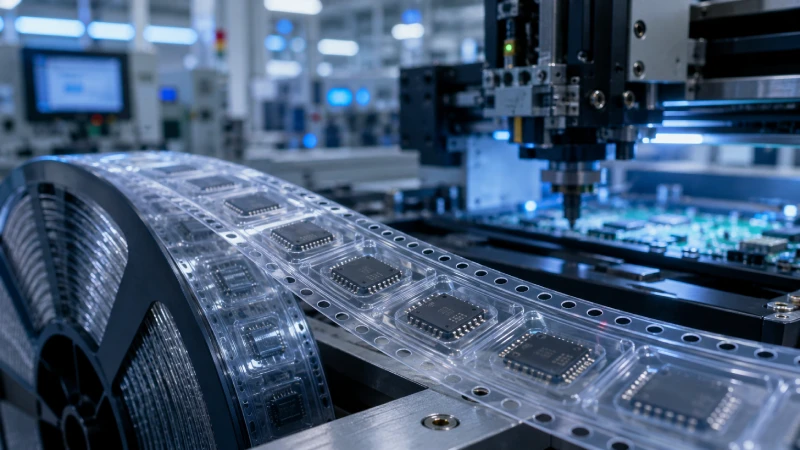
As electronic components continue becoming smaller, lighter, and more sensitive, packaging materials play a far more important role than many buyers initially realize. In modern SMT and semiconductor packaging environments, carrier tape material selection directly affects component protection, feeding stability, automation efficiency, and overall production reliability.
Among various carrier tape materials available today, PC carrier tape materials — also known as polycarbonate carrier tapes — are widely used in high-precision electronic packaging applications. Their excellent dimensional stability, transparency, impact resistance, and ESD performance make them especially suitable for IC chips, semiconductor devices, MEMS sensors, optical components, and other precision electronic parts.
For manufacturers operating high-speed SMT production lines or automated tape-and-reel systems, choosing the right carrier tape material is not simply a packaging decision. It is a process optimization decision that influences yield rates, feeding accuracy, and long-term production stability.
This guide explains everything you need to know about PC carrier tape materials, including their properties, advantages, applications, and how to choose the right solution for your packaging requirements.
What Are PC Carrier Tape Materials?
PC carrier tape materials refer to embossed carrier tapes manufactured from polycarbonate (PC) thermoplastic material. Polycarbonate is considered an engineering-grade plastic known for its high strength, excellent clarity, and superior dimensional stability.
In SMT and semiconductor packaging, PC materials are commonly thermoformed into precision carrier tapes containing accurately designed cavities. These cavities securely hold electronic components during transportation, storage, and automated pick-and-place assembly.
Compared with standard carrier tape materials, PC offers much tighter forming tolerances and better resistance to deformation. This makes it highly suitable for packaging miniature or highly sensitive electronic parts where cavity precision is critical.
The manufacturing process usually involves:
- Precision thermoforming
- Embossed cavity forming
- Conductive or anti-static surface treatment
- Reel winding and cover tape sealing
PC carrier tapes are widely used across industries such as:
- Semiconductor packaging
- IC packaging
- Automotive electronics
- MEMS sensor production
- Optical component packaging
- Medical electronic devices
As component sizes continue shrinking, the demand for high-precision PC carrier tape materials continues growing rapidly.
Key Properties of PC Carrier Tape Materials
One reason PC carrier tape materials are widely adopted in precision packaging is their balanced combination of mechanical strength, thermal stability, and forming accuracy.
Excellent Dimensional Stability
Dimensional consistency is essential in automated SMT production. Even slight cavity deformation may lead to feeding errors, component flipping, or pick-and-place failures.
Polycarbonate materials maintain stable cavity dimensions during forming, transportation, and high-speed feeding operations. This allows PC carrier tapes to perform reliably in precision automation systems.
For semiconductor packaging applications involving ultra-small components, stable cavity geometry becomes especially important.
High Transparency
Unlike some opaque packaging materials, PC carrier tapes provide excellent optical clarity. This allows:
- Easier visual inspection
- Better AOI compatibility
- Improved machine vision recognition
- Faster defect detection
Transparent carrier tape materials are particularly useful in automated inspection environments where camera systems verify component orientation and placement accuracy.
Strong Impact Resistance
Electronic components can easily become damaged during shipment or reel handling if the packaging material lacks sufficient durability.
Polycarbonate offers excellent impact resistance compared with more brittle materials like PS. This helps reduce:
- Cracked cavities
- Broken tape edges
- Component jumping
- Transportation damage
For export packaging or long-distance logistics, stronger carrier tape materials help improve overall packaging reliability.
Heat Resistance
High-speed SMT production environments often involve temperature fluctuations and continuous mechanical stress.
PC carrier tape materials maintain structural stability under elevated operating conditions, making them suitable for demanding automation lines.
This thermal resistance also helps maintain sealing consistency when used with cover tapes during tape-and-reel packaging operations.
Anti-Static and Conductive Performance
Electrostatic discharge (ESD) remains one of the biggest risks in semiconductor and IC packaging.
Many PC carrier tapes are available in:
- Anti-static grades
- Conductive grades
- Permanent ESD-safe formulations
These materials help protect sensitive electronic components from electrostatic damage during handling and automated assembly.
For IC chips, sensors, and microelectronic devices, ESD-safe packaging is often mandatory rather than optional.
PC Carrier Tape vs Other Carrier Tape Materials
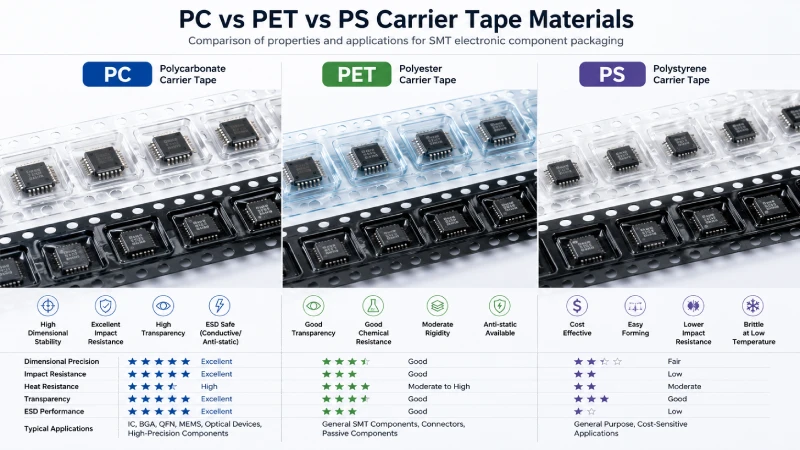
Different carrier tape materials serve different packaging requirements. While PS and PET remain common in the industry, PC materials are often preferred for higher precision applications.
PC vs PS Carrier Tape
PS (Polystyrene) carrier tape is widely used because of its lower cost and relatively simple forming characteristics. However, PS materials tend to be more brittle and less durable.
Compared with PS:
- PC offers better impact resistance
- PC provides higher forming precision
- PC maintains tighter dimensional tolerances
- PC performs better in high-speed SMT feeding
For general electronic components, PS may still be acceptable. But for semiconductor packaging or miniature components, PC usually provides more stable performance.
PC vs PET Carrier Tape
PET carrier tape materials are known for good transparency and environmental stability. However, PET materials may not achieve the same cavity precision as PC in certain ultra-small component applications.
Compared with PET:
- PC provides better rigidity
- PC allows more complex cavity structures
- PC supports higher precision forming
- PC performs better for microelectronic packaging
PET materials are often used in medium-precision packaging environments, while PC is more common in high-end semiconductor packaging.
When PC Is the Better Choice
PC carrier tape materials are especially suitable when packaging involves:
- IC chips
- MEMS sensors
- Miniature connectors
- Precision optical devices
- High-speed SMT lines
- Ultra-thin components
- Tight cavity tolerances
Although PC materials are generally more expensive, the improved packaging reliability often justifies the investment for high-value electronic products.
Common Applications of PC Carrier Tape Materials
Because of their precision and durability, PC carrier tapes are widely used across many advanced electronics industries.
Semiconductor Packaging
Semiconductor devices require extremely stable cavity dimensions and ESD protection. PC materials are commonly used for packaging:
- QFN packages
- BGA components
- CSP devices
- IC chips
- Logic controllers
The precise forming capability of PC helps maintain consistent component orientation during automated feeding.
SMT Electronic Components
Many SMT components are becoming smaller and lighter, increasing packaging difficulty.
PC carrier tapes are frequently used for:
- Precision capacitors
- Miniature resistors
- Connectors
- RF modules
- Microelectronic assemblies
Stable feeding performance is critical for modern high-speed SMT production lines.
Optical and Sensor Components
Optical devices and MEMS sensors are highly sensitive to cavity deformation and static electricity.
Polycarbonate carrier tapes provide:
- Excellent visibility
- Better component protection
- Stable pocket geometry
- Reliable transportation safety
These properties make PC materials ideal for advanced sensor packaging applications.
Conductive and Anti-Static PC Carrier Tape
In semiconductor manufacturing, ESD protection is a critical packaging requirement.
Even minor electrostatic discharge can permanently damage sensitive electronic devices before they reach the assembly line.
Conductive and anti-static PC carrier tape materials help minimize these risks by controlling surface resistance and static charge accumulation.
Typical ESD-safe carrier tape solutions include:
- Conductive PC carrier tape
- Anti-static PC carrier tape
- Permanent dissipative materials
Buyers should always verify ESD specifications before selecting carrier tape materials for semiconductor packaging projects.
Important factors include:
- Surface resistance range
- Conductivity stability
- Environmental durability
- Long-term static protection performance
Working with experienced packaging suppliers helps ensure ESD performance matches the actual application requirements.
How to Choose the Right PC Carrier Tape Material
Selecting the correct carrier tape involves more than simply choosing a material type. The packaging solution must match the component structure, automation speed, and production environment.
Component Geometry
The shape and dimensions of the electronic component determine cavity design requirements.
Key considerations include:
- Pocket depth
- Component weight
- Pin structure
- Orientation stability
Complex components often require tighter forming tolerances that PC materials can provide more effectively.
SMT Feeding Speed
Modern SMT lines operate at extremely high speeds. Carrier tape dimensional consistency becomes increasingly important as feeding speed increases.
Poorly formed cavities may cause:
- Component flipping
- Pick-up errors
- Feeding interruptions
- Production downtime
PC carrier tapes help improve stability in demanding automation environments.
ESD Sensitivity
For ICs and semiconductor devices, conductive or anti-static PC materials are usually necessary.
Packaging engineers should evaluate:
- Required surface resistance
- ESD compliance standards
- Production environment conditions
The wrong material selection may increase the risk of electrostatic damage.
Cover Tape Compatibility
Carrier tape performance also depends heavily on cover tape sealing consistency.
Poor compatibility may result in:
- Unstable peel strength
- Component jumping
- Feeding failures
Many manufacturers perform sealing validation and peel strength testing before mass production begins.
Companies using advanced carrier tape packaging machines can achieve more consistent sealing quality and automation stability.
The Importance of Precision Packaging Equipment
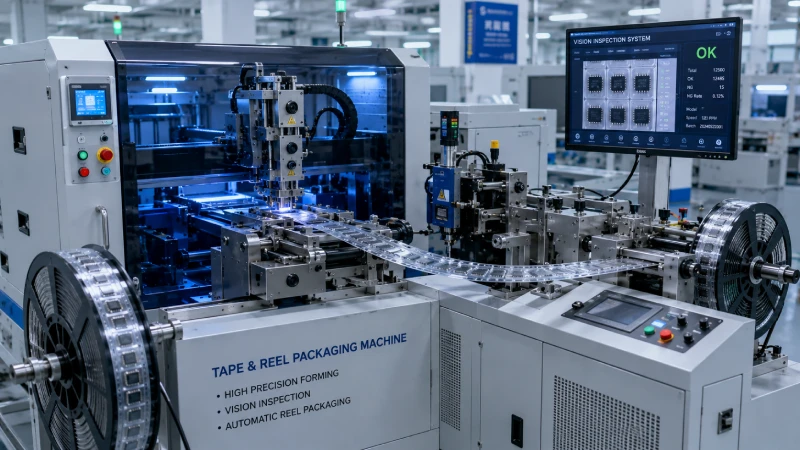
Even high-quality PC carrier tape materials cannot perform properly without accurate forming and packaging equipment.
Modern electronic packaging increasingly relies on:
- Precision thermoforming systems
- Vision inspection equipment
- Automated tape-and-reel packaging machines
- AI-assisted defect detection systems
High-end packaging systems help maintain:
- Cavity consistency
- Accurate component placement
- Stable cover tape sealing
- Reliable reel winding
Advanced tape & reel packaging solutions are especially important for semiconductor and miniature electronic component packaging.
Many manufacturers also integrate vision inspection systems to detect:
- Missing components
- Flipped orientation
- Incorrect cavity loading
- Packaging defects
As packaging precision requirements continue increasing, equipment capability becomes just as important as material quality.
Future Trends in PC Carrier Tape Materials
The electronics industry continues pushing toward smaller, faster, and more complex devices. This trend is driving further innovation in carrier tape materials.
Future developments will likely focus on:
- Ultra-thin cavity forming
- Higher precision automation compatibility
- Improved ESD performance
- Sustainable material solutions
- Smart manufacturing integration
As AI-driven inspection and high-speed SMT systems become more common, packaging materials must provide even tighter tolerances and greater consistency.
PC carrier tape materials are expected to remain one of the preferred solutions for advanced semiconductor and precision electronic packaging applications.
FAQ
What is PC carrier tape material?
PC carrier tape material is a polycarbonate-based embossed carrier tape used for packaging electronic components in SMT and semiconductor applications.
Why is polycarbonate used in carrier tapes?
Polycarbonate offers excellent dimensional stability, transparency, impact resistance, and precision forming capability, making it ideal for high-precision electronic packaging.
Is PC carrier tape anti-static?
Yes. Many PC carrier tapes are available in anti-static or conductive grades for ESD-sensitive electronic components.
What is the difference between PC and PET carrier tape?
PC carrier tape generally provides better rigidity and higher forming precision, while PET offers good transparency and environmental stability.
Is PC carrier tape suitable for semiconductor packaging?
Yes. PC carrier tape is widely used for IC chips, QFN, BGA, MEMS sensors, and other semiconductor devices because of its precision and ESD performance.
Conclusion
PC carrier tape materials have become an important solution for modern electronic packaging industries where precision, stability, and ESD protection are essential.
Compared with traditional carrier tape materials, polycarbonate provides superior dimensional stability, impact resistance, and forming accuracy. These advantages make PC carrier tapes particularly suitable for semiconductor devices, miniature SMT components, optical modules, and other high-value electronic products.
As SMT automation continues evolving toward higher speed and greater precision, the importance of selecting the right carrier tape material will continue increasing.
Manufacturers that combine high-quality PC carrier tape materials with advanced automated packaging equipment can significantly improve packaging reliability, feeding consistency, and long-term production efficiency.