
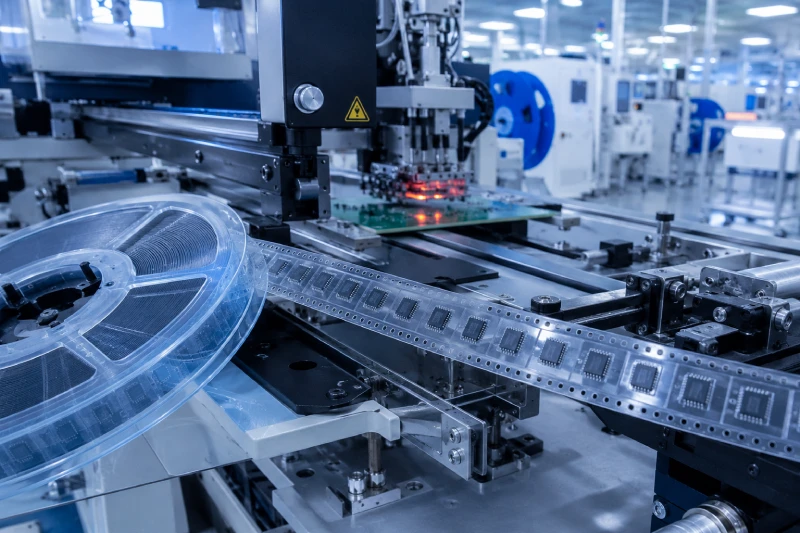
In SMT electronic component packaging, material selection directly affects packaging stability, feeding accuracy, sealing performance, and long-term component protection. Among all carrier tape materials, PET has become one of the most widely used choices for precision electronic packaging thanks to its excellent transparency, dimensional stability, and anti-static compatibility.
From IC chips and LEDs to miniature connectors and sensors, PET carrier tape materials are commonly used in automated tape-and-reel packaging systems where consistency and reliability are critical. Compared with traditional PS materials, PET offers better toughness, improved heat resistance, and enhanced durability during transportation and high-speed SMT assembly.
As electronic components become smaller and more sensitive, manufacturers are paying closer attention not only to carrier tape structure, but also to the material performance behind the packaging itself. Whether you operate an SMT packaging factory, semiconductor assembly line, or carrier tape production business, understanding PET carrier tape materials can help improve production efficiency while reducing packaging defects and feeding errors.
For manufacturers building automated SMT packaging lines, advanced Tape & Reel Packaging Machines for Carrier Tape Assembly are increasingly optimized specifically for PET carrier tape processing and high-speed sealing applications.
What Is PET Carrier Tape Material?
PET carrier tape material refers to carrier tape manufactured from Polyethylene Terephthalate, a thermoplastic polyester known for its strength, transparency, and dimensional consistency. In SMT packaging, PET sheets are thermoformed into embossed pockets that securely hold electronic components during transportation and automated placement.
PET materials are particularly popular in industries requiring:
- high-precision packaging,
- ESD-sensitive component protection,
- stable reel feeding performance,
- and transparent inspection capability.
Compared with some lower-cost materials, PET offers better crack resistance and improved pocket stability, especially in automated packaging environments running at high speeds.
A typical PET carrier tape structure includes:
- embossed component pockets,
- sprocket holes for indexing,
- cover tape sealing areas,
- anti-static or conductive layers,
- and precision-formed cavity dimensions.
Modern Carrier Tape Forming Machines are designed to maintain extremely tight forming tolerances when processing PET sheets, ensuring consistent pocket depth and feeding reliability.
Main Types of PET Carrier Tape Materials
Different SMT applications require different PET carrier tape characteristics. Manufacturers typically select materials based on component sensitivity, packaging environment, and production speed.
Transparent PET Carrier Tape
Transparent PET carrier tape is widely used when visual inspection is important. The clear material allows operators and automated inspection systems to easily identify components inside the pockets.
Common applications include:
- LED packaging,
- optical components,
- miniature precision parts,
- camera modules,
- and transparent component verification processes.
The optical clarity of PET also improves compatibility with machine vision inspection systems.
Anti-Static PET Carrier Tape
For ESD-sensitive electronic components, anti-static PET carrier tape is one of the most common choices. Anti-static additives or coatings help reduce static charge buildup during packaging, transportation, and automated SMT feeding.
This material is widely used for:
- IC chips,
- semiconductor devices,
- sensors,
- memory modules,
- and precision electronic assemblies.
Anti-static PET helps minimize the risk of electrostatic discharge damaging sensitive components before assembly.
Conductive PET Carrier Tape
Conductive PET carrier tape provides a higher level of ESD protection by incorporating conductive materials into the tape structure itself.
It is often used for:
- advanced semiconductor packaging,
- high-value integrated circuits,
- automotive electronics,
- aerospace electronics,
- and industrial control systems.
Although conductive PET is generally more expensive, it offers improved static dissipation performance for demanding applications.
Key Properties of PET Carrier Tape Materials
The reason PET has become so widely adopted in SMT packaging is because it balances multiple critical performance characteristics simultaneously.
Excellent Dimensional Stability
In automated tape-and-reel packaging, even minor dimensional variations can cause feeding problems, indexing errors, or pick-and-place failures.
PET materials maintain stable dimensions during:
- thermoforming,
- reel winding,
- sealing,
- storage,
- and transportation.
This stability becomes especially important in high-speed automated SMT production lines where feeding precision directly impacts productivity.
Strong Mechanical Strength
Compared with more brittle materials, PET provides better tensile strength and crack resistance. This reduces the risk of:
- tape deformation,
- pocket collapse,
- edge cracking,
- and reel damage during shipping.
For exporters shipping components internationally, PET carrier tape often provides better protection during long-distance transportation and warehouse handling.
Superior Heat Resistance
PET materials generally offer better heat resistance than standard PS carrier tape materials. This allows PET carrier tape to perform more consistently during:
- heat sealing,
- automated cover tape application,
- and high-speed packaging operations.
Stable sealing performance helps prevent cover tape lifting and component loss during transportation.
Manufacturers frequently pair PET materials with automated SMT Tape and Reel Packaging Machines capable of maintaining precise sealing temperatures for consistent packaging quality.
Transparency for Inspection
One major advantage of PET is its transparency. Clear PET carrier tape improves:
- visual quality inspection,
- automated optical inspection,
- component verification,
- and operator monitoring.
This is especially useful when packaging miniature or high-value components where accurate visual confirmation is important.
Reliable ESD Performance
Modern electronic components are increasingly sensitive to electrostatic discharge. PET materials can be modified with:
- anti-static coatings,
- conductive layers,
- or ESD additives.
This makes PET highly adaptable for semiconductor packaging applications.
Moisture Resistance
PET also offers relatively good moisture resistance, helping maintain packaging stability in humid warehouse or shipping environments.
For global electronics supply chains, this improves:
- storage reliability,
- export packaging stability,
- and long-term reel performance.
PET vs PS vs PC Carrier Tape Materials
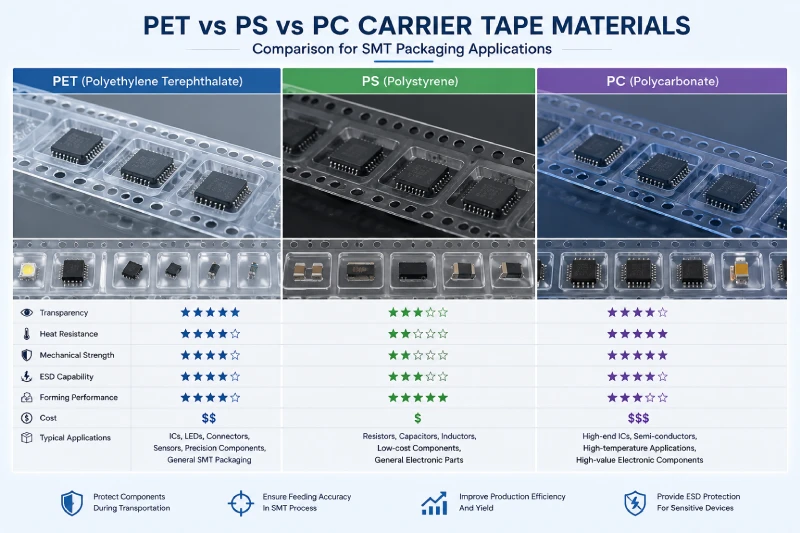
Choosing the right carrier tape material depends on component type, budget, and packaging requirements.
PET vs PS Carrier Tape
PS carrier tape is often used because of its lower material cost and easier thermoforming characteristics. However, compared with PET, PS materials are generally:
- more brittle,
- less heat resistant,
- and more prone to cracking.
PET offers:
- better durability,
- improved transparency,
- stronger pocket stability,
- and enhanced transportation performance.
For high-speed automated packaging and export-oriented production, PET is often preferred.
PET vs PC Carrier Tape
PC carrier tape materials provide even higher heat resistance and mechanical strength than PET. However, PC materials are typically more expensive and are usually reserved for:
- premium semiconductor packaging,
- advanced industrial electronics,
- and specialized high-temperature applications.
PET often provides the best balance between:
- performance,
- cost,
- ESD capability,
- and manufacturing efficiency.
Which Material Is Best?
The ideal material depends on the application:
| Component Type | Recommended Material |
|---|---|
| LEDs | Transparent PET |
| IC Chips | Anti-static PET |
| Semiconductor Devices | Conductive PET |
| Low-cost Passive Components | PS |
| High-Temperature Electronics | PC or PET |
| Precision Optical Components | PET |
Common Applications of PET Carrier Tape Materials
PET carrier tape is widely used across modern electronics manufacturing industries.
Semiconductor Packaging
PET materials are commonly used for:
- integrated circuits,
- memory chips,
- processors,
- and semiconductor modules.
The dimensional stability and ESD compatibility of PET help maintain packaging reliability throughout automated assembly processes.
LED Packaging
Transparent PET carrier tape is highly suitable for LED packaging because operators and vision systems can easily inspect component positioning.
Passive Components
Resistors, capacitors, and inductors are frequently packaged using PET carrier tape because of its consistent pocket forming quality and feeding stability.
Precision Electronics
Miniature connectors, sensors, and precision modules often require PET packaging because of its durability and protective performance.
Medical and Optical Electronics
Medical electronics and optical devices frequently benefit from PET’s:
- clean appearance,
- low contamination risk,
- and stable component positioning.
How PET Carrier Tape Is Manufactured
The production process behind PET carrier tape directly affects packaging quality.
PET Sheet Extrusion
The process begins with PET raw material extrusion into thin sheets with tightly controlled thickness.
Thickness consistency is essential for stable pocket forming and reliable reel feeding.
Thermoforming and Embossing
PET sheets are heated and thermoformed into embossed pockets using precision molds.
Accurate forming ensures:
- correct pocket dimensions,
- stable component placement,
- and reliable pick-and-place compatibility.
Sprocket Hole Punching
Sprocket holes are punched with precise spacing to ensure smooth indexing during automated SMT feeding.
Even small positioning errors can affect packaging line performance.
ESD Surface Treatment
Depending on application requirements, PET materials may receive:
- anti-static coatings,
- conductive treatments,
- or ESD modification layers.
Quality Inspection
High-quality manufacturers typically perform:
- dimensional inspection,
- vision inspection,
- and peel strength testing.
Advanced Carrier Tape Peel Strength Testers help verify sealing consistency and packaging reliability.
How to Choose the Right PET Carrier Tape Material
Selecting PET carrier tape should involve more than simply choosing material thickness.
Consider Component Fragility
Fragile components often require stronger pocket support and higher dimensional consistency.
PET is particularly suitable for protecting delicate miniature electronics during transportation.
Evaluate ESD Requirements
For static-sensitive components, manufacturers should carefully select between:
- anti-static PET,
- conductive PET,
- or standard transparent PET.
Higher-value semiconductor devices usually require stronger ESD protection.
Match Material with Packaging Equipment
Not all carrier tape materials behave the same during:
- thermoforming,
- sealing,
- and automated reel packaging.
Equipment compatibility is extremely important when running automated production lines.
Modern Embossed Carrier Tape Reel Machines are often optimized specifically for PET processing to achieve higher packaging accuracy and stability.
Consider Shipping Conditions
If components are exported internationally, PET may offer better durability during:
- long-distance transportation,
- warehouse handling,
- and humid environments.
Balance Cost and Performance
Although PET may cost more than standard PS materials, its improved durability and packaging reliability often reduce:
- production defects,
- reel feeding failures,
- and transportation damage.
Future Trends in PET Carrier Tape Materials
As electronics continue becoming smaller and more advanced, PET carrier tape materials are evolving rapidly.
Emerging trends include:
- ultra-thin PET materials for miniaturized components,
- improved conductive coatings,
- environmentally friendly recyclable PET solutions,
- and tighter dimensional tolerances for AI and semiconductor packaging.
Smart inspection systems integrated with machine vision technology are also increasing demand for highly transparent PET materials compatible with automated quality control systems.
Conclusion
PET carrier tape materials have become one of the most important solutions in modern SMT packaging because they combine:
- dimensional stability,
- transparency,
- mechanical durability,
- heat resistance,
- and reliable ESD performance.
Compared with traditional packaging materials, PET offers better compatibility with automated tape-and-reel production systems while improving transportation protection and feeding reliability.
As semiconductor packaging, precision electronics, and automated SMT manufacturing continue advancing, choosing the right PET carrier tape material becomes increasingly important for maintaining packaging quality and production efficiency.
If you are upgrading your SMT packaging process, optimizing both your carrier tape material and automation equipment together can significantly improve long-term production stability, reduce packaging defects, and increase operational efficiency.
FAQ
What is PET carrier tape material?
PET carrier tape material is a thermoplastic polyester material used to manufacture embossed carrier tape for SMT electronic component packaging.
Is PET better than PS for carrier tape?
PET generally offers better transparency, crack resistance, dimensional stability, and heat resistance than PS materials.
What is anti-static PET carrier tape?
Anti-static PET carrier tape contains ESD protection properties designed to reduce static electricity buildup during electronic component packaging.
Can PET carrier tape handle high temperatures?
Yes. PET materials usually provide better heat resistance than standard PS carrier tape, making them suitable for automated sealing processes.
What components are commonly packaged in PET carrier tape?
PET carrier tape is commonly used for IC chips, LEDs, semiconductors, connectors, sensors, and precision electronic components.
How do you choose the right PET carrier tape thickness?
The ideal thickness depends on component size, weight, fragility, pocket depth requirements, and packaging machine compatibility.