

A cover tape sample can pass one peel-force test and still fail to prove that the supplier can reproduce the same result across multiple reels, production lots, storage periods, and sealing conditions.
For electronic component manufacturers, semiconductor packaging teams, EMS companies, and SMT packaging buyers, supplier qualification must go beyond reviewing a quotation, technical data sheet, or quality-management certificate. The real question is whether the supplier can deliver repeatable cover tape performance under the buyer’s actual packaging conditions.
An effective qualification process should examine four areas:
- Peel-force consistency
- Lot traceability and change control
- Application-specific sample validation
- Quality documentation and production readiness
These checks help buyers distinguish a technically controlled supplier from one that can only provide a passing sample.
Build the Qualification Brief Before Requesting Samples
Supplier qualification should begin before the first sample roll is produced. The buyer must first define the packaging system in which the cover tape will operate.
At minimum, the qualification brief should include:
- Carrier tape material and nominal width
- Carrier tape flange geometry and surface condition
- Component package, weight, and ESD sensitivity
- Required cover tape sealing method
- Cover tape width
- Sealing equipment or taping machine
- Feeder model or downstream peeling conditions
- Reel format and winding requirements
- Expected storage and transport environment
- Customer-specific acceptance criteria
Cover tape does not perform independently. Its sealing and peeling behavior depends on the interaction among the adhesive system, carrier tape surface, tape dimensions, sealing equipment, process settings, conditioning, and test method.
Buyers who are still defining the material system can review available cover tape for tape-and-reel packaging before preparing the qualification request.
It is also important to separate three different types of requirements:
- Applicable industry-standard requirements
- The supplier’s internal specification and control limits
- The buyer’s project-specific acceptance criteria
The applicable version of EIA-481 may define tape-and-reel packaging and removal-force requirements, but a general statement such as “EIA-481 compliant” does not prove that a particular cover tape has been validated with the buyer’s carrier tape, sealing line, and feeder. Jiushuo’s EIA-481 tape-and-reel requirements guide provides additional background on the packaging elements that must work together.
Gate 1: Prove Peel-Force Consistency
Peel force is one of the most important qualification indicators, but a single average value is not enough.
A supplier may test a short section from one roll and report an acceptable average. That result only describes the tested section under the stated conditions. It does not automatically prove consistency through the roll, between rolls, or between production lots.
Normalize the Test Conditions
Peel-force results are comparable only when the test conditions are documented and controlled.
A supplier’s test report should identify:
- Cover tape product and lot number
- Carrier tape material and product identification
- Carrier tape width
- Sealing method
- Sealing parameters
- Sample conditioning
- Peel angle
- Peel speed
- Test length
- Number of specimens
- Test environment
- Tester and fixture
- Calibration status
- Data-processing method
For heat-activated adhesive cover tape, the report should also record the sealing temperature, pressure, dwell time, line speed, and sealing-head or roller configuration.
For pressure-sensitive adhesive cover tape, it should record the applied pressure, roller or shoe configuration, pressure distribution, tape alignment, carrier tape surface condition, and application environment.
Manufacturer data from 3M illustrates why these details matter. Its pressure-sensitive cover tape documentation states that sealing mechanism and pressure distribution may affect the result, even when other conditions appear similar. Published values are tied to specific materials and test conditions rather than presented as universal acceptance limits.
For a detailed explanation of specimen preparation, test geometry, curve review, and reporting, refer to the cover tape peel-force test method.
Request More Than an Average Value
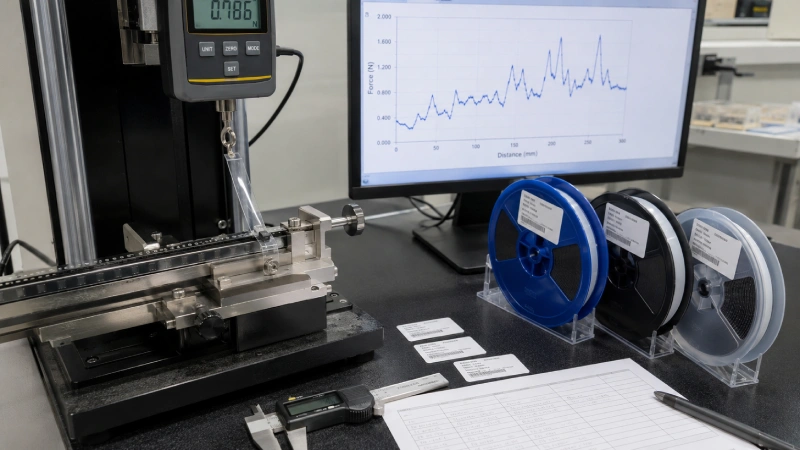
A useful qualification report should show force behavior across the tested distance, not just one calculated number.
Ask the supplier for:
- Raw force-versus-distance curves
- Minimum force
- Maximum force
- Mean or median force
- Force range
- Abnormal peaks
- Test section identification
- Sample and production-lot identification
Where the supplier’s quality system uses statistical measures such as standard deviation or process-capability indices, those results may also be reviewed. However, buyers should not impose a generic capability threshold without first defining the measurement method and project acceptance criteria.
Raw curves can reveal problems hidden by an average, including:
- Periodic force fluctuation
- Local under-sealing
- Sharp peel peaks
- Uneven sealing between the two flanges
- Adhesive transfer
- Film damage
- Intermittent lifting
- Slitting-related irregularity
A stable average combined with repeated peaks may still cause feeder vibration or component movement. The evaluation should therefore consider both force level and curve stability.
Evaluate Three Levels of Variation
Peel consistency should be reviewed at three levels.
Within-reel consistency checks different positions from the same roll, such as the beginning, middle, and end. This can reveal coating, slitting, winding, or process drift across the roll length.
Reel-to-reel consistency compares different rolls from the same production lot. It helps confirm whether rolls produced under the same lot identification have repeatable performance.
Lot-to-lot consistency compares separate production lots, dates, or relevant raw-material batches. This is the strongest evidence that the supplier can reproduce the approved result during repeat orders.
The relationship between variation and downstream production is discussed further in Jiushuo’s guide to peel consistency and SMT feeding stability.
A supplier does not necessarily need to disclose confidential formulations, but it should be able to show controlled, traceable performance data that supports repeat production.
Review the Failure Mode
The force value is only part of the result. The physical separation mode should also be recorded.
Acceptable peeling generally requires a clean, controlled release without:
- Cover tape tearing
- Adhesive residue on the carrier tape
- Carrier tape surface damage
- Delamination within the cover tape structure
- Uneven left-to-right release
- Intermittent edge lifting
Two samples may produce similar average force values but exhibit completely different failure modes. Visual inspection and curve analysis should therefore be reviewed together.
Gate 2: Verify Lot Traceability and Change Control
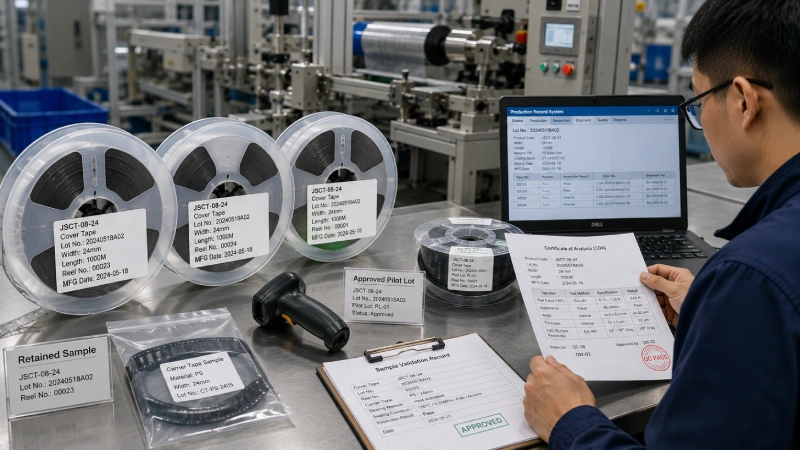
A lot number printed on a reel does not automatically prove traceability. The buyer should confirm that the number links the delivered roll to manufacturing, inspection, and shipment records.
Connect the Reel, Carton, COA, and Production Records
A practical traceability system should connect:
- Product code
- Specification revision
- Production lot
- Individual reel number
- Manufacturing or slitting date
- Width and roll length
- Relevant raw-material batches
- Production or coating records
- Inspection results
- COA or test-report number
- Carton identification
- Shipment record
To test the system, select a reel number from a previous sample or shipment and ask the supplier to retrieve the associated production and inspection records.
The exercise should show whether the supplier can identify:
- When and where the roll was produced
- Which material batches were used
- Which tests were completed
- Who approved the product
- Which other rolls belong to the same lot
- Which shipments could be affected by a confirmed defect
Supplier quality clauses used in the electronics industry commonly require batch identification and traceability back through the supply chain. They may also require documented control of nonconforming products and corrective-action responses. These requirements are buyer-specific examples, not universal EIA-481 provisions, but they illustrate the level of control expected in higher-risk electronic applications.
Confirm Change-Notification Rules
Cover tape performance may change when the supplier changes a material, process, test method, or production location.
The qualification agreement should define whether notification or requalification is required for changes involving:
- Base film
- Adhesive formulation
- Anti-static treatment
- Coating material supplier
- Coating line
- Curing process
- Slitting equipment
- Manufacturing facility
- Test equipment or method
- Product specification
- Packaging format
The buyer should know who receives the notification, how much technical information is provided, and whether approval is required before the changed product is shipped.
An ISO 9001 certificate may provide evidence that a supplier operates a quality-management system, but it does not independently approve a particular cover tape, material combination, or peel-force result. Application-specific verification is still necessary.
Gate 3: Validate Samples on the Actual Packaging System
Supplier samples should be tested with representative production materials, not only with the supplier’s preferred laboratory carrier tape.
Build a Representative Validation Matrix
The validation plan should cover the combinations that will actually be used in production:
| Validation Item | What to Confirm |
|---|---|
| Carrier tape | Actual material, width, flange geometry, and surface |
| Cover tape | Approved construction, width, and sealing method |
| Component | Representative size, weight, package, and ESD sensitivity |
| Sealing process | Actual equipment and production settings |
| Conditioning | Relevant storage, aging, or environmental exposure |
| Peel test | Controlled method with complete test conditions |
| Visual inspection | Alignment, seal continuity, residue, and film condition |
| Feeder trial | Peeling behavior, component stability, and pickup performance |
Material names such as PS, PET, PC, or PVC provide only the starting point. Surface chemistry, additives, flange flatness, contamination, dimensional tolerances, and sealing conditions may all affect the final result.
The buyer should therefore evaluate carrier tape and cover tape compatibility using actual project materials.
Validate the Correct Sealing Mechanism
A heat-activated adhesive system and a pressure-sensitive adhesive system should not be qualified using the same process assumptions.
When evaluating heat activated cover tape, the validation should record and control:
- Temperature
- Pressure
- Dwell time
- Line speed
- Seal-band position
- Sealing-head or roller condition
- Carrier tape flatness
- Peel behavior after sealing
The purpose is not to find one universal temperature or pressure. It is to establish a repeatable process window for the approved cover tape and actual carrier tape combination.
When evaluating pressure sensitive cover tape, the process should focus on:
- Carrier tape surface cleanliness
- Cover tape alignment
- Adhesive-zone position
- Roller or shoe contact
- Applied pressure and pressure distribution
- Tape tracking
- Room-temperature application conditions
- Peel behavior after application
Pressure-sensitive adhesive cover tape primarily bonds through applied pressure rather than heat activation. Product-specific manufacturer data should always be checked because equipment configuration and pressure distribution can influence the achieved seal.
Test Functional Performance
A passing laboratory peel result should not be the only acceptance condition.
Depending on the component and customer risk level, validation may also include:
- Seal-band continuity
- Cover tape alignment
- Pocket contamination inspection
- Adhesive-residue inspection
- Winding and rewinding checks
- Component retention
- Feeder peeling
- Component jumping or flipping observation
- Pickup stability
- Post-conditioning retesting
Pass/fail criteria should be agreed before testing begins. Otherwise, the buyer and supplier may interpret the same result differently after a failure occurs.
Use a Three-Stage Approval Process
One sample roll should not move directly into unrestricted mass-production approval.
Stage 1: Technical Sample Approval
The first stage confirms that the proposed material combination is technically feasible.
The sample record should identify the cover tape, carrier tape, sealing conditions, peel results, visual observations, and unresolved issues.
Passing this stage means the combination is suitable for further evaluation. It does not yet prove production repeatability.
Stage 2: Pilot-Lot Validation
The pilot stage evaluates multiple rolls produced under conditions closer to normal manufacturing.
The buyer should review:
- Reel-to-reel variation
- Lot identification
- Production inspection records
- Label accuracy
- COA structure
- Packaging condition
- Feeder performance
- Functional defects
The required sample quantity should be based on component risk, production volume, customer requirements, and the supplier’s available process history. There is no single quantity suitable for every cover tape project.
Stage 3: First Production Lot and Ongoing Monitoring
The first commercial production lot should be checked against the approved sample and pilot-lot records.
Ongoing controls may include:
- Incoming inspection
- Periodic peel-data review
- Supplier-performance monitoring
- Complaint trends
- Change notifications
- First-in, first-out storage control
- Requalification after significant changes
Requalification may be needed after an adhesive, film, carrier tape, production site, process, specification, or test-method change. It may also be required after repeated complaints, long supply interruptions, extended storage, or introduction of a new component or feeder.
Supplier Qualification Red Flags
Pause supplier approval when any of the following occurs:
- Only one average peel-force value is available.
- The supplier cannot identify peel angle, speed, carrier tape, or sealing conditions.
- Sample labels cannot be linked to test reports.
- Raw curves or complete test records are unavailable.
- Typical TDS values are presented as guaranteed batch results.
- The COA has no production-lot identification.
- Reel, carton, and inspection numbers cannot be connected.
- Material or process changes are made without notification.
- The production order uses a different construction from the approved sample.
- The supplier cannot isolate affected lots after a defect.
- Heat-activated and pressure-sensitive tapes are evaluated under the same undefined process.
- An ISO certificate or compliance statement is used instead of product-level evidence.
Buyers sourcing multiple tape-and-reel materials should also determine whether the supplier can support matched carrier tape and cover tape sourcing rather than treating each item as an unrelated purchase.
What to Send for a Qualification Sample
To prepare a technically meaningful sample request, provide:
- Component drawing or datasheet
- Physical component samples
- Actual carrier tape samples
- Carrier tape material and width
- Cover tape sealing method
- Required ESD configuration
- Sealing equipment information
- Heat, pressure, dwell time, and line speed for heat-activated systems
- Roller or shoe configuration for PSA systems
- Feeder model
- Target reel format
- Current peel-force report
- Defect photographs or videos
- Storage and transport conditions
- Customer acceptance specification
A qualified supplier should be evaluated on its ability to reproduce controlled results, not only on whether it can send a visually acceptable roll.
To begin a project-specific review, submit your carrier tape, component, sealing, and validation requirements. The final material selection, process window, peel-force limits, and production approval should be confirmed through documented testing with the actual packaging system.
FAQ
What peel-force records should a cover tape supplier provide?
The supplier should provide sample and lot identification, carrier tape details, sealing conditions, test speed, peel angle, conditioning, the raw curve, and calculated results. A single average without these conditions is not sufficient for comparison.
Is one passing sample reel enough for supplier approval?
No single reel can demonstrate complete reel-to-reel or lot-to-lot repeatability. A staged process using technical samples, a pilot lot, and first-production-lot review provides stronger evidence.
How many cover tape lots should be tested?
The number should be determined through a risk-based plan considering the component, application, production volume, customer requirements, and supplier history. A universal lot count should not be assumed.
What information should appear on a cover tape reel label and COA?
The records should identify the product, production lot, reel or shipment, manufacturing date where applicable, specification revision, and the inspection report or COA associated with the delivered material.
When should a cover tape supplier be requalified?
Requalification may be required after material, adhesive, coating, process, equipment, factory, test-method, or specification changes, as well as after repeated quality problems or major application changes.
Should heat-activated and pressure-sensitive cover tapes use the same qualification plan?
They may use the same approval gates, but their application conditions must be validated separately. Heat-activated systems require controlled heat, pressure, and time, while pressure-sensitive systems depend mainly on surface condition, alignment, and applied pressure.
Can an EIA-481 compliance statement replace feeder validation?
No. Standard-related testing, supplier process control, and actual feeder validation address different risks. The buyer should confirm each one where it is relevant to the application.