
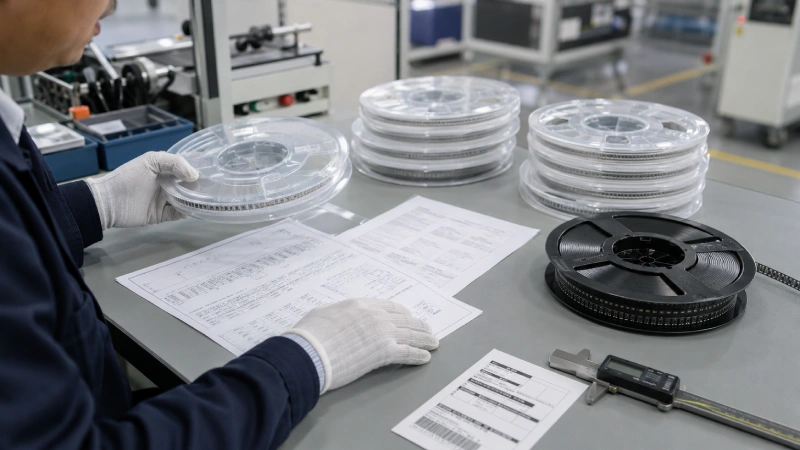
A cover tape technical data sheet may look complete: product name, film thickness, peel force, electrical properties, storage conditions, and references to industry standards. A Certificate of Analysis, or COA, may also show that the supplied lot has passed inspection.
However, neither document should be approved by appearance alone.
For SMT tape-and-reel packaging, a useful document review must answer three different questions:
- What product is being supplied?
- What performance does the supplier control?
- Does the actual production lot meet the agreed requirements under defined test conditions?
These questions matter because cover tape performance depends not only on the film itself, but also on the carrier tape material, sealing or application method, tape dimensions, storage history, and feeder peeling conditions.
This guide explains how purchasing, engineering, SQE, and incoming inspection teams can read a cover tape specification sheet and COA before approving samples or releasing production material.
Identify the Document Before Reviewing the Data
A supplier may provide several documents for the same cover tape. Their names and exact functions vary between manufacturers, so they should not automatically be treated as interchangeable.
| Document | Typical Purpose | Main Limitation |
|---|---|---|
| Technical Data Sheet, or TDS | Describes product construction, typical properties, formats, and recommended use conditions | May contain representative rather than guaranteed values |
| Controlled Product Specification | Defines the limits, methods, and requirements against which the product is supplied | May not include results for the actual shipment |
| Certificate of Analysis, or COA | Reports specification limits, test methods, or results associated with a production lot | May not cover every application-specific requirement |
| Certificate of Conformance, or CoC | Declares that the supplied product conforms to specified requirements | May contain no detailed measurement results |
| Safety Data Sheet, or SDS | Provides safety, handling, and regulatory information | Does not demonstrate SMT packaging performance |
| Qualification Report | Records testing performed to approve a material, process, or supplier change | May apply only to the tested material combination and conditions |
The first step is therefore to determine what document you actually received.
For example, 3M states in its technical data for one pressure-sensitive cover tape that published technical information is representative or typical and should not be used directly for specification purposes. The same document explains that the product COA contains the applicable test methods, specification limits, and test results. This is a useful example of why a TDS value and a lot-acceptance value should not be assumed to mean the same thing.
Confirm That All Documents Refer to the Same Product
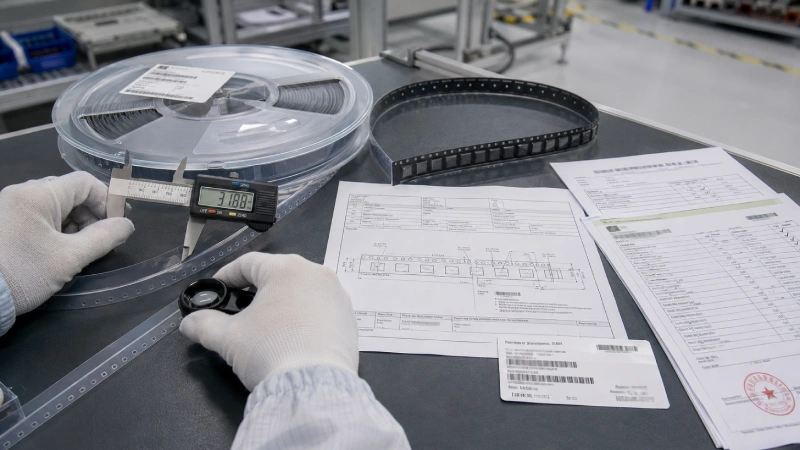
Before studying peel force or electrical properties, compare the identity information across the quotation, purchase order, product label, TDS, specification, and COA.
Check the following fields:
- Manufacturer and manufacturing site
- Product family and exact model number
- Cover tape width and width tolerance
- Film or total construction thickness
- Adhesive or sealing system
- Anti-static configuration
- Roll length and core configuration
- Lot or batch number
- Manufacturing date
- Document number and revision
- COA issue date
- Purchase order or shipment reference
A common mistake is approving a generic series-level TDS even though the ordered product has a different width, surface treatment, adhesive configuration, or roll format.
A small suffix in a part number may indicate a meaningful construction difference. The supplier should explain every part of the model code rather than expecting the buyer to infer it.
For Jiushuo products, the classification and mapping of individual model numbers should be confirmed with the Jiushuo technical team before being written into a customer specification.
Buyers who have not yet finalized the exact construction can review Jiushuo’s available cover tape options for tape-and-reel packaging before requesting controlled documents and samples.
Identify the Sealing System Before Interpreting Process Data
Cover tape documents should clearly identify whether the product uses a heat-activated adhesive or a pressure-sensitive adhesive. The relevant process fields are not identical.
Heat-Activated Cover Tape
A heat-activated adhesive forms a seal through a controlled combination of heat, pressure, and contact time. Its documentation may therefore need to identify:
- Sealing temperature or evaluated process window
- Applied pressure
- Dwell or contact time
- Line speed
- Sealing-head or roller configuration
- Seal-rail geometry
- Carrier tape material
- Conditioning before peel testing
- Peel behavior after initial or aged storage
These parameters must be read together. A sealing temperature stated without pressure, dwell time, equipment information, or carrier tape material is not a transferable production setting.
A 3M heat-activated cover tape document, for example, presents peel behavior under a stated combination of carrier tape, pressure, dwell time, machine, and sealing-shoe geometry. It also notes that sealing temperature depends on factors such as the equipment, pressure, dwell time, and carrier material. Those values describe that product and test setup; they should not be treated as universal cover tape settings.
For lines using controlled heat-and-pressure sealing, review the application requirements for heat activated cover tape and provide the supplier with the actual machine conditions before requesting a recommended setup.
Pressure Sensitive Cover Tape
Pressure-sensitive adhesive cover tape is primarily bonded through controlled pressure and normally does not require heat to activate the adhesive.
Relevant document fields may include:
- Application temperature
- Roller, shoe, or wheel mechanism
- Applied pressure or loading method
- Contact or dwell conditions
- Adhesive-stripe position
- Alignment over the carrier tape flanges
- Carrier tape surface condition
- Peel-test timing after application
- Restrictions related to heat exposure
The pressure value alone may still be insufficient. Different mechanisms can create different pressure distributions even when the displayed machine setting appears similar.
When evaluating a room-temperature process, compare the document requirements with the intended pressure sensitive cover tape application method.
Separate Typical Values, Specification Limits, and Lot Results
One of the most important tasks in document review is determining what each number represents.
Typical Value
A typical value describes representative performance observed during development or testing. It may help engineers understand the product, but it is not necessarily a guaranteed minimum or maximum.
Recommended Process Window
A recommended window identifies conditions under which the supplier has obtained acceptable results. It may be specific to certain equipment, carrier materials, tape widths, or test methods.
Specification Limit
A specification limit defines an acceptance boundary. It may include:
- Lower Specification Limit, or LSL
- Upper Specification Limit, or USL
- Target with tolerance
- Maximum value
- Minimum value
- Pass/fail criterion
The buyer should confirm whether the limit is a supplier specification, an industry requirement, or a customer-approved requirement.
Actual Lot Result
A lot result should relate to the material being supplied. It should be traceable to the lot or batch and interpreted against the applicable specification.
| Data Statement | Meaning | Suitable for Lot Acceptance? |
|---|---|---|
| Typical: X | Representative product performance | Usually not by itself |
| Recommended range: X to Y | Evaluated process guidance | Not automatically |
| Specification: LSL to USL | Controlled acceptance range | Potentially, if approved |
| Lot result: Y | Measurement from the applicable batch | Yes, when method and traceability are defined |
| Pass | Supplier disposition | Only if the underlying criteria are known |
Do not copy a typical TDS value directly into an incoming inspection procedure. First establish which limit is controlled, which method is used, and whether the supplier and customer have approved the same requirement.
Read the Main Specification Fields in Context
Dimensions and Roll Configuration
Check the nominal value, tolerance, and measurement method for:
- Total cover tape width
- Film or total thickness
- Adhesive exposure width
- Roll length
- Core inner diameter
- Winding direction
- Splice status
- Edge quality
Nominal cover tape width alone does not confirm that the adhesive or sealing areas will align correctly with both carrier tape flanges.
The cover tape must remain clear of sprocket holes and the pocket opening while maintaining continuous sealing bands. For dimensional selection, refer to the cover tape width matching guide for carrier tape and confirm the final pairing with actual samples.
Peel Force
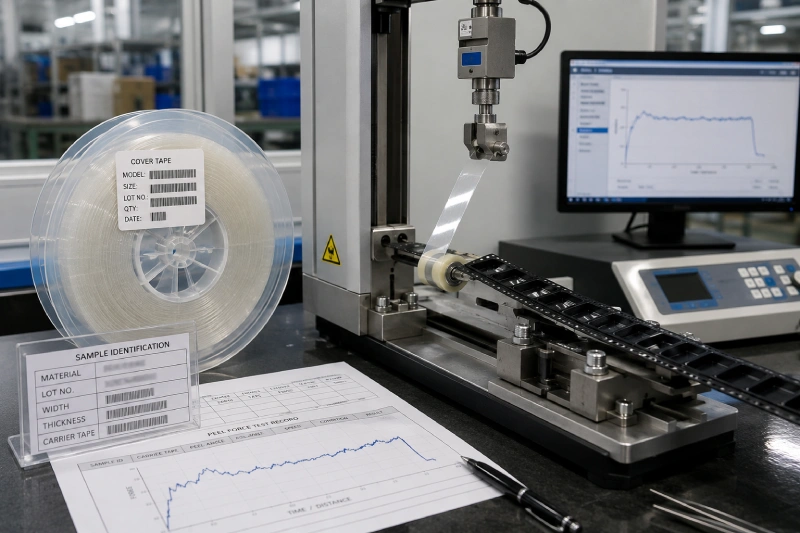
A peel-force result should never be reviewed as an isolated number. At minimum, determine whether the report identifies:
- Force unit
- Acceptance range
- Average, minimum, maximum, or full profile
- Sample quantity
- Test length
- Peel angle
- Peel speed
- Carrier tape material and model
- Sealing or pressure-application conditions
- Conditioning time
- Test temperature and humidity
- Initial or aged condition
Two suppliers may report similar average peel values while using different carrier materials, peel speeds, angles, or result-calculation methods.
Average force can also hide peaks, drops, or differences between the two sealing bands. These variations may affect component movement and feeder stability even when the average passes.
For further evaluation, review how cover tape peel-force consistency affects SMT feeding.
Electrical and ESD Properties
Cover tape documents may report surface resistance, surface resistivity, or both. These are not interchangeable terms.
The report should identify:
- Property being measured
- Unit
- Test method
- Test voltage
- Temperature and relative humidity
- Component side, outer side, or both sides
- Typical value, specification limit, or lot result
An Advantek heat-activated cover tape bulletin, for example, lists surface resistivity and surface resistance separately and assigns a different test method to each. This illustrates why the property name, unit, tested side, and method must be read as one complete data record.
Optical and Mechanical Properties
Depending on the packaging application, the TDS may also include:
- Transmittance
- Haze
- Clarity
- Tensile strength
- Elongation
- Tear behavior
These properties can matter when the customer performs visual inspection through the cover tape or when tape breakage is a line concern.
However, not every property must necessarily be tested on every production lot. Ask which items are lot-release tests and which are periodic qualification tests.
Storage and Shelf Life
Check whether the specification defines:
- Shelf-life start date
- Required storage temperature and humidity
- Original-packaging requirement
- Protection from sunlight, dust, oil, or moisture
- Opened-roll handling
- First-in, first-out control
- Retesting after expiration
- Disposition of aged material
Never transfer storage limits from another manufacturer’s data sheet to a Jiushuo product. Storage conditions and shelf life require product-specific confirmation.
Review Standard References Carefully
A statement such as “EIA-481 compliant” is not enough to evaluate the entire document.
Ask:
- Which revision of the standard is referenced?
- Which property or test is associated with it?
- Was the standard method modified?
- Does the standard define the limit, or does the supplier?
- Is the test result from the supplied lot?
- Has the customer approved the same method?
EIA-481 addresses requirements related to automatic handling of components in embossed carrier tape and other packaging formats. It should not be interpreted as an automatic guarantee of adhesive compatibility, ESD performance, storage life, or success on every sealing machine.
Jiushuo’s EIA-481 tape-and-reel requirements guide provides additional context, but the applicable revision and contractual requirements should still be confirmed for each project.
Read the COA as a Lot-Release Record
A useful COA should allow the buyer to connect the result to the received material.
Look for:
- Exact product model
- Lot or batch number
- Manufacturing date
- Quantity or roll reference
- Specification limits
- Test results
- Units
- Test methods
- Pass/fail disposition
- Approval or authorization
- Document revision
Do not assume that every COA field represents a measurement performed on every lot. Suppliers may use different control plans.
Ask which properties are:
- Tested for every production lot
- Tested at a defined frequency
- Verified through raw-material certification
- Monitored through process control
- Reported only as conformity statements
A COA that shows only “Pass” may still be acceptable under an agreed quality plan, but it gives the buyer less information than actual values with limits and methods. The appropriate format should be established during supplier approval.
Cross-Check the TDS, Specification, COA, and Label
A document should not be approved in isolation. Build a reconciliation table before releasing a new material.
| Item | TDS | Approved Specification | COA | Product Label |
|---|---|---|---|---|
| Product model | Confirm | Confirm | Confirm | Confirm |
| Width and construction | Review | Controlled limit | Lot configuration | Received configuration |
| Peel performance | Typical data | Acceptance requirement | Lot result or disposition | Not normally shown |
| Test method | Reference | Controlled method | Confirm method | Not applicable |
| Lot number | Not normally applicable | Not applicable | Required | Required |
| Revision | Required | Required | Required | As applicable |
Any mismatch should trigger clarification before production use.
Examples include:
- COA model differs from the label
- TDS revision is obsolete
- Units differ between the specification and COA
- Peel-force method changed without notice
- COA limits do not match the approved specification
- Anti-static side is not identified
- The quoted roll format differs from the shipment
Understand What the Documents Cannot Prove
Even a complete TDS and passing COA cannot by themselves prove that the cover tape will perform correctly with the customer’s actual process.
Application performance can still depend on:
- Carrier tape material and surface condition
- Flange geometry and flatness
- Cover tape alignment
- Sealing-head or roller pressure distribution
- Heat, pressure, dwell time, and line speed
- Storage and conditioning
- Feeder peel angle and speed
- Component pocket fit
- Long-reel process stability
That is why buyers should validate cover tape and carrier tape material compatibility using the intended material combination.
A published Analog Devices qualification report provides a practical example: the evaluation included dimensional inspection and a functional peel-strength test rather than relying only on supplier literature.
Convert the Documents Into a Qualification Plan
A controlled approval process may include:
- Review the current TDS and specification.
- Confirm the exact product and document revision.
- Request a sample from the intended production configuration.
- Inspect width, thickness, roll condition, and identification.
- Apply or seal the sample to the actual carrier tape.
- Record all sealing or pressure-application parameters.
- Measure the complete peel-force profile.
- Inspect for lifting, tearing, residue, wrinkles, and uneven seal bands.
- Perform conditioning or aging when required.
- Run a feeder-level trial.
- Approve a reference sample and customer-specific requirements.
- Establish lot documentation and change-notification expectations.
The goal is not to create unnecessary paperwork. It is to ensure that the specification, COA, material combination, and production process all refer to the same approved condition.
Questions to Ask the Cover Tape Supplier
Before approving a supplier, ask:
- Is this the current controlled revision?
- Does the COA relate to the supplied production lot?
- Which properties are tested for every lot?
- Are the TDS values typical or guaranteed?
- What peel-test method is used?
- Which carrier tape material was used?
- What were the sealing or application conditions?
- What peel angle, speed, and conditioning were used?
- Which surface was tested for ESD performance?
- Can a customer-specific specification be established?
- What process or material changes require customer notification?
- Can a sample reel be supplied for compatibility and feeder testing?
Request a Cover Tape Specification Review
A specification sheet helps identify the product. A COA helps confirm lot release. Neither replaces application validation with the intended carrier tape and equipment.
For technical review, provide:
- Current TDS and COA
- Cover tape label or model
- Carrier tape drawing or sample
- Carrier tape material
- Required cover tape width
- Sealing-machine or pressure-application information
- Peel-test requirements
- ESD requirements
- Defect photos, peel curves, or feeder videos
Jiushuo can use this information to review matched cover tape solutions and plan sample validation before mass production.
FAQ
Can a cover tape TDS be used as the incoming inspection specification?
Not automatically. A TDS may contain typical or representative values. Incoming inspection should use approved limits, defined methods, and an agreed supplier-customer specification.
Why can the COA values differ from the TDS?
The TDS may show typical performance, while the COA may use controlled specification limits and formal test methods. Also check the product model, revision, unit, and test conditions.
Should a COA include actual results or only “Pass”?
That depends on the supplier’s control plan and the customer agreement. Buyers should confirm which properties are measured for every lot and whether actual values are required.
Does a passing COA prove compatibility with my carrier tape?
No. It only proves what was evaluated under the stated COA conditions. Compatibility must be validated with the intended carrier tape material, sealing process, storage conditions, and feeder setup.
What information should accompany a peel-force result?
The result should identify the carrier tape, application or sealing conditions, peel angle, test speed, conditioning, environment, sample quantity, and method of calculating the reported value.
How should ESD data be reported?
The document should distinguish surface resistance from surface resistivity and state the unit, test method, test voltage, environmental conditions, and tested surface.
What documents should be requested before approving a new supplier?
Request the current TDS, controlled product specification, sample COA, test-method information, traceability details, change-control policy, and supporting sample-validation evidence.