
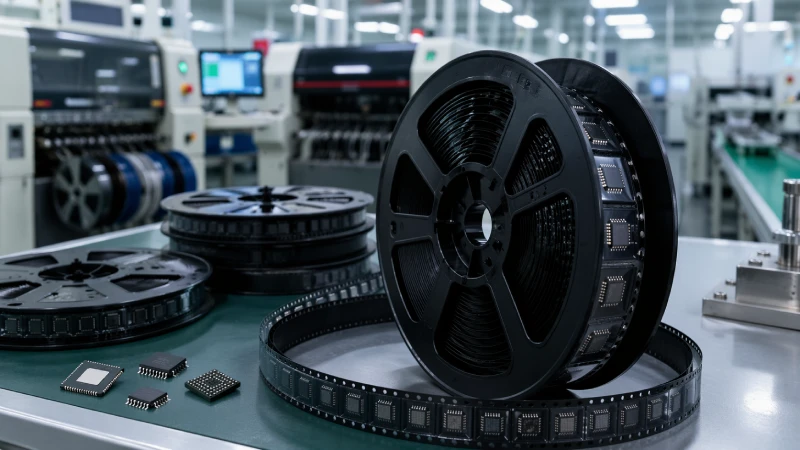
IC chip plastic reels are one of the most important parts of tape and reel packaging, yet they are often overlooked until feeding problems or shipping damage appear. In semiconductor packaging, the reel does much more than simply hold carrier tape. It protects IC chips during transportation, keeps the tape aligned for SMT production, and ensures compatibility with automated pick-and-place machines.
Choosing the wrong reel can create costly problems. A reel that is too small may damage the carrier tape. A reel made from the wrong material may allow electrostatic discharge to affect sensitive components. A reel that does not match your SMT machine can lead to feeding errors and production downtime.
This guide explains what an IC chip plastic reel is, how it works, which sizes and materials are available, and how to choose the right option for your packaging process.
What Is an IC Chip Plastic Reel?
An IC chip plastic reel is a round plastic spool used to wind carrier tape containing integrated circuits and other semiconductor devices. The reel is part of the complete tape and reel packaging system used in SMT manufacturing.
In a standard packaging process, IC chips are first placed into pockets inside a carrier tape. A cover tape seals the pockets to keep the components secure. The completed tape is then wound onto a plastic reel for shipping, storage, and use on automated SMT assembly lines.
The complete process looks like this:
Component → Carrier Tape → Cover Tape → Plastic Reel → SMT Pick-and-Place Machine
IC chip plastic reels are commonly used for:
- QFN packages
- SOP and SOIC packages
- BGA devices
- Small SMD ICs
- Semiconductor sensors and memory chips
Without a reel, the carrier tape could become twisted, damaged, or difficult to load into SMT equipment. The reel keeps the tape in the correct position and allows smooth feeding during production.
If you want to understand how the carrier tape itself works, see our guide: What Is Carrier Tape for IC and Electronic Components?
Why IC Chip Plastic Reels Matter in Semiconductor Packaging
Many manufacturers focus only on the IC chip and carrier tape, but the reel is equally important. A high-quality plastic reel directly affects product safety, production efficiency, and overall packaging cost.
Protect Components During Storage and Shipping
IC chips are fragile. Their leads, balls, or package surfaces can be damaged if the carrier tape is bent or compressed. A strong plastic reel keeps the tape tightly wound and protects the components from movement during transport.
For sensitive semiconductor devices, the reel can also reduce exposure to electrostatic discharge and moisture. Conductive or anti-static reels are often used for memory chips, processors, and other ESD-sensitive devices.
Improve SMT Feeding Efficiency
SMT production depends on stable and accurate tape feeding. If the reel dimensions are inconsistent, the tape may not unwind correctly. This can cause machine stoppages, misfeeds, or incorrect component placement.
A properly designed IC chip plastic reel ensures:
- Smooth unwinding of the carrier tape
- Stable feeding speed
- Better alignment inside the feeder
- Less downtime on the SMT line
That is why reel packaging has become the standard method for semiconductor assembly worldwide.
Lower Packaging and Logistics Costs
Plastic reels also improve shipping and storage efficiency. Reels can be stacked neatly, packed into trays or cartons, and shipped with less risk of damage. Compared with loose packaging, tape and reel systems reduce labor costs and make inventory handling easier.
Main Parts of an IC Chip Plastic Reel System
Although plastic reels appear simple, each part has a specific function.
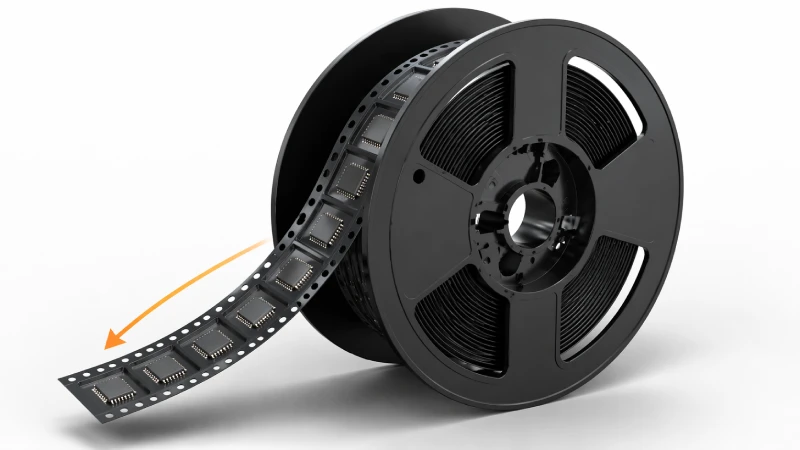
Reel Flange
The flange is the outer circular edge of the reel. It keeps the carrier tape from slipping off during storage or transportation. A reel with the wrong flange height may allow the tape to shift or unwind.
Reel Hub
The hub is the center section where the carrier tape is wound. Its diameter determines how tightly the tape wraps around the reel. If the hub is too small, the tape may bend too sharply and damage the IC components.
Arbor Hole
The arbor hole is the center opening of the reel. This hole allows the reel to be mounted onto an SMT feeder or winding machine. Most IC chip plastic reels use a standard 13 mm arbor hole, although larger reels may use different sizes.
Winding Direction
Carrier tape can be wound clockwise or counterclockwise depending on the customer’s SMT equipment. If the winding direction is wrong, the reel may not work properly with the feeder.
Before ordering reels, always confirm the correct winding direction required by your production line.
Common IC Chip Plastic Reel Sizes and Dimensions
The correct reel size depends on four main factors:
- Carrier tape width
- Size and weight of the IC chip
- Required quantity per reel
- Shipping and storage requirements
The most common reel diameters are 7 inch, 13 inch, and 15 inch.
| Reel Diameter | Typical Tape Width | Typical Use |
|---|---|---|
| 7 inch (178 mm) | 8–12 mm | Small IC chips, sample orders, short production runs |
| 13 inch (330 mm) | 8–56 mm | Standard SMT production and export packaging |
| 15 inch (380 mm) | 44–72 mm | Large-volume packaging and wide carrier tape |
7-Inch Reels
A 7-inch reel is usually used for smaller production volumes. It works well for narrow carrier tapes and low component quantities. Many prototype projects and small-batch orders use this size because it is compact and easy to handle.
13-Inch Reels
The 13-inch reel is the most widely used option in semiconductor packaging. It supports longer carrier tape lengths and higher quantities per reel. Most SMT factories are designed around 13-inch reels, making this the safest choice for mass production.
15-Inch Reels
A 15-inch reel is used when the carrier tape is wider or when very large quantities are needed. These reels are common in high-volume semiconductor packaging operations.
For a more detailed explanation of reel dimensions and semiconductor packaging applications, see: Semiconductor Packaging Plastic Reel
What Materials Are Used for IC Chip Plastic Reels?
Different reel materials provide different levels of strength, heat resistance, and ESD protection.
| Material | Advantages | Best For |
|---|---|---|
| PS (Polystyrene) | Low cost, rigid, easy to mold | Standard IC packaging |
| PC (Polycarbonate) | Strong, heat resistant | High-value semiconductor devices |
| ABS | Durable, impact resistant | Heavy reels and export shipping |
| Conductive Plastic | Anti-static and ESD-safe | Sensitive IC chips and memory devices |
Polystyrene (PS)
Polystyrene is the most common reel material because it is inexpensive and sufficiently rigid for standard IC packaging.
Polycarbonate (PC)
Polycarbonate is stronger and more heat resistant than PS. It is often selected for expensive semiconductor products that require additional protection.
ABS
ABS reels are tougher and more resistant to impact. They are often used for heavy carrier tapes or long-distance shipping.
Conductive and Anti-Static Reels
Many IC chips are sensitive to electrostatic discharge. Even a small static charge can damage a semiconductor device without leaving any visible sign.
For that reason, conductive or anti-static plastic reels are often used together with anti-static carrier tape. These reels help prevent static buildup during packaging, transportation, and SMT production.
Typical applications include:
- Microprocessors
- Memory chips
- Automotive ICs
- Communication chips
- High-value semiconductor devices
You can learn more about ESD-safe packaging here:
EIA-481 Standards for IC Chip Plastic Reels
Most IC chip plastic reels follow the EIA-481 standard. This is the international guideline that defines the dimensions and compatibility requirements for tape and reel packaging.
EIA-481 covers:
- Reel diameter
- Arbor hole size
- Hub dimensions
- Compatible tape widths
- Winding direction
- Spacing and feeding requirements
The purpose of the standard is to make sure that reels can work correctly with SMT equipment from different manufacturers.
For example, if a reel has a non-standard arbor hole or flange size, it may not fit properly into a pick-and-place feeder. Even if the IC chips are packaged correctly, the reel could still create feeding problems.
Following EIA-481 ensures:
- Better compatibility with SMT machines
- Easier global shipping and sourcing
- Lower risk of production downtime
- Consistent packaging quality
For a full explanation of the standard, visit: EIA-481 Standard in Tape and Reel Packaging
How to Choose the Right IC Chip Plastic Reel
Choosing the correct reel is easier when you follow a clear process.
Step 1: Confirm the Carrier Tape Width
The reel must match the width of the carrier tape. Narrow tapes may only need a 7-inch reel, while wide tapes often require a 13-inch or 15-inch reel.
Step 2: Check the Component Size and Weight
Large or heavy IC packages place more stress on the carrier tape. In these cases, a larger and stronger reel is often required.
Step 3: Consider ESD and Moisture Requirements
If your IC chip is sensitive to static electricity, choose a conductive or anti-static reel. For export shipments or long storage periods, stronger materials may also be necessary.
Step 4: Determine the Quantity Per Reel
A small sample order may only require a 7-inch reel, while a large production order may require a 13-inch or 15-inch reel to reduce reel changes on the SMT line.
Step 5: Verify SMT Machine Compatibility
Before placing an order, confirm the following with your customer or production team:
- Required reel diameter
- Arbor hole size
- Winding direction
- Tape width
- Reel material
IC Chip Plastic Reel Buyer Checklist
Before ordering, make sure you know:
- Carrier tape width
- IC package size
- Reel diameter
- Material type
- Anti-static requirement
- Winding direction
- Quantity per reel
- SMT feeder compatibility
Common Problems Caused by Using the Wrong Plastic Reel
Using the wrong reel can lead to serious problems during shipping and SMT production.
| Problem | Possible Cause | Solution |
|---|---|---|
| Tape slips off the reel | Incorrect flange size | Use the correct reel width and flange height |
| Feeding error in SMT machine | Wrong arbor hole or reel diameter | Use an EIA-481 compliant reel |
| IC chip damage | No anti-static protection | Choose a conductive or anti-static reel |
| Reel breaks during shipping | Weak material | Upgrade to ABS or PC material |
| Carrier tape bends too sharply | Hub diameter is too small | Use a reel with a larger hub |
These issues can increase rejection rates, create production delays, and damage customer trust. In most cases, spending slightly more on the correct reel saves money in the long term.
Why Custom IC Chip Plastic Reels Are Sometimes Necessary
Standard reel sizes work for most IC chips, but some semiconductor products require a custom solution.
Custom reels are often needed when:
- The carrier tape is unusually wide
- The IC package is very large or heavy
- The customer needs a specific reel color
- The reel must include a printed logo or part number
- The product requires a special conductive grade
Common customization options include:
- Custom reel diameter
- Custom hub size
- Black conductive material
- Transparent reel material
- Company logo printing
- Special quantity per reel
A reliable tape and reel supplier can design a reel that matches both the carrier tape and the customer’s SMT process.
How to Work With a Reliable IC Chip Plastic Reel Supplier
Not all reel suppliers provide the same level of quality and support. Before choosing a supplier, ask the following questions:
- Can you provide EIA-481 compliant reels?
- Do you offer conductive and anti-static materials?
- Can you match our carrier tape width and winding direction?
- Can you provide samples before mass production?
- What are your minimum order quantity and lead time?
A good supplier should also be able to review your IC chip dimensions and recommend the correct reel size automatically.
Frequently Asked Questions
What is the most common reel size for IC chips?
The 13-inch reel is the most common because it supports standard SMT production and larger quantities.
Are IC chip plastic reels reusable?
Some reels can be reused if they are not damaged. However, many companies use new reels for every shipment to maintain quality and consistency.
Do all IC chips require anti-static reels?
No. Standard IC chips may use ordinary plastic reels, but ESD-sensitive devices should always use conductive or anti-static reels.
What is the difference between a 7-inch and a 13-inch reel?
A 7-inch reel is smaller and better for short production runs. A 13-inch reel holds more carrier tape and is preferred for mass production.
How do I know if my reel follows EIA-481?
Your supplier should provide dimension drawings or specifications showing that the reel complies with EIA-481.
Can I order a custom plastic reel for unusual IC packages?
Yes. Most experienced tape and reel manufacturers can design custom reels for non-standard semiconductor packaging.
Conclusion
The right IC chip plastic reel does much more than hold carrier tape. It protects your IC chips, improves SMT feeding performance, reduces packaging damage, and helps your production line run more efficiently.
When selecting a reel, always consider the carrier tape width, reel diameter, material, ESD protection, and EIA-481 compliance. A small difference in reel design can have a major effect on shipping quality and SMT performance.
Ready to Choose the Right IC Chip Plastic Reel?
If you are unsure which reel fits your IC chip packaging project, our team can help. Simply send us your carrier tape width, IC package dimensions, and quantity requirements.
Contact us today to receive:
- A recommended reel size
- EIA-481 compatibility advice
- Anti-static material recommendations
- A sample reel for testing before mass production