
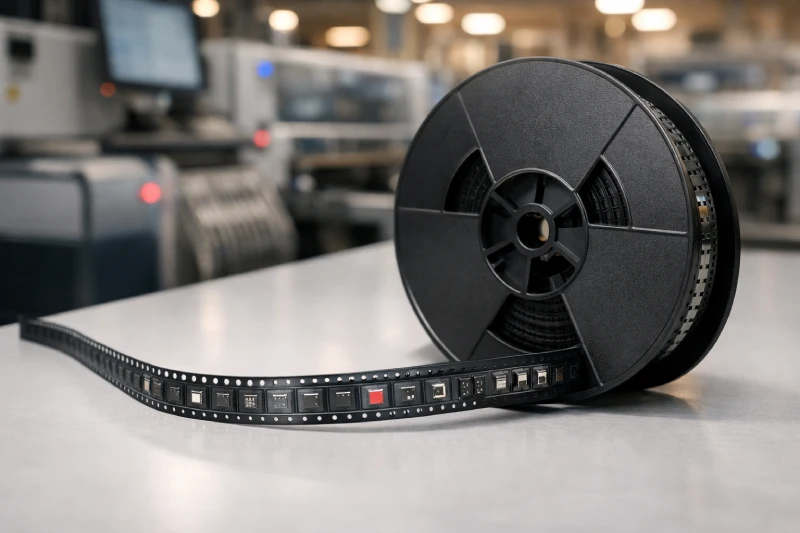
Semiconductor devices may be tiny, but the packaging system around them has a major impact on production efficiency and product quality. In tape-and-reel packaging, the plastic reel is often treated as a simple accessory. In reality, it plays a critical role in protecting carrier tape, preventing ESD damage, and ensuring smooth feeding on SMT assembly lines.
A poorly designed reel can lead to tape deformation, feeding jams, cracked flanges, or even hidden damage to sensitive semiconductor components. By contrast, the right reel improves handling, transportation, storage, and automated pick-and-place performance.
Plastic reels are used together with carrier tape and cover tape to form a complete tape-and-reel packaging system. If you are packaging ICs, LEDs, sensors, power devices, or other semiconductor components, selecting the correct reel is just as important as choosing the right tape.
In this guide, you will learn how semiconductor packaging plastic reels work, which sizes and materials are most common, how ESD-safe reels protect sensitive components, and how to choose the best reel for your application.
A semiconductor packaging plastic reel is a spool used to wind carrier tape containing ICs, LEDs, sensors, and other semiconductor devices. The correct reel improves SMT feeding, reduces ESD risk, and ensures compatibility with automated tape-and-reel packaging systems.
What Is a Semiconductor Packaging Plastic Reel?
A semiconductor packaging plastic reel is the circular spool used to wind carrier tape after semiconductor components have been loaded and sealed. The reel keeps the tape organized, protects it during shipping and storage, and allows the tape to feed smoothly into SMT pick-and-place equipment.
Without the reel, carrier tape would be difficult to transport and nearly impossible to use in high-speed automated production. The reel controls the winding tension and keeps the tape aligned so that every component pocket remains in the correct position.
Typical semiconductor components packaged on plastic reels include:
- Integrated circuits (ICs)
- LEDs
- Transistors
- Diodes
- Sensors
- MOSFETs
- Small connectors
- Passive SMD components
In most applications, the reel is part of a complete packaging system that includes carrier tape and cover tape. The carrier tape holds the components in formed pockets, while the cover tape seals the top surface. The plastic reel then stores the sealed tape in a compact and easy-to-handle format.
For companies using complete tape-and-reel systems, the reel must also be compatible with the tape width, total tape length, and SMT feeding equipment. This is why semiconductor manufacturers often choose reel suppliers that can also provide complete Tape & Reel Packaging Solutions and matching Carrier Tape products.
Why Plastic Reels Matter in Semiconductor Tape-and-Reel Packaging
Many buyers focus on the semiconductor component itself and pay little attention to the reel. However, a low-quality reel can create problems throughout the entire packaging and assembly process.
If the reel diameter is incorrect, the tape may become too loose or too tight. Excessive tension can distort the carrier tape pockets, while insufficient tension can cause the tape to shift or slip during transport. Both situations increase the risk of misfeeding on SMT lines.
Reel stability is equally important. A reel with poor dimensional accuracy may wobble when mounted on a feeder. That wobble can lead to inconsistent tape movement, skipped components, and pick-and-place errors.
Low-quality reels also tend to crack during shipping or storage. This is especially common when thin flanges or weak plastic materials are used. Once the reel breaks, the tape can unwind, causing component loss and packaging waste.
Another major concern is electrostatic discharge. Semiconductor devices are highly sensitive to static electricity. If the reel material is not anti-static or conductive, ESD can build up during handling and damage the components before they ever reach the assembly line.
| Low-Quality Reel Problems | High-Quality Reel Benefits |
|---|---|
| Tape slipping or loosening | Stable and consistent tape winding |
| Cracking during transport | Better impact resistance |
| Static buildup | ESD-safe protection |
| Feeding jams | Smooth SMT feeding |
| Inconsistent dimensions | Reliable machine compatibility |
Common Plastic Reel Sizes Used for Semiconductor Components
The correct reel size depends mainly on the carrier tape width, tape length, and the size of the semiconductor component being packaged.
7-Inch Plastic Reels
7-inch reels are commonly used for small-volume packaging and narrow carrier tape widths such as 8 mm or 12 mm. They are popular in prototype production, engineering samples, and low-volume SMT assembly.
Typical applications include:
- Small ICs
- LEDs
- Resistors and capacitors
- Small sensors
Because the reel diameter is smaller, it holds less tape and is easier to handle in compact packaging environments.
13-Inch Plastic Reels
13-inch reels are the most common choice in semiconductor packaging. They are widely used for standard SMT production because they can hold longer tape lengths and support a wider range of tape widths.
13-inch reels are typically used for:
- ICs
- Power management devices
- Transistors
- Sensors
- Semiconductor modules
These reels are commonly matched with wider tape sizes and are often preferred for automated mass production.
15-Inch and Custom Plastic Reels
For larger semiconductor devices, long tape lengths, or heavy components, 15-inch and custom-sized reels are often required. These are commonly used in automotive electronics, industrial semiconductor packaging, and power devices.
| Reel Size | Typical Tape Width | Common Components | Typical Use |
|---|---|---|---|
| 7 inch | 8–12 mm | LEDs, small ICs, passives | Prototype or low volume |
| 13 inch | 8–56 mm | ICs, sensors, transistors | Standard SMT production |
| 15 inch+ | 44–88 mm | Power devices, connectors | Large or custom packaging |
When selecting a reel size, always match the reel to the carrier tape width and total tape length. For embossed tape systems, it is especially important to verify compatibility with the selected Embossed Carrier Tape design.
Plastic Reel Materials: Which One Is Best?
The material used for a semiconductor packaging plastic reel affects strength, dimensional accuracy, durability, and ESD performance.
Polystyrene (PS) Reels
PS reels are widely used because they are lightweight, cost-effective, and provide good dimensional consistency. They are suitable for standard semiconductor packaging applications and are often chosen for ICs and small SMD devices.
However, PS reels are less impact-resistant than other materials. They may crack more easily if the reel is dropped or subjected to heavy loading.
Polycarbonate (PC) Reels
PC reels offer greater strength and better heat resistance. They are often used for heavier semiconductor components or applications where the reel must survive rough handling and long transportation cycles.
Although PC reels are more expensive, they are usually the preferred option for high-value or fragile semiconductor devices.
Conductive and Anti-Static Materials
For ESD-sensitive semiconductor products, conductive or anti-static reel materials are essential. These reels prevent static buildup and reduce the risk of hidden electrical damage.
| Material | Advantages | Limitations | Best For |
|---|---|---|---|
| PS | Low cost, lightweight, stable dimensions | Lower impact resistance | Standard IC packaging |
| PC | Strong, durable, heat resistant | Higher cost | High-value components |
| Conductive PS or PC | ESD-safe, protects sensitive devices | More expensive | ESD-sensitive semiconductor packaging |
In many semiconductor applications, the reel material should be selected together with the tape material. For example, when using Anti-Static Carrier Tape, it is usually best to pair it with an anti-static or conductive reel.
ESD Protection Requirements for Semiconductor Packaging Plastic Reels
Electrostatic discharge is one of the biggest hidden risks in semiconductor packaging. A static charge that is too small to feel can permanently damage a semiconductor device.
This is why many semiconductor packaging reels are manufactured with anti-static, dissipative, or conductive materials.
Anti-static reels reduce the buildup of static electricity on the reel surface. Dissipative reels slowly transfer static charges away from the component. Conductive reels provide the highest level of ESD protection and are often used in environments where extremely sensitive devices are handled.
| Reel Type | Surface Resistance | Typical Application |
|---|---|---|
| Anti-static | 10^9–10^12 Ω | General semiconductor handling |
| Dissipative | 10^5–10^9 Ω | Sensitive semiconductor packaging |
| Conductive | Below 10^5 Ω | High-risk ESD environments |
For most semiconductor packaging applications, anti-static or dissipative reels are sufficient. Conductive reels are usually selected for high-value ICs, advanced sensors, and automotive semiconductor devices.
It is also important to remember that the reel alone cannot provide complete ESD protection. The entire packaging system should include:
- ESD-safe carrier tape
- Proper cover tape
- Grounded handling procedures
- ESD-controlled storage and transportation
Using an ESD-safe reel may cost slightly more, but it can prevent expensive field failures and rejected components later in the production process.
How to Match the Plastic Reel with Carrier Tape and Cover Tape

A reel should never be selected independently from the rest of the packaging system. The reel, carrier tape, and cover tape must work together.
The reel diameter must match the carrier tape width and total tape length. The hub size, arbor hole, and flange width must also fit the tape-and-reel packaging machine and the SMT feeder.
If the reel is too small, the carrier tape may bend too sharply, causing pocket deformation. If the reel is too large, the tape may not wind tightly enough, creating loose coils and feeding problems.
The reel material should also be compatible with the sealing method. For example:
- Heat-sealed systems may require stronger, more temperature-resistant reel materials.
- Pressure-sensitive systems may use standard reel materials if the tape tension remains low.
When using complete tape-and-reel packaging systems, it is important to verify compatibility with both Cover Tape and the chosen Heat Activated Cover Tape or pressure-sensitive sealing method.
The best approach is to test the full packaging system before mass production. A reel supplier that can provide sample reels and perform feeding tests will help reduce the risk of line stoppages later.
Common Problems Caused by the Wrong Plastic Reel
The wrong reel can create multiple production and packaging issues.
| Problem | Likely Cause | Recommended Solution |
|---|---|---|
| Tape feeding jams | Incorrect reel diameter | Use the correct reel size |
| Component movement in pockets | Poor tape winding tension | Use a stronger reel structure |
| Reel cracking | Weak or brittle material | Upgrade to PC reel |
| ESD damage | Non-ESD-safe reel | Use anti-static or conductive reel |
| Pick-and-place downtime | Poor reel precision | Use an EIA-481 compliant reel |
One of the most common mistakes is choosing a reel only by price. While a low-cost reel may seem attractive, it often increases waste, downtime, and the risk of damaged components.
An EIA-481-compliant reel with proper dimensions and ESD-safe material will usually provide much lower total cost over time.
How to Choose a Reliable Semiconductor Packaging Plastic Reel Supplier
Choosing the right supplier is just as important as choosing the right reel.
A good supplier should be able to provide multiple reel sizes, anti-static materials, and compatibility testing. They should also understand semiconductor packaging standards and be able to recommend the correct reel based on your tape width, component type, and SMT process.
Before selecting a supplier, ask the following questions:
- Can you provide anti-static or conductive reel materials?
- Which reel sizes and tape widths do you support?
- Can you match the reel with my existing carrier tape?
- Do your products comply with EIA-481, RoHS, and REACH?
- Can you provide free samples for feeding and compatibility testing?
A reliable supplier should also offer custom options such as:
- Custom reel dimensions
- Different colors
- Custom logo printing
- Specialized materials for automotive or industrial semiconductor packaging
Working with a supplier that provides both reels and complete tape-and-reel packaging components can simplify purchasing and improve overall compatibility.
Conclusion
The semiconductor packaging plastic reel is much more than a simple spool. It is a key part of the tape-and-reel packaging system that affects transportation, ESD protection, SMT feeding performance, and overall production efficiency.
Choosing the correct reel size, material, and ESD protection level will help prevent tape damage, reduce line downtime, and protect sensitive semiconductor components.
If you are packaging ICs, LEDs, sensors, or other semiconductor devices, make sure your reel is fully matched to your carrier tape, cover tape, and SMT equipment.
Looking for EIA-481-compliant, anti-static semiconductor packaging plastic reels? Contact us to request free samples, get custom reel recommendations, and find the best solution for your semiconductor packaging process.