
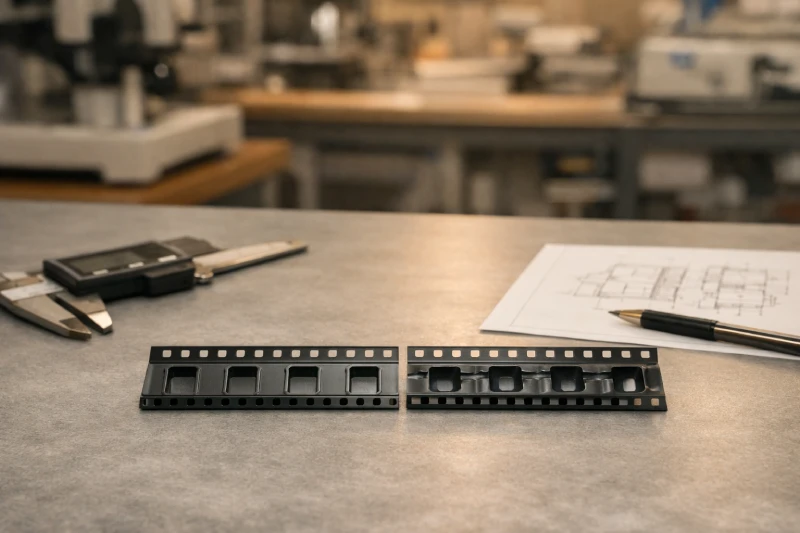
In many SMT projects, engineers do not start with custom packaging in mind. Standard carrier tape formats are designed to meet a wide range of component dimensions under EIA-481 guidelines. However, as assembly speeds increase and component designs evolve, standard solutions may no longer provide stable performance.
The real question is not “Can we order custom carrier tape?” but rather: When is customization technically justified? This article explains how to identify the need, evaluate alternatives, understand the development process, and weigh engineering advantages against potential risks.
What Signals That Standard Carrier Tape Is No Longer Suitable?
Standard embossed carrier tape works reliably when component dimensions align well with existing pocket geometries. But certain production signals suggest that a standard configuration may be reaching its limits.
Common warning signs include:
- Increased mispick rate during high-speed placement
- Component rotation within the pocket
- Intermittent drop issues during indexing
- Visible lateral clearance instability
- Inconsistent pick height due to pocket depth mismatch
These issues are often amplified on high-speed SMT lines, where minor dimensional deviations become magnified under acceleration and vibration.
Another indicator appears when new package designs—such as modified QFN, ultra-thin ICs, or custom LED modules—do not align well with available pocket width increments. If the component envelope falls between standard tape formats, repeated process adjustments may only offer temporary mitigation.
Before assuming customization is necessary, engineers typically compare performance against established formats such as standard embossed carrier tape. When optimization no longer stabilizes placement consistency, customization becomes a serious consideration.
How Do You Evaluate Whether Customization Is Technically Necessary or Just Process Optimization?
Not every placement issue originates from tape design. A critical engineering step is distinguishing packaging limitations from process variables.
Evaluation typically includes:
- Feeder indexing stability
- Alignment between sprocket holes and pocket center
- Tolerance stacking between tape, feeder, and pick head
- Component coplanarity
- Placement speed vs vibration profile
For example, feeder wear or indexing calibration drift can create symptoms similar to pocket misalignment. Likewise, excessive vacuum force or nozzle mismatch can induce rotation that is incorrectly attributed to tape geometry.
Tolerance stacking is particularly important. Even when each dimension is technically within specification, accumulated variation between pocket width, pocket depth, and component tolerance may result in unstable seating.
Only after systematic elimination of feeder and process variables should packaging geometry be modified. Custom carrier tape should be an engineering solution—not a reaction to insufficient line tuning.
What Is the Step-by-Step Custom Carrier Tape Development Process?
When customization is justified, the development process follows a structured engineering path rather than a simple design request.
1. Component Dimensional Review
A detailed analysis of length, width, height, and critical tolerances is conducted. Special attention is given to maximum material condition and potential warpage.
2. Pocket Geometry Design
Engineers design pocket width, depth, draft angle, and corner radius to balance retention and pick accessibility. Clearance must allow stable seating without excessive lateral movement.
3. Tooling Development
Embossing tooling is produced according to validated pocket geometry. Tooling precision directly impacts pocket repeatability across production runs.
4. Sampling and Validation
Initial samples are tested on actual SMT feeders. Engineers observe indexing smoothness, component seating, and pick consistency under operating speed.
5. Pilot Production
Limited-volume runs verify manufacturing consistency and material stability. This stage often includes ESD evaluation if anti-static requirements apply.
6. Mass Production Release
After validation, the design is released for volume manufacturing. At this stage, compatibility with cover tape sealing and reel winding stability is confirmed.
This structured process ensures that customization improves stability rather than introducing new variability.
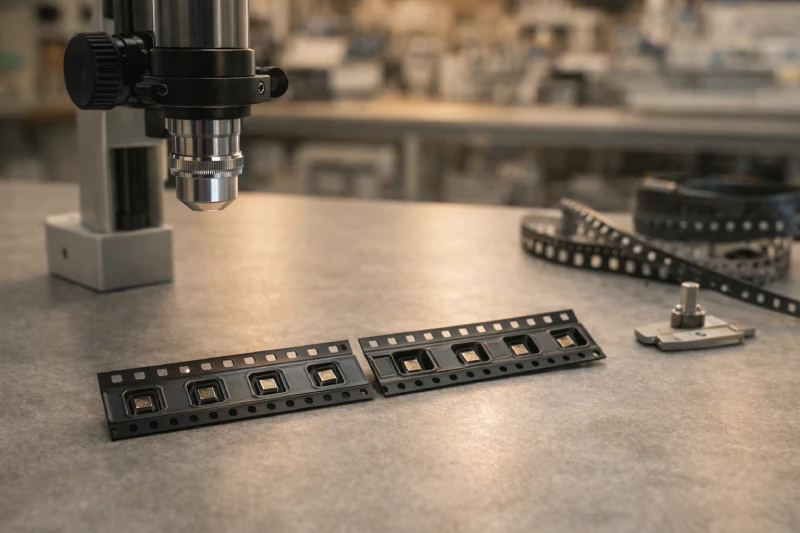
How Long Does Custom Carrier Tape Development Typically Take?
Development time depends on tooling complexity and validation cycles.
Typical timelines include:
- Tooling fabrication: 2–4 weeks
- Sample preparation: 1 week
- SMT validation and feedback: 1–2 weeks
- Revision (if needed): additional 1–2 weeks
Material choice can also affect lead time. Certain polymers may require additional forming trials to achieve dimensional stability.
Design revisions are the primary source of delay. If pocket geometry requires adjustment after validation, tooling modification extends the timeline. For projects with tight launch schedules, early dimensional review significantly reduces iteration cycles.
Custom packaging should therefore be aligned with product development milestones rather than introduced at the last moment.
What Engineering Advantages Does Custom Carrier Tape Provide in High-Speed SMT Lines?
When properly executed, custom carrier tape offers measurable engineering benefits—particularly in high-speed environments.
Key advantages include:
- Reduced mispick rate
- Improved pocket seating stability
- Lower component rotation probability
- More consistent pick height
- Reduced need for frequent feeder adjustments
At high indexing speeds, stable component positioning directly affects placement accuracy. Even minor improvements in pocket fit can reduce scrap and minimize downtime.
Over extended production cycles, improved stability translates into lower total cost of ownership. Reduced machine interruption and fewer rejected boards often offset the initial tooling investment.
Customization is not about aesthetics or over-engineering. It is about achieving mechanical stability aligned with actual production conditions.
What Are the Hidden Risks in Custom Carrier Tape Projects?
Despite its advantages, customization carries inherent risks.
Tooling Cost Amortization
Custom tooling requires sufficient production volume to justify investment. Low-volume programs may not recover tooling costs efficiently.
Over-Engineering
Designing excessively tight pockets may increase insertion difficulty or create sealing inconsistencies.
Revision Risk
If component dimensions change during product evolution, the existing tooling may become obsolete.
Feeder Compatibility
Not all feeders perform identically. A design validated on one line may behave differently in another factory.
Recognizing these risks early allows teams to balance engineering precision with practical scalability.
How Do You Decide Between Standard, Modified, and Fully Custom Carrier Tape?
Final decision-making should follow a structured logic:
- Standard tape is appropriate for mature components with proven placement stability.
- Modified geometry (minor dimensional adjustment) suits cases where pocket optimization improves performance without full redesign.
- Fully custom tape is justified when new component architecture or high-speed production demands exceed standard tolerances.
The decision should consider:
- Production volume
- SMT line speed
- Cost sensitivity
- Long-term product roadmap
In many cases, reviewing available standard and embossed carrier tape options provides sufficient stability. Customization becomes strategic when stability improvements directly impact yield and scalability.
Conclusion
Custom carrier tape is not automatically better than standard formats. Its value lies in precision alignment between component geometry and real-world production dynamics.
By evaluating technical necessity, understanding development workflow, and weighing measurable benefits against cost and risk, engineering teams can make informed packaging decisions.
Customization is most effective when driven by data, validated through testing, and aligned with long-term manufacturing goals—not simply as a reactive adjustment to temporary process instability.