

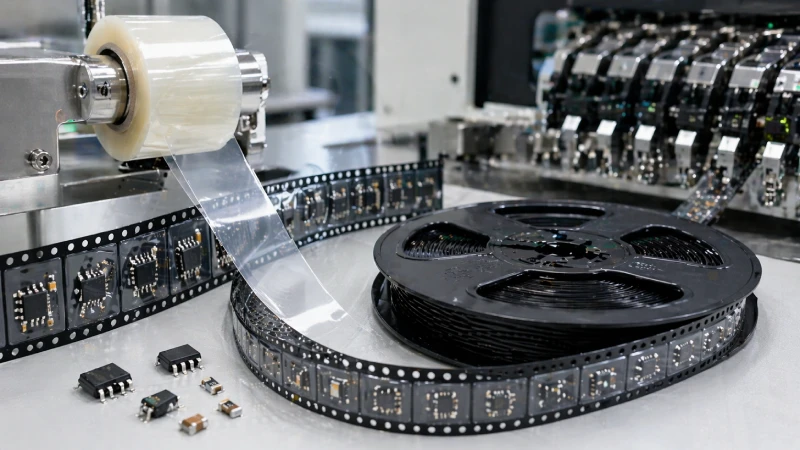
Tape and reel packaging is the standard method used to feed electronic components into automated SMT production lines. Components are placed into carrier tape pockets, sealed with cover tape, and wound onto a reel for precise, high-speed feeding.
Modern electronics manufacturing depends on accuracy, consistency, and speed. Even a small error in component orientation or handling can lead to production delays, machine stoppages, or damaged parts. That is why tape and reel packaging has become the preferred solution for resistors, capacitors, ICs, LEDs, connectors, and semiconductor devices.
Whether you are sourcing packaging for a new component or improving your SMT line efficiency, understanding how tape and reel works can help you reduce defects, improve feeding performance, and lower overall manufacturing costs.
If you are already looking for a supplier, you can also review our tape and reel packaging service page for available custom solutions and production capabilities.
What Is Tape and Reel Packaging?
Tape and reel packaging is a standardized packaging method used for electronic components in SMT assembly. Individual parts are loaded into pockets in a carrier tape, covered with a protective cover tape, and then wound onto a plastic reel.
The reel is then mounted onto a pick-and-place machine, which automatically feeds components into the production line one by one. This method ensures the component orientation remains correct and prevents parts from becoming mixed, damaged, or contaminated.
Tape and reel packaging is commonly used for:
- Integrated circuits (ICs)
- Resistors and capacitors
- LEDs
- Connectors
- Transistors
- Semiconductor devices
Compared with tray, tube, or bulk packaging, tape and reel offers much faster feeding and greater compatibility with automated equipment. It is especially important for manufacturers running high-volume SMT production.
If you are unfamiliar with the basic materials involved, you can first read our guide to carrier tape and our detailed explanation of cover tape.
How the Tape and Reel Process Works
The tape and reel process consists of four main steps. Each step affects the reliability of SMT feeding and the overall quality of the finished reel.
Step 1: Component Loading
The first step is loading components into the carrier tape pockets. These pockets are created either by embossing or punching the tape material.
Pocket size and shape must closely match the component dimensions. If the pocket is too large, the component may rotate or flip. If it is too small, the part may be difficult to load or could become damaged.
For precision parts such as ICs and connectors, correct orientation is critical. The polarity mark, pin direction, or contact side must face the proper direction so the SMT machine can place the component accurately.
Step 2: Cover Tape Sealing
After the components are loaded, a cover tape is applied to seal the pockets.
There are two common types of cover tape:
- Heat-seal cover tape
- Pressure-sensitive cover tape
Heat-seal tape is usually preferred for high-speed automated production because it provides stronger and more consistent sealing. Pressure-sensitive tape is often used for small-volume packaging or components that require a lower sealing temperature.
Peel strength is one of the most important factors during sealing. If the cover tape peels too easily, components may escape during transport. If the seal is too strong, the SMT machine may have difficulty removing the tape.
Step 3: Winding Onto the Reel
Once sealed, the carrier tape is wound onto a plastic reel. The reel protects the tape during shipping and allows the SMT machine to feed components smoothly.
The most common reel sizes are:
- 7 inch reel
- 13 inch reel
- 15 inch reel
The correct reel diameter depends on the tape width, total component quantity, and the type of feeder used in the SMT machine.
Step 4: SMT Feeding
During assembly, the reel is mounted on the SMT feeder. As the machine advances the tape, the cover tape peels away and each component is picked and placed onto the PCB.
Because every component is presented in the same position and orientation, tape and reel packaging allows extremely fast and reliable automated production.
Main Components of a Tape and Reel System
A complete tape and reel system includes four key elements: carrier tape, cover tape, plastic reel, and leader/trailer tape.
Carrier Tape
Carrier tape is the part that directly holds the electronic component. It contains a series of pockets designed to match the size and shape of the part.
There are two common types:
- Embossed carrier tape
- Punched carrier tape
Embossed tape is typically used for larger components such as connectors and ICs. Punched tape is more suitable for very small and flat parts.
Common carrier tape materials include:
- PS (Polystyrene)
- PC (Polycarbonate)
- PET (Polyethylene Terephthalate)
Each material offers different levels of rigidity, transparency, and temperature resistance.
Cover Tape
Cover tape seals the pockets after the components are loaded. It prevents parts from falling out during transport and feeding.
The choice between heat-seal and pressure-sensitive cover tape depends on the application, SMT speed, and required peel force.
Plastic Reel
The plastic reel supports the tape roll and protects it during handling.
Anti-static reels are often used for sensitive electronic components to prevent ESD damage. If your product requires electrostatic protection, it is important to use both conductive carrier tape and an anti-static reel.
You can learn more in our article on plastic reels for electronic components.
Leader Tape and Trailer Tape
Leader tape is the empty section at the beginning of the reel, while trailer tape is the empty section at the end.
These sections are necessary because the SMT machine needs extra tape length to load and unload the reel properly. Without sufficient leader and trailer tape, feeding problems may occur.
| Component | Function | Common Options |
|---|---|---|
| Carrier Tape | Holds the components | Embossed, punched |
| Cover Tape | Seals the pockets | Heat seal, pressure sensitive |
| Plastic Reel | Supports the tape roll | 7 inch, 13 inch, 15 inch |
| Leader/Trailer Tape | Supports machine feeding | Standard empty tape length |
Tape and Reel Standards: Understanding EIA-481
Most SMT factories and OEM manufacturers require tape and reel packaging to follow the EIA-481 standard.
EIA-481 defines:
- Tape width
- Pocket spacing
- Sprocket hole dimensions
- Reel diameter
- Leader and trailer length
- Component orientation
Following this standard ensures that the reel can be used with most SMT feeders and pick-and-place machines.
The most common tape widths are:
| Tape Width | Typical Application |
|---|---|
| 8 mm | Small resistors, capacitors, chips |
| 12 mm | LEDs, small ICs |
| 16 mm | Larger ICs and connectors |
| 24 mm | Modules and larger components |
| 32 mm+ | Heavy or oversized parts |
Using the wrong tape width or incorrect pocket pitch can cause feeding jams, skipped parts, or component rotation.
Benefits of Tape and Reel Packaging
Tape and reel packaging offers major advantages compared with manual loading or alternative packaging methods.
Faster SMT Production
Because components are already oriented and separated, the SMT machine can feed them continuously at high speed. This reduces cycle time and increases line productivity.
Lower Labor Costs
Manual sorting and loading are no longer necessary. Operators spend less time handling components, reducing labor costs.
Better Component Protection
The carrier tape pocket protects the component from shock, vibration, dust, and contamination during transport and storage.
Improved Accuracy
Every component arrives in the same orientation. This reduces pick-and-place errors and minimizes rejected boards.
Reduced Machine Downtime
Reliable tape design and correct peel strength reduce feeding interruptions. Fewer machine stops mean higher production efficiency.
Easier Storage and Shipping
Reels are compact, stackable, and easier to transport than trays or loose parts.
When properly designed, tape and reel packaging can significantly improve production efficiency while lowering total packaging cost.
Tape and Reel vs Other Packaging Methods
Tape and reel is not the only method used for electronic components. Some manufacturers still use tray, tube, or bulk packaging.
| Packaging Method | Best For | Advantages | Limitations |
|---|---|---|---|
| Tape and Reel | SMT automation | Fast feeding, high accuracy | Requires tooling |
| Tray Packaging | Large ICs and modules | Excellent protection | Slower handling |
| Tube Packaging | Through-hole components | Low cost | Limited automation |
| Bulk Packaging | Low-cost simple parts | Lowest packaging cost | High risk of damage |
Tray packaging is useful for large or fragile ICs that do not fit standard tape pockets. Tube packaging is often used for long through-hole parts. Bulk packaging is only suitable when speed and orientation are not important.
For most SMT applications, tape and reel remains the most efficient and reliable option.
Common Tape and Reel Problems and How to Avoid Them
Even a well-designed reel can experience problems if the packaging is not properly tested.
Component Flipping
If the pocket is too large or incorrectly shaped, the component may rotate or flip during transport.
To prevent this problem:
- Match the pocket size closely to the component
- Use proper pocket depth
- Test the design before mass production
Poor Peel Strength
Cover tape that is too loose or too strong can cause feeding issues.
Loose sealing may allow components to escape. Excessive peel force can tear the cover tape or stop the feeder.
The best solution is to test the peel strength under actual SMT conditions.
Static Electricity Damage
Some semiconductor devices are highly sensitive to electrostatic discharge.
Use conductive or anti-static carrier tape together with anti-static reels. Our anti-static carrier tape guide explains which materials are most suitable for ESD-sensitive parts.
Feeding Errors
Feeding jams often happen when the reel is deformed, the tape width is incorrect, or the sprocket holes do not meet EIA-481 requirements.
Good quality control and standard-compliant tooling help avoid these issues.
How to Choose the Right Tape and Reel Solution
Choosing the correct tape and reel solution depends on your component, production volume, and SMT equipment.
Before selecting a design, consider the following:
- Component dimensions and weight
- Required orientation
- Whether the component is ESD sensitive
- Required tape width and reel diameter
- Heat-seal or pressure-sensitive cover tape
- Required production quantity
- Whether custom tooling is needed
You should also ask:
- Which SMT machine and feeder will use the reel?
- What reel diameter is compatible with your line?
- Does the component require anti-static protection?
- Will the component fit a standard pocket, or is a custom design necessary?
- Do you need sample testing before mass production?
Many components can use standard 8 mm, 12 mm, or 16 mm carrier tape. However, unusual shapes often require custom tooling.
At Jiushuo, we typically recommend sending a drawing or physical sample before finalizing the tape design. This allows the pocket size, material, and sealing method to be verified in advance.
Need help selecting the correct tape and reel packaging for your component? Send us your component drawing, dimensions, or sample, and we can recommend a custom tape, cover tape, and reel solution based on your SMT process. You can also visit our custom tape and reel packaging service page to learn more about our capabilities and request a quotation.
Industries That Use Tape and Reel Packaging
Tape and reel packaging is widely used across many industries:
- Consumer electronics
- Automotive electronics
- Semiconductor manufacturing
- LED lighting
- Medical electronics
- Industrial control systems
In consumer electronics, tape and reel is used for smartphones, computers, and wearable devices. Automotive manufacturers use it for sensors, control modules, and safety systems. Semiconductor companies depend on precise packaging to protect delicate ICs during automated production.
As components become smaller and SMT lines become faster, the demand for high-quality tape and reel packaging continues to grow.
Frequently Asked Questions
What is the difference between carrier tape and tape and reel?
Carrier tape is only one part of the complete tape and reel system. Tape and reel includes the carrier tape, cover tape, plastic reel, and empty leader/trailer sections.
What reel size should I choose?
The most common reel sizes are 7 inch, 13 inch, and 15 inch. The correct size depends on tape width, feeder compatibility, and the total quantity of components.
Is tape and reel packaging ESD safe?
Yes, tape and reel can be made ESD safe by using conductive or anti-static materials for the carrier tape and reel.
Can tape and reel packaging be customized?
Yes. Pocket dimensions, tape width, reel size, material, and cover tape type can all be customized to match the component.
What components can be packaged in tape and reel?
Most electronic components can be packaged in tape and reel, including ICs, LEDs, resistors, capacitors, connectors, sensors, and semiconductor devices.
What is the standard tape width for SMT components?
The most common tape widths are 8 mm, 12 mm, 16 mm, and 24 mm. Smaller components usually use 8 mm tape, while larger parts require wider tape.
Final Thoughts
Tape and reel packaging remains the most effective solution for modern SMT assembly because it improves speed, protects components, and ensures accurate feeding.
The right combination of carrier tape, cover tape, and reel can reduce defects, lower labor costs, and improve overall production efficiency. Standard EIA-481 compliance and proper material selection are essential for reliable SMT performance.
If you are looking for a tape and reel solution for a new electronic component, contact Jiushuo with your drawing or sample. We can help you design the correct carrier tape, choose the right cover tape, and provide a custom reel solution for your production line.