
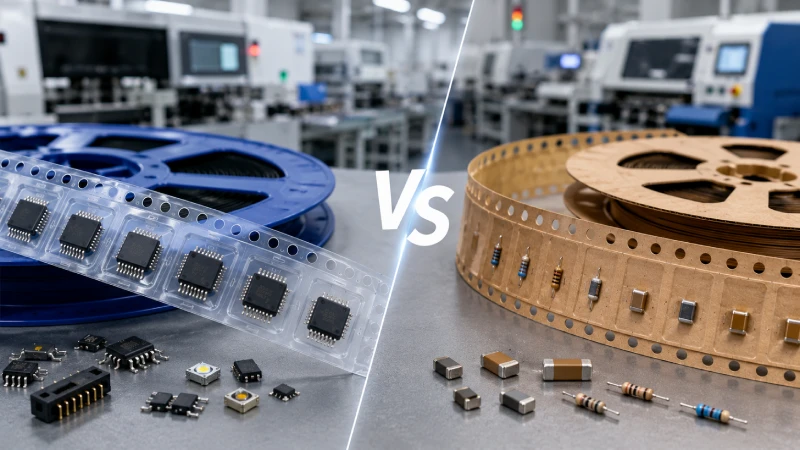
In the electronics manufacturing industry, selecting the right packaging material is just as important as choosing the right component. Carrier tape plays a critical role in protecting electronic parts during transportation, storage, and automated SMT assembly.
Among the various packaging options available today, plastic carrier tape and paper carrier tape are the two most commonly used solutions. While both serve the same basic purpose, they differ significantly in terms of durability, precision, cost, environmental impact, and application suitability.
Understanding these differences can help manufacturers reduce packaging failures, improve SMT feeding efficiency, and optimize overall packaging costs. This guide provides a detailed comparison between plastic and paper carrier tape to help you determine which option is best for your products.
What Is Carrier Tape?
A carrier tape is a specialized packaging material designed to hold electronic components in individual pockets during tape-and-reel packaging. Components are securely positioned within the pockets and sealed with cover tape before being wound onto reels for transportation and automated assembly.
Carrier tapes are widely used in SMT production lines because they enable high-speed pick-and-place machines to feed components accurately and efficiently.
If you’re new to component packaging, understanding the fundamentals of carrier tape can help you better evaluate different packaging solutions and their applications.
What Is Plastic Carrier Tape?
Plastic carrier tape is manufactured from thermoformable plastic materials and is widely used for packaging precision electronic components.
Common materials include:
- Polystyrene (PS)
- Polycarbonate (PC)
- Polyethylene Terephthalate (PET)
- ABS
These materials are heated and formed into precise pocket shapes that match the dimensions of specific electronic components.
One of the most common forms is embossed carrier tape, which is produced through a thermoforming process that creates highly accurate pockets with excellent dimensional consistency.
Plastic carrier tape is commonly used for:
- Integrated Circuits (ICs)
- LEDs
- Sensors
- Connectors
- Automotive electronic components
- Medical electronic devices
Because of its superior strength and precision, plastic carrier tape has become the preferred packaging solution for many advanced electronics manufacturers.
What Is Paper Carrier Tape?
Paper carrier tape is manufactured from specially treated paper materials and is typically used for smaller and less fragile electronic components.
The pockets are generally produced through punching or die-cutting processes rather than thermoforming.
Paper carrier tape is most commonly used for:
- Chip resistors
- MLCC capacitors
- Small diodes
- Passive electronic components
Compared with plastic carrier tape, paper carrier tape offers lower material costs and is often viewed as a more environmentally friendly option.
For a detailed overview of this packaging type, see paper carrier tape.
Although paper carrier tape remains popular for high-volume passive component packaging, its performance characteristics differ considerably from plastic alternatives.
Plastic vs Paper Carrier Tape: Key Differences
At first glance, both materials appear capable of performing the same function. However, their performance varies significantly in real-world manufacturing environments.
Material Strength
Plastic carrier tape offers higher mechanical strength and better resistance to deformation.
Paper carrier tape can become damaged under excessive pressure, moisture exposure, or rough handling during transportation.
Pocket Precision
Plastic carrier tape provides extremely accurate pocket dimensions through thermoforming technology.
Paper carrier tape relies on punching processes, which typically result in lower dimensional precision.
This difference becomes increasingly important when packaging miniature or high-value components.
Moisture Resistance
Plastic materials naturally resist moisture absorption.
Paper materials may absorb moisture from the environment, potentially affecting dimensional stability and packaging performance.
Transparency
Certain plastic carrier tape materials can be manufactured with transparent or semi-transparent properties, allowing easier visual inspection.
Paper carrier tape does not provide this advantage.
Cost
Paper carrier tape generally has a lower initial material cost.
However, packaging efficiency, defect rates, and component protection should also be considered when evaluating total packaging expenses.
Pocket Accuracy and Dimensional Stability
Pocket accuracy is one of the most important factors in tape-and-reel packaging.
Even slight dimensional variations can cause:
- Misfeeding
- Component rotation
- Pick-and-place errors
- Production downtime
Plastic carrier tape excels in this area because thermoforming technology creates highly repeatable pocket geometries.
The material maintains its shape throughout transportation and storage, ensuring consistent feeding performance on SMT assembly lines.
Paper carrier tape, while suitable for many passive components, can experience dimensional changes due to humidity fluctuations and material deformation.
For applications involving tight tolerances or miniature components, plastic carrier tape is generally the safer choice.
Component Protection Performance
Protecting components throughout the supply chain is a primary objective of carrier tape packaging.
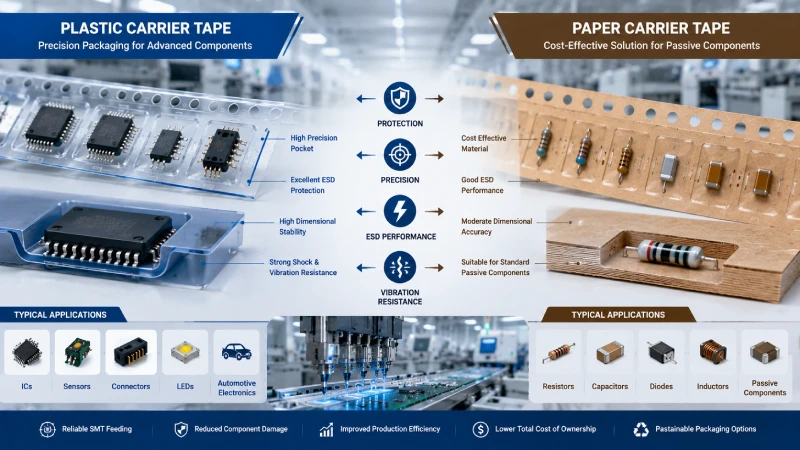
Plastic carrier tape provides superior protection because of its:
- Higher impact resistance
- Better vibration resistance
- Greater pocket retention force
- Improved structural integrity
These characteristics are especially valuable during:
- International shipping
- Long-distance transportation
- High-volume logistics operations
Fragile components such as ICs, sensors, and LEDs are often packaged in plastic carrier tape because the risk of damage is significantly reduced.
Paper carrier tape offers adequate protection for many standard passive components but may not provide the same level of security for delicate devices.
ESD Performance Comparison
Electrostatic discharge (ESD) is a major concern in electronic component packaging.
A single static discharge event can permanently damage sensitive semiconductor devices.
Plastic carrier tapes can be manufactured with:
- Anti-static properties
- Conductive properties
- Dissipative properties
This allows manufacturers to select specific ESD performance levels based on component sensitivity.
Many semiconductor manufacturers use anti-static plastic carrier tapes for packaging:
- ICs
- MOSFETs
- Sensors
- Memory devices
Paper carrier tape can also receive anti-static surface treatments, but its ESD performance is generally less consistent than engineered plastic materials.
For highly sensitive electronic components, plastic carrier tape usually provides better protection against electrostatic risks.
Is Paper Carrier Tape Really More Cost Effective?
Many buyers assume paper carrier tape is automatically the cheaper option.
While its material cost is lower, packaging decisions should be based on Total Cost of Ownership (TCO).
Factors influencing overall packaging costs include:
- Material cost
- Tooling expenses
- Component loss rates
- Feeding efficiency
- SMT downtime
- Shipping damage
For example, if a lower-cost paper carrier tape results in increased feeding failures or component damage, the total packaging cost may actually become higher.
Plastic carrier tape often delivers better long-term value because it improves process stability and reduces production disruptions.
Sustainability and Environmental Considerations
Environmental responsibility has become increasingly important across the electronics industry.
Paper carrier tape offers several sustainability advantages:
- Renewable raw materials
- Easier recycling
- Lower plastic consumption
These benefits make paper carrier tape attractive for companies pursuing environmental initiatives.
However, plastic carrier tape manufacturers have also made significant progress in sustainability.
Modern developments include:
- Recyclable materials
- Reduced material thickness
- Eco-friendly formulations
- Improved manufacturing efficiency
As sustainability standards continue to evolve, both packaging solutions are becoming more environmentally responsible.
When Should You Choose Plastic Carrier Tape?
Plastic carrier tape is generally the preferred option when:
- Packaging precision electronic components
- Using high-speed SMT assembly lines
- Shipping products internationally
- Requiring excellent dimensional accuracy
- Handling ESD-sensitive devices
Industries that commonly choose plastic carrier tape include:
- Semiconductor manufacturing
- Automotive electronics
- Medical electronics
- Consumer electronics
- Industrial automation
Its superior protection and feeding performance often justify the higher initial material cost.
When Should You Choose Paper Carrier Tape?
Paper carrier tape remains an excellent choice in specific situations.
It is particularly suitable when:
- Packaging standard passive components
- Producing extremely high volumes
- Managing tight packaging budgets
- Environmental goals are a priority
Applications commonly include:
- Resistors
- Capacitors
- Diodes
- Basic passive devices
For these products, paper carrier tape can provide reliable performance while minimizing packaging costs.
How Plastic Carrier Tape Works with Tape Reels
Carrier tape and reels function as a complete packaging system.
After components are loaded into the pockets and sealed with cover tape, the carrier tape is wound onto reels for storage and transportation.
The choice of reel material can also influence packaging performance.
Many manufacturers pair plastic carrier tape with a plastic tape reel because both materials provide excellent durability and compatibility with automated SMT equipment.
A properly designed tape-and-reel system helps improve:
- Component protection
- Storage efficiency
- Transportation reliability
- Production line productivity
Plastic vs Paper Carrier Tape: Quick Decision Guide
Choose Plastic Carrier Tape If:
- You package ICs or precision components.
- You require maximum protection.
- You operate high-speed SMT lines.
- ESD control is critical.
- International transportation is involved.
Choose Paper Carrier Tape If:
- You package passive components.
- Cost reduction is the primary goal.
- Environmental considerations are important.
- Component sensitivity is relatively low.
Future Trends in Carrier Tape Materials
The carrier tape industry continues to evolve as component sizes become smaller and manufacturing requirements become more demanding.
Emerging trends include:
- Recyclable plastic carrier tapes
- Bio-based packaging materials
- Ultra-thin thermoformed structures
- Enhanced ESD protection technologies
- Hybrid material solutions
Manufacturers are increasingly focused on balancing performance, sustainability, and cost efficiency.
As electronics continue to advance, packaging materials will play an even greater role in ensuring product quality and manufacturing reliability.
Conclusion
There is no universal winner in the plastic vs paper carrier tape debate. The best choice depends on your component type, packaging requirements, production environment, and cost objectives.
Paper carrier tape remains a cost-effective solution for many passive electronic components and offers environmental advantages. However, plastic carrier tape delivers superior dimensional accuracy, stronger component protection, better ESD performance, and greater reliability in demanding SMT applications.
For manufacturers seeking maximum packaging performance and long-term process stability, plastic carrier tape is often the preferred solution.
If you are evaluating packaging options for your electronic components, working with an experienced carrier tape supplier can help you select the most suitable material, pocket design, and tape-and-reel configuration for your specific application.