

Plastic tape reels are one of the most important parts of modern SMT packaging. Although they may look simple, the correct reel directly affects feeding stability, component protection, storage efficiency, and production speed.
In a complete tape and reel packaging system, components are loaded into carrier tape pockets, sealed with cover tape, and then wound onto a plastic reel. The reel keeps the tape organized during transportation and allows SMT pick-and-place machines to feed components smoothly and continuously.
A poor-quality or incorrectly sized reel can cause feeding jams, tape slipping, static damage, or even production downtime. Choosing the correct plastic tape reel helps reduce waste, improve automation, and protect valuable electronic components.
Whether you package ICs, LEDs, connectors, resistors, capacitors, or custom parts, understanding reel size, material, ESD protection, and standard requirements is essential.
For a complete packaging solution, plastic reels are normally used together with carrier tape, cover tape, and automated loading equipment. If you are still selecting the full packaging structure, you can first review your carrier tape design and sealing method before choosing the reel.
What Is a Plastic Tape Reel?
A plastic tape reel is a circular spool used to hold carrier tape loaded with electronic components. After the components are placed into the carrier tape pockets and sealed with cover tape, the finished tape is wound onto the reel for storage, transportation, and SMT feeding.
Plastic reels are widely used in tape and reel packaging because they provide better protection and more stable feeding than loose packaging or bulk bags. They also allow manufacturers to handle large quantities of components more efficiently.
A standard plastic tape reel includes several main parts:
- Flange: the two side walls that keep the carrier tape in place
- Hub: the center section where the tape is wound
- Arbor hole: the center opening used to mount the reel onto a feeder or machine
- Reel width: determines how much carrier tape the reel can hold
- Reel diameter: determines total tape length and feeder compatibility
Unlike loose packaging, a plastic reel keeps the carrier tape aligned and under proper tension. This reduces the risk of component damage, misalignment, and handling errors during SMT production.
Not every reel works with every component. Reel diameter, width, and anti-static properties must match both the carrier tape and the SMT feeder system.
How Plastic Tape Reels Work in SMT Packaging
In a standard tape and reel packaging process, the plastic reel is the final stage before shipment or SMT assembly.
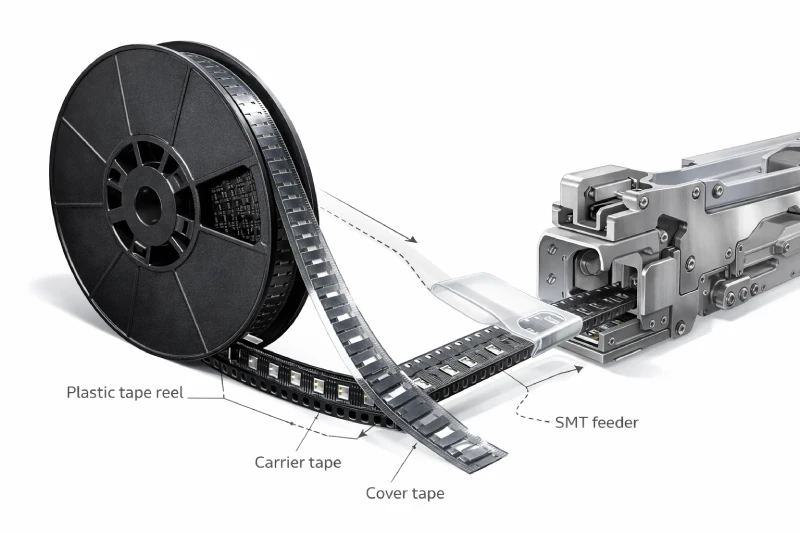
The process normally works like this:
- Components are placed into carrier tape pockets
- Cover tape seals the carrier tape
- The completed tape is wound onto a plastic reel
- The reel is packed and shipped to the SMT production line
- The SMT feeder loads the reel and feeds components automatically
When the reel is installed in a pick-and-place machine, it rotates slowly while the carrier tape advances through the feeder. The machine indexes the tape pocket-by-pocket, allowing the nozzle to pick up each component accurately.
If the reel dimensions do not match the tape or feeder, several problems can occur:
- Tape slipping or telescoping
- Uneven winding tension
- Feeding jams
- Reel deformation during storage
- Static discharge damage to sensitive components
These issues often result in wasted components, slower production, and machine downtime.
If you want to avoid these problems, it is important to choose a reel that matches your carrier tape width, tape length, and feeder requirements. Companies that already use custom embossed carrier tape or anti-static cover tape should make sure the reel is compatible with those materials as well.
Standard Plastic Tape Reel Sizes
Plastic tape reels are available in several standard sizes. The correct reel size depends on the carrier tape width, the total tape length, the component size, and the requirements of the SMT line.
The two most common reel diameters are 7 inch and 13 inch.
7 Inch Plastic Reels
7 inch plastic reels are typically used for smaller production runs or shorter tape lengths. They are common in prototype manufacturing, low-volume assembly, and applications using narrow carrier tape such as 8 mm or 12 mm.
Advantages of 7 inch reels include:
- Lower material cost
- Easier storage and shipping
- Better for small component quantities
- Compatible with many compact SMT feeders
However, because the diameter is smaller, the reel can only hold a shorter length of carrier tape.
13 Inch Plastic Reels
13 inch plastic reels are the industry standard for high-volume SMT production. They can hold significantly longer carrier tape lengths and are widely used by OEM and EMS factories.
13 inch reels are ideal when:
- Large quantities of components are required
- Production runs are continuous
- Wider carrier tape is used
- Fewer reel changes are preferred during manufacturing
Compared with 7 inch reels, 13 inch reels reduce machine stoppage because operators do not need to replace reels as often.
Typical reel widths are selected according to the carrier tape width:
| Carrier Tape Width | Typical Reel Width |
|---|---|
| 8 mm | 8–12 mm |
| 12 mm | 12–16 mm |
| 16 mm | 16–24 mm |
| 24 mm | 24–32 mm |
| 32 mm and above | Custom |
Before ordering, confirm three key dimensions:
- Carrier tape width
- Reel diameter
- Arbor hole size
If you are using a custom carrier tape design or unusual component size, you may also need a custom reel width or custom flange design.
Plastic Reel Materials and ESD Protection
Not all plastic tape reels are made from the same material. Different materials provide different levels of strength, temperature resistance, and ESD protection.
The most common materials include:
- PS (Polystyrene): low cost and widely used for standard reels
- HIPS (High Impact Polystyrene): stronger than standard PS and more durable
- ABS: good impact resistance and dimensional stability
- PC (Polycarbonate): high strength and suitable for demanding applications
For electronic components, ESD protection is often more important than the material itself.
Plastic tape reels are generally available in three categories:
| Reel Type | Surface Resistance | Best For |
|---|---|---|
| Standard Reel | No ESD protection | Basic passive components |
| Anti-Static Reel | 10⁹–10¹¹ Ω | General SMT electronics |
| Conductive Reel | 10³–10⁵ Ω | Sensitive ICs and semiconductors |
Standard reels are acceptable for low-risk components such as simple resistors or capacitors. However, if you are packaging ICs, chips, sensors, or other ESD-sensitive parts, an anti-static or conductive reel is strongly recommended.
An anti-static reel reduces the build-up of static electricity during handling and transportation. A conductive reel provides even higher protection and is commonly used in semiconductor packaging.
If you are already using anti-static carrier tape, the reel should provide a similar level of ESD protection. Otherwise, the packaging system may still expose the components to static damage.
Why EIA-481 Standards Matter
The ANSI/EIA-481 standard defines how carrier tape and plastic reels should be designed for SMT component packaging.
This standard includes requirements for:
- Reel diameter
- Arbor hole size
- Tape orientation
- Direction of winding
- Leader and trailer length
- Compatibility with SMT feeders
Following EIA-481 is important because it ensures the reel can be used in standard pick-and-place equipment.
For example, if the arbor hole size is incorrect, the reel may not fit the feeder spindle. If the winding direction is wrong, the SMT machine may not be able to position the components correctly.
A reel that follows EIA-481 helps manufacturers:
- Reduce feeding errors
- Improve machine compatibility
- Minimize production downtime
- Avoid packaging disputes with customers
Many buyers specifically request EIA-481-compliant packaging when ordering custom carrier tape or tape and reel services.
How to Choose the Right Plastic Tape Reel
Choosing the correct plastic tape reel starts with the carrier tape.
1. Match the Carrier Tape Width
The reel width must match the carrier tape width closely. If the reel is too wide, the tape may shift during winding. If it is too narrow, the tape may be compressed or damaged.
2. Select the Correct Reel Diameter
Use a 7 inch reel for small-volume production, samples, or short tape lengths. Choose a 13 inch reel when you need longer tape length and fewer reel changes.
3. Confirm SMT Machine Compatibility
Check the feeder type, spindle size, and arbor hole requirements of your SMT equipment. Some machines only support specific reel diameters or center hole sizes.
4. Consider ESD Requirements
If your components are static-sensitive, choose an anti-static or conductive reel rather than a standard reel.
5. Decide Between Standard and Custom Reels
Standard reels are suitable for most common applications. However, custom reels may be necessary if:
- Your carrier tape width is unusual
- Your components are oversized
- You need special reel colors or materials
- Your SMT feeder has unique requirements
| Application | Recommended Reel |
|---|---|
| Prototype or small production run | 7 inch plastic reel |
| High-volume SMT production | 13 inch plastic reel |
| ESD-sensitive components | Conductive or anti-static reel |
| Unusual tape width or part shape | Custom plastic reel |
Common Plastic Tape Reel Problems and Solutions
Even high-quality reels can create problems if they are not selected or stored correctly.
| Problem | Cause | Solution |
|---|---|---|
| Reel deformation | Low-quality material or high storage temperature | Use stronger material such as ABS or PC and store properly |
| Tape slipping | Reel width too large or poor winding tension | Match reel width to carrier tape and improve tension control |
| Feeding failure | Wrong arbor hole or non-standard reel dimensions | Use EIA-481 compliant reels |
| Static damage | Standard reel used for sensitive parts | Switch to anti-static or conductive reel |
| Loose winding | Incorrect flange size | Use the correct flange width and winding method |
Proper storage also matters. Plastic reels should be stored in a dry environment away from excessive heat or direct sunlight. High temperatures may deform the reel and reduce feeding stability.
Custom Plastic Tape Reel Solutions
Standard reel sizes work for most SMT applications, but not every component fits a standard solution.
Custom plastic tape reels are often used for:
- Large connectors
- Irregular electronic parts
- Wide carrier tape
- Extra-long tape lengths
- Unique feeder requirements
A custom reel can include:
- Custom diameter
- Custom reel width
- Custom arbor hole size
- Anti-static or conductive material
- Different colors for product identification
If your component cannot fit a standard reel, a custom reel can improve feeding stability, reduce packaging waste, and support fully automated production.
For best results, provide the following information when requesting a reel recommendation:
- Component drawing
- Carrier tape drawing
- Required tape width
- Required reel diameter
- SMT machine model
Need Help Selecting the Right Plastic Tape Reel?
The correct plastic tape reel improves component protection, feeding stability, and SMT efficiency. Choosing the wrong reel can increase machine downtime, static damage, and packaging costs.
Whether you need a standard 7 inch or 13 inch reel, or a completely custom solution, the best choice depends on your carrier tape dimensions, component type, and SMT feeder requirements.
If you are unsure which reel specification is right for your project, send your component drawing or carrier tape specification and request a reel recommendation. A suitable reel design can improve packaging performance and reduce production problems before they happen.