
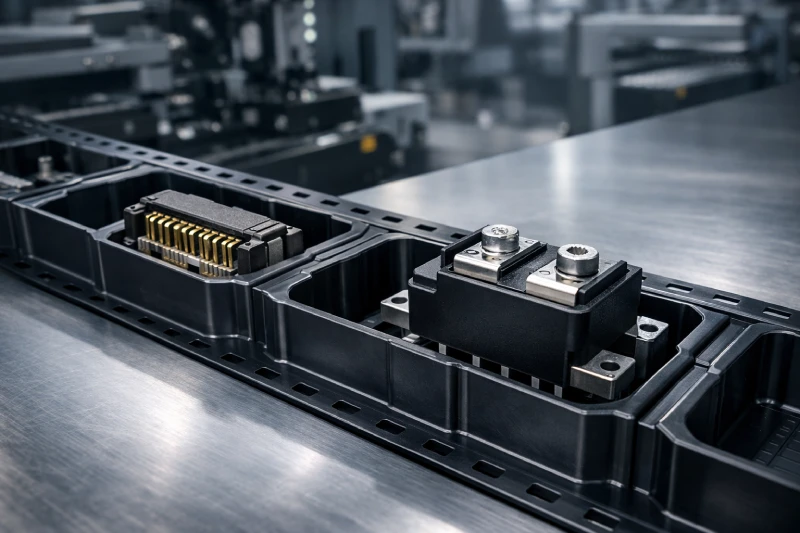
When electronic components become larger, heavier, or more fragile, standard carrier tape is often no longer enough. Connectors, relays, automotive sensors, power modules, and large IC packages can deform ordinary pockets during shipping or SMT feeding. Once that happens, components may tilt, move, crack, or jam inside the feeder.
High-strength carrier tape is designed to solve this problem. By using thicker materials, reinforced pocket structures, and stronger polymers, it keeps heavy components stable from packaging to final placement on the SMT line.
For manufacturers shipping expensive or irregular-shaped components, the right carrier tape is not only a packaging decision—it directly affects yield, production efficiency, and customer satisfaction.
If you are not sure whether your part requires a stronger tape design, submit your drawing or sample for a free evaluation before production begins.
What Is High-Strength Carrier Tape?
High-strength carrier tape is a reinforced version of embossed carrier tape designed for components that place more stress on the pocket during winding, shipping, and feeding. Compared with standard tape, it uses stronger materials and more stable pocket geometry to resist bending, collapse, and cracking.
In most cases, the additional strength comes from one or more of the following:
- Thicker plastic material
- Stronger resin such as PC or PET
- Reinforced pocket walls or ribs
- Optimized pocket depth and support structure
- Better resistance to vibration and winding pressure
A standard carrier tape may work well for lightweight resistors, capacitors, or small ICs. However, once the component becomes heavier or taller, the pocket can begin to deform. High-strength carrier tape prevents that by keeping the component firmly positioned throughout the tape and reel process.
| Feature | Standard Carrier Tape | High-Strength Carrier Tape |
|---|---|---|
| Typical Component Weight | Light | Medium to Heavy |
| Pocket Stability | Moderate | High |
| Resistance to Deformation | Standard | Excellent |
| Suitable for Long-Distance Shipping | Limited | Yes |
| Typical Applications | Small ICs, passive components | Connectors, relays, power modules |
For components with higher mechanical requirements, a reinforced version of Embossed Carrier Tape provides much more reliable protection.
Why Standard Carrier Tape Can Fail with Heavy Components
The most common reason standard carrier tape fails is that the pocket structure cannot handle the combined load of component weight, reel winding pressure, and transportation vibration.
When the pocket walls are too thin or the material is too soft, several problems may occur:
- Pocket walls bend inward
- The bottom of the pocket collapses
- Sharp-edged components crack the sidewall
- The component shifts or tilts inside the cavity
- Cover tape begins to peel because of uneven pressure
- The tape jams during SMT feeding
These failures often appear after the reel has been wound, stacked, shipped, or stored for a period of time. In some cases, the tape looks acceptable during production, but components move during transportation and arrive damaged.
Typical signs that your current carrier tape is not strong enough include:
- Components lean or rotate inside the pocket
- Pocket walls appear bent after winding
- Frequent feeder jams on the SMT line
- Components are damaged after shipping
- Cover tape opens unexpectedly
The hidden cost of using the wrong tape can be much higher than the cost of upgrading to a stronger design. Scrap, rework, production downtime, customer complaints, and missed delivery schedules can all result from insufficient tape strength.
Which Components Require High-Strength Carrier Tape?
Not every component requires reinforced tape. In general, high-strength carrier tape is recommended whenever the component is heavy, large, fragile, or unusually shaped.
Large or Heavy Electronic Components
The most common applications include:
- Board-to-board connectors
- Automotive connectors
- Power modules
- Relays
- Large inductors
- Sensors
- Large IC packages
- RF modules and communication devices
These parts often place much more pressure on the pocket than small SMT components. During reel winding, the weight of the part can distort a weak cavity.
Components with Irregular Shapes
Some components are not especially heavy, but their shape still makes them difficult to package. Examples include:
- Tall components
- Components with sharp corners
- Parts with uneven weight distribution
- Fragile housings or exposed terminals
For these products, the pocket must not only be stronger, but also designed to match the exact shape of the part. A customized pocket structure is often necessary. In these cases, Custom Embossed Carrier Tape is usually the best option.
Harsh Logistics or SMT Conditions
High-strength carrier tape is also valuable when:
- Products are exported long distances
- Reels are stacked during shipping
- Components are used on high-speed SMT lines
- Larger reel diameters increase winding pressure
| Component Type | Why Extra Strength Is Needed |
|---|---|
| Connector | High weight and irregular shape |
| Relay | Large size can deform the pocket |
| Automotive Sensor | Sensitive to vibration |
| Power Module | Heavy and expensive |
| Large IC Package | Requires stable positioning |
Best Materials for High-Strength Carrier Tape
The strength of a carrier tape depends heavily on the material used. Different materials offer different levels of rigidity, cost, and resistance to deformation.
Polycarbonate (PC)
Polycarbonate is generally considered the strongest carrier tape material. It provides excellent rigidity and dimensional stability, making it ideal for large, heavy, or high-value components.
PC is often used for:
- Automotive connectors
- Power modules
- Large industrial components
- Precision parts that must not move inside the pocket
The main disadvantage is cost. PC is usually more expensive than PET or PS, but for critical components, the additional protection is often worth it.
PET
PET offers a strong balance between strength and cost. It is more rigid than standard PS and works well for many heavy-duty packaging applications.
PET is suitable for:
- Medium-weight connectors
- Sensors
- Industrial electronics
- General-purpose reinforced tape
PS / HIPS
Polystyrene and high-impact polystyrene are widely used in standard carrier tape because they are inexpensive and easy to form. However, they are not always strong enough for heavier components.
They may still be acceptable for moderately sized parts, but they are usually not the first choice when maximum strength is required.
Conductive and Anti-Static Materials
Many heavy components are also sensitive to static electricity. In those cases, the tape must provide both mechanical strength and ESD protection.
Conductive PC and conductive PET are commonly used for semiconductors, sensors, and automotive electronics. If your component requires ESD-safe packaging, an Anti-Static Carrier Tape made from conductive material is recommended.
| Material | Strength | Cost | Best For |
|---|---|---|---|
| PC | Very High | High | Heavy connectors, automotive parts |
| PET | High | Medium | General heavy-duty applications |
| PS / HIPS | Medium | Low | Lightweight components |
| Conductive PC / PET | High | High | ESD-sensitive heavy parts |
Design Factors That Determine Carrier Tape Strength
Material alone is not enough. The design of the pocket and reel system also has a major influence on performance.
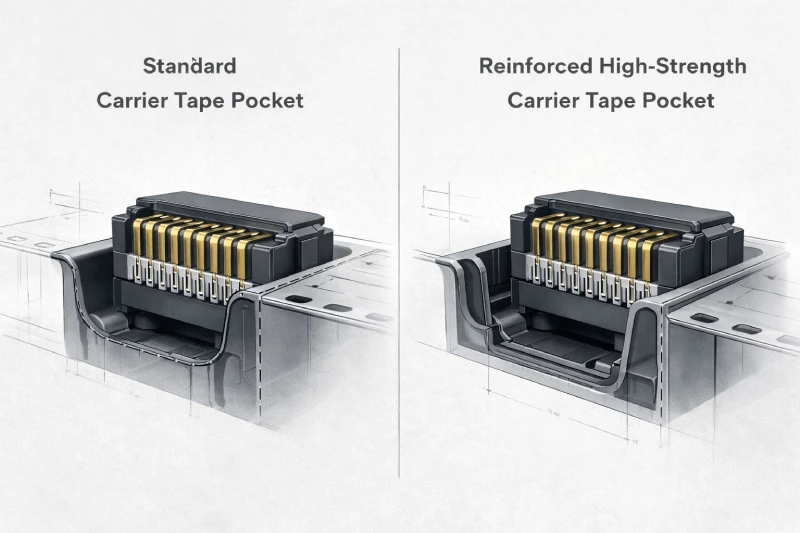
Material Thickness
Thicker material usually creates a stronger and more rigid pocket. As thickness increases, the tape becomes less likely to collapse during winding and transportation.
However, thicker is not always better. If the tape becomes too rigid, it may not feed smoothly through the SMT machine. The ideal thickness depends on the component size, weight, and feeder requirements.
Pocket Geometry
Pocket design has a direct effect on how well the tape supports the component. Important design details include:
- Pocket depth
- Wall angle
- Corner radius
- Bottom support area
- Reinforcement ribs
A pocket with stronger sidewalls and additional support features can hold a heavy component much more securely than a standard cavity.
Reel Diameter and Winding Tension
Large and heavy components often benefit from a larger reel diameter because the tape is bent less sharply. Excessive winding tension can still deform the pocket, even when strong material is used.
Proper reel size and controlled winding force are therefore essential parts of the packaging design.
Cover Tape Selection
High-strength carrier tape must also be matched with the correct cover tape. If the sealing force is too weak, the component may escape from the pocket. If it is too strong, the cover tape may not peel properly during feeding.
In general:
- Heat Activated Cover Tape provides stronger sealing for heavy components
- Pressure Sensitive Cover Tape is easier to use and works well for lighter applications
The best result comes from designing the carrier tape and cover tape as a complete system.
How to Choose the Right High-Strength Carrier Tape
Choosing the correct tape starts with understanding the component and its packaging conditions. Before selecting a material or pocket design, ask the following questions:
- How much does the component weigh?
- What are the component dimensions?
- Does the component require ESD protection?
- Will the reel be shipped long distance?
- What feeder speed will be used?
| Question | Why It Matters |
|---|---|
| Component weight | Determines required material strength |
| Pocket dimensions | Prevents movement and tilt |
| ESD requirement | Determines whether conductive material is needed |
| Shipping distance | Affects risk of deformation and vibration |
| SMT line speed | Influences feeding performance |
For example, a heavy automotive connector shipped internationally may require:
- Conductive PC material
- Reinforced pocket ribs
- Larger reel diameter
- Heat-activated cover tape
A smaller industrial sensor may only require PET with a customized pocket shape.
The easiest way to make the right decision is to provide your supplier with:
- Component drawing
- 3D file or dimensions
- Weight information
- Sample component
- SMT line requirements
With that information, an experienced supplier can recommend the optimal tape structure and perform a trial run before mass production.
High-Strength Carrier Tape vs Standard Carrier Tape: Which Should You Use?
Many companies continue using standard carrier tape because it is less expensive. For lightweight components, that is usually the correct decision. However, once the component becomes heavier or more expensive, the risk of failure increases quickly.
| Situation | Standard Tape | High-Strength Tape |
|---|---|---|
| Small passive components | Best choice | Not necessary |
| Large connectors | Risky | Recommended |
| Long-distance shipping | Limited | Recommended |
| High-speed SMT line | May deform | Better performance |
| Expensive components | Higher risk | Better protection |
In most cases, high-strength carrier tape costs only slightly more than standard tape. Yet it can significantly reduce feeder problems, damaged components, and production delays.
If the cost of a damaged part or line stoppage is greater than the small increase in packaging cost, high-strength carrier tape is the better choice.
FAQs
What is the strongest material for carrier tape?
Polycarbonate is generally the strongest material used for carrier tape. It provides excellent rigidity and is ideal for heavy connectors, power modules, and other demanding applications.
Can high-strength carrier tape also be anti-static?
Yes. Conductive PC and conductive PET materials combine high mechanical strength with ESD protection. They are commonly used for semiconductors and automotive electronics.
Is thicker carrier tape always better?
No. Thicker material increases strength, but if it becomes too rigid, feeding performance may suffer. The correct thickness depends on both the component and the SMT process.
How do I know if my component needs reinforced pockets?
If the component is heavy, tall, irregularly shaped, or frequently moves inside the pocket, reinforced pockets are recommended.
Can high-strength carrier tape be customized?
Yes. High-strength carrier tape can be fully customized based on your component dimensions, weight, and SMT requirements.
Protect Your Components with the Right Carrier Tape
Using the wrong carrier tape may save a small amount on packaging, but it can lead to damaged components, SMT feeding problems, and expensive production delays.
A properly designed high-strength carrier tape keeps heavy and fragile parts secure throughout shipping and assembly. By selecting the right material, pocket design, and cover tape combination, you can reduce risk and improve production reliability.
Need help choosing the correct solution? Send your component drawing, sample, or specification to our engineering team and request a free carrier tape evaluation today.