
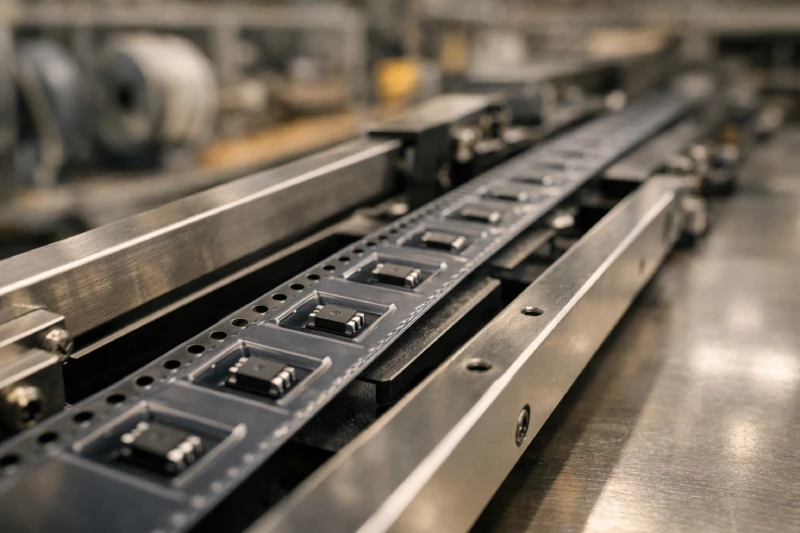
In modern SMT environments, Carrier Tape is no longer a passive packaging material—it is a structural component that directly influences placement accuracy, feeding stability, and long-term process consistency. Many subtle placement deviations, feeder inconsistencies, and even incoming quality fluctuations are not caused by machine misalignment, but by insufficient material rigidity and structural stability in the tape itself.
High-strength Carrier Tape does not simply mean “thicker” or “harder.” It refers to a material and structural configuration capable of maintaining pocket geometry, sprocket-hole alignment, and dimensional consistency under dynamic feeding, transportation stress, and extended storage conditions.
To determine whether upgrading tape strength is necessary, engineers must evaluate three core dimensions: geometric stability, dynamic feeding behavior, and transportation durability. The following sections analyze how higher structural strength contributes to packaging precision—and when it becomes critical.
What Hidden Accuracy Issues Can Occur When Carrier Tape Lacks Structural Strength?
In high-speed SMT lines—especially above 60,000 CPH—the tape experiences repeated tensile and bending forces as it advances through the feeder. If the material rigidity is insufficient, micro-deflection and lateral deformation may gradually occur.
Common symptoms include:
- Cumulative pitch drift over long feeding distances
- Slight pocket center deviation
- Minor sprocket-hole alignment variation
- Increased lateral movement of components before pick-up
These issues rarely appear during short incoming inspections. Instead, they become evident after extended feeder operation. Engineers often begin troubleshooting machine calibration, nozzle offsets, or program compensation. However, if machine repeatability is verified, the tape’s structural rigidity becomes a critical factor.
In such cases, upgrading to a more dimensionally stable embossed carrier tape solution can significantly improve long-run feeding consistency without modifying machine parameters.
When Should You Consider High-Strength Carrier Tape Instead of Standard Specifications?
Not every project requires higher structural strength. The key is identifying risk conditions where standard tape may become a performance limitation.
Consider evaluating high-strength options when:
- Components are large, heavy, or mechanically sensitive (connectors, power devices)
- Production lines operate at high placement speeds
- Shipments involve long-distance export or multi-stage logistics
- Storage conditions include elevated temperature or humidity
- Components require repeated re-taping or partial reel handling
Under these circumstances, the tape is exposed to increased mechanical and environmental stress. If the material modulus is insufficient, micro-deformation may already occur during transport, later amplifying into feeding instability during assembly.
For complex or non-standard components, optimized structural design—such as reinforced walls in custom carrier tape configurations—may enhance rigidity without unnecessary material upgrades.
How Does Material Rigidity Directly Influence Pocket Geometry Stability?
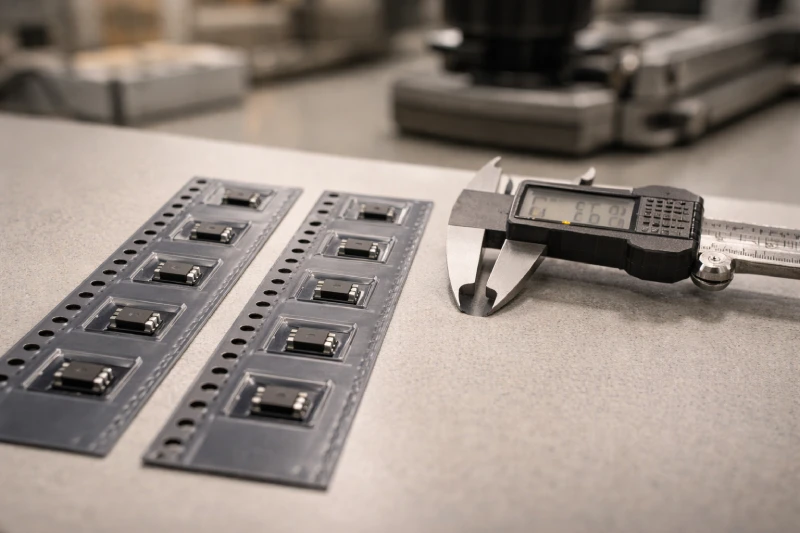
Carrier Tape stability is primarily determined by material modulus and formed wall thickness.
Common materials such as PS, PET, and PC exhibit different flexural properties. Lower-modulus materials are more prone to creep behavior under sustained load, especially when reels are stacked or stored under pressure. Over time, this can subtly alter pocket geometry.
Consequences may include:
- Slight component tilt inside the pocket
- Increased lateral clearance
- Reduced positional stability before pick-up
Although such changes are often invisible to the naked eye, they can reduce pick-up repeatability and increase placement variability.
Higher-strength material solutions combine improved modulus with optimized wall thickness, minimizing long-term deformation and maintaining pocket-center integrity. This geometric stability forms the foundation of consistent packaging precision.
How Does High-Strength Carrier Tape Improve Impact Resistance During Transportation?
Transportation frequently imposes greater mechanical stress on tape than the SMT process itself.
When reels are stacked, continuous vertical pressure is applied to lower layers. During shipping, vibration energy transfers through the reel structure to the pockets. If the material lacks sufficient strength, stress concentration may lead to micro-cracking or subtle pocket distortion.
These issues often appear at incoming inspection as:
- Localized pocket cracking
- Component orientation irregularities
- Inconsistent cover tape peeling behavior
By improving flexural and impact resistance, high-strength Carrier Tape reduces transportation-induced deformation, lowering incoming defect variability. This advantage is particularly relevant for export programs and multi-region supply chains.
Does Higher Structural Strength Affect Cover Tape Peeling Stability?
A common misconception is that stronger material automatically results in unstable or excessive peel force.
In practice, structural modulus and surface energy are separate parameters. With appropriate surface treatment and conductive layer design, high-strength materials can maintain stable peel-force windows within EIA-481 guidelines.
Key factors include:
- Surface energy control
- Proper cover tape matching
- Controlled peel angle and speed
- Standardized validation testing
For example, anti-static carrier tape designs integrate surface treatment and conductivity without compromising mechanical rigidity. Therefore, upgrading structural strength does not inherently create peeling instability—provided the system is engineered holistically.
How Can You Optimize Strength and Precision Without Excessive Cost Increase?
Higher strength does not necessarily mean switching entirely to premium materials such as PC.
Engineering optimization may include:
- Adjusting pocket wall thickness
- Adding structural reinforcement features
- Improving forming precision
- Enhancing batch-to-batch dimensional consistency
In many cases, structural refinement delivers sufficient rigidity improvement without major material cost escalation.
It is also important to recognize that tooling accuracy and forming stability often contribute more to precision than material selection alone. Material upgrades should be data-driven decisions supported by dimensional validation and feeder testing—not assumptions.
How Can You Determine Whether Carrier Tape Has Become a Precision Bottleneck?
When placement instability persists after machine and program verification, a structured evaluation of the tape is recommended.
Practical validation methods include:
- Measuring pocket-to-hole center deviation
- Inspecting cumulative pitch variation over long tape sections
- Conducting extended feeder-run comparison tests
- Analyzing performance trends across different production batches
If deviation increases with feeding length, or if batch-to-batch consistency fluctuates despite stable process parameters, the tape’s structural performance may be limiting overall accuracy.
High-strength Carrier Tape is not about over-specification—it is about maintaining geometric integrity under real-world dynamic and environmental conditions. For high-speed, low-variation SMT production environments, long-term dimensional stability often determines overall yield consistency more than short-term machine calibration alone.