
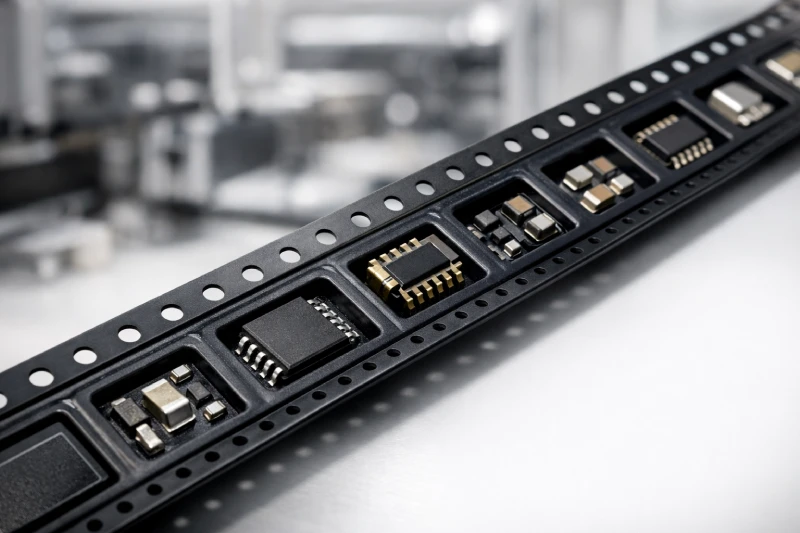
Low-quality carrier tape often looks acceptable at first glance. The pockets may appear clean, the tape may fit the reel, and the dimensions may seem close enough. But once the tape enters an SMT feeder, small quality issues can quickly become expensive production problems.
Inconsistent pocket dimensions, weak material strength, poor peel force, or inaccurate sprocket holes can cause misfeeds, component flipping, feeder stoppages, and even damage to valuable electronic parts. When thousands of components are loaded every hour, even a small defect rate can significantly reduce yield and increase manufacturing cost.
High quality carrier tape is therefore not simply “better-looking” tape. It is a critical part of the entire SMT packaging system. A well-designed tape protects the component, feeds smoothly, works consistently with the cover tape, and maintains stable performance from the first reel to the last.
If you are comparing suppliers or evaluating your current packaging process, this guide explains what high quality carrier tape really means, how to evaluate it, and how to choose the right solution for your components.
For a broader overview of available materials and structures, you can first explore our carrier tape solutions.
What Is Considered a High Quality Carrier Tape?
A high quality carrier tape is a tape that can hold components securely, feed reliably through SMT equipment, and maintain stable performance throughout transportation, storage, and production.
Many buyers judge carrier tape only by appearance or price. In reality, carrier tape quality is determined by whether it performs consistently across the entire tape-and-reel process. A tape that looks acceptable but causes feeder problems or unstable sealing is not truly high quality.
A high quality carrier tape should:
- Hold each component securely inside the pocket
- Prevent movement, flipping, or damage during shipping
- Feed smoothly through pick-and-place equipment
- Maintain stable pocket dimensions and sprocket hole accuracy
- Work consistently with the selected cover tape and reel
- Resist cracking, deformation, or static buildup
5 Core Characteristics of High Quality Carrier Tape
- Precise pocket dimensions
- Stable material strength
- Reliable peel force with cover tape
- Accurate pitch and indexing holes
- Low defect rate during mass production
Carrier tape should never be evaluated as a standalone product. It must work correctly within the complete tape and reel packaging process. If any part of the system is unstable, overall SMT performance suffers.
Why Low-Quality Carrier Tape Causes Expensive Problems
Low-quality carrier tape does not only create minor inconvenience. It can directly increase downtime, labor cost, and component loss.
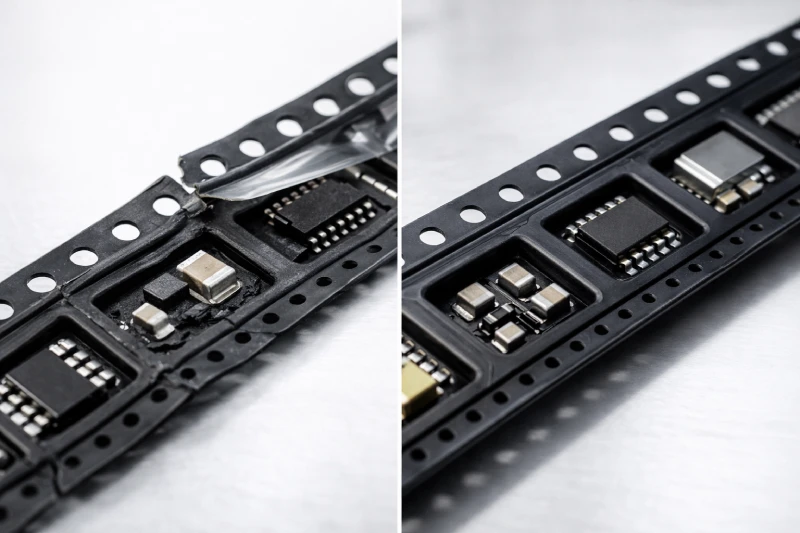
The most common problems include:
- Pocket dimensions that vary from reel to reel
- Thin material that bends or cracks during transport
- Incorrect sprocket hole position that affects feeder accuracy
- Weak sealing between carrier tape and cover tape
- Components tilting, flipping, or escaping from the pocket
When these issues occur on an SMT line, the result is often feeder stoppage. Operators must stop the machine, remove the damaged reel, and restart the line. Even a few minutes of downtime becomes expensive when multiple feeders are affected.
| Low-Quality Carrier Tape | High Quality Carrier Tape |
|---|---|
| Inconsistent pocket size | Tight dimensional tolerance |
| Feeding problems and jams | Smooth, stable machine feeding |
| Weak material and deformation | Durable and repeatable structure |
| Cover tape lifting or peeling | Stable sealing performance |
| High scrap rate | Lower component loss |
Low-quality tape can also damage the component itself. Delicate ICs, connectors, and precision sensors may crack, scratch, or lose alignment inside the pocket. The more expensive the component, the greater the financial impact.
In high-volume production, even a 0.5% defect rate can create thousands of rejected parts. That is why many manufacturers now prefer premium carrier tape instead of choosing only by price.
7 Key Factors That Determine Carrier Tape Quality
Before selecting a carrier tape supplier, engineers and buyers should evaluate these seven quality factors.
1. Material Stability
The carrier tape material determines whether the tape can maintain its shape and performance during storage, shipping, and production.
Common materials include:
- PS (Polystyrene): economical and widely used
- PC (Polycarbonate): stronger and more dimensionally stable
- PET: good for heat resistance and durability
- Anti-static or conductive materials: used for static-sensitive components
For components with tight tolerances or long transportation distances, stronger materials usually perform better. Thin or unstable materials can bend, shrink, or crack, especially in high-temperature environments.
For static-sensitive components such as semiconductors or ICs, anti-static carrier tape is often required to prevent ESD damage.
2. Pocket Accuracy
Pocket accuracy is one of the most important indicators of high quality carrier tape.
The width, depth, shape, and radius of the pocket must match the component precisely. If the pocket is too large, the component may move or rotate. If the pocket is too small, the component may become damaged during loading.
Pocket accuracy is especially important for:
- ICs and chips
- Fine-pitch connectors
- LEDs
- Precision sensors
- Small or irregular-shaped electronic parts
A reliable carrier tape supplier should be able to provide pocket drawings, dimensional reports, and sample reels for testing.
3. Sprocket Hole Accuracy and Pitch
The sprocket holes guide the tape through the feeder. If their size or position is inconsistent, the feeder cannot index correctly.
Poor sprocket hole accuracy may cause:
- Feeding misalignment
- Incorrect pick position
- Feeder jams
- Machine stoppages
High quality carrier tape should comply with EIA-481 standards for pitch, hole diameter, and dimensional tolerance.
4. Peel Force Consistency
Peel force refers to how easily the cover tape separates from the carrier tape during feeding.
If the peel force is too high, the feeder may struggle to open the tape smoothly. If it is too low, the cover tape may lift during transport and allow components to fall out.
Stable peel force depends on the correct combination of carrier tape and cover tape. In many cases, a supplier should recommend whether heat activated cover tape or pressure sensitive cover tape is more suitable for the application.
The goal is consistent opening performance across the entire reel, not only at the beginning.
5. ESD Protection
Many modern electronic components are sensitive to electrostatic discharge. Even a small static charge can damage semiconductor parts.
For these applications, carrier tape must provide ESD protection through conductive or anti-static material.
ESD-safe carrier tape is especially important for:
- ICs
- Semiconductor devices
- Sensitive sensors
- Communication modules
- High-value electronic assemblies
Without proper ESD performance, the component may fail before it even reaches the SMT line.
6. Strength and Durability
A high quality carrier tape should remain stable during:
- Long-distance shipping
- Reel winding and unwinding
- High-speed feeder operation
- Warehouse storage
- Export transportation
The tape should resist:
- Cracking
- Compression
- Bending
- Deformation
- Pocket collapse
This is particularly important when components are shipped internationally or stored for long periods before use.
7. Production Consistency
A good sample reel is not enough. The real test of carrier tape quality is whether every production batch performs the same way.
Some suppliers can produce one excellent sample but cannot maintain the same quality during mass production. As a result, buyers receive reels with different pocket sizes, material thickness, or peel force.
A professional supplier should have:
- Stable tooling and forming process
- Clear inspection standards
- Batch traceability
- Consistent material sourcing
- In-line and final quality inspection
The lower the variation between batches, the more reliable the carrier tape will be in real production.
How to Evaluate Carrier Tape Quality Before Ordering
Before approving a new carrier tape supplier, it is important to test more than just a few pocket dimensions.
Use the following checklist before placing a production order:
- Request a detailed pocket drawing and tolerance report
- Confirm material type, thickness, and ESD specification
- Ask whether the tape complies with EIA-481
- Test the tape in the actual feeder machine you use
- Check that the tape works correctly with the selected cover tape
- Compare multiple sample reels, not just one
- Verify that the component remains stable during vibration and transport testing
- Ask for the supplier’s inspection method and defect rate target
Before approving mass production, always test at least one reel on your real SMT line. This is the fastest way to identify potential problems before a larger order is placed.
If your component has a special shape, unusual thickness, or tight dimensional tolerance, using a custom embossed carrier tape is usually the safest option. A custom pocket reduces movement and improves pick-and-place accuracy.
Which Components Need Higher-Quality Carrier Tape Most?
Not every component requires the same level of carrier tape performance. Small, delicate, or high-value parts usually need much tighter control.
| Component Type | Why High Quality Carrier Tape Matters |
|---|---|
| ICs / Chips | Static-sensitive and require precise positioning |
| Connectors | Irregular shapes can tilt or jam easily |
| LEDs | Sensitive to pressure, vibration, and movement |
| Precision Sensors | Easily damaged during transport |
| Fine-Pitch Components | Require highly accurate pick-and-place alignment |
ICs and chips are among the most demanding applications because they are both fragile and ESD-sensitive. Connectors often require custom pocket shapes because of their unusual geometry.
For many of these applications, embossed carrier tape provides better pocket accuracy and more reliable retention than standard flat tape.
As a general rule, the more expensive or delicate the component is, the more important carrier tape quality becomes.
How to Choose the Right High Quality Carrier Tape Supplier
Choosing a carrier tape supplier only by price often creates more cost later.
A low-cost supplier may provide cheaper tape initially, but if the tape causes production delays or component damage, the total cost becomes much higher.
Instead, choose a supplier based on:
- Experience with similar components
- Ability to design custom pockets
- Understanding of ESD and material selection
- Capability to provide drawings and test samples
- Stable quality control process
- Fast response and engineering support
- Ability to support both prototype and mass production
Questions to Ask a Carrier Tape Supplier
Before placing an order, ask the supplier:
- Have you produced carrier tape for similar components?
- Can you provide dimensional drawings and sample reels?
- Which material do you recommend, and why?
- What inspection process do you use?
- Can you guarantee batch-to-batch consistency?
- Which cover tape is compatible with this carrier tape?
- How quickly can you provide samples and production lead time?
An experienced supplier should answer these questions clearly and confidently.
If your component has a complex shape or tight tolerance, working with a custom carrier tape manufacturer can reduce risk, improve feeder performance, and shorten development time.
FAQs
What is the difference between standard and high quality carrier tape?
Standard carrier tape may meet only basic dimensional requirements. High quality carrier tape provides tighter tolerances, more stable material, better peel force, and more consistent feeding performance.
How do I know if my carrier tape is causing SMT feeding issues?
Common signs include feeder jams, component flipping, inaccurate pick position, damaged parts, or cover tape lifting during operation.
Is anti-static carrier tape necessary for all components?
No. Anti-static carrier tape is mainly required for static-sensitive components such as ICs, semiconductors, and sensitive sensors.
Can custom carrier tape improve production efficiency?
Yes. Custom carrier tape can improve component retention, reduce feeding problems, and increase pick-and-place accuracy.
What standards should carrier tape follow?
Most carrier tape should comply with EIA-481. Depending on the application, buyers may also require RoHS, REACH, and internal quality inspection standards.
Conclusion
High quality carrier tape is more than packaging material. It is a key part of SMT production reliability.
The right carrier tape protects valuable components, improves feeding stability, reduces machine downtime, and lowers overall production cost. When evaluating carrier tape, focus on material stability, pocket accuracy, peel force, ESD protection, and batch consistency instead of choosing only by price.
If you are experiencing feeding problems, damaged components, or inconsistent reel quality, it may be time to review your current packaging method.
Need help selecting the right carrier tape for your component? Send us your component drawing or sample, and our engineering team can recommend the most suitable carrier tape structure, material, and cover tape combination for your application.