
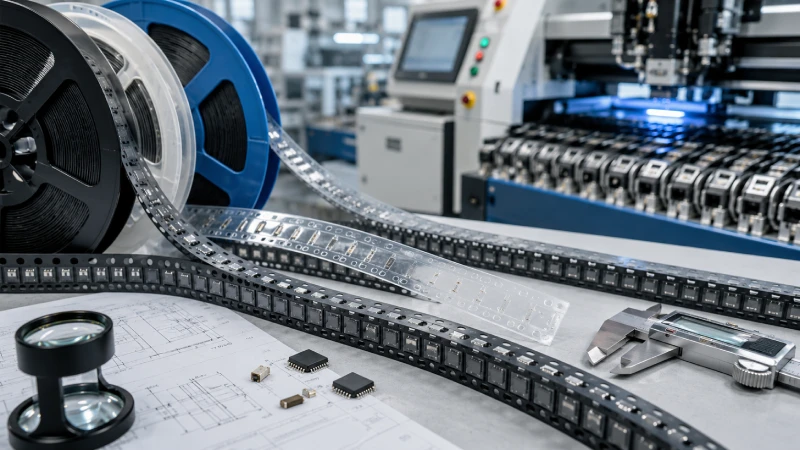
For electronic component manufacturers, SMT assembly suppliers, OEM quality teams, and procurement teams, carrier tape is not just a packaging material—it directly affects SMT feeding stability, component protection, and production efficiency.
That is why sourcing from an EIA-481 carrier tape manufacturer is not just about compliance wording. It is about ensuring the tape-and-reel packaging actually performs smoothly in real SMT production environments.
Buyers do not need to deeply study the full standard. Instead, they should focus on practical confirmation points: pocket fit, tape width, pitch consistency, cover tape behavior, reel compatibility, and sample approval before mass production.
Jiushuo supports carrier tape, embossed carrier tape, cover tape, and plastic reel solutions for SMT tape-and-reel packaging applications.
What Does EIA-481 Mean for Carrier Tape Buyers?
EIA-481 is a widely used reference standard for tape-and-reel packaging in SMT applications. For buyers, it mainly defines a shared packaging framework between component manufacturers, tape suppliers, and SMT assembly lines.
It ensures that components can be packaged, transported, and fed into SMT machines in a predictable way.
However, from a procurement perspective, the real value is not reading the standard—it is ensuring:
- Components remain stable inside pockets
- Tape runs smoothly through SMT feeders
- Cover tape protects components during transport
- Reels match automation systems
- Packaging supports consistent mass production
In practice, EIA-481 is a starting point, not the final guarantee of performance.
Why EIA-481 Compatibility Matters When Choosing a Carrier Tape Manufacturer
Working with an experienced EIA-481 carrier tape manufacturer reduces risks across the SMT supply chain.
Common production issues caused by poor carrier tape design include:
- Component rotation inside pockets
- Pick-and-place misalignment
- Feeding interruption on SMT lines
- Unstable cover tape peeling
- Reel deformation during transport
- Inconsistent indexing through sprocket holes
These issues often lead to downtime or rework in SMT production.
A qualified supplier helps solve these problems early by optimizing:
- Pocket geometry based on real component shape
- Tape width and pitch consistency
- Material selection for stability and protection
- Cover tape sealing performance
- Reel compatibility with automation systems
Jiushuo’s embossed carrier tape is designed for SMT components that require stable positioning, controlled movement, and consistent feeding performance.
Key EIA-481-Related Items Buyers Should Confirm With Suppliers
| Item | Buyer Confirmation Point |
|---|---|
| Tape width | Must match component size and feeder system |
| Pocket pitch | Ensures stable indexing and spacing |
| Pocket dimensions | Fit A0/B0/K0 requirements of component |
| Pocket stability | Prevents rotation or tilt during movement |
| Sprocket hole alignment | Ensures smooth SMT feeder operation |
| Cover tape sealing | Must protect component and peel consistently |
| Reel compatibility | Matches storage and feeding equipment |
| Winding direction | Prevents assembly orientation errors |
| Material type | Anti-static or conductive as required |
| Sample validation | Must be confirmed before mass production |
This checklist helps procurement teams avoid vague RFQs and ensures clearer communication with suppliers.
How to Evaluate an EIA-481 Carrier Tape Manufacturer
A reliable supplier should always start with the component, not the order quantity.
Before quoting, they should request:
- Component drawings or datasheets
- 3D models or physical samples
- Orientation requirements in the tape
- SMT feeder or machine compatibility
- Packaging environment requirements
A strong manufacturer should be able to provide:
- Pocket design recommendations
- Embossed carrier tape customization
- Cover tape compatibility matching
- Reel selection guidance
- Sample production before bulk order
- Repeat production consistency control
Jiushuo provides full tape-and-reel packaging support, including carrier tape, cover tape, and plastic reels for SMT applications.
Carrier Tape Standard vs Real SMT Feeding Performance
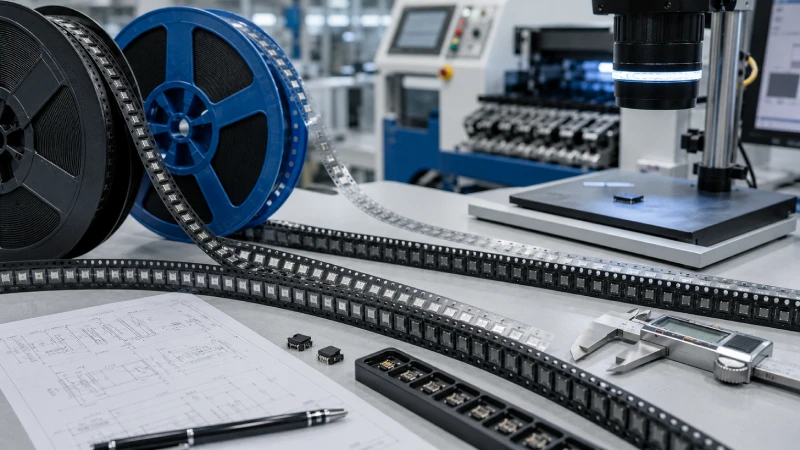
Even when a tape is designed according to EIA-481 principles, real SMT performance can still vary.
This is because standards cannot fully account for:
- Component weight distribution differences
- Irregular geometries
- Machine-specific feeder tolerances
- Vibration during transport
- Humidity or static conditions
Common real-world issues include:
- Component shifting inside pockets
- Unstable pick-up positions
- Feeding jams in high-speed SMT lines
- Cover tape peeling inconsistency
- Reel deformation under tension
This is why sample testing is essential. Buyers should always validate:
- Real component fit inside pockets
- SMT feeder performance
- Pick-and-place accuracy
- Cover tape peeling behavior
- Reel winding stability
A supplier that supports trial runs and sample approval reduces long-term production risk significantly.
Cover Tape and Reel Compatibility Should Not Be Ignored
Carrier tape does not work alone—it is part of a full packaging system.
Cover tape ensures:
- Component protection during transport
- Dust and contamination resistance
- Stable peeling performance during SMT feeding
Plastic reels ensure:
- Safe winding and storage
- Stable unwinding in SMT machines
- Reduced deformation during logistics
Jiushuo provides integrated solutions including:
- cover tape for stable sealing performance
- plastic reel for SMT-compatible winding systems
A matched system reduces compatibility risks and improves overall production stability.
Quotation Checklist for Buyers
To get accurate quotations from a carrier tape manufacturer, buyers should prepare:
Component details:
- Size (L/W/H)
- Shape and structure
- Orientation requirements
- Lead or terminal configuration
- Sensitivity (ESD or mechanical)
Packaging requirements:
- Tape width and pitch, if known
- Pocket fit expectations
- Cover tape requirement
- Reel size requirement
- Monthly or annual volume
- Sample quantity
Supplier communication questions:
- Can you recommend pocket design?
- Can you provide samples before mass production?
- Can you ensure repeat production consistency?
- Can you support full tape-and-reel packaging?
When Should Buyers Choose Custom Embossed Carrier Tape?
Custom embossed carrier tape is recommended when:
- Components have irregular shapes
- Standard pockets cannot ensure stability
- High precision SMT feeding is required
- Components are high-value or sensitive
- New product packaging is being developed
In these cases, pocket design becomes critical to production success.
Jiushuo’s embossed carrier tape solutions help buyers optimize:
- Component positioning
- Feeding stability
- Orientation control
- SMT efficiency
Need EIA-481-Compatible Carrier Tape for SMT Packaging?
Jiushuo supports full SMT tape-and-reel packaging solutions including carrier tape, embossed carrier tape, cover tape, and plastic reels.
If you are sourcing packaging for SMT components, you can request:
- Component review
- Tape structure recommendation
- Sample testing support
- Full packaging system matching
FAQ
What is EIA-481 carrier tape?
It is a tape-and-reel packaging reference used in SMT production to support consistent component handling and feeder compatibility.
Does EIA-481 guarantee SMT feeding success?
No. It provides a framework, but real performance still depends on component fit, sample testing, and machine conditions.
Why is sample testing important?
Because real component behavior inside pockets can only be verified under actual SMT feeding conditions.
What should I confirm with a carrier tape supplier?
Tape width, pocket size, pitch, cover tape, reel compatibility, and sample approval process.
Can one supplier provide tape, cover tape, and reels together?
Yes, and this is recommended to improve system compatibility and reduce sourcing risk.
When should I use custom embossed carrier tape?
When standard tape cannot provide stable fit or when components require precise positioning and protection.