

Carrier tape plays a direct role in how electronic components are protected, transported, stored, and fed into automated assembly equipment. For component manufacturers, SMT packaging teams, OEM buyers, and distributors, carrier tape quality is not only a packaging concern. It can affect component orientation, pick-and-place stability, production efficiency, and customer acceptance.
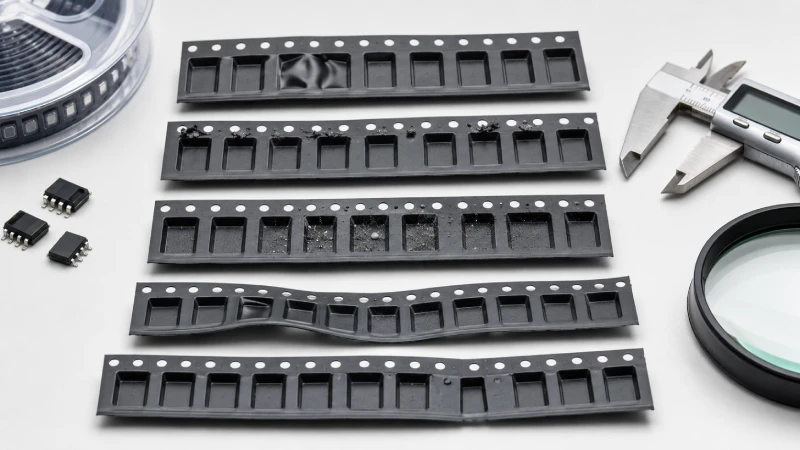
Many carrier tape defects are visible or can be found through practical inspection before shipment or mass production. These include pocket deformation, poor forming, wrong pocket size, burrs, dust, tape warping, pitch inconsistency, weak sealing, and ESD-related concerns. While advanced testing may be required for some applications, most buyers first need a clear and practical way to understand what should be checked and why it matters.
This guide explains common carrier tape defects, typical inspection methods, and the key confirmation points buyers should discuss with suppliers. It also explains how Jiushuo supports embossed carrier tape quality control through pocket design review, sample approval, cover tape matching, and pre-shipment inspection.
Why Carrier Tape Inspection Matters Before Mass Production
Carrier tape is designed to hold components in a stable and repeatable position. During transport and SMT feeding, each component should stay in the pocket without excessive movement, rotation, tilting, or damage. If the tape is poorly formed or the pocket is not properly matched to the part, problems may appear later in the production line.
For example, a slightly oversized pocket may allow components to rotate during movement. A pocket that is too tight may cause scraping or jamming. Uneven sealing may make the cover tape difficult to peel, while weak sealing may allow parts to move or fall out. Even small defects can become serious when the tape is used in high-volume packaging.
That is why carrier tape inspection should happen before mass production whenever a new component, new tooling, new material, or new packaging requirement is involved. The goal is not to promise that defects can never happen. The practical goal is to reduce risk, confirm compatibility, and help both the supplier and buyer identify issues before large quantities are produced.
Common Carrier Tape Defects Buyers Should Watch For
Carrier tape defects can come from material selection, forming conditions, tooling, punching, handling, storage, or sealing setup. Some defects are easy to see, while others only become clear after placing real components into the pockets.
Pocket deformation is one of the most common issues. A deformed pocket may not hold the component in the correct position. Poor forming can also create unclear pocket walls, uneven depth, or weak pocket structure. These problems may affect component seating and feeding stability.
Wrong pocket size is another critical defect. If the pocket length, width, or depth does not match the component, the part may move too much or fit too tightly. For irregular components, the pocket design must consider not only basic dimensions but also shape, weight, orientation, and contact points.
Burrs and rough edges may appear near punched holes, tape edges, or pocket openings. They can affect smooth feeding and may also create loose particles. Dust and visible contamination can cause concern for sensitive electronic components, especially when cleanliness is important.
Tape warping or curling may affect how the tape moves through packaging or SMT equipment. Pitch inconsistency can cause alignment problems. Weak sealing or uneven cover tape adhesion may lead to unstable packaging. For ESD-sensitive parts, the material type and surface control also need to match the buyer’s requirements.
Carrier Tape Defects, Possible Causes, and Inspection Focus
| Defect Type | Possible Cause | Inspection Focus |
|---|---|---|
| Pocket deformation | Improper forming, unstable tooling, unsuitable material thickness | Check pocket shape, component seating, and visible deformation |
| Poor pocket forming | Inconsistent forming temperature or tooling condition | Check pocket clarity, sidewall shape, and repeatability |
| Wrong pocket size | Incorrect design data, inaccurate sample measurement, or tooling mismatch | Check component fit, pocket width, length, depth, and clearance |
| Burrs or rough edges | Cutting, punching, or trimming issues | Check sprocket holes, tape edges, and pocket openings |
| Dust or contamination | Poor handling, storage, or production environment | Check tape surface, pockets, and reel cleanliness |
| Tape warping or curling | Material stress, storage condition, or forming imbalance | Check tape flatness and feeding stability |
| Pitch inconsistency | Punching or forming alignment issue | Check pocket pitch and sprocket hole consistency |
| Weak or uneven sealing | Cover tape mismatch or poor sealing setup | Check cover tape adhesion, peeling smoothness, and sealing consistency |
| ESD concern | Wrong material selection or unclear surface requirement | Confirm conductive or anti-static material needs before production |
This table is not a replacement for formal quality standards. Instead, it gives buyers and packaging teams a practical starting point when reviewing carrier tape samples, supplier reports, or pre-shipment inspection details.
Practical Carrier Tape Inspection Methods
Carrier tape inspection does not always need to be complicated. For many projects, the first stage is a practical review of visible quality, dimensions, component fit, sealing condition, and packaging appearance.
Visual inspection is used to check pocket deformation, rough edges, dust, scratches, tape warping, and general forming condition. This step is simple but important because many packaging risks can be found before testing with equipment.
Dimensional checks are used to confirm pocket length, width, depth, pitch, and sprocket hole alignment. The goal is to make sure the tape matches the component and is suitable for feeding. For custom components, this step should be based on actual drawings or physical samples.
Component fit checks are especially important. The component should sit securely in the pocket without being forced into place. It should not rotate excessively, tilt easily, or move in a way that affects feeding. For heavier or irregular parts, fit checking is often more valuable than looking only at basic dimensions.
Cover tape sealing checks help confirm whether the sealing is stable and suitable for the application. The cover tape should seal well enough to protect the components, but it should also peel smoothly during automated use. Jiushuo can also support matching between carrier tape and cover tape so that buyers can reduce sealing-related packaging risks.
Before shipment, packaging inspection may include reel condition, winding quality, labeling, outer packing, and protection during transport. These points matter because even a well-made carrier tape can be affected by poor winding or handling.
Pocket Size and Component Fit: The Most Important Inspection Point
Among all carrier tape inspection items, pocket fit is often the most important. A carrier tape may look clean and well formed, but if the pocket does not match the component, the packaging may still fail during actual use.
If the pocket is too small, components may be difficult to load or may become scratched. A tight pocket can also create jamming risks. If the pocket is too large, the component may rotate, shift, or tilt during movement. This can lead to incorrect pickup position during SMT assembly.
Pocket depth also needs attention. A shallow pocket may not provide enough protection, while a very deep pocket may affect pickup stability or component presentation. For taller or heavier components, the pocket structure should support the part without allowing unnecessary movement.
This is why custom tape design should start with accurate component information. Buyers should provide component drawings, actual samples, packaging direction, and any special handling requirements. For parts with irregular shapes, Jiushuo can help develop custom carrier tape based on practical packaging needs rather than using a one-size-fits-all approach.
Cover Tape Matching and Sealing Quality
Carrier tape quality should not be checked separately from cover tape. In tape and reel packaging, the carrier tape, cover tape, and reel need to work together. If the cover tape does not match the carrier tape material or sealing condition, the final packaging may still have problems.
Weak sealing can allow components to move, fall out, or become exposed during transport. Uneven sealing may create inconsistent peeling. If the cover tape is too difficult to peel, it may interrupt automated feeding. If it peels too easily, it may not provide enough protection.
Buyers should confirm the cover tape type, sealing method, expected peeling behavior, and compatibility with the carrier tape material. For sensitive components, ESD needs should also be discussed clearly. The right cover tape choice helps improve packaging stability and reduce problems during automatic feeding.
Why Sample Approval Matters Before Mass Production
Sample approval is one of the most effective ways to reduce carrier tape defects before mass production. It gives both the buyer and supplier a chance to confirm the design, material, pocket fit, cover tape matching, and packaging direction before bulk quantities are produced.
During sample approval, the buyer can place real components into the pockets and check whether the fit is stable. The packaging team can review orientation, pocket depth, tape flatness, and sealing condition. If needed, the sample can also be tested with actual packaging equipment or SMT equipment.
This step is especially important for new components, irregular shapes, heavier parts, sensitive electronic components, and projects with strict packaging requirements. Without sample approval, small design errors may only be found after mass production begins, which can lead to delays, rework, or rejected packaging.
Jiushuo supports sample confirmation for embossed carrier tape, cover tape matching, and complete tape and reel packaging requirements. The purpose is to help buyers make decisions with more confidence before moving to large-volume production.
What Buyers Should Confirm With Carrier Tape Suppliers
Before placing an order, buyers should confirm several practical points with the carrier tape supplier. These details help reduce misunderstanding and improve production consistency.
First, the buyer should confirm whether the supplier has accurate component drawings or actual samples. If only approximate dimensions are provided, the pocket design may not be reliable. Second, the required pocket length, width, depth, pitch, and orientation should be discussed clearly.
Material selection is also important. Buyers should confirm whether the component needs conductive, anti-static, or standard material. For ESD-sensitive components, the requirement should be stated before sample production.
Cover tape type and sealing preference should also be confirmed. A complete packaging solution should consider the relationship between carrier tape, cover tape, reel, winding direction, and packaging protection.
Buyers should also ask about sample approval, inspection before shipment, labeling, and packing method. For export projects, stable packing and clear labeling help distributors and OEM buyers manage inventory and incoming inspection more easily.
How Jiushuo Supports Carrier Tape Quality Control
Jiushuo supports carrier tape quality control by focusing on practical production and packaging needs. Instead of treating carrier tape as a simple plastic packaging material, Jiushuo reviews component fit, forming quality, cover tape compatibility, and shipment readiness.
For embossed carrier tape projects, Jiushuo can help review component size, pocket structure, material selection, tape width, pitch, and reel matching. During sample preparation, the team can check visible forming quality, pocket shape, fit condition, and sealing compatibility.
For buyers who need a more complete solution, Jiushuo can also support cover tape matching and tape and reel packaging coordination. This helps reduce problems caused by mismatched materials, poor sealing, or unclear packaging requirements.
The goal is to help component manufacturers, SMT packaging teams, OEM buyers, and distributors reduce packaging risk before mass production and shipment. While no supplier should claim that defects can be completely eliminated, a clear inspection and sample approval process can greatly improve confidence and consistency.
Need Help Checking Carrier Tape Quality Before Production?
If you are developing carrier tape for electronic components, Jiushuo can help review pocket fit, material selection, cover tape matching, sample approval, and packaging requirements before mass production.
Share your component drawing, actual sample, or packaging requirement with Jiushuo’s team. We can help recommend a practical carrier tape solution based on component size, shape, protection needs, feeding requirements, and shipment conditions.
Contact Jiushuo to request carrier tape support for your next packaging project.
FAQ
What are the most common carrier tape defects?
Common carrier tape defects include pocket deformation, poor pocket forming, wrong pocket size, burrs, dust, tape warping, pitch inconsistency, weak sealing, and ESD-related concerns. These issues may affect component protection, orientation, sealing stability, or automated feeding.
How do you inspect carrier tape before shipment?
Carrier tape inspection usually includes visual checks, dimensional checks, component fit checks, cover tape sealing checks, tape flatness review, reel winding inspection, and packaging confirmation. The exact inspection items depend on the component type and packaging requirement.
Why is pocket size important in carrier tape quality control?
Pocket size affects how the component sits inside the tape. If the pocket is too tight, the component may jam or become scratched. If the pocket is too loose, the component may rotate, tilt, or shift during transport and SMT feeding.
Can cover tape cause packaging problems?
Yes. If cover tape does not match the carrier tape material or sealing condition, it may cause weak sealing, uneven peeling, excessive peel force, or feeding interruptions. Cover tape matching should be confirmed before mass production.
Why should buyers approve samples before mass production?
Sample approval helps confirm pocket design, component fit, material selection, sealing quality, and packaging direction before bulk production. It reduces the risk of producing large quantities with incorrect or unstable packaging.
Does Jiushuo support custom carrier tape inspection?
Yes. Jiushuo supports practical inspection for custom embossed carrier tape projects, including pocket fit review, visible forming checks, cover tape matching, sample approval, and pre-shipment packaging review.