

Choosing the right carrier tape width is one of the first steps when preparing electronic components for SMT packaging. For buyers, distributors, and OEM sourcing teams, tape width is not just a number on a drawing. It affects how the component sits inside the pocket, how smoothly the tape runs through SMT feeders, how the cover tape seals, and which reel should be used for storage and delivery.
A common question is: should we use 8mm carrier tape, 12mm carrier tape, 16mm carrier tape, 24mm carrier tape, or a wider custom option? The answer depends on the component size, height, shape, orientation, pocket layout, and the assembly equipment used by your customer or production line.
This carrier tape width guide explains common tape widths in practical terms, without going too deep into dimensional standards. The goal is to help buyers understand what to check before placing an order and how to work with a carrier tape supplier to avoid packaging problems.
What Does Carrier Tape Width Mean?
Carrier tape width refers to the total width of the tape that holds electronic components in individual pockets. These pockets keep components positioned correctly during storage, transport, and SMT pick-and-place feeding.
In embossed carrier tape, the width must allow enough space for several functional areas. These include the pocket area, sprocket holes, sealing area for cover tape, and the side edges that help guide the tape through equipment. This means carrier tape width is not decided only by the length and width of the component.
For example, a small component may fit inside a narrow pocket, but if the component is tall, irregular, or needs a special orientation, a wider tape may still be required. This is why buyers should review the complete packaging requirement instead of choosing tape width only by component size.
Jiushuo provides different embossed carrier tape width options for electronic component packaging, including common standard widths and custom designs for special requirements.
Why Carrier Tape Width Matters for Buyers
Carrier tape width affects several important parts of the packaging process. If the tape is too narrow, there may not be enough space to design a stable pocket. The component may move, tilt, or sit too close to the sealing area. This can create problems during pick-and-place operation.
If the tape is wider than necessary, it may increase packaging cost, take more reel space, and reduce packing efficiency. Wider tape may also require a larger reel or a different feeder setup.
For buyers, the main concern is not simply whether the component can fit into the tape. The real question is whether the component can be packed, sealed, stored, shipped, and fed reliably. A good carrier tape width should support stable pocket design, correct cover tape sealing, suitable reel matching, and smooth SMT feeding.
Common Carrier Tape Widths and Typical Application Considerations
The following table gives a practical overview of common carrier tape widths. It should be used as a general guide, not as a fixed rule. Final width selection should always be confirmed based on component drawing, sample, feeder requirements, and packaging needs.
| Carrier Tape Width | Typical Application Considerations | Buyer Notes |
|---|---|---|
| 8mm carrier tape | Often used for very small components and compact SMD packages | Suitable when the component is small and high-volume feeding efficiency is important |
| 12mm carrier tape | Used for small to medium components that need more pocket space than 8mm tape | Helpful when component height, shape, or orientation requires extra room |
| 16mm carrier tape | Common for medium-size components or parts with more complex shapes | Buyers should check pocket depth, component stability, and feeder compatibility |
| 24mm carrier tape | Often selected for larger components, connectors, modules, or irregular packages | Cover tape width and reel size should be confirmed together |
| 32mm carrier tape | Used for larger or wider components that need more pocket support | Suitable when the part needs a larger pocket layout or better handling stability |
| Custom carrier tape width | Used when standard widths cannot support the component or production requirement | Component drawing, sample, or 3D data is usually needed for proper design |
8mm Carrier Tape: For Small and Compact Components
8mm carrier tape is one of the most common widths for small electronic components. It is often used when components are compact, lightweight, and suitable for high-volume SMT assembly.
The main advantage of 8mm carrier tape is efficiency. It allows compact packaging, smaller reels, and smooth feeding for small parts when the pocket design is correct. For buyers handling large-volume components, 8mm tape can be a practical and cost-effective option.
However, 8mm carrier tape should not be selected only because the component looks small. Buyers should still confirm component height, pocket depth, component movement inside the pocket, and feeder compatibility. Some small components may still require 12mm tape if they need more space for stable positioning.
12mm Carrier Tape: A Flexible Option for Small to Medium Parts
12mm carrier tape is often chosen when 8mm tape does not provide enough room. It gives more space for the pocket, which can be useful for components that are slightly larger, taller, or more sensitive to orientation.
For many buyers, 12mm carrier tape is a flexible middle option. It is still compact enough for efficient SMT packaging, but it provides more design space than 8mm tape. This can help improve pocket stability and reduce the risk of component movement during transport and feeding.
12mm tape may be suitable for small to medium components, but the final decision should depend on the component’s real dimensions and packaging behavior. If the part has a special shape, raised structure, or fragile surface, the supplier should review the sample or drawing before confirming the tape width.
16mm Carrier Tape: More Space for Stable Pocket Design
16mm carrier tape is commonly used for medium-size electronic components. Compared with 8mm and 12mm tape, it provides more room for pocket layout, component positioning, and pocket depth.
This width is often useful when the component needs better support inside the pocket. Some components may not be very large, but they may require a wider tape because of their height, shape, or orientation requirement. In these cases, 16mm tape can help create a more stable packaging structure.
Buyers should also check feeder support before confirming 16mm carrier tape. Most SMT lines support common tape widths, but it is still important to confirm the tape width accepted by the production line or the end customer’s assembly equipment.
24mm and 32mm Carrier Tape: For Larger Components and Modules
24mm and 32mm carrier tape are usually selected for larger components, connectors, modules, sensors, shielding parts, and other parts that need more pocket space. These widths provide more room for component placement and can support more stable handling during storage and SMT feeding.
When using wider carrier tape, buyers should pay more attention to matching parts of the full packaging system. Wider tape may require wider cover tape, a suitable plastic reel, and the correct feeder setup. It may also affect packing quantity per reel, shipping volume, and warehouse storage.
For large or irregular components, the goal is not just to select a tape that is wide enough. The supplier also needs to design a pocket that holds the component securely without making pick-up difficult. This balance is especially important for components with uneven shapes or delicate surfaces.
How Tape Width Affects Cover Tape and Reel Matching
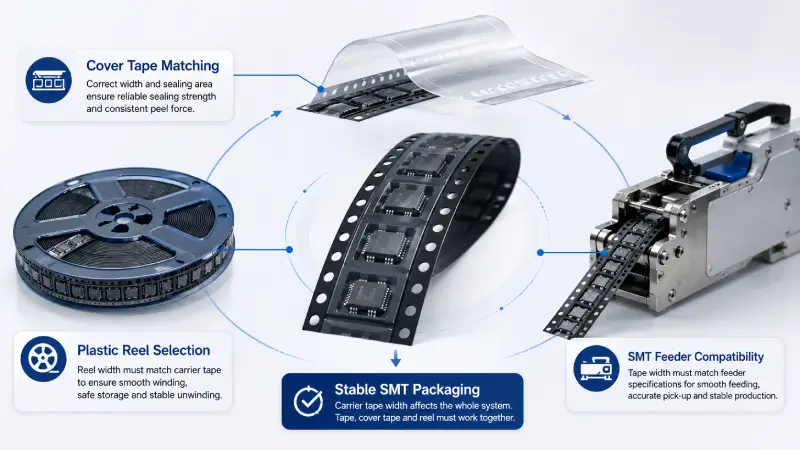
Carrier tape width must be matched with the correct cover tape and reel. These three items should be reviewed together instead of being ordered separately.
Cover tape is used to seal the components inside the carrier tape pockets. If the cover tape is too narrow, it may not seal the pocket area properly. If it is too wide, it may interfere with tape movement or peeling performance. Correct matching helps maintain stable sealing strength and consistent peel force during SMT production.
Buyers can review Jiushuo’s cover tape options when confirming carrier tape width. The cover tape type and size should be selected based on carrier tape material, sealing requirement, component sensitivity, and customer feeding conditions.
Reel matching is also important. Wider carrier tape usually needs a matching reel width. The reel must support smooth winding, safe storage, and stable unwinding during production. If the reel does not match the tape properly, the tape may shift, deform, or unwind unevenly.
For this reason, buyers should also confirm the correct plastic reel together with carrier tape and cover tape. A complete tape-and-reel solution helps reduce packaging risk and makes the product easier to use on SMT lines.
How Carrier Tape Width Affects Feeder Compatibility
SMT feeders are designed to support specific tape widths. If the carrier tape width does not match the feeder, production problems may happen. These problems can include poor feeding, machine stops, tape misalignment, unstable pick-up, or component loss.
For buyers who supply components to OEMs or EMS factories, feeder compatibility is very important. Even if the tape design looks correct, the packaging may still cause complaints if the end customer cannot run it smoothly on their SMT line.
Before confirming the tape width, buyers should check whether the assembly line supports that width. If the buyer does not have this information, it is helpful to ask the customer or production team for feeder requirements. This step can prevent costly changes after mass packaging has started.
When Custom Carrier Tape Width May Be Required
Standard carrier tape widths such as 8mm, 12mm, 16mm, 24mm, and 32mm can cover many electronic component packaging needs. However, custom carrier tape width or custom pocket design may be required when standard options cannot support the component properly.
Custom width may be needed when the component is too large for a standard pocket layout, has an irregular shape, requires a special placement direction, or moves too much inside standard tape. It may also be needed when the customer has specific feeder, reel, or packaging requirements.
In some cases, the tape width itself may be standard, but the pocket design must be customized. In other cases, both the width and pocket structure need to be developed according to the component.
Jiushuo supports custom carrier tape design based on component drawings, samples, and packaging requirements. For projects involving new components, special packages, or unstable feeding issues, custom design support can help buyers reduce trial-and-error and improve production reliability.
What Information Should Buyers Provide Before Confirming Tape Width?
To choose the right carrier tape width, buyers should provide as much packaging information as possible. The most useful information includes component length, width, height, weight, drawing, datasheet, and sample parts if available.
Buyers should also share the required tape width if already specified by the customer, the SMT feeder type if known, the expected quantity per reel, cover tape requirements, reel size requirements, and any special handling concerns.
If the component has a fragile surface, unusual shape, sharp edges, high value, or strict orientation requirement, this should also be mentioned early. These details may affect pocket depth, pocket clearance, cover tape selection, and reel matching.
The more information the supplier has, the easier it is to recommend a practical and stable embossed carrier tape width.
Simple Buying Advice: Do Not Choose Width by Component Size Alone
Carrier tape width selection should start with component dimensions, but it should not end there. A reliable packaging solution also needs to consider pocket design, component stability, feeder compatibility, cover tape sealing, reel matching, and production handling.
For small parts, 8mm carrier tape may be suitable. For slightly larger or taller parts, 12mm or 16mm carrier tape may be a better choice. For larger components, connectors, and modules, 24mm or 32mm tape may be needed. For irregular or special components, custom carrier tape design may be the safest option.
The best approach is to let the supplier review the complete packaging requirement before confirming production. This helps avoid feeder mismatch, sealing issues, reel problems, and unstable SMT feeding.
Need Help Choosing the Right Carrier Tape Width?
Jiushuo provides embossed carrier tape in common widths such as 8mm, 12mm, 16mm, 24mm, 32mm, and custom options for special electronic component packaging needs.
If you are not sure which carrier tape width is suitable for your component, Jiushuo can review your drawing, sample, feeder requirement, cover tape needs, and reel specification to recommend a practical packaging solution.
Send your component details to Jiushuo to get support for embossed carrier tape width selection, custom pocket design, cover tape matching, and reel selection.
FAQ
What is the most common carrier tape width?
Common carrier tape widths include 8mm, 12mm, 16mm, 24mm, and 32mm. The right width depends on the component size, shape, height, pocket design, and feeder requirement.
When should I choose 8mm carrier tape?
8mm carrier tape is usually used for small and compact components. However, buyers should still confirm component height, pocket stability, and SMT feeder compatibility before choosing it.
Is 12mm carrier tape better than 8mm carrier tape?
Not always. 12mm carrier tape provides more pocket space, but 8mm tape may be more efficient for smaller components. The better option depends on the actual component and production setup.
Does carrier tape width affect cover tape selection?
Yes. Cover tape must match the carrier tape width and sealing area. Incorrect cover tape matching may affect sealing quality, peel force, and SMT feeding stability.
Does carrier tape width affect reel selection?
Yes. Wider carrier tape usually requires a matching reel width. Carrier tape, cover tape, and plastic reel should be confirmed together to avoid winding or feeding problems.
Can Jiushuo make custom carrier tape widths?
Yes. Jiushuo supports custom embossed carrier tape design for components that cannot be packed properly with standard tape widths. Buyers can provide drawings, datasheets, samples, or packaging requirements for review.