

In high-speed SMT production, carrier tape is more than a packaging material. It plays a direct role in how components are presented, picked, and placed by automated equipment. When the carrier tape is consistent, the feeder can index smoothly, the nozzle can pick parts from a stable position, and the production line can run with fewer interruptions. When the tape is inconsistent, even small variations may lead to mis-picks, feeder alarms, component movement, or unexpected downtime.
For buyers, quality managers, and electronic component suppliers, carrier tape tolerance control does not need to be understood as a complicated engineering formula. The practical question is simple: can the tape hold and present each component in a repeatable way during high-speed pick-and-place?
This is why choosing the right embossed carrier tape for stable SMT feeding is important, especially for precision components, connectors, sensors, terminals, stamped parts, and other products that require stable positioning during automated assembly.
Why Carrier Tape Consistency Matters in High-Speed SMT Feeding
High-speed pick-and-place machines depend on repeatability. The machine expects each pocket to arrive at a predictable location, with the component sitting in a stable position and orientation. If the pocket size, tape pitch, pocket depth, tape flatness, or cover tape sealing is inconsistent, the machine may still operate, but the risk of unstable feeding increases.
In real production, carrier tape tolerance problems often appear as small but repeated interruptions. For example, components may shift inside the pocket, rotate before pickup, sit too high or too low, or become difficult to pick consistently. Sometimes the issue is not caused by the component itself, but by how the component is held, sealed, and wound inside the tape and reel package.
For SMT assembly teams, these issues can reduce production efficiency. For component suppliers, they may lead to customer complaints or rejected packaging batches. For procurement teams, they may increase hidden costs because unstable packaging can affect downstream assembly performance. Good carrier tape tolerance control helps reduce these risks before products reach the SMT line.
Key Carrier Tape Tolerance Areas Buyers Should Understand
Carrier tape accuracy involves several practical areas. Buyers do not need to focus on complex measurement theory, but they should understand which parts of the tape affect feeding stability.
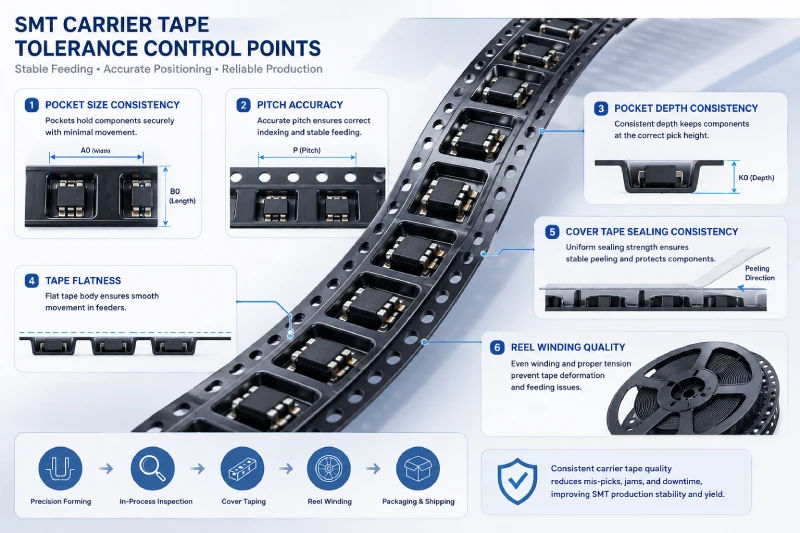
Pocket Size Consistency
Pocket size is one of the most important factors in carrier tape tolerance. The pocket must hold the component securely without being too tight or too loose. If the pocket is too tight, the component may get stuck or become difficult to pick. If the pocket is too loose, the component may move, tilt, rotate, or shift away from the correct pick position.
This is especially important for irregular components, such as connectors, terminals, sensors, stamped metal parts, and components with pins, leads, or uneven shapes. These parts often cannot be packed reliably in standard tape. A properly designed custom embossed carrier tape can help improve component fit and reduce movement during feeding, handling, and transportation.
Pocket consistency also matters from one pocket to the next. Even if the first few pockets look correct, variation across the reel can still cause feeding instability. This is why inspection during carrier tape production is important before mass packaging begins.
Pitch Accuracy
Pitch refers to the distance between pockets. In high-speed SMT feeding, pitch accuracy helps the feeder index the tape correctly. If the distance between pockets is not consistent, the component may arrive slightly before or after the expected pick position. This can increase the chance of mis-picks, nozzle correction, or machine stoppage.
Pitch accuracy becomes more important as production speed increases. At slower speeds, small variations may be less visible. At high speed, however, the machine has less time to adjust. A small inconsistency repeated across thousands of pockets can become a real production problem.
For buyers, the key point is to confirm that the supplier has stable carrier tape forming and inspection processes. Carrier tape should not only match the component drawing; it should also support reliable feeding on automated equipment.
Tape Flatness
Tape flatness affects how smoothly the carrier tape moves through feeders. If the tape curls, warps, bends, or becomes uneven after forming or winding, it may not run smoothly during production. This can cause feeder resistance, indexing instability, or component presentation errors.
Tape flatness can be influenced by material selection, forming quality, storage conditions, winding tension, and reel handling. Even a well-designed pocket may not perform correctly if the tape body is not stable.
For high-speed pick-and-place applications, flatness should be checked not only immediately after production, but also after winding. In some cases, tape deformation may appear after the reel has been stored or shipped. This is why packaging condition and reel quality should be considered together with the tape itself.
Pocket Depth Consistency
Pocket depth affects how the component sits inside the tape. If the pocket is too shallow, the component may sit too high and contact the cover tape. If the pocket is too deep, the component may sit too low for stable pickup. If pocket depth varies from pocket to pocket, the pick height may become inconsistent during SMT feeding.
This is especially important for tall components, fragile components, heavy parts, and parts with sensitive surfaces. The component should be protected inside the pocket, but it should also remain easy for the pick-and-place nozzle to access.
Good pocket depth control helps keep the component at a stable height. It also reduces the risk of surface damage, cover tape interference, or poor pickup performance.
Cover Tape Sealing Consistency
Carrier tape and cover tape work together as a system. The carrier tape holds the component, while the cover tape protects it and keeps it inside the pocket during transportation and feeding. If sealing is too weak, components may move or the cover tape may lift. If sealing is too strong or uneven, peeling may become unstable during feeding.
Unstable peeling can cause vibration, flying components, feeder alarms, or interruptions on the SMT line. For this reason, buyers should not evaluate carrier tape alone. The matching between carrier tape material and cover tape for SMT packaging should also be reviewed.
Consistent sealing helps maintain stable peel performance. It also reduces the risk of component movement before the pick position. For sensitive components or high-speed production, sample testing with the selected cover tape is strongly recommended before mass production.
Reel Winding Quality
Even if the carrier tape is well formed, poor reel winding can still create feeding problems. Uneven winding tension, loose layers, tight spots, or reel deformation may affect how the tape unwinds during SMT production. This can lead to unstable movement, tape distortion, or feeder resistance.
The plastic reel should match the tape width, packaging quantity, and handling requirements. A suitable plastic reel for tape and reel packaging helps protect the tape during storage, shipment, and production use.
For buyers, reel winding should not be treated as a secondary detail. Tape quality, cover tape sealing, and reel winding all affect the final feeding experience.
Common Tolerance Issues and Possible SMT Impact
| Tolerance or Packaging Issue | Possible SMT Impact |
|---|---|
| Inconsistent pocket size | Component movement, rotation, tilt, or unstable pick position |
| Poor pitch accuracy | Misalignment during feeder indexing or pickup |
| Uneven pocket depth | Component sits too high or too low, causing pick instability |
| Tape warping or curling | Feeder jamming, unstable tape movement, or line interruption |
| Inconsistent cover tape sealing | Unstable peeling, flying components, or feeder alarms |
| Poor reel winding | Uneven feeding tension, tape deformation, or handling problems |
| Material inconsistency | Variation between batches and higher packaging quality risk |
This table shows why carrier tape tolerance should be viewed from a production stability perspective. The purpose is not only to meet dimensions on paper, but to make sure the tape performs reliably in the actual SMT process.
What Should Be Checked Before Mass Production
Before mass production, buyers and suppliers should confirm several practical details. The first step is to understand the component itself. Its size, shape, weight, pin structure, surface sensitivity, and required orientation all affect the carrier tape design.
Next, the pocket fit should be reviewed. The component should not move excessively inside the pocket, but it should also not be too tight. Buyers should check whether the part can rotate, tilt, jump, or become stuck. For components with irregular geometry, pocket design may need to support specific contact points or clearance areas.
Pocket depth should also be checked carefully. The component should sit at a stable height for picking, while still being protected by the pocket and cover tape. For taller components or fragile parts, the relationship between pocket depth and cover tape clearance is especially important.
Tape pitch, sprocket holes, and tape flatness should be reviewed for feeder compatibility. The tape should move smoothly and index consistently. If the tape curls or deforms after winding, the issue should be solved before bulk production.
Cover tape sealing and peeling should be tested together with the carrier tape. The sealing should be strong enough to protect the components, but stable enough for smooth peeling during SMT feeding. Finally, reel size, winding direction, winding tension, and packaging quantity should be confirmed.
For complete packaging projects, buyers may also consider Jiushuo’s tape and reel packaging service, which can help review carrier tape, cover tape, reel selection, and sample packaging before mass production.
How Sample Approval Reduces Packaging and Feeding Risk
Sample approval is one of the most effective ways to reduce carrier tape feeding risk. Drawings and specifications are important, but physical samples allow buyers and suppliers to confirm whether the design works in real conditions.
During sample approval, buyers can check whether components sit correctly in the pockets. They can see if the component moves, rotates, tilts, or becomes difficult to remove. SMT teams can also run sample reels through actual feeders to test feeding stability, pickup performance, and cover tape peeling.
Quality teams can review pocket forming consistency, tape flatness, sealing quality, winding condition, and packaging appearance. If any issue appears during sample testing, it can be corrected before mass production begins. This helps avoid costly rework, delayed shipments, or customer complaints after large-volume packaging is completed.
Sample approval is especially important for non-standard components, such as connectors, sensors, MEMS devices, stamped metal parts, terminals, relays, fuses, and parts with sharp pins or fragile surfaces. These components often have special packaging risks that are difficult to solve with standard tape.
Jiushuo supports carrier tape design, sample preparation, inspection, and packaging verification based on component drawings or physical samples. For projects that require stable SMT feeding, Jiushuo can help review pocket design, tape material, cover tape matching, and reel packaging before mass production.
Jiushuo’s Support for Stable SMT Carrier Tape Production
Jiushuo provides custom carrier tape production and inspection support for electronic component suppliers, SMT packaging buyers, and OEM sourcing teams. The goal is to help components feed more smoothly in automated pick-and-place production, not simply to provide tape as a packaging material.
For different component types, Jiushuo can support embossed carrier tape design based on component dimensions, orientation, shape, material sensitivity, and packaging requirements. This includes components such as ICs, connectors, sensors, terminals, precision metal stamped parts, automotive electronics, and other non-standard parts.
Jiushuo also helps match carrier tape with cover tape and plastic reel options, so the complete packaging system can support storage, transportation, sealing, peeling, and SMT feeding. This system-based approach is important because feeding problems may come from the pocket, the sealing, the reel winding, or the combination of all three.
By reviewing samples before mass production, Jiushuo helps buyers reduce packaging uncertainty. This is especially useful for new components, irregular shapes, and projects where previous packaging caused movement, mis-picks, or unstable feeding.
Need Carrier Tape That Feeds Reliably in High-Speed SMT Production?
If your SMT production requires stable component positioning, smooth feeding, and reliable pick-and-place performance, carrier tape tolerance control should be considered early in the packaging process.
Send Jiushuo your component drawing, datasheet, or physical samples. Our team can help review pocket fit, tape material, cover tape matching, reel packaging, and sample approval before mass production. Whether you need packaging for electronic components, connectors, sensors, ICs, terminals, stamped parts, or other precision components, Jiushuo can provide practical carrier tape solutions for stable SMT feeding.
To discuss your project, request a custom carrier tape solution from Jiushuo.
FAQ
What is carrier tape tolerance?
Carrier tape tolerance refers to the consistency of important tape features such as pocket size, pocket depth, pitch, sprocket holes, tape flatness, and forming quality. For buyers, the main concern is whether the tape can present components reliably during SMT feeding.
Why does carrier tape tolerance matter for high-speed pick-and-place?
High-speed pick-and-place machines depend on repeatable component positioning. If the carrier tape is inconsistent, components may shift, rotate, sit at different heights, or arrive at the wrong pick position. This can lead to mis-picks, feeder alarms, and line interruptions.
Can poor carrier tape accuracy cause SMT feeding problems?
Yes. Poor carrier tape accuracy can contribute to feeder jamming, unstable indexing, component movement, flying parts, pickup errors, and production downtime. The issue may come from pocket design, tape flatness, cover tape sealing, reel winding, or material consistency.
What should buyers provide before ordering custom carrier tape?
Buyers should provide component drawings, physical samples if available, dimensions, weight, orientation requirements, ESD requirements, packaging quantity, and any known SMT feeding concerns. This information helps the supplier design a more suitable carrier tape solution.
Why is sample approval important before mass production?
Sample approval allows buyers to test pocket fit, cover tape sealing, reel winding, and feeding performance before large-volume production. It helps identify problems early and reduces the risk of rework, shipment delays, or customer complaints.
Does Jiushuo support carrier tape inspection and matching?
Yes. Jiushuo supports custom carrier tape production, sample checking, cover tape matching, reel selection, and inspection support. This helps buyers improve SMT feeding stability and reduce packaging-related production risks.