
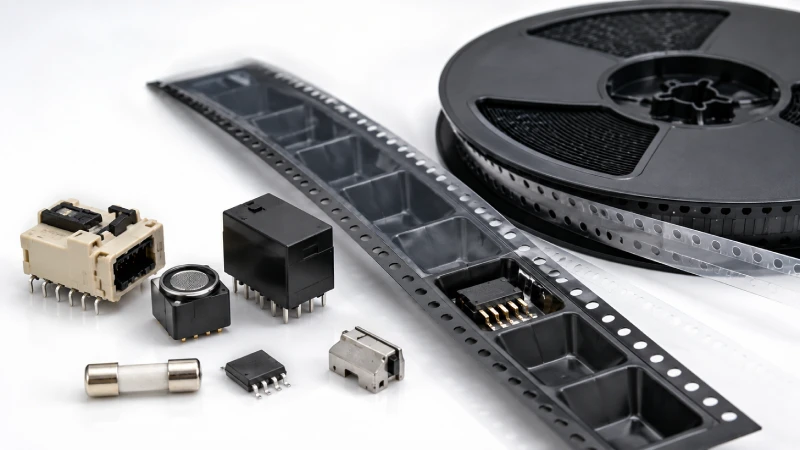
Automated tape-and-reel packaging is widely used to prepare electronic components for storage, transportation, and pick-and-place assembly. However, many connectors, sensors, relays, fuses, precision metal parts, and specialized IC packages do not fit conventional carrier tape pockets.
An irregular component may be too tall, asymmetrical, fragile, or difficult to orient. It may also include exposed pins, sensing surfaces, terminals, latches, or other features that require additional protection. In these cases, simply selecting a carrier tape that is large enough is not sufficient.
Reliable tape-and-reel packaging depends on matching the component with the correct pocket structure, carrier tape material, cover tape, reel, and sealing conditions. The objective is not only to place the component inside a pocket, but also to maintain its orientation, protect sensitive areas, control movement, and support stable automated feeding.
Which Non-Standard Components May Need Custom Tape-and-Reel Packaging?
A non-standard component is not necessarily an unusually large component. The term can also refer to parts with irregular geometry, uneven weight distribution, fragile surfaces, or strict orientation requirements.
Components that commonly require additional packaging evaluation include:
- Connectors with exposed pins, latches, clips, or uneven housings
- Sensors with sensitive windows, membranes, or sensing surfaces
- ICs with uncommon package dimensions or delicate terminals
- Relays with tall bodies and uneven centers of gravity
- Cylindrical, rectangular, or irregularly shaped fuses
- Precision stamped, molded, ceramic, optical, or metal parts
- Application-specific components produced in limited or customized designs
Even two components with similar overall dimensions may behave differently inside a carrier tape pocket. One may remain stable, while another rotates, tilts, or contacts the cover tape because of its shape or weight distribution.
For this reason, tape-and-reel packaging for irregular components should be evaluated according to the actual component rather than selected only from a dimensional chart.
Common Packaging Challenges for Irregular Components
Non-standard components create packaging risks that may not appear during a simple dimensional check. A component may fit inside the pocket but still move excessively during winding, shipping, or feeding.
The most common concerns include pocket fit, component orientation, top clearance, sensitive-area protection, sealing consistency, and reel compatibility.
| Non-Standard Component Challenge | Packaging Risk | Practical Packaging Solution |
|---|---|---|
| Irregular or asymmetrical shape | Rotation or inconsistent orientation | Use a pocket that supports stable reference surfaces |
| Excessive component height | Contact with the cover tape or incomplete sealing | Increase pocket depth and confirm suitable top clearance |
| Exposed pins, leads, or terminals | Bending, scratching, or pressure damage | Create protected areas around sensitive features |
| Loose pocket fit | Excessive movement during transport and feeding | Adjust pocket dimensions and allowable movement |
| Tight pocket fit | Loading difficulty or component damage | Add suitable clearance based on actual tolerances |
| Uneven weight distribution | Tilting or unstable indexing | Position pocket support around stable areas of the component |
| Strict directional requirements | Incorrect presentation to the assembly machine | Add orientation features and define a consistent loading direction |
| Incorrect material combination | Cover tape lifting, reel deformation, or unstable feeding | Match carrier tape, cover tape, and reel as one packaging system |
A successful packaging solution must balance protection and accessibility. The pocket needs enough clearance for loading and unloading, but not so much space that the component can rotate or bounce inside the cavity.
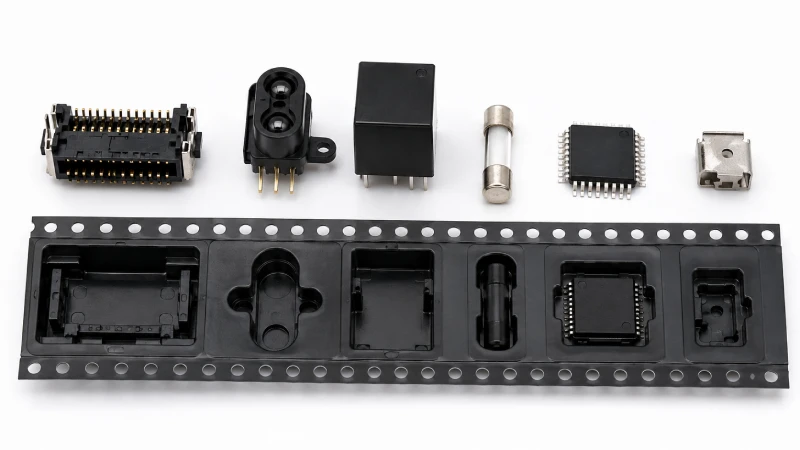
Why Standard Carrier Tape May Not Work
Standard carrier tape is suitable for many common packages, especially when component dimensions, shape, and orientation match an existing pocket specification. For irregular components, however, a standard pocket may create problems even when the part appears to fit.
A standard pocket may be too shallow for a tall relay or connector. It may provide excessive side clearance for a narrow sensor, allowing the part to rotate. It may also place pressure on a terminal, optical window, or fragile surface.
Other limitations include insufficient tape width, unsuitable pocket pitch, and an orientation that does not match the required pick-up direction.
Most importantly, physical fit does not always mean packaging suitability. A component may fit into a standard pocket during manual inspection but become unstable during cover tape sealing, reel winding, transportation, or automated feeding.
When standard options cannot provide controlled positioning and adequate protection, a custom carrier tape should be evaluated. Customization allows the pocket dimensions and support areas to be developed around the actual component and its handling requirements.
How a Matched Tape-and-Reel Packaging Solution Is Developed
Packaging development for non-standard components should begin with the component itself and then extend to the complete tape-and-reel system.
1. Review the Component Shape and Sensitive Areas
The first step is to review the component’s overall length, width, height, tolerances, protrusions, terminals, and fragile surfaces.
It is also important to identify which areas can safely contact the carrier tape pocket. A plastic housing may tolerate controlled support, while a sensing window, plated contact, thin lead, or polished surface may need a no-contact area.
Physical samples are particularly useful because drawings may not fully show weight distribution, surface sensitivity, or how the component naturally rests.
2. Define the Required Orientation
Automated production usually requires every component to be presented in the same direction.
For connectors, this may involve pin direction or latch position. For sensors and ICs, polarity, pin-one position, or the functional surface may determine the loading orientation. Relays and fuses may also need a specific presentation direction for pick-up.
The pocket should help maintain this orientation throughout loading, sealing, winding, transportation, and feeding.
3. Evaluate Pocket Fit and Movement
The pocket must support the component without squeezing it or allowing uncontrolled movement.
If the pocket is too tight, the component may be difficult to load or remove. Tight contact may also damage terminals, coatings, or sensitive surfaces. If the pocket is too loose, the component may tilt, rotate, or move vertically.
A well-developed custom embossed carrier tape controls the component using appropriate support points and clearance rather than simply surrounding it with a large cavity.
The design should also consider the component’s actual dimensional tolerances. Developing a pocket only around nominal dimensions can create problems when components from normal production batches vary slightly in size.
4. Match the Carrier Tape and Cover Tape
The carrier tape and cover tape must work together. Pocket fit alone cannot prevent components from leaving the cavity if the cover tape does not seal consistently.
The selected cover tape should provide suitable sealing and peel performance for the carrier tape material and the intended packaging process. It must retain the component during transportation while allowing predictable opening during automated feeding.
Top clearance is especially important for tall or irregular parts. The component should not press continuously against the cover tape, as this can affect sealing, damage sensitive areas, or create inconsistent peel behavior.
Conductive, anti-static, or other ESD-related requirements should also be confirmed according to the sensitivity of the packaged component.
5. Match the Reel and Winding Requirements
The reel must be compatible with the carrier tape width, packaged quantity, and intended handling process.
An unsuitable reel can cause lateral movement, poor winding, tape deformation, or feeding problems. Reel diameter and hub size also influence how tightly the tape is wound, which can be important for deep-pocket tapes and tall components.
Selecting the correct plastic reel helps protect the carrier tape during storage and transportation while supporting smooth unwinding at the customer’s production line.
6. Validate Before Bulk Production
Before bulk production, the proposed packaging combination should be evaluated using actual components whenever possible.
Typical checks include:
- Component loading and removal
- Orientation consistency
- Movement inside the pocket
- Clearance beneath the cover tape
- Cover tape sealing and peeling
- Winding and unwinding performance
- Protection during handling and transportation
- Compatibility with the intended feeding process
Validation reduces the risk of discovering packaging problems after a larger production quantity has already been completed.
Key Factors That Affect Automated Feeding Stability
Stable feeding depends on more than the shape of the pocket. The carrier tape, cover tape, reel, component loading, and packaging process must work together consistently.
Important factors include:
- Consistent pocket pitch and tape dimensions
- Correct orientation in every pocket
- Controlled side-to-side and vertical movement
- Adequate pocket depth and top clearance
- Stable cover tape sealing
- Predictable cover tape peel performance
- Correct reel width and hub dimensions
- Suitable leader and trailer sections
- Protection from pocket deformation during transportation
- Clean packaging for sensitive electronic and precision components
A custom pocket may hold the component correctly, but feeding problems can still occur if the cover tape lifts, the reel does not guide the tape properly, or the component moves during winding.
For this reason, buyers should evaluate the complete tape-and-reel packaging solution rather than sourcing each material independently without compatibility checks.
When Is Custom Embossed Carrier Tape Recommended?
Custom embossed carrier tape should be considered when an existing standard pocket cannot provide reliable positioning, protection, or feeding performance.
Typical situations include:
- The component cannot sit flat in a standard pocket.
- The component rotates or tilts because of an asymmetrical shape.
- Pins, terminals, windows, or functional surfaces need protection.
- The component is unusually tall, wide, heavy, or unbalanced.
- Standard pockets allow excessive vertical or lateral movement.
- The component contacts the cover tape.
- The required orientation cannot be maintained.
- A buyer is converting from trays, tubes, or loose packaging to automated tape and reel.
- Existing packaging causes pick-up, sealing, or feeding problems.
- A newly developed component requires production-ready packaging.
However, customization should not be based on irregular appearance alone. The packaging method must be evaluated using the component’s dimensions, tolerances, sensitivity, weight, orientation, expected volume, and downstream handling requirements.
Not every non-standard component requires the same tape structure, and one pocket design should not be assumed to suit an entire component family without verification.
What Buyers Should Send for Packaging Evaluation
Providing complete component information helps reduce revisions and allows the packaging supplier to make a more practical recommendation.
Buyers should send:
- A dimensional drawing showing length, width, height, and tolerances
- A 3D file when available
- Clear photographs from the top, bottom, and sides
- Physical samples for fit evaluation
- Required loading and pick-up orientation
- Identification of fragile or no-contact areas
- Component material and approximate weight
- Details of pins, leads, terminals, latches, or protrusions
- Required tape width or pitch, if already specified
- Expected quantity per reel
- Preferred reel diameter
- Conductive or anti-static requirements
- Cover tape or peel-force requirements, if known
- Information about the intended feeding process
- Existing packaging samples and descriptions of current problems
When samples are available, it is helpful to provide parts from normal production rather than only ideal prototypes. This allows the evaluation to consider realistic component variation.
Jiushuo Support for Non-Standard Component Packaging
Jiushuo supports custom embossed carrier tape development for connectors, sensors, ICs, relays, fuses, and other precision components that cannot be reliably packaged in standard pockets.
The evaluation can cover component orientation, pocket fit, sensitive-area protection, carrier tape material, cover tape compatibility, reel size, and packaging requirements.
Rather than treating the carrier tape, cover tape, and reel as separate products, Jiushuo can help match them as a complete packaging material set. This helps buyers reduce compatibility problems related to sealing, winding, storage, transportation, and feeding.
Sample evaluation and packaging validation can also be carried out before bulk production. The final recommendation will depend on the component geometry, dimensional tolerances, surface sensitivity, packaging quantity, ESD requirements, and intended production process.
Request a Tape-and-Reel Packaging Evaluation
Need Automated Tape-and-Reel Packaging for an Irregular Component?
Send Jiushuo your component drawing, photographs, required orientation, estimated packaging quantity, and physical samples when available.
Our team can evaluate whether an existing carrier tape is suitable or whether a custom embossed carrier tape, matched cover tape, and compatible reel are required.
FAQ
Can irregular components be packaged in tape and reel?
Many irregular components can be packaged in tape and reel, but feasibility depends on their shape, size, height, weight distribution, fragile areas, orientation, and feeding requirements. Each component should be evaluated individually.
When is custom embossed carrier tape necessary?
Custom embossed carrier tape is usually needed when a standard pocket cannot control movement, maintain orientation, protect sensitive features, or provide sufficient depth and cover tape clearance.
How much clearance should a custom carrier tape pocket have?
Pocket clearance depends on component tolerances, loading requirements, sensitive areas, and allowable movement. The correct clearance should be determined using drawings and preferably actual component samples.
Can one carrier tape be used for several similar component models?
It may be possible when the models have compatible dimensions, orientations, and sensitive areas. However, visually similar components can still behave differently inside the same pocket, so each model should be checked before approval.
Why must the cover tape and reel be evaluated with the carrier tape?
The cover tape affects component retention, sealing, and peel performance, while the reel affects winding, storage, and feeding. A poorly matched cover tape or reel can cause problems even when the carrier tape pocket fits correctly.
What does Jiushuo need before recommending a packaging solution?
Jiushuo typically needs component drawings, photographs, orientation requirements, estimated quantities, ESD requirements, and information about the intended feeding process. Physical samples are strongly recommended for pocket-fit and packaging evaluation.