
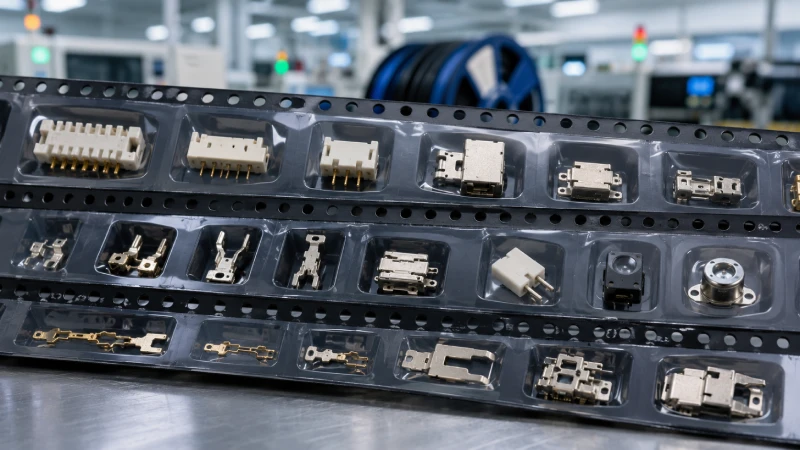
Not every electronic component can be packaged well with standard carrier tape. For simple chip components with regular shapes and predictable dimensions, standard pockets may be enough. But for connectors, terminals, sensors, metal stamped parts, and other non-standard components, the packaging requirement is often more complicated.
Irregular components may have uneven height, sharp pins, fragile surfaces, long bodies, asymmetrical shapes, or special orientation requirements. These details can affect how the component sits inside the pocket, how the cover tape seals, and how smoothly the tape feeds into automated equipment.
That is why many buyers need custom carrier tape for irregular components instead of relying on standard tape. Custom carrier tape is not only about making a pocket that matches the component size. It is about improving protection, positioning, feeding stability, and packaging consistency from loading to final SMT assembly.
For component manufacturers, OEM sourcing teams, and SMT packaging buyers, understanding when custom carrier tape is needed can help reduce packaging problems before mass production begins.
Why Irregular Components Are Difficult to Package
Standard carrier tape is usually designed for common component sizes and simple shapes. The pocket dimensions are fixed or only available in limited options. This works when the component has a flat body, consistent height, and a balanced shape.
Irregular components are different. A connector may have pins extending from one side. A sensor may have a sensitive surface that cannot be scratched. A stamped metal part may have sharp edges or a thin structure that bends easily. A terminal may be long and narrow, making it difficult to keep in the correct direction.
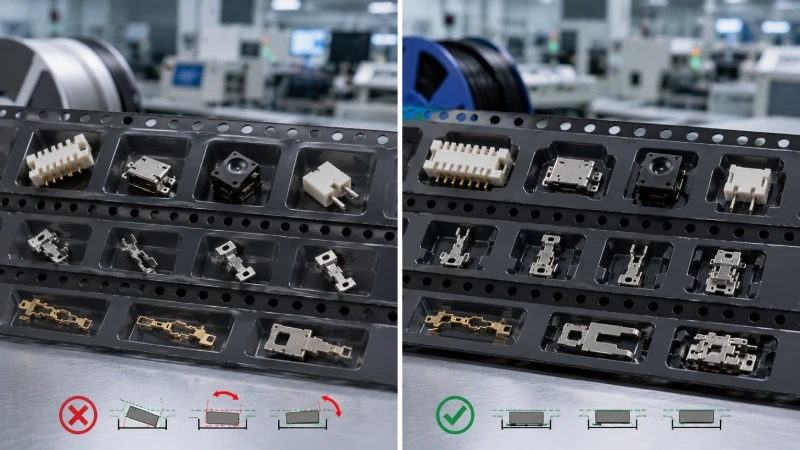
These issues create real packaging risks. If the pocket is too loose, the component may rotate or tilt. If the pocket is too tight, pins may bend or surfaces may be damaged. If the pocket depth is not correct, the cover tape may press on the component or fail to seal properly.
In tape and reel packaging, small fit problems can become larger production problems. A component that moves inside the pocket may cause pick-and-place errors. A part that sits too high may interfere with cover tape peeling. A fragile surface that touches the pocket wall may result in quality complaints after transport.
This is why irregular components often need custom pocket design instead of standard tape selection.
Common Irregular Component Features and Packaging Risks
Different irregular features create different packaging risks. Buyers should not only look at the overall size of the component. They should also consider shape, height, surface sensitivity, weight, and feeding direction.
| Irregular Component Feature | Possible Packaging Risk |
|---|---|
| Unusual outer shape | Loose fit, rotation, or unstable positioning inside the pocket |
| Uneven height or stepped structure | Poor clearance, cover tape pressure, or sealing difficulty |
| Sharp pins or metal edges | Pocket damage, cover tape puncture, or component scratch risk |
| Fragile surface or coating | Surface marks, pressure damage, or quality complaints |
| Heavy component weight | Pocket deformation, movement during transport, or unstable feeding |
| Long or thin structure | Bending risk, poor support, or difficult orientation control |
| Asymmetrical design | Wrong pick-up position or orientation error |
| Small protrusions, leads, or terminals | Pin bending, pocket interference, or poor loading consistency |
This table shows why a simple length, width, and height check is not always enough. For irregular parts, the way the component contacts the pocket can be just as important as the pocket size itself.
Why Standard Carrier Tape May Not Be Enough
Standard carrier tape may look like a convenient option because it is faster to select and may cost less at the beginning. However, it may not solve the real packaging needs of non-standard components.
One common problem is loose fit. If the pocket is larger than the actual component shape, the part may move during vibration, transport, or reel unwinding. This can lead to rotation inside the pocket, especially for asymmetrical parts. Even if the component is not damaged, its final position may not be stable enough for automated pick-and-place.
Another problem is poor height clearance. Irregular components often have a raised area, pin structure, or uneven top surface. If the standard pocket depth is too shallow, the cover tape may press directly on the component. If the pocket is too deep, the component may tilt or become difficult to pick up.
Standard pockets also may not protect sharp or fragile areas. For example, metal terminals and stamped parts may have edges that can scrape the pocket or damage the cover tape. Sensors and small precision parts may have surfaces that need extra clearance or controlled contact points.
For these reasons, buyers often move from standard tape to custom embossed carrier tape when packaging reliability becomes more important than simple tape availability.
Standard Carrier Tape vs Custom Carrier Tape
The difference between standard carrier tape and custom carrier tape is not only the pocket size. The main difference is whether the pocket is selected from existing options or designed around the actual component.
| Item | Standard Carrier Tape | Custom Carrier Tape |
|---|---|---|
| Best for | Common component sizes and regular shapes | Non-standard, irregular, fragile, or heavier components |
| Pocket design | Fixed or limited dimensions | Designed based on the actual component shape |
| Component stability | May be acceptable for simple parts | Better control of movement, rotation, and position |
| Protection | Basic protection | More targeted protection for pins, surfaces, and edges |
| Feeding reliability | Depends on how well the component fits | Designed to support stable automated feeding |
| Buyer input needed | Basic size information | Samples, drawings, datasheets, and packaging requirements |
Standard carrier tape can be useful for common parts with predictable dimensions. But for unusual component shapes, custom carrier tape gives buyers more control over how the part is held, protected, sealed, and fed.
A custom pocket can be designed to reduce unnecessary movement while still allowing easy loading and pick-up. It can also provide better clearance for tall areas, sharp pins, or fragile surfaces. This makes it more suitable for components that cannot be safely packaged in a simple rectangular pocket.
Key Factors Buyers Should Consider Before Custom Design
Before requesting custom carrier tape, buyers should prepare more than just basic dimensions. A good custom packaging solution depends on understanding how the component behaves inside the pocket.
Component Shape and Contact Points
The outer shape of the component is the first consideration. Buyers should identify which areas can safely contact the pocket and which areas should avoid pressure. For example, a plastic body may be safe to support, while a pin area, coating, or optical surface may need clearance.
Pocket Fit and Movement Control
The component should not move too much inside the pocket. However, the pocket should not be so tight that loading becomes difficult or the component gets damaged. The goal is controlled fit, not maximum tightness.
For irregular components, pocket design may need support areas, clearance zones, or shape-matching features to reduce movement and rotation.
Height Clearance
Height is especially important for stepped or tall components. The pocket must be deep enough to protect the component and allow the cover tape to seal properly. At the same time, the component should remain accessible for pick-and-place equipment.
If the part sits too high, the cover tape may touch or press on it. If it sits too low or at an angle, feeding and pick-up may become unstable.
Orientation Requirement
Some components must stay in one fixed direction throughout packaging and assembly. This is common for connectors, terminals, sensors, and shaped metal parts.
If the pocket does not control orientation, the component may rotate inside the tape. That can cause inspection issues, loading inconsistency, or SMT feeding problems. A custom pocket can help guide the part into the correct position and reduce the risk of wrong orientation.
Surface and Pin Protection
Fragile surfaces, sharp pins, and exposed leads need special attention. A standard pocket may allow these areas to touch the pocket wall or cover tape. Over time, vibration and movement may cause scratches, bending, or other damage.
Custom pocket design can provide more suitable clearance and support, helping protect sensitive areas during packaging, storage, and transport.
Feeding Stability
Carrier tape is not only used for storage. It must also work smoothly in automated feeding systems. If the component moves, tilts, or sits inconsistently in the pocket, it may affect pick-up accuracy.
A well-designed tape and reel packaging solution should consider pocket fit, cover tape sealing, reel winding, and feeding stability together.
How Custom Embossed Carrier Tape Helps Irregular Components
Custom embossed carrier tape helps solve practical problems that standard tape cannot always handle. The purpose is not to make the packaging more complicated. It is to make the component easier to protect, handle, and feed.
For irregular components, a custom pocket can help keep the part in the right position. This reduces the chance of rotation, tilting, and movement during transport or reel unwinding. When the component position is more consistent, downstream SMT feeding is usually more stable.
Custom carrier tape can also help protect component features that are easy to damage. For example, a pocket can be designed to avoid direct pressure on fragile surfaces, provide clearance for pins, or support the stronger part of the component body.
Another advantage is better sealing consistency. If the pocket depth and component height are properly matched, the cover tape can seal more reliably without pressing too hard on the part. This matters for components with uneven height or raised areas.
Jiushuo supports custom carrier tape development based on component samples, drawings, and datasheets. For buyers who are not sure whether standard tape can work, providing physical samples and technical information can help evaluate the pocket structure more accurately.
Cover Tape Matching Also Matters
Carrier tape and cover tape work together as one packaging system. Even if the carrier tape pocket is well designed, poor cover tape matching can still create problems.
For irregular components, cover tape for carrier tape packaging should be selected carefully. The cover tape must seal properly to the carrier tape without damaging the component. It should also peel smoothly during SMT feeding.
If the cover tape sealing is too weak, components may fall out or become exposed. If the sealing is too strong or unstable, peeling may cause vibration, jumping components, or feeder interruptions. If the cover tape presses too closely against a tall component, it may damage the part or affect its position inside the pocket.
This is why carrier tape design, cover tape selection, and sealing conditions should be considered together. For unusual component shapes, the complete packaging structure matters more than any single material choice.
Quotation Checklist: What Buyers Should Prepare
Before requesting a quotation for custom carrier tape, buyers can prepare the following information. This helps the supplier understand the packaging requirement and reduce unnecessary sampling revisions.
- Component samples, if available
- 2D or 3D drawings
- Component datasheet
- Length, width, height, and key tolerance information
- Photos from different angles
- Details of pins, leads, sharp edges, or fragile surfaces
- Required orientation inside the pocket
- ESD protection requirement
- Estimated packaging quantity
- Preferred carrier tape width, if known
- Reel size requirement, if known
- SMT feeding or pick-and-place requirements
- Previous packaging problems, such as rotation, bending, jamming, or poor sealing
For irregular components, samples are especially useful. A drawing can show dimensions, but a real sample helps the packaging team understand weight balance, surface risk, sharp areas, and how the part naturally sits inside a pocket.
When Should You Choose Custom Carrier Tape?
Custom carrier tape should be considered when the component cannot sit securely in a standard pocket. It is also a good option when the component has an unusual shape, asymmetrical structure, exposed pins, fragile surface, or strict orientation requirement.
Buyers should also consider custom carrier tape when standard tape causes movement, rotation, poor sealing, or feeding instability. Even if the component fits into a standard pocket, that does not always mean the packaging is suitable for production.
For manufacturers of connectors, terminals, sensors, stamped metal parts, and other non-standard electronic components, custom carrier tape can help improve packaging reliability before products reach the SMT line.
Need Custom Carrier Tape for Irregular Components?
If your component has an unusual shape, uneven height, fragile surface, sharp pins, or strict orientation requirement, Jiushuo can help evaluate a suitable custom carrier tape solution.
Our team supports custom embossed carrier tape design based on samples, drawings, datasheets, and real packaging needs. From pocket design to cover tape matching and tape and reel packaging, Jiushuo helps buyers create packaging that supports protection, stable positioning, and smoother automated feeding.
To discuss your component packaging requirement, you can request a custom carrier tape solution based on your sample, drawing, or datasheet.
FAQ
Why can’t irregular components use standard carrier tape?
Irregular components may have unusual shapes, uneven height, sharp pins, fragile surfaces, or orientation requirements. Standard carrier tape may not control these features well, which can lead to movement, rotation, damage, or feeding instability.
What types of components usually need custom carrier tape?
Connectors, terminals, sensors, metal stamped parts, relays, power components, and other non-standard electronic parts often need custom carrier tape because their shapes are not easy to package with standard pockets.
What information is needed for custom carrier tape design?
Buyers should provide samples, drawings, datasheets, dimensions, orientation requirements, ESD needs, and any known packaging problems. This information helps the supplier design a more suitable pocket.
Can custom carrier tape help prevent component rotation?
Yes. A properly designed custom pocket can reduce unnecessary movement and help keep the component in the correct position during loading, transport, storage, and SMT feeding.
Is cover tape important for irregular components?
Yes. Cover tape affects sealing, protection, and peeling stability. For irregular components, the cover tape must match the carrier tape pocket, component height, and feeding requirements.
Does Jiushuo support custom carrier tape based on samples?
Yes. Jiushuo can support custom embossed carrier tape design based on component samples, drawings, and datasheets. This helps create a packaging solution that better matches the real component shape and production needs.