
Introduction
In semiconductor packaging, stability is rarely determined by a single process step. Even when component fabrication, inspection, and placement systems operate within specification, subtle inconsistencies in handling can introduce avoidable risk. Carrier tape sits at a critical junction between device protection, transportation, and automated assembly. Its performance directly affects how consistently semiconductor components transition from packaging into high-speed SMT placement environments.
For advanced and miniaturized devices, tolerances are tighter and failure margins are smaller. Minor pocket misalignment, inconsistent dimensional control, or insufficient electrostatic behavior may not cause immediate visible defects, but they can influence pick accuracy, placement repeatability, and long-term yield stability. In high-volume production, these seemingly marginal variables compound quickly.
Understanding why carrier tape design and material behavior matter is not about comparing products. It is about recognizing how packaging precision supports overall semiconductor manufacturing reliability.
What Risks Emerge When Carrier Tape Is Not Precisely Matched to Semiconductor Components?
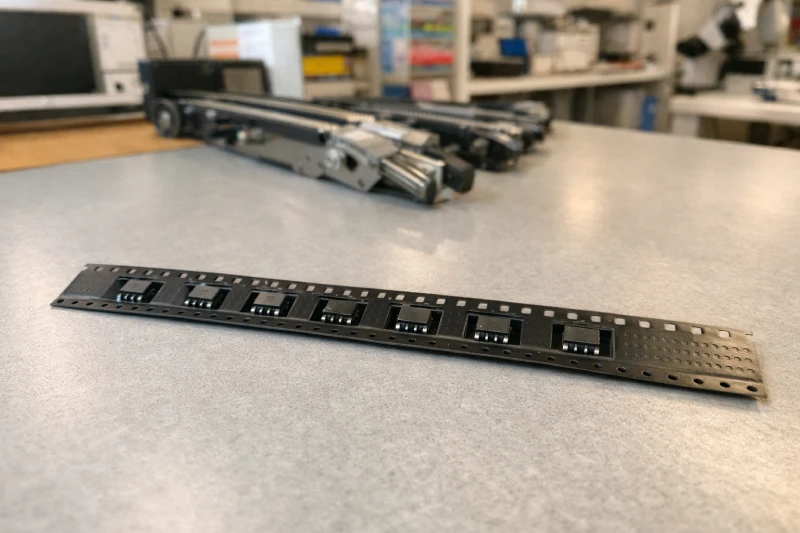
When carrier tape geometry does not closely match the physical profile of a semiconductor device, instability often appears in subtle but measurable ways. Excess lateral clearance can allow micro-rotation during reel handling and feeder indexing. Insufficient pocket depth may reduce vertical support, increasing the likelihood of tilt under vibration. Even small deviations in wall angle or cavity uniformity can alter how consistently a component is presented to the pick nozzle.
These variations rarely cause immediate catastrophic failure. Instead, they introduce incremental placement variation that accumulates over time. Slight shifts in component posture can reduce pick accuracy, affect vision alignment correction margins, and increase the probability of misplacement in high-speed SMT environments.
In advanced packaging scenarios where device dimensions are shrinking and pitch spacing is tighter, tolerance stacking becomes more critical. A marginal mismatch between device and pocket design may remain unnoticed during sampling but reveal itself during extended production runs. Identifying these risks early allows engineers to determine whether a standard configuration remains sufficient or whether tighter structural control is required.
How Does Pocket Geometry Directly Influence Pick-and-Place Accuracy?
Pocket geometry determines how consistently a semiconductor device is positioned before vacuum pickup. While feeder systems and vision alignment software compensate for minor deviations, the initial mechanical presentation still defines the correction window. If pocket width allows excessive lateral movement, the component may settle differently between indexing cycles. If the cavity floor lacks uniform depth, vertical variation can alter nozzle engagement consistency.
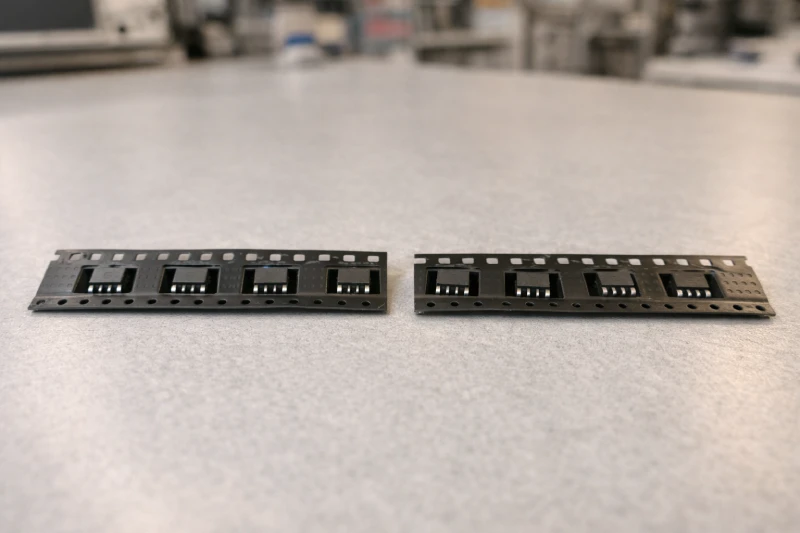
Wall angle and corner radius also influence how the device rests within the cavity. Overly sharp transitions may create localized contact points, while excessive clearance reduces side support during reel acceleration. In both cases, repeatability becomes dependent on dynamic motion rather than controlled positioning. For high-speed SMT lines, even slight inconsistency can reduce placement stability at scale.
Pitch consistency across the entire tape length is equally critical. Dimensional drift from cavity to cavity increases reliance on machine correction algorithms, narrowing process margins. When geometry is precisely controlled, pick-and-place accuracy becomes a predictable mechanical outcome rather than a corrective response.
Why Does Static Control in Carrier Tape Matter More for Advanced Semiconductor Devices?
As semiconductor devices become smaller and more densely integrated, their tolerance to electrostatic discharge decreases significantly. During packaging, transportation, and feeder operation, repeated contact and separation between materials can generate localized charge accumulation. If carrier tape material properties are not properly controlled, this charge may discharge through sensitive device structures before placement even occurs.
Unlike mechanical misalignment, electrostatic damage is often invisible at the packaging stage. Devices may pass initial inspection yet exhibit latent reliability failures after assembly or during field operation. For fine-pitch components and advanced nodes, the threshold for damage can be far lower than traditional handling assumptions.
Static behavior in carrier tape is therefore not simply a compliance checkbox. Surface resistivity consistency, material stability over humidity variation, and predictable dissipation characteristics all influence risk exposure. In high-volume semiconductor production, controlling electrostatic behavior at the packaging interface reduces the probability of hidden yield loss that is otherwise difficult to trace back to its source.
At What Production Volume Does Carrier Tape Selection Start Affecting Yield Economics?
In early prototyping or low-volume runs, minor placement variation may appear manageable. Scrap rates remain limited, and occasional misfeeds can be corrected without major disruption. As production scales into sustained high-volume manufacturing, however, small inefficiencies multiply rapidly. A fractional increase in misplacement or feeder interruption can translate into significant cumulative loss over millions of units.
Carrier tape selection affects process consistency as much as mechanical stability. Variation in pocket geometry, static behavior, or indexing precision can introduce intermittent defects that increase rework and reduce line efficiency. These secondary effects often outweigh apparent material cost differences.
At higher volumes, predictability becomes more valuable than marginal savings. Tape performance that reduces variability supports stable process windows and fewer corrective adjustments. Identifying when packaging consistency begins influencing yield economics allows decisions to be evaluated from a total manufacturing cost perspective rather than simple unit pricing.
How Can Inconsistent Carrier Tape Performance Disrupt SMT Line Stability?
SMT production lines depend on synchronized mechanical motion and predictable component presentation. When carrier tape performance varies between reels or across cavities, feeder systems must compensate for inconsistent indexing or component posture. Even small dimensional fluctuations can increase pick retries, nozzle correction events, or brief feeder pauses.
Individually, these interruptions may seem minor. In continuous automated production, however, rhythm stability is essential. Repeated micro-stoppages reduce overall equipment effectiveness and create imbalance across the line. Operators may focus on machine calibration while the underlying variability originates in packaging.
Uniform mechanical behavior across the entire tape length supports stable advancement, consistent pocket registration, and reliable exposure at the pick point. When geometry, stiffness, or dimensional control lacks repeatability, line performance depends on corrective adjustment rather than stable input conditions. Maintaining carrier tape consistency therefore supports sustained SMT throughput and process predictability.
When Should Engineers Move from Standard to Custom Carrier Tape?
Standard carrier tape configurations are appropriate when component geometry fits established dimensional ranges and placement stability remains consistent across runs. If sampling confirms stable pick accuracy, minimal rotation, and no feeder disruption, a standard format may remain sufficient.
Recurring micro-misalignment, irregular device shapes, or unusually tight placement tolerances can indicate structural mismatch. Components with asymmetrical outlines, fine leads, or reduced thickness often require more controlled cavity support. Increased electrostatic sensitivity or scaling into higher volumes may also expose marginal instability.
The transition toward custom carrier tape should be guided by measurable production behavior. When machine compensation becomes routine or defect patterns correlate with packaging presentation, structural refinement may be warranted. Using performance data rather than assumption helps determine whether tighter pocket control is required to sustain long-term manufacturing stability.
What Evaluation Criteria Should Be Used Before Finalizing Carrier Tape for Semiconductor Applications?
Before approving carrier tape for semiconductor production, evaluation should go beyond basic dimensional fit. Consistency across the reel length—including cavity uniformity, pitch accuracy, and material stability—must be verified under expected storage and operating conditions.
Mechanical support should be assessed dynamically, not only through static inspection. Testing during feeder indexing confirms whether component posture remains stable under motion and vibration. Electrostatic behavior must also be reviewed in relation to device sensitivity and environmental humidity range.
Compatibility with reel systems and cover tape sealing performance further affect predictable handling. Establishing measurable evaluation criteria before volume commitment helps engineering and procurement teams reduce the risk of latent instability appearing after production scaling.