
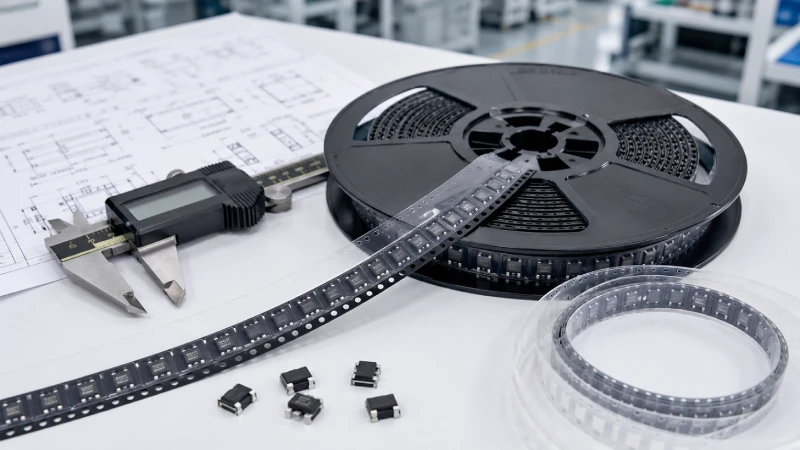
A stable tape and reel packaging process is not created by choosing one suitable material. It depends on how well the component, carrier tape, cover tape, reel, and inspection requirements work together.
For electronic component manufacturers, distributors, OEM teams, and SMT packaging buyers, packaging instability can lead to component rotation, bent leads, inconsistent peeling, damaged pockets, feeding interruptions, or pick-and-place failures. Many of these problems can be reduced before mass production by confirming the packaging requirements in the correct order.
Instead of treating tape and reel packaging as a simple final packing step, buyers should manage it as a coordinated process. This includes reviewing the component, selecting the correct carrier tape, developing the pocket design, matching the cover tape, confirming the reel, approving samples, and establishing production inspection points.
A supplier that can provide coordinated tape and reel packaging solutions can make it easier to match these materials and reduce repeated communication between different vendors.
What Makes a Tape and Reel Packaging Process Stable?
Tape and reel packaging stability means that components remain protected and correctly positioned from the moment they are loaded into the carrier tape until they are picked up by automated assembly equipment.
A stable process should achieve several practical results:
- Components do not rotate, tilt, or move excessively inside the pockets.
- Leads, terminals, pins, and sensitive surfaces are not damaged.
- Cover tape remains sealed during winding, storage, and transportation.
- Cover tape peels smoothly and consistently during use.
- Carrier tape feeds without cracking, stretching, or pocket deformation.
- The finished reel is correctly wound, labeled, and protected.
These results depend on more than the carrier tape itself. A suitable pocket design can still create problems if the cover tape does not match the carrier material. A correctly sealed tape can also become unstable if the reel size or winding method deforms the pockets.
For this reason, buyers should evaluate the carrier tape, cover tape, and plastic reel as one packaging system.
Start with a Complete Component Review
The first step in building a stable tape and reel packaging process is collecting accurate component information.
Nominal package names are not always enough. Two components with similar external dimensions may have different terminals, polarity marks, center-of-gravity positions, or surface protection requirements. These details can affect the carrier tape design.
Buyers should begin by confirming the component length, width, height, and dimensional tolerances. Any leads, pins, connectors, clips, or irregular features extending beyond the main body should also be included.
Physical samples are especially useful when the component shape is difficult to understand from a two-dimensional drawing.
Orientation is another important confirmation point. The packaging supplier should know how the component must face inside the pocket, including the position of pin one, polarity marks, terminals, or connection points. Incorrect orientation may not damage the component, but it can create serious problems during automated placement.
The review should also identify packaging risks, such as:
- Fragile or easily bent leads
- Components with uneven shapes
- Sensitive optical or plated surfaces
- Static-sensitive devices
- Parts that may rotate inside a rectangular pocket
- Components with a high or uneven center of gravity
This information provides the basis for selecting the carrier tape material and designing the pocket.
Select the Right Carrier Tape Type and Material
Carrier tape holds each component in a controlled position while supporting storage, transport, feeding, and automated pickup.
Buyers can choose from different carrier tape options depending on the component type and packaging requirements. Common choices include standard embossed carrier tape, conductive carrier tape, anti-static carrier tape, black carrier tape, and transparent carrier tape.
The material should be selected according to practical requirements rather than appearance alone.
For example, static-sensitive electronic components may require conductive or anti-static material. Transparent tape can make visual inspection easier, while black conductive tape is commonly used when electrostatic protection is more important.
Mechanical strength also matters. The carrier tape should maintain its shape during forming, sealing, winding, transportation, and feeding. A material that is too soft may allow pocket deformation, while a material that is too brittle may crack when bent around the reel.
Standard carrier tape may be suitable for common components with established package sizes. However, irregular parts, delicate terminals, unusual dimensions, or strict orientation requirements may require custom embossed carrier tape.
The goal is not simply to find a pocket that is large enough. The carrier tape must hold the component securely while still allowing smooth loading and pickup.
Develop a Pocket Design That Controls Component Movement
Pocket design is one of the most important parts of the carrier tape packaging process.
The pocket needs enough clearance for the component to enter and leave without sticking. At the same time, excessive clearance may allow the part to rotate, tilt, or collide with the pocket walls.
A stable design balances these two requirements.
Pocket length and width should be based on the actual component dimensions and tolerances. The designer should also consider small protrusions, terminals, leads, or uneven edges that may interfere with the pocket.
Pocket depth is equally important. The component should normally sit below the sealing surface so that the cover tape does not press directly against it. However, an unnecessarily deep pocket can create greater vertical movement and may affect pickup consistency.
For components with fragile leads or pins, the pocket should support the main component body without placing pressure on delicate features. Clearance may need to be added around terminals or connectors.
The pocket design should also confirm:
- Tape width
- Pocket pitch
- Sprocket-hole position
- Feeding direction
- Component orientation
- Winding direction
Where possible, the pocket should be tested with actual production components rather than only drawings. Physical samples help reveal movement, interference, and pickup risks that may not be visible in digital design files.
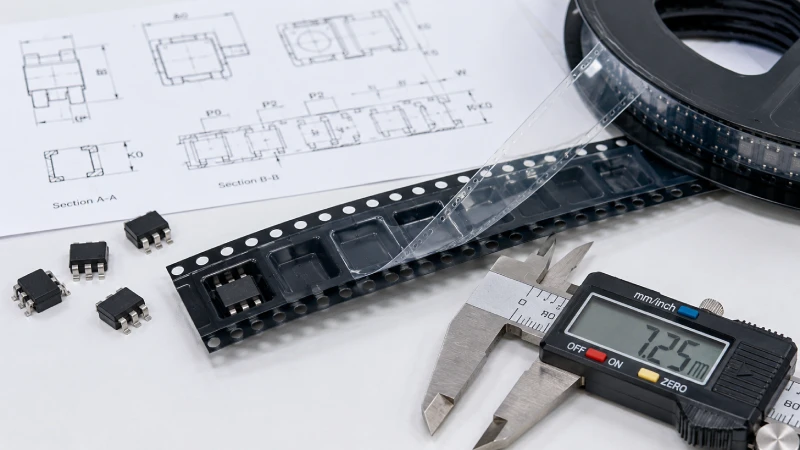
Match the Cover Tape with the Carrier Tape
A stable carrier tape design can still fail if the cover tape does not match the carrier material.
The cover tape keeps components inside the pockets during handling, storage, and transportation. During automated assembly, it must peel away consistently without disturbing the components.
When selecting cover tape for SMT packaging, buyers should confirm the tape width, sealing type, carrier tape compatibility, static-control level, transparency, and expected peel performance.
Sealing strength needs to remain within a practical range.
If the seal is too weak, the cover tape may lift during winding or shipping. Components may escape from the pockets, dust may enter, or the tape may arrive partially open.
If the seal is too strong, the cover tape may peel unevenly, tear, create vibration, or cause feeding interruptions. Excessive peel force can also disturb lightweight components inside the pockets.
The cover tape should therefore be tested together with the selected carrier tape. Approving the two materials separately does not confirm that they will perform well as a combination.
Sample evaluation should include both sealing appearance and actual peel behavior. Buyers should check several points along the sample instead of evaluating only one short section.
Confirm the Plastic Reel and Winding Requirements
The reel supports the finished tape during storage, transportation, and assembly-line use.
Buyers should select plastic reels for carrier tape according to the carrier tape width, packaging length, component size, and handling requirements.
Important reel specifications include:
- Reel diameter
- Hub diameter
- Flange width
- Tape width compatibility
- Flange strength
- Static-control properties
- Label area
The reel should provide enough space for the required tape length without compressing the embossed pockets. If the hub is too small or the tape is wound too tightly, pocket deformation may occur near the inner layers.
Winding direction must also be clearly confirmed. The component orientation, sprocket-hole position, and cover tape peeling direction should match the customer’s feeder and production requirements.
Leader tape, trailer tape, quantity per reel, and label information should be included in the final packaging specification.
Key Tape and Reel Packaging Confirmation Steps
| Process Step | Key Confirmation Point |
|---|---|
| Component review | Dimensions, tolerances, orientation, polarity, and fragile features |
| Carrier tape selection | Material, tape width, static-control level, and mechanical strength |
| Pocket design | Pocket size, depth, clearance, pitch, and component movement |
| Cover tape matching | Material compatibility, width, sealing quality, and peel consistency |
| Reel confirmation | Reel diameter, hub size, tape width, winding direction, and quantity |
| Sample packaging | Component fit, pocket movement, sealing, peeling, and pickup performance |
| Mass production inspection | Pocket quality, orientation, sealing, winding, labels, and reel condition |
Approve Packaging Samples Before Mass Production
Sample approval is the most effective way to identify packaging problems before a large order is produced.
Whenever possible, testing should use actual components from the customer’s normal production batch. One sample component may not represent the full dimensional tolerance, so several components should be evaluated.
The first check is component fit. The parts should sit in a stable position without excessive rotation, tilting, rattling, or contact with the cover tape. Buyers should also confirm that leads, pins, surfaces, and other delicate features are not under pressure.
The second check is sealing and peeling. The cover tape should remain aligned and fully sealed, without wrinkles, lifted edges, open sections, or visible contamination. During peeling, the force should feel reasonably consistent across the sample length.
A short assembly-line trial is recommended when practical. This helps confirm indexing, sprocket-hole engagement, cover tape removal, component presentation, and pick-and-place performance under real operating conditions.
After approval, the buyer and supplier should maintain a clear sample record containing:
- Approved carrier tape drawing
- Component orientation
- Carrier tape material
- Cover tape specification
- Reel specification
- Winding direction
- Packaging quantity
- Approval date and version
This record becomes the reference for mass production and future repeat orders.
Common Problems in Unstable Tape-and-Reel Packaging
Components Rotate or Move Inside the Pocket
This usually happens when the pocket clearance is too large or the pocket shape does not support the component correctly. The component’s height and center of gravity may also have been overlooked.
The solution is to review the pocket dimensions using actual samples and confirm movement in more than one direction.
Components Stick Inside the Pocket
Sticking may be caused by insufficient clearance, interference with leads or corners, rough pocket surfaces, or static attraction.
Buyers should inspect both the pocket dimensions and the carrier tape material. A component should not require excessive force to leave the pocket.
Cover Tape Lifts During Storage or Shipping
Cover tape lifting can result from poor material compatibility, insufficient sealing, contamination, or deformation of the carrier tape.
The full carrier tape and cover tape combination should be tested after winding and handling, not only immediately after sealing.
Peel Strength Is Too High or Uneven
Uneven peeling may be related to unsuitable cover tape, inconsistent sealing, carrier tape surface variation, or misalignment.
Testing should cover multiple areas across the tape width and along the reel length.
Carrier Tape Bends, Cracks, or Deforms
Possible causes include unsuitable material thickness, poor pocket forming, excessive winding tension, weak reel support, or improper storage conditions.
Finished reels should be checked after winding to confirm that the pockets remain consistent from the outer layers to the hub area.
Feeding or Pickup Is Inconsistent
Feeding problems may come from incorrect pitch, sprocket-hole misalignment, pocket position variation, unstable peeling, or tape distortion.
A short feeder and pickup trial can help separate packaging-related issues from machine-related issues.
Establish Mass Production Inspection Points
Once the sample is approved, the same requirements must be maintained during mass production.
Incoming materials should be checked against the approved carrier tape, cover tape, and reel specifications. Material codes or batch records should be retained where traceability is required.
During packaging, inspection points should include pocket dimensions, component orientation, empty pockets, cover tape alignment, sealing appearance, and winding direction.
Finished reels should be checked for:
- Correct quantity
- Reel flange condition
- Leader and trailer length
- Label accuracy
- Winding quality
- Pocket deformation
- Packaging protection
For important projects, retained samples and inspection records can make future quality investigations much easier. They help determine whether a problem came from the component batch, packaging material, pocket design, or packaging process.
Build a Repeatable Packaging Specification
A stable SMT packaging process should not depend on verbal instructions or individual operator experience.
Buyers should create a repeatable packaging specification that includes the component drawing, approved sample, carrier tape material, pocket dimensions, component orientation, cover tape, reel size, winding direction, quantity per reel, labeling, and inspection requirements.
When any component dimension, supplier, surface treatment, or assembly requirement changes, the packaging specification should be reviewed again.
This prevents old packaging from being used for a modified component and reduces repeated confirmation for future orders.
How Jiushuo Supports Tape and Reel Packaging Projects
Jiushuo supports buyers with carrier tape, custom embossed carrier tape, compatible cover tape, plastic reels, and other tape-and-reel packaging materials.
Customers can provide component drawings, physical samples, orientation requirements, expected quantities, tape width, reel requirements, and static-control needs.
By reviewing these requirements together, Jiushuo can support material selection, pocket development, sample preparation, cover tape matching, reel confirmation, and bulk packaging-material supply.
This coordinated approach helps buyers avoid selecting each packaging material independently and makes it easier to build a more repeatable tape and reel packaging process.
Build a More Stable Tape and Reel Packaging Process
A stable process begins before mass production.
Confirm the component, carrier tape, pocket design, cover tape, reel, sample, and inspection requirements as one complete system. Clear approval records and repeatable specifications can reduce packaging variation and improve consistency across future orders.
To review a new packaging project, send Jiushuo your component drawing, physical sample, dimensions, orientation, tape width, reel size, static-control requirements, and expected order quantity.
Request a packaging review to confirm the right carrier tape, cover tape, plastic reel, and tape-and-reel packaging materials for your component.
FAQ
What information is needed to develop tape-and-reel packaging?
Useful information includes component drawings, actual samples, dimensions, tolerances, orientation, polarity, tape width, reel size, static-control requirements, expected quantity, and assembly-line requirements.
Should carrier tape and cover tape be tested together?
Yes. Sealing quality and peel performance depend on the combination of the carrier tape material, cover tape, and packaging conditions.
When is custom embossed carrier tape necessary?
Custom embossed carrier tape is often required for irregular components, unusual dimensions, sensitive leads, strict orientation control, or parts that cannot be held securely in standard pockets.
How much movement is acceptable inside a carrier tape pocket?
The component needs enough clearance for loading and pickup, but it should not rotate, tilt, or move enough to affect orientation, cause damage, or create unstable pickup.
Why should samples be approved before mass production?
Sample approval confirms component fit, pocket clearance, orientation, cover tape sealing, peel consistency, reel winding, and feeding performance before a larger quantity is produced.
What should be checked during bulk tape-and-reel production?
Key checks include carrier tape dimensions, pocket quality, component orientation, empty pockets, cover tape alignment, sealing consistency, reel winding, quantity, labels, and finished reel condition.