
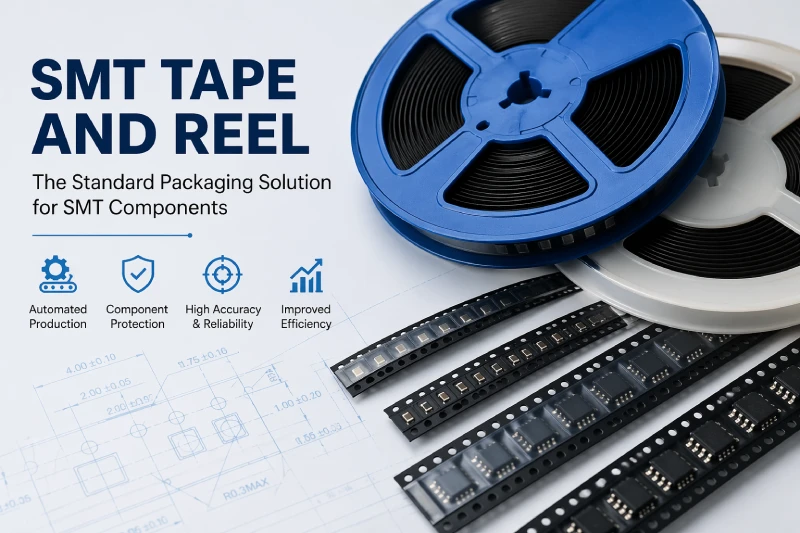
SMT tape and reel packaging is one of the most important parts of modern electronics manufacturing. Without a reliable tape and reel system, even the most advanced SMT production line can suffer from misfeeds, damaged components, machine downtime, and lower placement accuracy.
In SMT assembly, electronic parts such as resistors, capacitors, ICs, LEDs, and connectors must be delivered to the pick-and-place machine in a precise, repeatable format. SMT tape and reel packaging solves this problem by placing components into carrier tape pockets, sealing them with cover tape, and winding the tape onto a reel.
Whether you are sourcing custom packaging for a new component or evaluating suppliers, understanding how SMT tape and reel works can help you reduce defects, improve production efficiency, and avoid costly line stoppages.
What Is SMT Tape and Reel Packaging?
SMT tape and reel packaging is a packaging method designed for automated surface-mount assembly. Components are loaded into specially designed carrier tape pockets, sealed with a cover tape, and then wound onto a plastic reel. The reel is installed directly onto a pick-and-place machine, which automatically feeds the components into the SMT production line.
A complete SMT tape and reel system normally includes:
- Carrier tape
- Cover tape
- Plastic reel
- Leader tape
- Trailer tape
The carrier tape holds each component in the correct position. The cover tape seals the components into the pockets during transport and storage. The loaded tape is then wound onto a reel so it can be used directly on SMT machines.
Manufacturers use tape and reel packaging because it offers several important advantages:
- Faster automated production
- Better protection during transport
- Lower manual handling cost
- More accurate component feeding
- Reduced risk of contamination or damage
To better understand the individual materials used in the system, you can also read our detailed guide to carrier tape and cover tape.
How SMT Tape and Reel Packaging Works
Although the finished reel looks simple, the tape and reel process requires a high level of precision. Even a small error in tape pitch, pocket size, or cover tape sealing can cause a pick-and-place machine to stop.
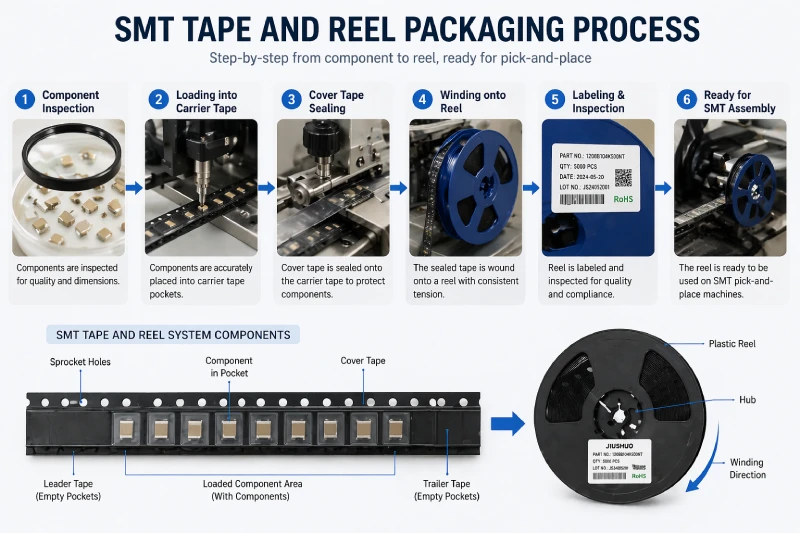
A typical SMT tape and reel workflow includes the following steps:
- Components are inspected before packaging.
- The correct carrier tape pocket design is selected.
- Components are loaded into the carrier tape.
- Cover tape is sealed onto the carrier tape.
- The completed tape is wound onto a reel.
- The reel is labeled, packed, and shipped.
First, the component dimensions are measured carefully. The tape pocket must be large enough to protect the component, but not so large that the part can move, rotate, or flip inside the cavity.
Next, the components are loaded into the carrier tape using manual or automated equipment. After loading, a cover tape is applied. Depending on the application, the supplier may use pressure-sensitive cover tape or heat-seal cover tape.
The sealed tape is then wound onto a reel, usually with a leader tape at the beginning and a trailer tape at the end. These extra tape sections help the SMT machine feed the reel smoothly.
A small packaging error in tape pitch or sealing can stop an entire SMT production line.
That is why experienced suppliers perform multiple inspections during the tape and reel process, including pocket dimension checks, peel strength tests, orientation verification, and anti-static testing.
Key Parts of an SMT Tape and Reel System
Carrier Tape
Carrier tape is the main part of the system because it holds the electronic components. Most SMT carrier tape is made using embossed plastic materials such as PS, PET, or PC.
The pocket shape and size are customized based on the component dimensions. Small chip resistors may only require a narrow 8 mm tape, while larger connectors or ICs may require 24 mm, 32 mm, or wider tape.
There are two common types of carrier tape:
- Embossed carrier tape
- Punched carrier tape
Embossed carrier tape is used for most SMT electronic components because it can create precise pocket shapes and support custom cavity designs.
For static-sensitive components, manufacturers often choose anti-static or conductive materials. This helps protect semiconductors and sensitive electronic devices from electrostatic discharge.
If your product requires ESD protection, see our guide to anti-static carrier tape.
Cover Tape
Cover tape seals the components into the carrier tape pockets. The correct cover tape must provide strong enough adhesion to protect the components during transport, but still allow smooth peeling during SMT assembly.
There are two main types of cover tape:
- Pressure-sensitive cover tape
- Heat-seal cover tape
Pressure-sensitive cover tape is easier to use and does not require additional heat. Heat-seal cover tape offers stronger sealing performance and is often used for larger or heavier components.
You can learn more about the difference in our article about heat-seal cover tape.
Plastic Reel
Once the tape is loaded and sealed, it is wound onto a plastic reel. Standard reel sizes include:
- 7 inch reel
- 13 inch reel
- 15 inch reel
Small reels are often used for sampling and low-volume production, while larger reels are preferred for mass production because they reduce reel changes on the SMT line.
Black conductive reels are commonly used for sensitive components because they offer better ESD protection.
For more information, visit our SMT plastic reel page.
Leader Tape and Trailer Tape
Leader tape is attached before the first component pocket, while trailer tape is added after the final component. These tape sections help the reel load smoothly into the pick-and-place machine and prevent damage to the first and last components.
Without sufficient leader or trailer tape, the SMT machine may fail to feed correctly.
SMT Tape and Reel Standards You Need to Know
The most important standard in SMT tape and reel packaging is EIA-481. This standard defines the dimensions and requirements for carrier tape, reel size, sprocket holes, pocket spacing, and cover tape peel force.
By following EIA-481, the packaged components can work correctly on different pick-and-place machines from different manufacturers.
Typical EIA-481 requirements include:
| Standard Item | Typical Requirement |
|---|---|
| Tape Width | 8 mm, 12 mm, 16 mm, 24 mm |
| Reel Diameter | 7 inch, 13 inch, 15 inch |
| Sprocket Hole Position | Defined by EIA-481 |
| Pocket Pitch | Based on component size |
| Cover Tape Peel Strength | Controlled for stable feeding |
EIA-481 compliance matters because it helps prevent:
- Machine feeding problems
- Incorrect component orientation
- Tape jamming
- Placement errors
- Increased rejection rates
If the tape and reel package does not follow the standard, the SMT machine may not feed the component correctly, even if the component itself is good.
Common SMT Tape and Reel Sizes and Configurations
The correct tape width and reel size depend on the size, weight, and shape of the component.
Common SMT tape widths include:
- 8 mm
- 12 mm
- 16 mm
- 24 mm
- 32 mm
- 44 mm
In most cases:
- 8 mm tape is used for small resistors, capacitors, and chips
- 12 mm to 24 mm tape is used for ICs, LEDs, and connectors
- 32 mm and wider tape is used for large or irregular components
The pocket depth and cavity shape must also be customized carefully. A pocket that is too shallow may damage the component, while a pocket that is too deep can cause poor feeding accuracy.
Reel size is another important factor. Smaller reels are useful when testing a new product or running short production batches. Larger reels are more suitable for high-volume SMT production because they reduce machine downtime.
For example:
- 7 inch reels are commonly used for samples and small runs
- 13 inch reels are the most common option for production
- 15 inch reels may be used for larger tape widths or higher quantities
When choosing a tape and reel configuration, you should consider:
- Component dimensions
- Required production quantity
- Pick-and-place machine compatibility
- Shipping and storage requirements
Common Problems in SMT Tape and Reel Packaging
Poor packaging quality can create serious problems during SMT production. Many production issues that appear to come from the component itself are actually caused by the tape and reel package.
Common SMT tape and reel problems include:
- Incorrect pocket dimensions
- Weak or inconsistent cover tape sealing
- Component flipping or rotation
- Wrong winding direction
- Missing leader tape
- Electrostatic damage
- Incorrect reel labeling
These problems can lead to:
- Pick-and-place misfeeds
- Increased machine downtime
- Lower placement accuracy
- Missing or damaged components
- Higher scrap rates
One of the most common issues is component rotation. If the cavity is too large, the part may move inside the pocket and reach the SMT machine in the wrong orientation.
Another common problem is weak cover tape adhesion. If the cover tape peels too easily during transport, the components may fall out before they reach the production line.
To avoid these problems, manufacturers should:
- Verify pocket dimensions carefully
- Test cover tape peel strength
- Confirm component orientation
- Use anti-static materials when necessary
- Inspect the reel before shipping
Working with an experienced supplier is one of the easiest ways to reduce these risks.
How to Choose the Right SMT Tape and Reel Supplier
Not all SMT tape and reel suppliers provide the same level of quality, engineering support, or production capability. A low-cost supplier may save money at first, but poor packaging quality can create expensive SMT production problems later.
When selecting a supplier, look for the following:
- EIA-481 compliant packaging
- Custom pocket design capability
- Anti-static and conductive material options
- In-house tooling and sampling
- Experience with SMT components
- Stable quality control procedures
- Fast lead time and technical support
A good supplier should be able to review your component drawing and recommend the best tape width, pocket design, cover tape type, and reel size.
Before placing an order, ask these questions:
- Can you provide sample reels for testing?
- Can you customize the pocket design?
- Which cover tape is best for this component?
- What reel size do you recommend?
- Can you support both low-volume and mass production?
If the supplier cannot answer these questions clearly, they may not have enough experience with SMT tape and reel packaging.
You should also choose a supplier that offers both design support and manufacturing in one place. This helps reduce lead time and makes it easier to solve technical issues.
For companies looking for custom solutions, our custom tape and reel packaging services support chips, ICs, connectors, LEDs, semiconductors, and irregular electronic components.
Frequently Asked Questions
What is SMT tape and reel packaging?
SMT tape and reel packaging is a method of packaging electronic components into carrier tape pockets, sealing them with cover tape, and winding them onto a reel for automated SMT assembly.
What is the difference between carrier tape and cover tape?
Carrier tape holds the components in place, while cover tape seals the components inside the carrier tape pockets.
What tape width is normally used for SMT components?
The most common tape widths are 8 mm, 12 mm, 16 mm, and 24 mm. The correct size depends on the component dimensions.
What is the EIA-481 standard?
EIA-481 is the international standard that defines the dimensions and requirements for SMT tape and reel packaging.
Can SMT tape and reel packaging be customized?
Yes. The carrier tape pocket, tape width, cover tape type, and reel size can all be customized based on the component.
Need Custom SMT Tape and Reel Packaging for Your Components?
Whether you need packaging for chips, ICs, LEDs, connectors, semiconductors, or irregular parts, choosing the right SMT tape and reel design is essential for smooth production.
Jiushuo provides custom pocket design, EIA-481 compliant packaging, anti-static material options, fast sampling, and support for both low MOQ and mass production.
If you would like a packaging recommendation, simply send us your component drawing, sample, or dimensions. Our engineering team can help you select the correct carrier tape, cover tape, and reel configuration for your SMT production line.