

SMT plastic reels are an essential part of tape and reel packaging for electronic components. They are used together with carrier tape and cover tape to hold, protect, and feed components into automated SMT pick-and-place machines.
In modern electronics manufacturing, choosing the correct plastic reel is not just about packaging. The right reel size, material, and standard can improve feeding reliability, reduce downtime, prevent ESD damage, and lower overall production costs.
In simple terms, an SMT plastic reel is a spool used to wind carrier tape loaded with electronic components. Common sizes include 7-inch, 13-inch, and 15-inch reels, and most are produced according to ANSI/EIA-481 standards for compatibility with SMT feeder systems.
What Is an SMT Plastic Reel?
An SMT plastic reel is a circular spool designed to hold carrier tape containing electronic components. After components are loaded into carrier tape pockets and sealed with cover tape, the entire tape is wound onto a reel for storage, transport, and automated assembly.
Unlike ordinary packaging, SMT reels are part of the production process. During assembly, the reel is mounted directly onto the feeder of a pick-and-place machine. The carrier tape is indexed through the feeder, and each component is presented in the correct position for automatic placement.
SMT plastic reels are widely used for:
- ICs and semiconductor devices
- LEDs
- Resistors and capacitors
- Connectors
- Transistors
- Small SMT modules and sensors
Plastic reels are preferred over trays or tubes in many applications because they support high-speed automation and can hold a larger quantity of parts in a compact format. They are also easier to transport and store while keeping components protected from contamination and physical damage.
For example, narrow carrier tape used for resistors or LEDs is commonly wound onto a 7-inch reel, while larger ICs or connectors often require a 13-inch reel with wider tape.
To better understand how the reel works with the rest of the packaging system, it is helpful to first review your carrier tape and tape & reel packaging structure. Natural internal links can point readers to your Carrier Tape page and Tape & Reel Packaging Solutions page.
How SMT Plastic Reels Work in Tape and Reel Packaging
The SMT packaging process begins when components are loaded into embossed carrier tape pockets. The carrier tape is then sealed with cover tape to prevent components from moving or falling out during handling.
Once sealed, the carrier tape is wound onto a plastic reel. The reel keeps the tape aligned and evenly wound so it can later be mounted into an SMT feeder.
The complete process usually follows these steps:
- Components are placed into carrier tape pockets.
- Cover tape is sealed onto the carrier tape.
- The taped components are wound onto a plastic reel.
- The reel is packed and shipped.
- The reel is loaded into a feeder on the SMT production line.
- The feeder indexes the tape so the machine can pick each component automatically.
Each part of the system has a specific function:
- Carrier tape holds and positions the component.
- Cover tape protects the component inside the pocket.
- Plastic reel stores and feeds the tape.
Because all three parts work together, the reel must match the tape width, the total tape length, and the feeder dimensions.
If the reel is too small, the carrier tape may bend excessively or fail to fit the required quantity of components. If the reel hub or arbor hole does not match the feeder, the reel may wobble or jam during operation.
High-quality reels also improve feeding performance. A reel with poor roundness or weak flanges may deform during transport. This can cause tape telescoping, feeder errors, or misaligned components on the SMT line.
Manufacturers that run high-volume production often choose custom reel dimensions or stronger reel materials to improve automation efficiency and reduce line stoppages.
Standard SMT Plastic Reel Sizes
SMT plastic reel size is usually selected according to the carrier tape width, component size, and quantity per reel.
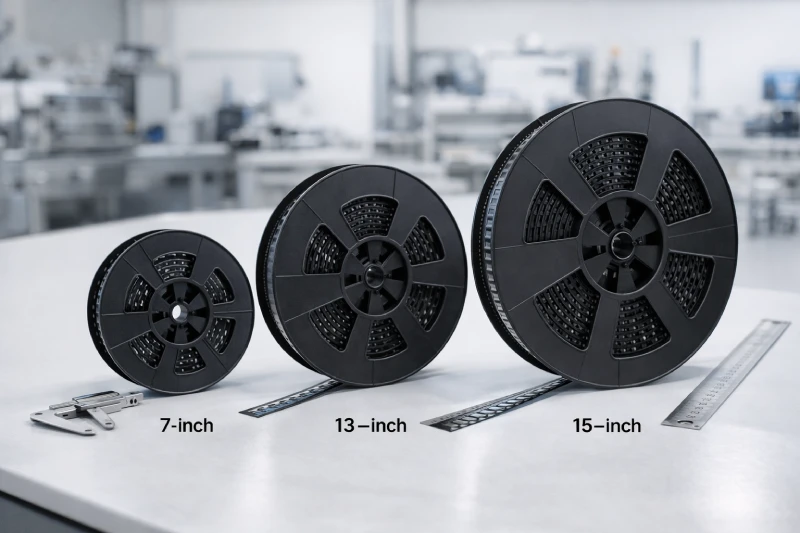
The most common reel sizes are 7-inch, 13-inch, and 15-inch.
7-Inch SMT Plastic Reel
A 7-inch reel is commonly used for narrow carrier tape and lower-volume applications. It is usually paired with 8 mm or 12 mm tape.
Typical uses include:
- Resistors
- Capacitors
- LEDs
- Small diodes
- Small SMD components
Because of its compact size, a 7-inch reel is often used for prototypes, small production runs, or components that do not require a large quantity per reel.
13-Inch SMT Plastic Reel
The 13-inch reel is the most common size in electronics manufacturing. It provides more tape capacity and is suitable for medium and high-volume production.
A 13-inch reel is often used with:
- 8 mm to 56 mm carrier tape
- ICs
- Connectors
- Larger semiconductor packages
- Complex SMT assemblies
Because it can hold more components, the 13-inch reel reduces reel changes on the production line and improves production efficiency.
15-Inch and Custom Reel Sizes
15-inch reels and other custom sizes are usually used when:
- The carrier tape is extra wide
- The component is large or fragile
- A very high quantity per reel is required
- A non-standard feeder system is used
Custom reels are common in advanced semiconductor packaging and large industrial electronics projects.
| Reel Size | Typical Tape Width | Typical Quantity | Common Application |
|---|---|---|---|
| 7 inch | 8 mm, 12 mm | Low to medium | LEDs, resistors, capacitors |
| 13 inch | 8 mm–56 mm | Medium to high | ICs, connectors, SMT assemblies |
| 15 inch | 24 mm+ | High volume | Large components, custom projects |
When discussing reel sizes, this is also a good place to naturally link readers to your Plastic Reel product page or Custom Carrier Tape page.
SMT Plastic Reel Materials: Standard, Anti-Static, and Conductive
The material used for an SMT plastic reel affects durability, ESD protection, and cost.
Most reels are made from PS, HIPS, or modified conductive plastics.
Standard Plastic Reels
Standard plastic reels are the most economical option. They are suitable for components that are not sensitive to electrostatic discharge.
These reels are commonly used for:
- Passive components
- Resistors
- Capacitors
- General-purpose SMT products
However, standard reels do not provide ESD protection. If the component is sensitive to static electricity, a different material should be used.
Anti-Static SMT Plastic Reels
Anti-static reels reduce static buildup on the reel surface. They are commonly used for:
- ICs
- MOSFETs
- Semiconductor devices
- Sensitive SMT components
An anti-static reel helps protect the component during packaging, transport, and handling. It is often used together with anti-static carrier tape to create a complete ESD-safe packaging system.
Conductive SMT Plastic Reels
Conductive reels provide the highest level of ESD protection. Instead of only reducing static buildup, they actively dissipate electrical charge.
Conductive reels are commonly used in:
- Advanced semiconductor packaging
- Automotive electronics
- High-value ICs
- Medical and industrial electronics
| Material Type | ESD Protection | Typical Use | Cost Level |
|---|---|---|---|
| Standard PS/HIPS | None | Passive components | Low |
| Anti-static plastic | Moderate | ICs and semiconductor devices | Medium |
| Conductive plastic | High | High-value and ESD-sensitive products | High |
If your product requires ESD protection, internal links to your Anti-Static Carrier Tape page can help guide readers toward a complete packaging solution.
ANSI/EIA-481 Standards for SMT Plastic Reels
Most SMT plastic reels are produced according to ANSI/EIA-481 standards. This standard defines the dimensions and requirements for tape and reel packaging used in SMT production.
ANSI/EIA-481 specifies:
- Reel diameter
- Arbor hole size
- Hub width
- Tape winding direction
- Carrier tape position
Standardization is important because SMT feeders are designed to work with reels that follow these dimensions. If a reel does not meet the standard, it may not fit the feeder correctly.
For example, a non-standard arbor hole may cause the reel to wobble. A reel with incorrect hub width may cause the carrier tape to shift during feeding.
Common problems caused by non-standard reels include:
- Feeder mismatch
- Tape slipping
- Misaligned carrier tape pockets
- Increased component loss
- Unexpected machine downtime
By using EIA-481 compliant reels, manufacturers can ensure that their packaging works with a wide range of SMT equipment and feeder brands.
Many buyers specifically search for “EIA-481 SMT plastic reel dimensions” before placing an order because standard compliance directly affects production reliability.
How to Choose the Right SMT Plastic Reel
Choosing the right SMT plastic reel depends on four main factors: tape width, component size, feeder compatibility, and ESD requirements.
1. Match the Reel to the Carrier Tape Width
The reel must match the width of the carrier tape.
- 8 mm tape is usually paired with a 7-inch or 13-inch reel.
- 12 mm tape may use either size depending on quantity.
- 16 mm, 24 mm, and wider tape often require larger 13-inch or 15-inch reels.
2. Consider Component Size and Quantity
Small components with low volume may only need a 7-inch reel. Large components or high-volume production often require a larger reel that can hold more tape.
A larger reel means:
- Fewer reel changes
- Higher productivity
- Lower labor cost
3. Check Feeder and Machine Compatibility
Different SMT machines may have different feeder requirements. Before choosing a reel, verify:
- Arbor hole size
- Maximum reel diameter
- Hub width
- Feeder type
Always confirm that the reel is compatible with your SMT line.
4. Determine Whether ESD Protection Is Needed
If your components are sensitive to static electricity, select an anti-static or conductive reel.
As a general rule:
- Passive components → standard reel
- ICs and semiconductor devices → anti-static reel
- High-value or highly sensitive components → conductive reel
If you are not sure which reel is suitable, provide your packaging supplier with:
- Component dimensions
- Carrier tape width
- Quantity per reel
- SMT machine model
With this information, the supplier can recommend the correct reel size and material.
Common SMT Plastic Reel Problems and How to Avoid Them
Even when the correct reel size is selected, poor reel quality can still create problems.
| Problem | Cause | Solution |
|---|---|---|
| Reel deformation | Weak flange or poor material | Use stronger reel material or thicker flange |
| Tape telescoping | Uneven winding | Improve winding tension and reel design |
| Feeder jamming | Incorrect arbor hole or hub size | Use EIA-481 compliant reel |
| Static damage | No ESD protection | Use anti-static or conductive reel |
| Component loss | Incorrect reel size or poor tape alignment | Match reel size to tape width and quantity |
A high-quality reel reduces these risks and improves consistency on the production line.
Custom SMT Plastic Reel Solutions
Standard reel sizes do not fit every application. In some cases, custom SMT plastic reels are necessary.
Custom reels may include:
- Special reel diameter
- Custom arbor hole size
- Wider hub
- Stronger flange thickness
- Anti-static or conductive material
- Different color or OEM appearance
Custom reel solutions are commonly required when:
- The carrier tape is wider than standard
- The component is unusually large or fragile
- The feeder system is non-standard
- A specific quantity per reel is required
To create a custom reel, suppliers usually need:
- Carrier tape width
- Component dimensions
- Required quantity per reel
- Machine or feeder information
A properly designed custom reel can improve feeding reliability, reduce packaging failures, and support more efficient SMT production.
Conclusion
SMT plastic reels are more than simple packaging. They are a critical part of the tape and reel system used in automated electronics manufacturing.
The correct reel size, material, and standard compliance can improve feeder performance, reduce downtime, and protect sensitive components.
For most applications, 7-inch and 13-inch reels are the standard choice. However, anti-static materials, conductive reels, and custom sizes may be necessary depending on your component type and SMT process.
Need help selecting the right SMT plastic reel for your components? Share your tape width, component size, reel quantity, and machine information to receive a packaging recommendation tailored to your production line.
Frequently Asked Questions
What is the difference between a 7-inch and 13-inch SMT plastic reel?
A 7-inch reel is smaller and usually used for narrow tape and lower quantities. A 13-inch reel holds more tape and is more suitable for high-volume production.
Are SMT plastic reels reusable?
Some SMT plastic reels can be reused if they remain undamaged and still meet feeder requirements. However, reused reels should always be checked for deformation or contamination before use.
What material is best for ESD-sensitive components?
Anti-static reels are suitable for most ICs and semiconductor devices, while conductive reels are recommended for highly sensitive or high-value electronic components.
How do I know if a reel meets EIA-481 standards?
Check whether the reel supplier provides ANSI/EIA-481 specifications for diameter, arbor hole, hub width, and tape winding direction.
Can SMT plastic reels be customized?
Yes. Custom SMT plastic reels can be produced with different diameters, hub sizes, materials, and ESD properties to match specific carrier tape and feeder requirements.