
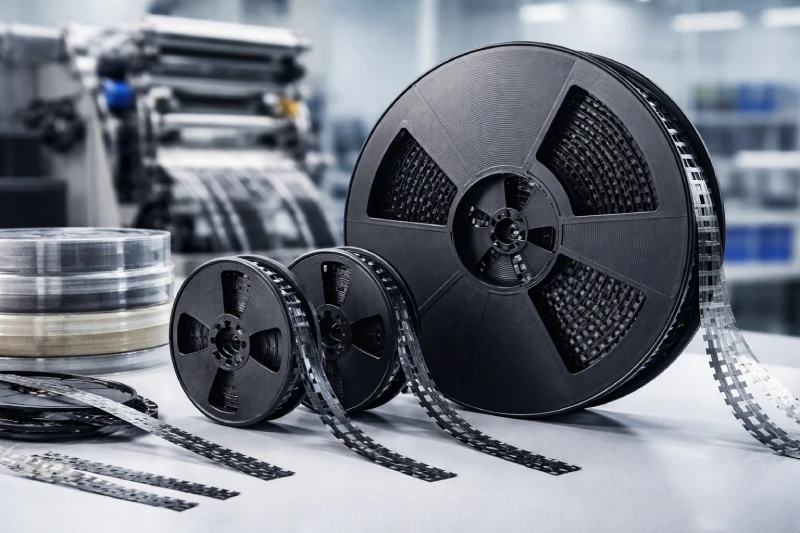
SMD plastic reels are a critical part of tape and reel packaging for electronic components. While carrier tape and cover tape hold the components in place, the plastic reel keeps the entire package organized, protected, and compatible with SMT feeder systems.
In modern electronics manufacturing, the wrong reel can cause tape deformation, feeding errors, static damage, or unnecessary production downtime. Choosing the correct reel size, material, and standard is therefore just as important as choosing the right carrier tape.
This guide explains what an SMD plastic reel is, the most common reel sizes, the materials available, the ANSI/EIA-481 standard, and how to select the best reel for your application.
What Is an SMD Plastic Reel?
An SMD plastic reel is the outer spool used in tape and reel packaging. After components are placed into carrier tape pockets and sealed with cover tape, the tape is wound onto a plastic reel for storage, shipping, and automated SMT assembly.
The reel itself does not directly touch the components. Instead, it supports the carrier tape and ensures the tape can be smoothly loaded into pick-and-place machines.
A typical tape and reel packaging structure includes:
- Carrier tape to hold the components
- Cover tape to seal the pockets
- Plastic reel to wind and store the tape
For example, an SMT manufacturer may package resistors, capacitors, LEDs, connectors, or ICs inside embossed carrier tape, seal the tape, and then wind it onto a 7-inch or 13-inch reel.
If you are unfamiliar with the complete packaging process, it is helpful to first understand how carrier tape and cover tape work together before selecting the reel.
You can naturally link this section to your existing pages about carrier tape, cover tape, and tape & reel packaging solutions.
Why SMD Plastic Reels Matter in Electronics Manufacturing
Many buyers focus only on the carrier tape specification and ignore the reel. However, the reel directly affects transport safety, SMT feeding stability, and production efficiency.
A properly designed SMD plastic reel helps:
- Prevent tape twisting and deformation
- Keep the tape wound evenly
- Protect sensitive components during shipping
- Improve feeder compatibility
- Reduce line stoppages and operator intervention
Without the correct reel, the tape may unwind unevenly or shift during transport. This can lead to damaged components, jammed feeders, or high scrap rates on the SMT line.
| Without Proper Reel | With Proper SMD Plastic Reel |
|---|---|
| Tape deformation | Stable and even winding |
| Feeding errors | Smooth feeder operation |
| Higher scrap rate | Better component protection |
| Frequent machine stoppages | Higher line efficiency |
In high-volume SMT production, even a small feeding problem can stop an entire line. That is why experienced manufacturers select the reel based not only on price, but also on tape width, machine compatibility, and component sensitivity.
Standard SMD Plastic Reel Sizes Explained
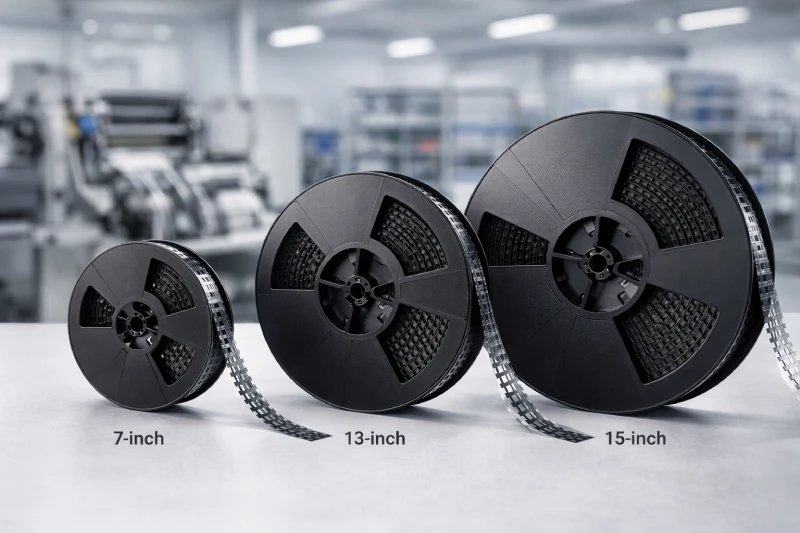
The most common SMD plastic reel sizes are 7 inch, 13 inch, and 15 inch. The correct size depends on the carrier tape width, the quantity of components required per reel, and the type of SMT feeder used.
7 Inch SMD Plastic Reel
A 7-inch reel is commonly used for smaller production runs, prototype orders, or low-volume packaging.
It is usually paired with:
- 8 mm carrier tape
- 12 mm carrier tape
- 16 mm carrier tape
Typical applications include:
- Resistors
- Capacitors
- Small LEDs
- Small IC packages
Because the reel is smaller, it holds fewer components and requires more frequent reel changes during production. However, it is often the best choice for sampling, small batch manufacturing, or when the available feeder space is limited.
13 Inch SMD Plastic Reel
The 13-inch reel is the most widely used size in SMT manufacturing. It offers much higher component capacity and is ideal for mass production.
A 13-inch reel is often used with:
- 8–44 mm carrier tape
- Medium and large production volumes
- Automatic pick-and-place lines
Compared with a 7-inch reel, a 13-inch reel reduces reel changes and improves line efficiency. Most standard SMT feeders are designed to work with 13-inch reels.
15 Inch Plastic Reel
A 15-inch reel is typically used for:
- Wide carrier tape
- Large or heavy components
- Long continuous production runs
- Custom tape and reel packaging
This size is often required for connectors, large modules, or components packaged in 24–72 mm carrier tape.
| Reel Size | Typical Tape Width | Approximate Capacity | Best For |
|---|---|---|---|
| 7 inch | 8–16 mm | Low to medium | Prototype and small batch |
| 13 inch | 8–44 mm | Medium to high | Standard mass production |
| 15 inch | 24–72 mm | High | Large parts and long runs |
If your application involves standard SMT components, a 13-inch reel is usually the most practical option. For larger parts or wider carrier tape, a custom 15-inch reel may provide better support.
For more detailed reel options, you can insert an internal link here to your Plastic Reel product page.
SMD Plastic Reel Materials: Which One Should You Choose?
SMD plastic reels are available in different materials. The correct material depends on the component weight, transport conditions, and whether ESD protection is required.
PS (Polystyrene) Reels
Polystyrene, or PS, is one of the most common reel materials.
Advantages include:
- Low cost
- Lightweight structure
- Good rigidity
- Suitable for most standard SMT components
PS reels are widely used for resistors, capacitors, and other general electronic parts. If your components are not sensitive to static electricity and do not require special strength, a PS reel is often the most economical choice.
PC (Polycarbonate) Reels
Polycarbonate reels are stronger and more durable than PS reels.
They are often used when:
- Components are heavier
- Larger tape widths are required
- Higher heat resistance is needed
- Shipping conditions are more demanding
PC reels are less likely to crack or deform during transportation, especially for larger 13-inch or 15-inch reels.
Anti-Static and ESD Plastic Reels
For semiconductors and sensitive electronic components, an anti-static or ESD-safe reel is necessary.
These reels help prevent electrostatic discharge that could damage:
- ICs
- Sensors
- Memory chips
- Semiconductor devices
- Sensitive SMT modules
| Material | Main Advantages | Typical Application |
|---|---|---|
| PS | Low cost and lightweight | Standard SMT parts |
| PC | Stronger and more durable | Large or heavy components |
| ESD Plastic | Protects against static discharge | ICs and sensitive electronics |
If you are already using anti-static carrier tape, the reel should also provide ESD protection to ensure the entire packaging system is safe.
This section is an ideal place to include an internal link to your Anti-Static Carrier Tape page.
SMD Plastic Reel Dimensions and ANSI/EIA-481 Standards
Not all plastic reels are interchangeable. To work correctly with SMT feeders, the reel dimensions must follow the ANSI/EIA-481 standard.
This standard defines important features such as:
- Reel diameter
- Hub diameter
- Arbor hole size
- Reel width
- Winding direction
- Tape width compatibility
The most common dimensions include:
| Specification | Typical Value |
|---|---|
| Reel Diameter | 178 mm or 330 mm |
| Arbor Hole Diameter | 13 mm or 21 mm |
| Compatible Tape Width | 8–72 mm |
| Reel Width | Depends on tape width |
| Winding Direction | Clockwise or counterclockwise |
The reel diameter determines whether the reel is considered a 7-inch or 13-inch model. The arbor hole must fit the SMT feeder spindle, while the reel width must match the carrier tape width.
If a reel does not follow EIA-481 dimensions, it may:
- Fail to fit the feeder
- Cause tape misalignment
- Jam during production
- Reduce feeding accuracy
For this reason, using a standard-compliant reel is usually safer and more cost-effective than purchasing a low-cost non-standard reel.
This section can naturally link to a future article about the ANSI/EIA-481 standard.
How to Choose the Right SMD Plastic Reel
Choosing the correct reel is easier when you follow a simple step-by-step process.
Step 1: Identify the Carrier Tape Width
The reel must be compatible with the tape width.
For example:
- 8 mm tape usually works with a 7-inch or 13-inch reel
- 24 mm or wider tape often requires a larger reel
- Very wide tape may require a custom 15-inch reel
Step 2: Consider the Component Size and Weight
Small resistors and capacitors can usually use a standard PS reel. Larger connectors or heavier modules may require a stronger PC reel.
Step 3: Check SMT Feeder Compatibility
Different SMT machines support different reel sizes and arbor hole diameters.
Before ordering, confirm:
- Maximum reel diameter
- Arbor hole size
- Supported tape width
- Required winding direction
Step 4: Determine Whether ESD Protection Is Needed
If your components are static-sensitive, choose an anti-static reel.
Typical components requiring ESD-safe reels include:
- ICs
- Sensors
- Semiconductor modules
- Communication chips
Step 5: Estimate Quantity Per Reel
A larger reel holds more components and reduces changeover time.
If your production line runs continuously, a 13-inch or 15-inch reel may improve efficiency and lower labor costs.
Quick Selection Checklist
Before finalizing the reel specification, confirm:
- Carrier tape width
- Reel diameter
- Material type
- Arbor hole size
- ESD requirement
- Quantity per reel
- SMT machine compatibility
If you are uncertain, a tape and reel packaging supplier can usually recommend the correct reel based on your component drawings and tape specification.
Common Problems Caused by the Wrong Plastic Reel
Using the wrong reel can create unexpected production problems.
The most common issues include:
| Problem | Recommended Solution |
|---|---|
| Reel cracks during transport | Use stronger PC reel |
| Static-sensitive parts fail | Use ESD-safe reel |
| Feeder jams occur | Choose EIA-481 compliant reel |
| Tape slips or loosens | Select correct reel width and hub size |
| Too many reel changes | Upgrade to a larger 13-inch or 15-inch reel |
For example, if a reel flange is too narrow, the carrier tape may move sideways during transport. If the arbor hole does not match the feeder spindle, the reel may not rotate correctly.
Similarly, using a standard plastic reel for sensitive ICs without ESD protection may result in hidden damage that is only discovered later during testing.
Most of these problems can be avoided by selecting the reel based on the actual application rather than choosing the cheapest available option.
You can also add an internal link here to your article about common tape and reel packaging defects.
Custom SMD Plastic Reels vs Standard Reels
Standard reels are suitable for most SMT components, but some applications require a custom solution.
Custom SMD plastic reels are often used when:
- The carrier tape is unusually wide
- Components are especially large or heavy
- A special feeder system is used
- Branded packaging is required
- A specific reel color or structure is needed
| Standard Reel | Custom Reel |
|---|---|
| Lower cost | Designed for your application |
| Faster delivery | Better fit and protection |
| Standard dimensions | Custom dimensions available |
| Suitable for common components | Suitable for unique or difficult parts |
Although custom reels are more expensive, they often reduce feeding issues and improve long-term production efficiency.
For manufacturers using non-standard components, a custom reel can provide better protection and smoother operation.
This is also a good place to guide readers toward your custom tape and reel packaging service page with a soft CTA.
Conclusion
SMD plastic reels play an essential role in SMT tape and reel packaging. The correct reel improves feeder performance, protects components, and reduces production problems.
When selecting an SMD plastic reel, always consider:
- Reel size
- Tape width
- Material type
- ESD requirements
- ANSI/EIA-481 compatibility
For most standard SMT applications, a 13-inch reel made from PS or ESD material is often the best balance between cost and performance. However, larger components or special packaging may require a stronger or custom reel.
If you are unsure which SMD plastic reel is right for your carrier tape or SMT feeder system, working with an experienced tape and reel packaging supplier can help you avoid costly production issues and select the most suitable solution for your project.