
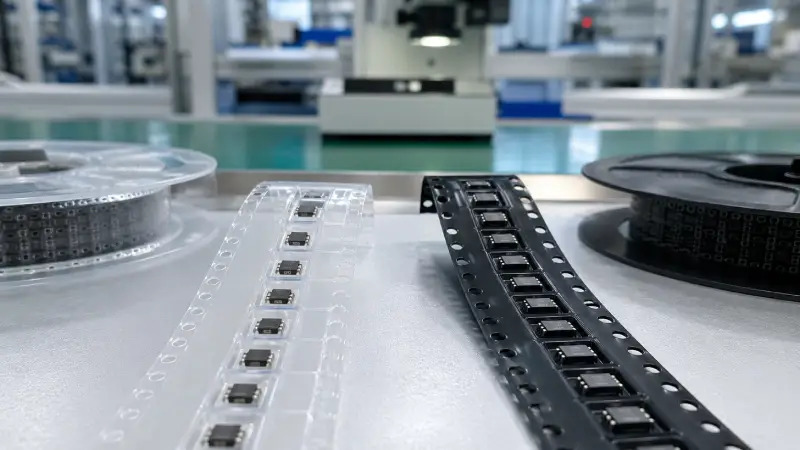
When buyers compare PS carrier tape and PET carrier tape, the most important question is not simply “Which material is better?” A better question is: which material is more suitable for your component, packaging process, inspection requirement, ESD need, and cost target?
Both PS and PET are commonly used materials for embossed carrier tape in SMT packaging. They can be formed into pockets to hold electronic components securely during storage, transport, and automatic feeding. However, they perform differently in areas such as forming stability, transparency, rigidity, cost, and application suitability.
For buyers, component distributors, OEM sourcing teams, and SMT packaging teams, the right choice should be based on practical packaging requirements rather than material name alone. If you are developing packaging for ICs, sensors, connectors, LEDs, passive components, or other electronic parts, it is usually worth reviewing both material options before confirming production.
Jiushuo provides different embossed carrier tape materials, including PS, PET, PC, ABS, and anti-static or conductive options, depending on component size, pocket design, ESD requirement, and packaging application.
PS vs PET Carrier Tape: Quick Comparison for Buyers
PS carrier tape is often selected for cost-effective and general-purpose electronic component packaging. It is widely used because it can support many standard pocket designs and offers a practical balance between forming performance and cost.
PET carrier tape is often considered when buyers need better transparency, a cleaner visual appearance, or certain material performance advantages. It can be useful when component visibility, inspection, or presentation matters more in the packaging process.
However, neither material should be selected based only on price or appearance. Buyers should consider the full packaging system, including component size, pocket depth, cover tape compatibility, ESD control, reel matching, and SMT feeding stability.
In many real projects, the final decision is confirmed after sample testing. A material that looks suitable on paper may still need adjustment once the pocket is formed and tested with actual components.
PS Carrier Tape vs PET Carrier Tape Comparison
| Factor | PS Carrier Tape | PET Carrier Tape | Buyer Consideration |
|---|---|---|---|
| Common use | General electronic component packaging | Applications needing visibility or stable appearance | Match material with component and inspection needs |
| Forming stability | Suitable for many standard embossed pockets | Suitable for many formed pocket designs | Confirm pocket depth and component fit |
| Transparency | Available in different options, but not always chosen for clarity | Often considered when visibility is important | Useful for inspection and visual confirmation |
| Rigidity | Practical for many standard components | May be selected for specific material performance needs | Consider component weight and protection |
| ESD options | Can be anti-static or conductive | Can be anti-static or conductive | Confirm surface resistance requirements |
| Cost | Often cost-effective | May cost more depending on specification | Balance budget and performance |
| SMT feeding | Depends on tape design, pocket accuracy, and sealing | Depends on tape design, pocket accuracy, and sealing | Test with real components before bulk order |
This table gives a basic comparison, but it should not replace supplier evaluation. The same material can perform differently depending on tape width, thickness, forming depth, pocket shape, and component characteristics.
How Material Choice Affects Pocket Forming
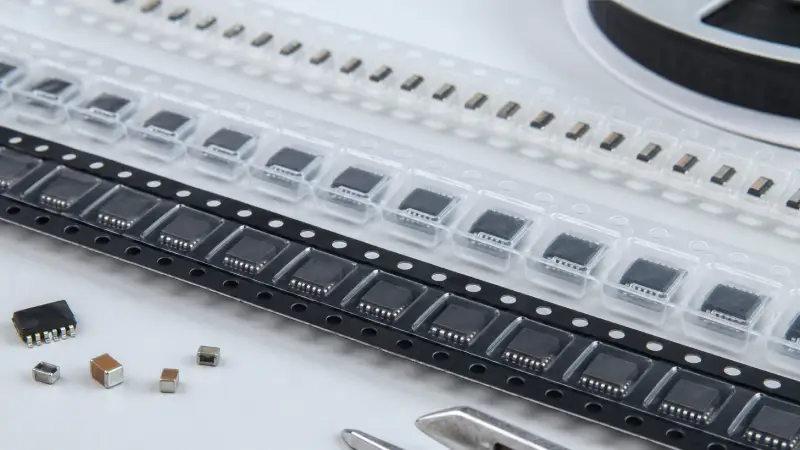
Pocket forming is one of the most important factors in carrier tape production. The pocket must hold the component securely without creating excessive movement, pressure, or deformation.
PS is commonly used for many standard embossed carrier tape applications because it can be formed into stable pockets for a wide range of electronic parts. For regular component shapes and moderate pocket depths, PS can often meet practical packaging requirements.
PET may be preferred when buyers need a cleaner appearance, good visibility, or a certain level of material stability for specific packaging needs. However, the final forming result still depends on the component structure and pocket design.
For both PS and PET, buyers should avoid choosing material before confirming pocket requirements. A good pocket design should consider component length, width, height, weight, orientation, clearance, and pick-and-place requirements.
If the pocket is too loose, the component may move during transport or feeding. If the pocket is too tight, the component may be difficult to place or pick. If the material is not suitable for the pocket depth, forming consistency may become a problem.
That is why custom pocket design and sample testing are important for carrier tape projects, especially when components are small, fragile, irregular, or ESD-sensitive.
How Material Choice Affects Component Protection
Carrier tape is not only a container. It is part of the component protection system. During packaging, winding, shipping, storage, and SMT feeding, the tape must help keep each component in the correct position.
For many common electronic components, PS carrier tape can provide enough support and protection when the pocket is properly designed. It is often a practical choice for buyers who need stable packaging at a reasonable cost.
PET carrier tape may be considered when the buyer needs better visibility or specific performance from the tape material. For example, if the component must be checked visually through the tape, PET may be more attractive because of its transparency advantages.
Component weight also matters. Lightweight passive components may not require the same carrier tape rigidity as heavier connectors, modules, or precision components. If the component is heavier or has a more complex shape, the supplier may recommend a different material, thickness, or even another material option such as PC or ABS.
A good supplier should not simply ask, “Do you want PS or PET?” Instead, the supplier should evaluate the component, recommend a suitable material, and confirm whether the design can support stable packaging and feeding.
Transparency, Inspection, and Visual Confirmation
One of the key reasons buyers compare PS and PET carrier tape is transparency. In some applications, transparent carrier tape helps operators, inspectors, or packaging teams confirm component presence, position, and orientation more easily.
PET carrier tape is often considered when visibility is important. It can support applications where buyers want to see the component more clearly inside the pocket. This may be helpful for visual inspection, packaging confirmation, or customer presentation.
PS carrier tape can also be available in different visual forms, depending on material and production requirements. However, when transparency is a major requirement, PET is often included in the discussion.
Still, buyers should not assume that transparent tape is always better. In some cases, black carrier tape or ESD-focused carrier tape may be more suitable, especially for sensitive ICs, sensors, or components that require stronger ESD control.
Inspection equipment also matters. Some buyers use visual inspection, while others rely on machine detection or downstream SMT equipment. Carrier tape material and color should be tested with the actual inspection and feeding environment whenever possible.
ESD Requirements: Anti-Static and Conductive Options
For ESD-sensitive components, material choice must include electrostatic protection requirements. PS and PET carrier tape can both be supplied with anti-static or conductive options, but the required ESD performance should be confirmed clearly before production.
Anti-static carrier tape is commonly used when the goal is to reduce static buildup during packaging and handling. Conductive carrier tape is often considered for components with higher ESD sensitivity or stricter protection requirements.
Buyers should not rely only on the material name. A tape described as PS or PET does not automatically mean it meets ESD requirements. The buyer should confirm surface resistance range, anti-static or conductive treatment, testing conditions, and whether the cover tape and reel also need ESD consideration.
If ESD control is a key requirement, Jiushuo can support anti-static carrier tape and other ESD-focused carrier tape options based on the component and packaging environment.
For sensitive components, the full packaging system should be reviewed, including carrier tape, cover tape, reel, handling process, storage condition, and customer requirement.
When to Choose PS Carrier Tape
PS carrier tape may be a suitable choice when the component is standard in size, not unusually heavy, and does not require special transparency. It is often selected for general electronic component packaging because it offers a practical balance between cost and performance.
Buyers may consider PS carrier tape when cost control is important, the pocket design is relatively standard, and sample testing confirms that the tape can provide stable forming and feeding.
PS may also be suitable when anti-static or conductive performance can be added to meet the packaging requirement. For many common SMT components, PS remains a reliable and economical material option.
However, buyers should still confirm the details. If the component has a deep pocket, irregular shape, strict inspection requirement, or high ESD sensitivity, the supplier should review whether PS is still the best choice.
When to Choose PET Carrier Tape
PET carrier tape may be a better option when component visibility is important, when the buyer wants a transparent packaging appearance, or when the application requires certain material characteristics that PET can support.
It may be useful for components that need visual confirmation during packaging or inspection. It can also be considered when the buyer wants a cleaner-looking tape for customer approval or internal quality checking.
PET may also be selected when the supplier recommends it after reviewing component shape, pocket design, or forming requirements.
However, PET should not be selected only because it looks better. Buyers still need to check cost, forming result, ESD performance, cover tape compatibility, and SMT feeding performance.
In short, PET can be a strong option for certain packaging needs, but it is not automatically better than PS in every project.
Do Not Forget Cover Tape Compatibility
Carrier tape material should always be considered together with cover tape. Even if the pocket design is correct, poor cover tape matching can cause sealing instability, peeling issues, or component exposure during transport.
The cover tape must match the carrier tape material, tape width, sealing area, peel force requirement, and packaging process. For example, heat-seal cover tape and pressure-sensitive cover tape may behave differently depending on the carrier tape material and sealing condition.
Before confirming PS or PET carrier tape, buyers should also review cover tape selection. A complete tape-and-reel packaging solution should include carrier tape, cover tape, and reel matching, not just one material decision.
Quotation Checklist: What Buyers Should Send Before Choosing PS or PET
To help the supplier recommend the right material, buyers should prepare the following information:
- Component drawing or datasheet
- Component length, width, height, and weight
- Component photos or physical samples if available
- Required tape width
- Pocket depth and orientation requirement
- ESD requirement
- Preferred color or transparency
- Cover tape requirement
- Reel size
- Estimated order quantity
- SMT feeding or inspection requirement
- Special customer packaging standard, if any
The more complete the information, the easier it is for the supplier to recommend a suitable material and reduce trial-and-error during sampling.
Jiushuo Support for PS, PET, and Other Carrier Tape Materials
Jiushuo supports embossed carrier tape materials such as PS, PET, PC, ABS, and anti-static or conductive options. The recommended material depends on the component type, pocket design, ESD need, inspection requirement, and cost target.
For standard components, PS may be enough. For visibility-focused applications, PET may be considered. For heavier or more demanding parts, other material options may need to be reviewed.
Instead of choosing material based only on general comparison, buyers should work with a supplier that can evaluate component drawings, design suitable pockets, match cover tape, and provide samples before mass production.
Conclusion: PS or PET Carrier Tape?
PS and PET carrier tape are both useful materials for SMT packaging. PS is often practical for cost-effective and general-purpose applications, while PET may be more suitable when transparency, visibility, or certain material performance requirements are important.
The best choice depends on your component, not only the material name. Buyers should consider pocket forming, component protection, ESD control, inspection needs, cover tape matching, reel compatibility, and production stability.
If you are not sure which material is better for your component, send Jiushuo your component drawing, packaging requirement, and ESD needs. Our team can help recommend a suitable embossed carrier tape material and provide sample support before bulk production.
FAQ
Is PS carrier tape cheaper than PET carrier tape?
In many cases, PS carrier tape is considered a cost-effective option. However, the final cost depends on tape width, thickness, pocket design, order quantity, ESD treatment, and cover tape matching.
Is PET carrier tape always better than PS carrier tape?
No. PET may be better for some visibility or material performance needs, but PS is still widely used for many standard electronic components. The right choice depends on the packaging application.
Can both PS and PET carrier tape be anti-static?
Yes. Both PS and PET carrier tape can be supplied with anti-static or conductive options depending on ESD requirements. Buyers should confirm the required surface resistance and testing conditions.
Which material is better for transparent carrier tape?
PET is often considered when transparency and component visibility are important. However, buyers should still confirm forming performance, ESD needs, and inspection compatibility.
Does carrier tape material affect SMT feeding?
Yes, but material is only one factor. SMT feeding stability also depends on pocket accuracy, tape width, cover tape sealing, reel matching, and overall production quality.
Can Jiushuo recommend the right material from a drawing?
Yes. Jiushuo can review your component drawing, dimensions, ESD requirement, and packaging needs to recommend suitable PS, PET, PC, ABS, anti-static, or conductive carrier tape options.