

Choosing between PC carrier tape and PS carrier tape is not about deciding which material is always better. It is about matching the carrier tape material to the component, pocket design, handling risk, SMT feeding requirement, and project budget.
For many electronic components, PS carrier tape provides a practical balance of forming performance and cost. For heavier, larger, higher-value, or more demanding components, PC carrier tape may offer stronger rigidity and better pocket protection. This guide compares the two materials from a buyer’s point of view, so sourcing teams, quality teams, and production engineers can make a more practical material selection decision.
Jiushuo supports multiple embossed carrier tape material options, including PS, PET, PC, ABS, and anti-static options for different electronic component packaging needs.
Why Carrier Tape Material Selection Matters
Carrier tape material affects more than the appearance of the tape. It can influence how stable the pocket shape is after forming, how well the component is protected during taping and transport, and whether the tape performs smoothly during SMT feeding.
If the material is too weak for the component, the pocket may deform, the component may move inside the cavity, or pick-and-place stability may be affected. If the material is stronger than necessary, the buyer may pay extra cost without a clear production benefit.
A good material selection process should consider component weight, component size, package sensitivity, anti-static requirements, cover tape compatibility, shipping conditions, and production quantity. For custom applications, buyers should evaluate the material together with the pocket design and sealing process instead of choosing material based on name alone.
What Is PC Carrier Tape?
PC carrier tape is an embossed carrier tape material option often considered when stronger rigidity and impact resistance are needed. In practical packaging terms, PC can help create a stronger pocket structure and may provide better support for components that need more protection during storage, handling, or SMT feeding.
Buyers may consider PC carrier tape for larger components, heavier parts, higher-value devices, or applications where pocket deformation could create production risk. It can also be useful when the packaging needs to maintain a more stable pocket shape under handling pressure.
However, PC carrier tape is not automatically required for every electronic component. If the component is small, light, and not sensitive to normal handling, a more cost-effective material such as PS may already meet the packaging requirement after sample testing.
What Is PS Carrier Tape?
PS carrier tape is widely used for many general electronic component packaging applications. It is a practical material choice for standard embossed carrier tape pockets and is often selected when the component does not require extra rigidity or stronger impact resistance.
For many small to medium components, PS carrier tape offers a good balance of forming performance, availability, and cost efficiency. This makes it suitable for high-volume production where buyers need stable packaging quality while also controlling unit cost.
PS carrier tape is commonly used when the component is not unusually heavy, the pocket design is not too demanding, and standard pocket protection is enough. For buyers comparing material options, PS is often the first material to evaluate before moving to stronger or more specialized alternatives.
PC Carrier Tape vs PS Carrier Tape: Key Comparison
The table below summarizes the practical differences between PC carrier tape and PS carrier tape from a procurement and production perspective.
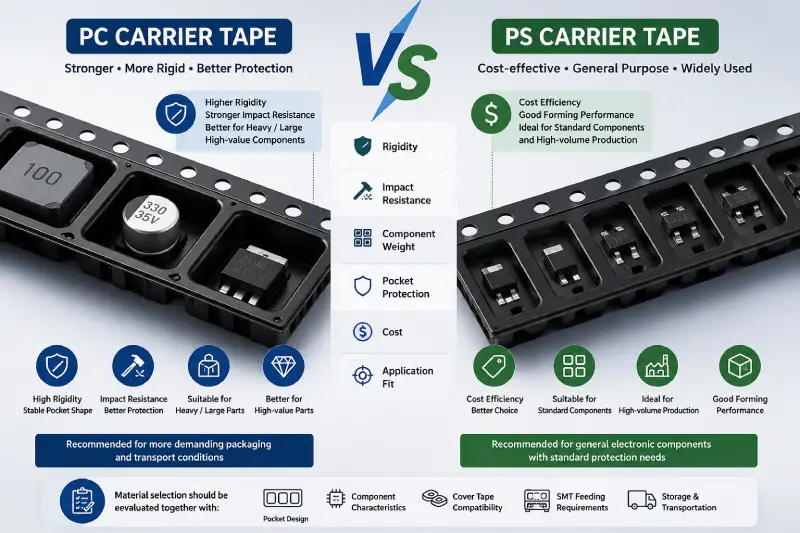
| Comparison Point | PC Carrier Tape | PS Carrier Tape |
|---|---|---|
| Rigidity | Generally stronger and more rigid | Suitable for many standard applications |
| Impact Resistance | Better option when added protection is needed | Enough for many regular components |
| Forming Stability | Good for applications requiring stable pocket shape | Good for standard pocket designs |
| Component Weight | Often considered for heavier or larger components | Suitable for many light to medium components |
| Pocket Protection | Helpful when component movement or pocket deformation is a concern | Practical for standard protection needs |
| Cost | Usually higher than PS | More cost-effective for general use |
| Application Fit | Higher protection or more demanding packaging requirements | General electronic component packaging |
| Selection Logic | Choose when the component needs stronger material support | Choose when standard performance and cost balance are enough |
This comparison should be used as a starting point, not as a fixed rule. The final material choice should be confirmed through component drawings, pocket design review, cover tape sealing tests, and sample validation.
When PC Carrier Tape May Be a Better Choice
PC carrier tape may be a better choice when the packaging risk is higher than the material cost difference. This is often the case when the component is relatively heavy, large, fragile, sharp-edged, or high-value.
For these components, pocket rigidity matters because the carrier tape must hold the component securely throughout taping, reel storage, transportation, and SMT feeding. If the pocket wall is not strong enough, the component may tilt, move, or create feeding problems. Stronger material support can help reduce these risks.
PC carrier tape may also be useful when the buyer wants better impact resistance or when the tape needs to maintain a more stable pocket shape during handling. It is not always the lowest-cost option, but it can be a practical choice when better protection helps reduce rejection, rework, or production interruption.
When PS Carrier Tape May Be Enough
PS carrier tape may be enough when the component is small, light, and commonly packaged. For many standard electronic components, PS can provide reliable pocket forming and practical protection without increasing material cost unnecessarily.
This makes PS carrier tape a strong option for high-volume production, cost-sensitive projects, and applications where the component does not require extra rigidity. If the pocket design is standard and sample testing confirms good component fit, stable sealing, and smooth SMT feeding, PS can be a sensible material choice.
Buyers should not assume that stronger material is always the better purchasing decision. In many cases, the best material is the one that meets the required packaging performance at the right cost. For standard components, PS often provides that balance.
Other Embossed Carrier Tape Material Options from Jiushuo
In addition to PC and PS carrier tape, Jiushuo can support other carrier tape material options based on the component and application. These may include PET carrier tape, ABS carrier tape, and anti-static options for components that need ESD-conscious packaging support.
PS is often used for general electronic component packaging. PC may be selected when stronger rigidity and pocket protection are required. PET and ABS may be considered for different forming or application requirements. Anti-static options can be reviewed when the component has electrostatic sensitivity.
For many projects, the best result comes from reviewing the material together with the custom carrier tape design, pocket dimensions, component weight, cover tape sealing, and reel packaging process. The material should support the full packaging system, not only the pocket itself.
Quotation Checklist: What to Confirm Before Choosing PC or PS Carrier Tape
Before requesting a quotation, buyers should prepare the key information that affects carrier tape material selection. This helps the supplier recommend a suitable material more accurately and reduces unnecessary sampling delays.
- Component name and package type
- Component length, width, height, and weight
- Whether the component is fragile, heavy, sharp-edged, or high-value
- Required carrier tape width and pocket dimensions
- Estimated order quantity or monthly usage
- SMT feeding or pick-and-place requirements
- Anti-static or ESD packaging requirements
- Cover tape sealing requirements
- Reel size and packaging method
- Sample testing requirements before bulk production
- Target budget or cost sensitivity
If the project requires both carrier tape and cover tape, sealing compatibility should be checked during the sample stage.
Need Help Choosing the Right Carrier Tape Material?
If you are not sure whether PC carrier tape or PS carrier tape is more suitable, Jiushuo can help review your component size, weight, pocket design, and packaging requirements before production.
Send us your component drawing, sample details, packaging quantity, and SMT feeding requirements. Our team can help evaluate whether PS, PC, PET, ABS, or anti-static embossed carrier tape is a better fit for your application. A practical material recommendation can help you avoid over-specifying the tape while still protecting the component properly.
FAQ
Is PC carrier tape always better than PS carrier tape?
No. PC carrier tape may offer stronger rigidity and better protection, but PS carrier tape is enough for many standard electronic components. The right choice depends on component size, weight, protection needs, and cost target.
When should I choose PC carrier tape?
PC carrier tape may be suitable when the component is heavier, larger, higher-value, or requires stronger pocket protection during handling, storage, transportation, or SMT feeding.
When is PS carrier tape a good choice?
PS carrier tape is a practical option for many general electronic components, especially when the component is light to medium in weight and standard pocket protection is enough.
Does carrier tape material affect pocket stability?
Yes. Material choice can affect pocket rigidity, forming stability, and how well the pocket protects the component during packaging, transportation, and SMT feeding.
Can Jiushuo provide anti-static PC or PS carrier tape?
Jiushuo can support embossed carrier tape material options including PS, PET, PC, ABS, and anti-static options depending on the component and packaging requirements.
Should I test samples before choosing PC or PS carrier tape?
Yes. Sample testing is recommended to confirm pocket fit, component protection, cover tape sealing, and SMT feeding performance before bulk production.