
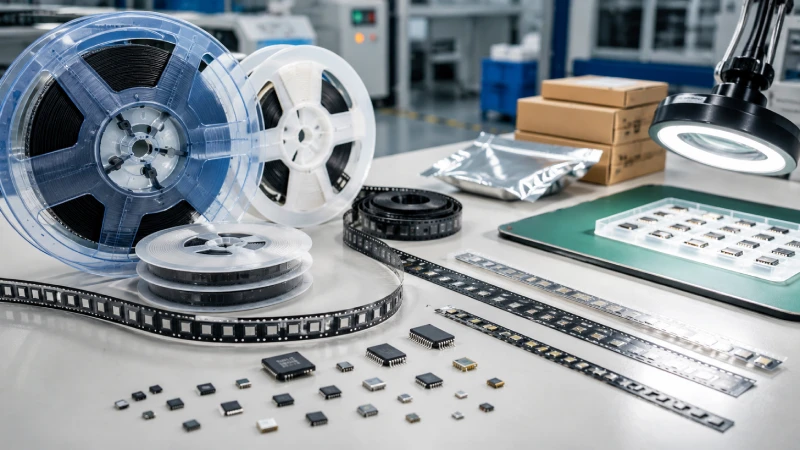
Not every component packaging project begins with mass production. For many startups, engineering teams, OEM buyers, and component distributors, the first step is often a small batch: prototype packaging, customer samples, pilot production, or a new component launch.
In these situations, a low MOQ custom carrier tape solution can help buyers test packaging fit, reduce early-stage risk, and prepare for future production without committing too early to large packaging volumes. The goal is not simply to buy a smaller quantity. The real value is being able to confirm whether the component can be packed, sealed, handled, and delivered properly before the project moves forward.
Jiushuo supports custom embossed carrier tape projects and sampling discussions for buyers who need practical packaging evaluation before larger production. Since every component and packaging project is different, MOQ and sampling feasibility should always be confirmed based on actual requirements.
What Does Low MOQ Custom Carrier Tape Mean?
Low MOQ custom carrier tape refers to customized carrier tape support for smaller project quantities compared with standard mass-production orders. It is commonly used when buyers need packaging for samples, trial orders, new components, or early production batches.
For carrier tape, “low MOQ” does not mean the same thing for every project. The practical order quantity may depend on the component size, pocket design, tape width, material, forming method, sample requirement, and future production plan. A simple component with a common tape format may be easier to evaluate than a complex part requiring special pocket design.
That is why buyers should avoid treating low MOQ only as a price question. A better approach is to discuss the packaging goal first: What needs to be tested? How will the components be used? Is this only for sample delivery, or will the same tape design later support mass production?
For buyers starting a new packaging project, Jiushuo’s custom carrier tape solutions can be reviewed based on component drawings, size details, and sampling needs.
When Is Low MOQ Carrier Tape Useful?
Low MOQ carrier tape is especially useful when a buyer is not yet ready for high-volume tape-and-reel packaging. This often happens in early product development, new component launches, and customer approval stages.
For startups and small-batch component manufacturers, demand may not be stable at the beginning. They may need packaging for investor samples, customer validation, engineering approval, or first production lots. Ordering too much packaging too early can create unnecessary cost and inventory risk, especially if the component design or customer requirement changes.
Engineering sample buyers often need a more controlled packaging format than loose bulk packaging. If components must be sent to customers, internal test teams, or production partners, custom carrier tape can help protect the part and present it in a more production-ready format.
OEM sourcing teams may also use small-batch custom carrier tape during trial production. Before approving a supplier or finalizing a packaging specification, they need to check whether the carrier tape fits the component, works with the cover tape, and supports the next production step.
Component distributors may use low MOQ custom carrier tape to test market demand. Instead of preparing large packaging stock for a new component immediately, they can start with a smaller trial order and evaluate customer response.
In all these cases, low MOQ carrier tape is not only about lower initial quantity. It is a way to reduce uncertainty before larger purchasing decisions are made.
Low MOQ Project Types and Packaging Considerations
| Low MOQ Project Type | Typical Buyer Concern | Packaging Consideration |
|---|---|---|
| Prototype component packaging | The component is still new or not fully validated | Confirm basic pocket fit, component orientation, and handling safety |
| Engineering sample shipment | Samples need to arrive safely and look professional | Check cavity size, cover tape matching, and reel handling |
| New component launch | Demand is uncertain in the first stage | Use sampling to validate packaging before larger orders |
| OEM trial production | The first batch is limited but must support approval | Confirm tape width, pitch, material, and reel format |
| Distributor test order | Customer demand is being tested | Keep packaging practical for possible repeat orders |
| Packaging change project | Existing packaging causes movement, damage, or handling issues | Compare improved pocket design and sealing performance |
| Pre-production approval | Customer needs to approve the packaging format | Use sample tape as a reference before mass production |
This table shows why low MOQ custom carrier tape is often connected with decision-making, not just purchasing. The buyer is usually trying to answer a practical question: “Can this packaging work for our component before we order more?”
What Buyers Should Confirm Before Ordering
A low MOQ carrier tape project can move faster when the buyer provides clear information from the beginning. Even if not every detail is finalized, the manufacturer needs enough input to understand the component and the packaging goal.
The most important information is the component drawing or datasheet. This helps the manufacturer understand the length, width, height, shape, and any sensitive features of the part. Clear photos or 3D files may also help when the component has an irregular shape.
Buyers should also explain the purpose of the order. Is the tape for engineering samples, customer approval, a small production run, or a transition to future mass production? The answer affects how the project should be evaluated.
If the buyer already knows the required tape width, reel size, cover tape requirement, or ESD preference, these details should be shared early. If not, the manufacturer can review the component and discuss a suitable direction.
Jiushuo’s embossed carrier tape solutions are commonly used for components that need formed pockets to support positioning, protection, and organized packaging. For small-batch projects, confirming the pocket design direction before production is especially important.
Custom Embossed Carrier Tape Sampling: What Usually Happens
Custom embossed carrier tape sampling is a practical step between early packaging discussion and larger production. It allows the buyer and manufacturer to evaluate whether the proposed tape design is suitable before the buyer commits to a higher-volume order.
A typical sampling process begins with the buyer sharing component information. This may include drawings, datasheets, photos, sample quantity, and the intended packaging use. The manufacturer then reviews whether the component can be packed in a suitable embossed carrier tape format.
Next, the tape design direction is discussed. The goal is not to make the explanation overly technical, but to confirm practical packaging points such as pocket fit, component orientation, depth, cover tape matching, and reel handling.
After a sample is prepared, the buyer can check whether the component sits correctly inside the pocket, whether movement is controlled, and whether the packaging supports the intended next step. If the sample reveals a problem, adjustments can be discussed before larger production begins.
This is one reason custom embossed carrier tape sampling is valuable for new components. It gives the buyer a chance to identify packaging issues early, when changes are easier and less expensive to manage.
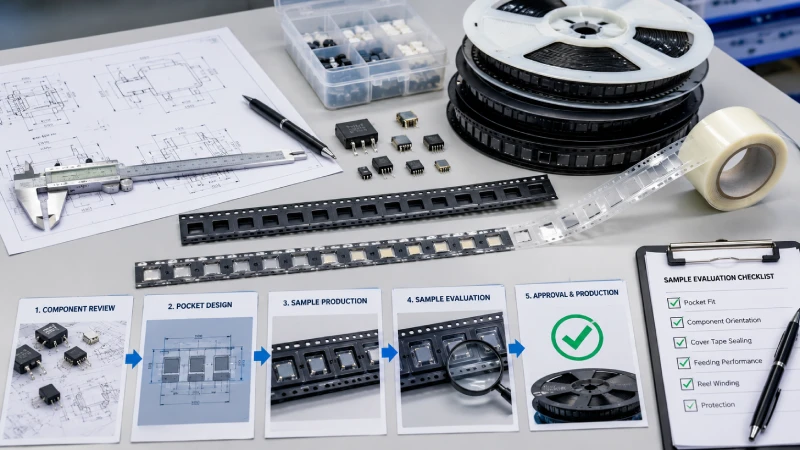
Why Sampling Matters Before Larger Orders
Carrier tape is not just a container. It affects how components are positioned, protected, sealed, transported, stored, and used in downstream assembly or distribution. A packaging issue that seems small during sampling can become costly if it appears after a larger production order.
Sampling helps buyers reduce several common risks. One risk is poor component fit. If the pocket is too loose, the component may move too much during handling or shipping. If the pocket is too tight, loading and unloading may become difficult, or the component may be damaged.
Another risk is incorrect orientation. For components that must be presented in a consistent direction, orientation should be checked before approval. A sample can help the buyer confirm whether the tape design supports the required placement.
Cover tape compatibility is also important. The carrier tape and cover tape need to work together to protect the component while still allowing practical handling. Buyers can review Jiushuo’s cover tape options when discussing sealing requirements for custom tape projects.
Sampling can also reveal whether the project is ready for tape and reel packaging at a larger scale. If the sample performs well, it can become the reference point for future production. If it does not, the buyer can adjust the packaging direction before investing in a bigger order.
For startups and OEM teams, this is especially useful because early product requirements may change. Sampling gives the team a controlled way to test packaging without locking the project too early.
Low MOQ Does Not Mean Ignoring Future Production
A low MOQ order is often the first step, not the final packaging plan. Buyers should still think about what happens after the sample or trial batch is approved.
For example, if the component receives customer approval, can the same packaging design be used for repeat orders? If demand increases, can the supplier support larger quantities with consistent material, tape dimensions, and cover tape matching? If the buyer needs to provide packaging documentation to customers, can the sample specification become the basis for future production?
These questions matter because a low MOQ project should not create a dead end. A good low MOQ carrier tape manufacturer should help buyers avoid restarting the packaging process when the project moves from sample approval to production.
This is especially important for OEM sourcing teams and distributors. The first order may be small, but the packaging decision may influence future supply chain efficiency, customer approval, and production stability.
Quotation Checklist for Low MOQ Custom Carrier Tape
Before requesting a quotation, buyers should prepare as much of the following information as possible:
- Component name and application
- Component drawing or datasheet
- Length, width, height, and shape details
- Component photos or 3D files, if available
- Required sample or trial order quantity
- Tape width requirement, if known
- Material preference, if known
- Conductive or anti-static requirement, if applicable
- Cover tape requirement
- Reel size requirement
- Packaging destination or shipping requirement
- Expected future order volume, even if only estimated
- Target approval timeline
- Any known handling or packaging issue with the current solution
Not every buyer will have all these details at the first discussion. That is normal for early-stage projects. However, clearer input usually leads to faster review, more accurate quotation, and better sampling suggestions.
Buyers should also be transparent about the purpose of the low MOQ order. If the project is only for engineering samples, the manufacturer may evaluate it differently from a project that is expected to move into regular production.
How to Choose a Low MOQ Carrier Tape Manufacturer
Choosing a low MOQ carrier tape manufacturer should not be based only on the lowest starting cost. For custom carrier tape, especially custom embossed carrier tape, the supplier’s ability to understand the component and support sampling can be just as important as the initial quotation.
A practical supplier should be able to review component details before making promises. If a manufacturer offers a fixed MOQ or fixed solution before seeing the drawing, buyers should be careful. Carrier tape requirements can change significantly depending on component size, shape, sensitivity, and packaging purpose.
Good communication is also important. The supplier should ask useful questions about the project: What is the sample used for? Will the tape support customer approval? Is future production expected? Are there cover tape or reel requirements? These questions help avoid mistakes before sampling begins.
A reliable supplier should also understand the transition from small batch to larger production. The goal is not only to make a sample, but to create a packaging direction that can support future repeat orders if the project grows.
Jiushuo provides custom embossed carrier tape solutions for component packaging projects and can discuss sampling support based on actual project requirements. For buyers working on prototype packaging, engineering samples, new component launches, or small-batch trials, this can help create a more practical path from first sample to production packaging.
Need Low MOQ Custom Carrier Tape for a Sample or Trial Project?
If you are preparing engineering samples, prototype packaging, a new component launch, or a small-batch production trial, Jiushuo can help review your component details and discuss a suitable custom embossed carrier tape solution.
To start the discussion, share your component drawing, sample quantity, tape requirement, cover tape needs, and expected production plan. Jiushuo will review the project and suggest a practical next step based on the actual packaging requirements.
Contact Jiushuo to request a custom carrier tape quotation, send your component drawing, or discuss a custom embossed carrier tape sampling project.
FAQ
What is low MOQ custom carrier tape?
Low MOQ custom carrier tape refers to customized carrier tape support for smaller project quantities, often used for prototypes, engineering samples, trial production, or new component launches. The exact feasibility depends on the component, tape design, material, and project requirements.
Can I order custom carrier tape for engineering samples?
Yes. Many engineering sample projects need custom carrier tape before mass production. Buyers should provide component drawings, dimensions, sample quantity, and packaging goals so the manufacturer can review the best sampling direction.
Is low MOQ carrier tape suitable for startups?
Yes. Low MOQ carrier tape can be useful for startups developing new electronic components or hardware products. It allows the team to test packaging fit, customer sample delivery, and early production requirements before committing to larger packaging volumes.
Why should I sample custom embossed carrier tape before mass production?
Sampling helps confirm pocket fit, component orientation, cover tape matching, and handling performance. This reduces the risk of packaging issues after a larger production order has already started.
Do low MOQ carrier tape orders always require custom tooling?
Not always. The requirement depends on the component shape, tape format, and pocket design. Some projects may be easier to evaluate, while others may need more customized development. Buyers should let the manufacturer review the component details before assuming the tooling route.
What should I send to request a quotation?
Send the component drawing or datasheet, key dimensions, sample quantity, tape width if known, material preference, cover tape requirement, reel size requirement, and expected future production plan. Clear information helps the supplier provide a more accurate quotation and sampling recommendation.