
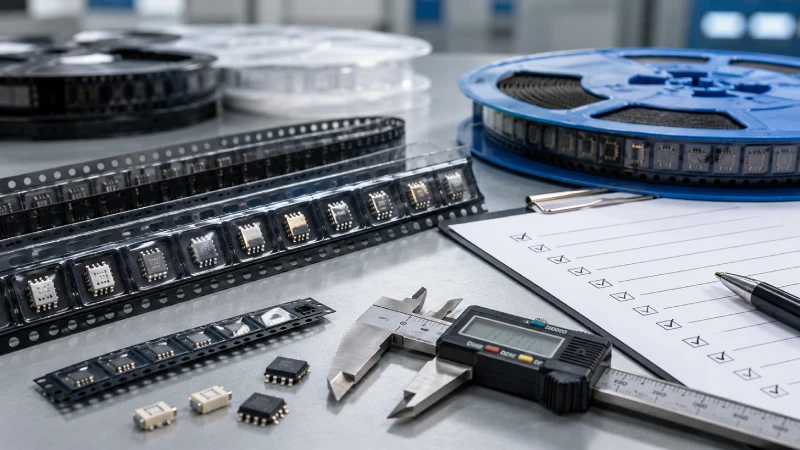
Approving carrier tape for mass production should not be based only on a drawing, quotation, or product photo. For electronic component manufacturers, OEM sourcing teams, SMT packaging buyers, and quality teams, the real question is simple: will this carrier tape protect the component and run smoothly in production?
Carrier tape may look like a small packaging detail, but it directly affects component handling, storage, transport, cover tape sealing, reel winding, and SMT feeding. A pocket that is slightly too loose may allow component rotation. A pocket that is too tight may create loading or pickup issues. An unsuitable cover tape may seal poorly or peel unevenly during automated assembly. These problems are much easier to fix during sampling than after mass production has started.
This guide explains what buyers should check before approving carrier tape for mass production. It focuses on practical buyer-side verification, including component fit, pocket depth, orientation, cover tape matching, reel winding, ESD needs, packaging quantity, and SMT feeding trials. For projects that require new pocket design, Jiushuo can support custom carrier tape sampling, embossed carrier tape design, cover tape matching, and production confirmation before bulk orders.
Why Carrier Tape Verification Matters Before Mass Production
Carrier tape is not only used to hold components. It also helps control how parts are positioned, sealed, wound, shipped, stored, and fed into automated equipment. When the tape is properly designed and verified, buyers can reduce the risk of part movement, cover tape failure, feeding interruption, and production rework.
Before mass production, buyers should confirm that the tape works with the actual component, the selected cover tape, the reel format, and the intended SMT process. Even if the carrier tape dimensions appear correct on paper, real components may have small shape differences, height variations, fragile edges, uneven surfaces, or pickup limitations. These details can only be checked properly with samples.
Verification is especially important for custom components, irregular shapes, connectors, sensors, terminals, power parts, precision stamped parts, and components with strict ESD or orientation requirements. A short sample review can prevent costly problems later in production.
Start With Carrier Tape Sample Approval
The first step is to approve a physical carrier tape sample. Drawings are useful, but they cannot fully show how the component behaves inside the pocket. A sample allows buyers to place real components into the tape, check movement, confirm orientation, test sealing, and review reel winding before committing to mass production.
For custom projects, buyers should provide component drawings and actual samples whenever possible. Jiushuo can use this information to design a suitable pocket and produce sample tape for confirmation. If the component has a special shape, fragile pins, a high center of gravity, or a sensitive pickup surface, actual samples are especially important.
Sample approval should not be rushed. The goal is not only to confirm that the tape can be produced, but also to confirm that the tape is practical for the buyer’s packaging and assembly process. Before approving bulk production, buyers should check whether the sample can be loaded smoothly, sealed properly, wound correctly, and fed without obvious issues.
For buyers developing a new packaging solution, Jiushuo’s custom carrier tape service can help confirm the pocket structure, tape width, pitch, material, and production details before mass production.
Check Component Fit Inside the Pocket
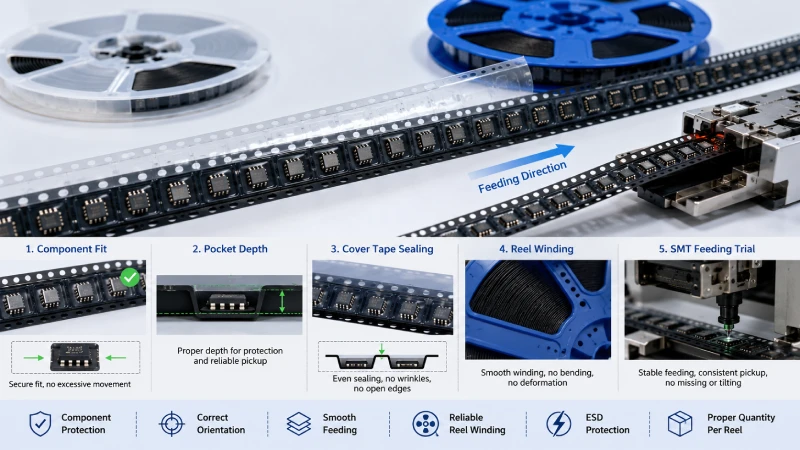
Component fit is one of the most important points in carrier tape verification. The component should sit securely inside the pocket without excessive movement, but it should not be so tight that loading or pickup becomes difficult.
Buyers should first check whether the component sits flat in the pocket. If the part tilts, rocks, or rests on a fragile edge, the pocket may need adjustment. For parts with terminals, leads, pins, or irregular edges, the pocket should support the component body while avoiding unnecessary pressure on sensitive areas.
Next, check the clearance around the component. A small amount of clearance is usually needed for easy loading and stable pickup, but too much space can allow the part to rotate, shift, or collide with the pocket walls during winding and transport. Excessive movement may also create problems when the cover tape is peeled during SMT feeding.
A practical way to check fit is to place several actual components into the sample tape, gently move the tape by hand, and observe whether the components remain in the correct position. If the parts rotate, stand up, slide too much, or get stuck, the pocket design should be reviewed before mass production.
Confirm Component Orientation and Feeding Direction
Correct orientation is just as important as correct pocket size. Many production problems happen because the component fits inside the pocket, but the direction is wrong for the buyer’s assembly process.
Before approval, buyers should confirm the required orientation of the component inside the carrier tape. This may include polarity direction, pin direction, marking side, terminal position, pickup surface, or the side that should face upward. For components with a defined assembly direction, this step should be confirmed clearly with drawings or sample photos.
Buyers should also check the tape feeding direction. The way the component is placed in the pocket must match how the tape will enter the SMT feeder or downstream process. If the orientation is reversed, the tape may still look correct visually but create problems during assembly.
For custom projects, it is helpful to mark the feeding direction and component orientation during sample confirmation. This reduces misunderstanding between the buyer, packaging team, and production team before mass production begins.
Verify Pocket Depth and Pickup Clearance
Pocket depth affects both component protection and SMT pickup. If the pocket is too shallow, the component may protrude above the tape surface or press against the cover tape. This can create sealing problems, rubbing, or part movement. If the pocket is too deep, the component may sit too low, making pickup less stable.
Buyers should check whether the component is protected inside the pocket while still leaving enough access for vacuum pickup or manual handling. The top surface used for pickup should remain visible and reachable. For taller components, connectors, modules, and irregular-shaped parts, pocket depth should be reviewed carefully.
This is one of the main reasons many buyers choose embossed carrier tape for custom packaging. Embossed pockets can be designed with different depths and shapes to support the component more securely than flat packaging. However, the design still needs to be checked with real components before approval.
Carrier Tape Verification Checklist Before Mass Production
| Verification Item | Why It Matters |
|---|---|
| Component fit | Prevents loose movement, tight loading, rotation, or damage |
| Pocket length and width | Confirms the component can sit securely without jamming |
| Pocket depth | Affects protection, cover tape clearance, and SMT pickup |
| Component orientation | Prevents wrong feeding direction or assembly errors |
| Pocket pitch | Helps confirm compatibility with feeding equipment |
| Sprocket hole quality | Supports stable tape movement during feeding |
| Cover tape sealing | Prevents parts from falling out during storage and transport |
| Peel stability | Helps maintain smooth cover tape removal on SMT lines |
| Reel winding | Prevents tape deformation, bending, or uneven tension |
| ESD requirement | Protects static-sensitive electronic components |
| Packaging quantity | Confirms pieces per reel and production planning accuracy |
| SMT feeding trial | Verifies real production compatibility before approval |
This checklist does not need to be complicated. Buyers can use it as a practical approval guide during sample review. The main purpose is to confirm that the tape is suitable for the component, packaging process, and production environment.
Check Cover Tape Matching and Sealing
Carrier tape should always be checked together with the selected cover tape. Even if the pocket design is suitable, poor cover tape matching can still cause packaging failure.
During sample verification, buyers should check whether the cover tape seals evenly across the carrier tape. The seal should be strong enough to keep components inside during winding, storage, and transport, but it should not be so strong that peeling becomes difficult. Uneven sealing, wrinkles, open edges, or weak adhesion should be reviewed before production approval.
Peel stability is also important. If the cover tape peels with sudden force changes, it may cause tape vibration or component movement during SMT feeding. A smooth and stable peel helps support better assembly performance.
Jiushuo can help match suitable cover tape with the carrier tape material and component packaging requirement. This is especially important when the component is heavy, tall, sensitive, or requires reliable transport protection.
Review Reel Winding and Tape-and-Reel Packaging
Carrier tape approval should include reel winding review, not only pocket inspection. A tape sample may look correct when flat, but problems can appear after winding onto a reel.
Buyers should check whether the tape winds smoothly and evenly. The tape should not be crushed, bent, twisted, or wound with unstable tension. Uneven winding can affect storage, transport, and later feeding. For larger components or deeper pockets, reel winding becomes even more important because pocket height and tape stiffness may influence how the reel behaves.
Buyers should also confirm reel size, hub size, leader length, trailer length, winding direction, and quantity per reel. These details affect production planning, operator handling, and SMT line setup. For complete packaging projects, Jiushuo can support tape and reel packaging confirmation to help buyers align carrier tape, cover tape, reel, and packaging quantity before bulk production.
Confirm ESD and Material Requirements
Many electronic components require ESD protection during packaging and handling. Before approving carrier tape, buyers should confirm whether the component needs anti-static, dissipative, or conductive material. This decision should not be made only by looking at the part; it should be based on the component’s handling requirements and the buyer’s internal packaging rules.
Material choice may also affect transparency, inspection, stiffness, color, and sealing performance. For example, some buyers may need transparent tape for visual inspection, while others may need black conductive tape for static-sensitive components. These requirements should be discussed before mass production, because changing material later may require new sample confirmation.
Buyers should also confirm whether the cover tape and reel packaging are suitable for the selected material. Carrier tape verification works best when the full packaging system is reviewed together.
Run a Small SMT Feeding Trial When Possible
The most practical way to confirm carrier tape performance is to run a small feeding trial. This does not need to be a complicated validation process. The purpose is to see whether the tape works in real or similar production conditions.
During the feeding trial, buyers should check whether the tape moves smoothly through the feeder, whether the sprocket holes engage correctly, whether the cover tape peels cleanly, and whether the components remain in the correct position. The pickup process should also be observed. If the machine misses parts, picks inconsistently, or causes parts to shift, the pocket design may need adjustment.
A feeding trial is especially useful for new components, custom tape designs, deeper pockets, or components with special pickup surfaces. It gives buyers greater confidence before approving mass production.
Common Problems Found During Sampling
Finding problems during sampling does not mean the project has failed. In fact, this is the purpose of sample approval. It is much better to find small issues early than to discover them after thousands of meters of carrier tape have been produced.
Common sampling problems include pockets that are too loose, causing the component to move or rotate. Some pockets may be too tight, making loading difficult or affecting pickup. In other cases, the component may sit too deep, tilt inside the pocket, rub against the cover tape, or face the wrong direction for assembly.
Cover tape issues are also common during sample review. Buyers may find weak sealing, uneven sealing, wrinkles, or peel force that feels too high or unstable. Reel winding may reveal tape deformation, loose winding, or tension problems. For ESD-sensitive components, material mismatch may also need correction before approval.
These problems can usually be improved by adjusting pocket dimensions, depth, material, sealing parameters, cover tape selection, or reel packaging details. The key is to identify them before mass production.
Information Buyers Should Confirm Before Mass Production
Before approving carrier tape for bulk production, buyers should confirm all essential packaging details. This helps avoid misunderstandings and reduces the need for later changes.
Important information includes the component drawing, actual component samples, component orientation, pickup surface direction, tape width, pocket pitch, pocket depth requirements, cover tape type, reel size, quantity per reel, and ESD requirements. Buyers should also confirm any SMT feeding requirements, packaging labels, shipment needs, and expected production schedule.
For custom components, actual samples are highly recommended. Drawings may not show every small detail that affects pocket design. Samples allow the carrier tape supplier to check shape, height, balance, fragile areas, and handling behavior more accurately.
Jiushuo can help review component samples, design custom embossed pockets, provide sample tape, match cover tape, and confirm production requirements before mass production. This support helps buyers reduce packaging risk and make approval decisions with more confidence.
FAQ
How do I verify carrier tape before mass production?
Start by checking a physical carrier tape sample with real components. Confirm component fit, pocket depth, orientation, cover tape sealing, reel winding, ESD requirements, packaging quantity, and SMT feeding performance before approving bulk production.
Why is carrier tape sample approval important?
Carrier tape sample approval helps buyers find problems before mass production. It can reveal issues such as loose pockets, wrong orientation, unstable peeling, poor sealing, or feeding problems. These issues are easier and less costly to fix during the sampling stage.
What should I check in a custom carrier tape sample?
Buyers should check whether the component fits securely, sits in the correct direction, has enough pickup clearance, remains stable after winding, and works properly with the selected cover tape. Reel size, quantity per reel, and ESD requirements should also be confirmed.
Should carrier tape be tested together with cover tape?
Yes. Carrier tape and cover tape should be verified together because sealing and peeling directly affect transport protection and SMT feeding. A good pocket design still needs suitable cover tape matching to work reliably.
Is an SMT feeding trial necessary before mass production?
A feeding trial is strongly recommended when possible, especially for custom carrier tape, new components, or irregular-shaped parts. It helps confirm feeding smoothness, cover tape peeling, component pickup, and orientation stability before bulk production.
What information should I provide for custom carrier tape sampling?
You should provide component drawings, actual samples, required orientation, pickup surface direction, tape-and-reel packaging needs, ESD requirements, reel size, quantity per reel, and any SMT equipment or feeding requirements.
Can Jiushuo help confirm carrier tape before mass production?
Yes. Jiushuo can support carrier tape sample review, custom embossed carrier tape design, cover tape matching, reel packaging confirmation, and production preparation before mass production.