

Choosing a carrier tape manufacturer is not just a purchasing decision. For OEM sourcing teams, electronic component suppliers, component distributors, and SMT packaging teams, the right supplier can affect component protection, production stability, delivery schedules, and customer satisfaction.
A low unit price may look attractive at first, but poor pocket fit, unstable tape winding, weak cover tape matching, or inconsistent dimensions can create bigger costs later. The better approach is to evaluate a carrier tape supplier based on practical buying criteria: product capability, custom design support, material options, quality control, sampling process, lead time, communication, and packaging compatibility.
This guide explains how to choose a reliable carrier tape manufacturer and what questions buyers should ask before placing an order.
Start with Your Packaging Requirement
Before comparing suppliers, define what type of carrier tape you need. Many purchasing problems happen because buyers ask for a quote too early, before the component packaging requirements are clear.
For standard electronic components, a regular carrier tape solution may be enough. For components that need formed pockets, better component seating, or more stable protection during handling, embossed carrier tape is often required. If your component has an unusual size, shape, height, or orientation requirement, you may need a custom carrier tape solution instead of a standard option.
Buyers should also remember that carrier tape is only one part of the tape-and-reel packaging system. Matching cover tape and reels are also important. A good supplier should understand how carrier tape, cover tape, and plastic reel support work together for storage, transport, and SMT feeding.
Check the Manufacturer’s Product Capability
The first question is simple: can the manufacturer actually produce what your project needs?
A reliable carrier tape manufacturer should be able to support different tape widths, pocket sizes, materials, and production quantities. They should also have experience with electronic component packaging, not just general plastic forming or packaging production.
For procurement teams, this matters because your current order may be simple, but future requirements may change. You may start with a standard component, then later need a custom pocket design, a different material, or matching cover tape and reel support. Working with a supplier that has a wider product range can reduce the need to qualify a new vendor later.
When evaluating product capability, ask whether the supplier can handle both sampling and production orders. Also confirm whether they support common SMT packaging needs, including stable pocket formation, accurate sprocket holes, clean winding, and consistent packaging format.
Jiushuo supports carrier tape, embossed carrier tape, custom carrier tape, cover tape, and plastic reels, which can help buyers source related SMT packaging materials from one supplier when project compatibility is important.
Evaluate Custom Carrier Tape Support
Not every component can be packaged well with standard carrier tape. Some components may move inside the pocket, tilt during handling, or require a specific orientation. In these cases, custom carrier tape support becomes important.
A good custom carrier tape manufacturer should be able to review your component drawing, datasheet, or physical samples before recommending a solution. They do not need to overcomplicate the process, but they should ask the right questions: What is the component size? Which side should face up? Is the part fragile? Does it require anti-static or conductive material? Will the tape be used for automatic assembly?
Custom design support should include sample confirmation before mass production. Buyers should avoid suppliers that move directly from quotation to bulk production without checking component fit. Even a small mismatch in pocket depth, width, or orientation can create issues during packaging, storage, or SMT feeding.
The best supplier is not always the one that gives the fastest quote. It is often the one that asks enough practical questions before quoting.
Compare Material Options Based on Use Case
Carrier tape material selection should be based on the component’s protection needs, handling requirements, visibility preference, and ESD sensitivity.
For many electronic components, buyers may need conductive or anti-static carrier tape. For visual inspection or certain packaging preferences, transparent carrier tape may be useful. For ESD-sensitive components or light-sensitive parts, black carrier tape may be more suitable.
Procurement teams do not need to go deep into material theory, but they should ask the supplier to explain why a certain material is suitable for the component. The supplier should be able to explain the difference in practical terms: component protection, handling stability, sealing compatibility, storage condition, and cost impact.
It is also important to confirm whether the selected material works well with the required cover tape. If the cover tape does not seal properly or peel consistently, the packaging system may fail even if the carrier tape itself looks acceptable.
Review Quality Control and Consistency
Quality control is one of the most important factors when choosing a carrier tape supplier. Carrier tape must perform consistently, especially when used in automated equipment.
Buyers should ask how the manufacturer checks pocket dimensions, sprocket hole accuracy, tape width, winding quality, and surface cleanliness. These points may sound basic, but they directly affect packaging reliability.
Poor pocket consistency can cause component movement. Inaccurate sprocket holes can affect feeding. Bad winding can create problems during storage or machine loading. Dust, burrs, or deformation may lead to complaints from downstream users.
A good manufacturer should have a clear inspection process before shipment. They should also be willing to discuss quality requirements during the inquiry stage. If a supplier cannot explain how quality is controlled, buyers should be cautious.
For repeat orders, consistency matters even more. OEMs, distributors, and component suppliers need the same packaging performance across multiple batches, not just one good sample.
Ask About Sampling Before Mass Production
Sampling is one of the best ways to reduce risk before placing a larger order. A sample allows the buyer to check whether the component fits properly, whether the pocket design is stable, and whether the packaging format meets internal or customer requirements.
For custom carrier tape projects, sampling should be treated as a normal step, not an optional extra. The process usually starts with component drawings or samples, followed by supplier review, initial sample production, buyer-side fit checking, and adjustment if needed.
Buyers should confirm whether the supplier can revise the design if the first sample is not ideal. This is especially important for new components, irregular shapes, or packaging projects where the end customer has strict requirements.
A supplier that supports clear sampling and confirmation can help reduce production delays, packaging failures, and unnecessary rework.
Check Lead Time, MOQ, and Flexibility
Carrier tape purchasing is often connected to production schedules. If the tape is delayed, component packaging or shipment may also be delayed. That is why lead time should be evaluated carefully.
Buyers should ask about sample lead time, mass production lead time, and the supplier’s ability to support repeat orders. It is also helpful to confirm whether the supplier can support trial orders or small batches before larger production.
MOQ is another important factor. Some buyers need low-volume sampling, while others need stable mass production. A practical carrier tape supplier should be clear about MOQ for standard tape and custom tape, and should explain any cost differences between small and large orders.
Flexibility matters when project schedules change. A supplier does not need to promise impossible delivery times, but they should communicate clearly if materials, tooling, or production capacity may affect the schedule.
Confirm Cover Tape and Reel Compatibility
Carrier tape should not be evaluated alone. The complete packaging set includes carrier tape, cover tape, and reel support. If these parts do not work together, the final packaging may not meet production or customer requirements.
Buyers should confirm what type of cover tape is suitable for the carrier tape material and sealing process. They should also ask about peel stability, sealing consistency, and whether the supplier can recommend matching options.
Reel compatibility is also important. Plastic reel size, winding direction, and packaging format should match the buyer’s storage, transport, and SMT usage requirements. Jiushuo’s cover tape and plastic reel support can help buyers evaluate the complete tape-and-reel packaging setup instead of sourcing each item separately without compatibility checks.
Carrier Tape Supplier Selection Checklist
| Selection Factor | What Buyers Should Ask |
|---|---|
| Product capability | Can the supplier produce the required tape width, pocket size, and tape type? |
| Custom design support | Can they review drawings or samples and suggest a practical custom carrier tape solution? |
| Material options | Do they offer suitable options such as conductive, anti-static, black, or transparent carrier tape? |
| Quality control | How do they inspect pocket dimensions, sprocket holes, winding quality, and cleanliness? |
| Sampling process | Can they provide samples for fit checking before mass production? |
| Cover tape compatibility | Can they recommend matching cover tape for sealing and peeling stability? |
| Reel support | Can they supply compatible plastic reels for the required packaging format? |
| Lead time | What are the sample and production lead times? |
| MOQ flexibility | Can they support small trial orders, repeat orders, or larger production volumes? |
| Communication | Are they responsive when confirming drawings, revisions, samples, and delivery schedules? |
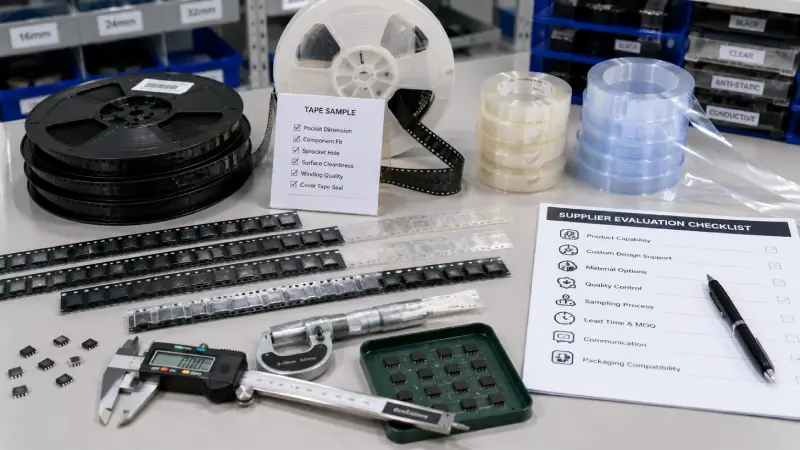
Red Flags When Choosing a Carrier Tape Supplier
Some warning signs are easy to identify during the first inquiry.
Be careful if a supplier gives a price before understanding your component size, tape type, quantity, or packaging requirements. Fast quoting is useful, but quoting without basic information may mean the supplier is not carefully reviewing the application.
Another red flag is the absence of a sample confirmation process. For custom carrier tape, skipping samples can create serious risk. Buyers should also be cautious if the supplier cannot explain material options, quality control steps, or cover tape compatibility.
Poor communication is another issue. If a supplier is slow to answer questions during the inquiry stage, communication may become even more difficult when there is a production issue, revision request, or urgent delivery need.
Other red flags include vague lead times, unclear MOQ, no experience with electronic component packaging, and no support for related packaging materials such as cover tape or reels.
Documents and Details to Prepare Before Inquiry
A clear inquiry helps the supplier provide a more accurate quotation and recommendation. Before contacting a carrier tape manufacturer, buyers should prepare as much information as possible.
Useful details include component drawings, datasheets, component samples, dimensions, shape, package type, quantity, and estimated annual usage. If you already know the required tape width, material preference, reel size, or cover tape requirement, include those details as well.
For custom carrier tape projects, buyers should also share the required component orientation, packaging direction, and any existing problem that needs to be improved. For example, if the current tape causes component movement, poor sealing, or feeding issues, explain the problem clearly.
You should also provide your target sample schedule and mass production deadline. This helps the supplier evaluate whether the timeline is realistic.
The more complete your inquiry is, the easier it is for the supplier to recommend the right carrier tape, embossed carrier tape, custom carrier tape, cover tape, and reel combination.
How Jiushuo Supports Carrier Tape Buyers
For OEM sourcing teams, component suppliers, distributors, and SMT packaging teams, Jiushuo can help review component details, recommend suitable tape options, support sampling confirmation, and provide related packaging materials for complete tape-and-reel applications.
This can be especially useful when buyers want to reduce compatibility risks between carrier tape, cover tape, and reels, or when they need supplier support for both sampling and repeat production.
Conclusion
Choosing a carrier tape manufacturer should be based on more than price. Buyers should evaluate whether the supplier understands electronic component packaging, supports the right tape type, offers custom design assistance, provides suitable materials, controls quality consistently, and communicates clearly during sampling and production.
A reliable supplier should help you reduce packaging risk, not create additional uncertainty. By preparing the right project details and using a practical selection checklist, sourcing teams can choose a carrier tape supplier that supports both current production needs and future packaging projects.
FAQ
What should I check first when choosing a carrier tape manufacturer?
Start with your component size, shape, quantity, tape type, and packaging requirements. These details help the supplier decide whether standard carrier tape, embossed carrier tape, or custom carrier tape is more suitable.
When do I need a custom carrier tape manufacturer?
You may need a custom carrier tape manufacturer when standard tape cannot hold the component securely, when the component has an unusual shape, or when a specific pocket fit, orientation, or protection level is required.
Is the lowest-priced carrier tape supplier always the best choice?
No. A very low price may come with risks such as poor pocket consistency, weak cover tape compatibility, unstable winding, unclear quality control, or unreliable delivery. Buyers should compare total packaging reliability, not only unit price.
Why is sampling important before mass production?
Sampling helps buyers check component fit, pocket stability, cover tape sealing, and reel packaging before placing a larger order. It reduces the risk of production delays, quality complaints, and rework.
Should I source carrier tape, cover tape, and reels from the same supplier?
It is not always required, but it can reduce compatibility risks. A supplier that supports carrier tape, cover tape, and plastic reels can help buyers confirm the complete tape-and-reel packaging setup more efficiently.
What information should I send for an accurate carrier tape quote?
Send component drawings or samples, dimensions, quantity, material preference, tape width if known, cover tape needs, reel size, packaging direction, and target lead time. More complete information usually leads to a faster and more accurate quotation.