
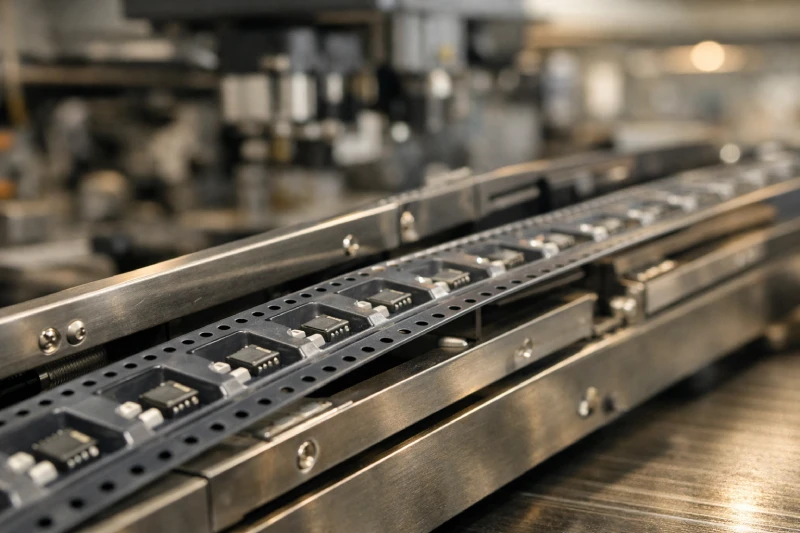
In high-speed SMT environments, production efficiency is rarely limited by machine capability alone. Modern pick-and-place systems can operate at extremely high indexing speeds, yet real-world throughput often falls short of theoretical performance. The missing variable is frequently packaging stability.
Embossed carrier tape plays a structural role in component presentation, alignment, and retention. When pocket geometry, pitch control, and material rigidity are engineered correctly, feeding becomes predictable. When they are not, even advanced equipment compensates by slowing down or stopping.
This article examines how embossed carrier tape affects real production efficiency — not in theory, but in measurable indicators such as feeder downtime, mis-pick rate, and OEE stability.
Why Does Pocket Accuracy Directly Affect Pick-and-Place Speed?
At high placement speeds, pick-and-place accuracy depends on repeatable component positioning within each pocket. Pocket center offset relative to sprocket holes determines how precisely the feeder indexes the component under the nozzle.
If pocket positioning tolerance drifts — even slightly — machines compensate through micro-adjustments. Over time, this results in:
- Reduced maximum indexing speed
- Increased vision correction time
- Higher reject or re-pick frequency
Embossed carrier tape with stable pocket geometry maintains alignment between pitch, pocket center, and sprocket reference. This allows feeders to operate closer to rated speed without correction delays.
In many efficiency audits, engineers initially suspect feeder wear or calibration issues. However, cumulative pocket tolerance deviation is often the hidden cause.
Evaluating pocket-to-hole concentricity and pitch stability is therefore a direct path to recovering lost throughput.
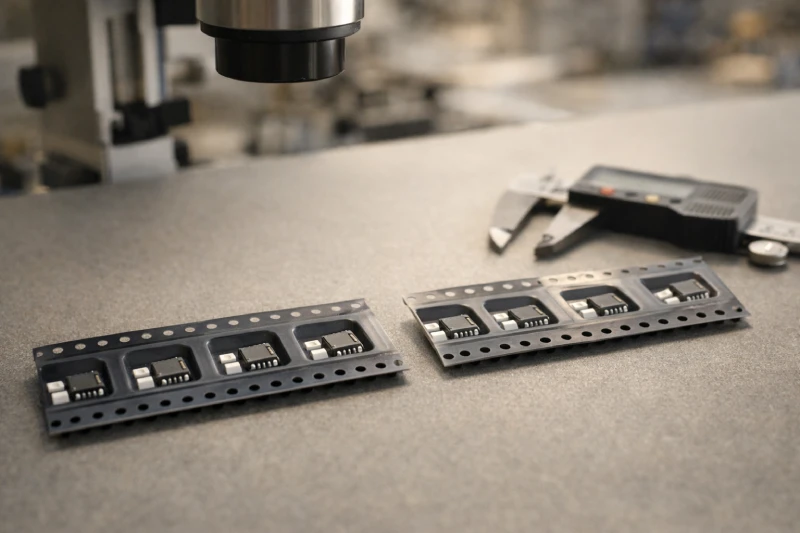
How Can Stable Component Retention Reduce Feeder Jamming and Downtime?
Component retention inside the pocket must balance two competing factors: secure holding during transport and easy release during pick-up.
When pocket fit is too loose:
- Components rotate
- Lead orientation shifts
- Pick position becomes inconsistent
When retention is too tight:
- Vacuum pickup struggles
- Components lift unevenly
- Occasional pocket deformation occurs
Both conditions increase feeder alarms and operator intervention.
Embossed carrier tape with optimized cavity depth and wall structure reduces lateral movement while maintaining smooth release. The result is fewer unexpected stops during long production runs.
Across multi-shift environments, even small reductions in feeder jamming significantly improve effective production hours.
If recurring feeder stoppage appears unrelated to machine condition, reviewing pocket design parameters may reveal improvement opportunities.
Does Embossed Tape Improve Feeding Consistency at High Indexing Speeds?
High-speed SMT lines introduce dynamic forces that are rarely visible during low-speed testing. As indexing frequency increases, tape rigidity and pocket integrity become critical.
Flat or weakly structured tape may experience:
- Micro flexing
- Pocket deformation
- Uneven pitch advancement
Embossed structures increase material stiffness and dimensional stability. Properly formed pockets resist collapse and maintain uniform shape even under tension.
This mechanical consistency supports smoother feeder movement and stable indexing at higher speeds.
When production lines struggle to scale speed without introducing instability, the packaging structure should be examined as part of the root cause analysis.
Feeding consistency is not only about machine calibration; it is directly influenced by carrier tape structural integrity.
When Does Anti-Static Performance Influence Line Stability?
Electrostatic behavior often affects efficiency indirectly. Static accumulation can cause:
- Components sticking to pocket walls
- Delayed release during pickup
- Micro-rotation inside cavities
In dry environments or with highly sensitive semiconductor components, these effects become more pronounced.
Anti-static embossed carrier tape mitigates charge buildup and stabilizes component behavior inside the pocket.
When unexplained pick inconsistency or minor positional variation appears without mechanical explanation, ESD-related retention effects should be considered.
Evaluating surface resistivity and environmental humidity conditions helps determine whether anti-static versions are necessary for stable throughput.
In some cases, line stability improves immediately after switching to anti-static tape configurations.
How Does Dimensional Tolerance Impact Multi-Shift Production Consistency?
Single-shift testing rarely reveals long-term tolerance accumulation. However, in extended production cycles, minor pitch variation compounds over thousands of indexing cycles.
Cumulative pitch deviation can result in:
- Progressive misalignment
- Increased vision correction time
- Feeder synchronization drift
Embossed carrier tape manufactured with strict pitch control maintains consistency across the entire reel length.
For procurement and engineering teams evaluating supplier performance, reel-to-reel consistency and long-run tolerance stability are stronger efficiency indicators than short sample inspection.
If efficiency decreases after several hours of continuous operation rather than at startup, cumulative tolerance behavior should be examined.
Stable dimensional control directly supports consistent OEE across multiple shifts.
When Should You Consider Custom Pocket Design for Efficiency Gains?
Standard cavity dimensions may not always provide optimal retention for unique component geometries.
Signs that custom pocket design may improve efficiency include:
- Irregular-shaped components
- High-value semiconductor packages
- Components prone to micro-rotation
- Frequent minor mis-picks despite stable feeding
Custom embossed carrier tape can adjust cavity depth, wall angle, and support features to enhance presentation stability.
The goal is not customization for complexity, but alignment between component geometry and cavity structure.
When mis-pick rates persist after machine calibration, pocket redesign can deliver measurable improvements without altering line hardware.
Engineering-led customization often yields higher long-term efficiency than incremental machine tuning.
How to Evaluate If Your Current Carrier Tape Is Limiting Throughput?
Before changing equipment or feeder configuration, a structured evaluation helps determine whether carrier tape performance is the limiting factor.
Key indicators include:
- Mis-pick rate exceeding baseline norms
- Frequent minor feeder alarms
- Throughput below machine specification
- Increased operator adjustments during long runs
- Efficiency decline over extended production cycles
If multiple indicators appear simultaneously, packaging stability should be included in root cause analysis.
Comparing current tape specifications with embossed alternatives can clarify whether structural optimization may improve efficiency.
Production efficiency is rarely a single-variable issue — but packaging precision often plays a larger role than initially assumed.