
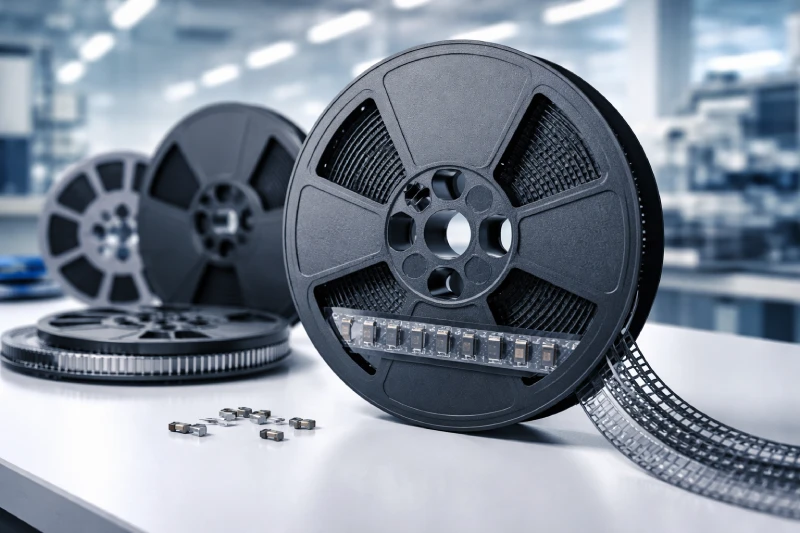
Plastic reels are one of the most overlooked parts of SMT packaging, yet they directly affect feeding stability, shipping safety, and production efficiency. In a typical tape-and-reel system, electronic components are placed into carrier tape pockets, sealed with cover tape, and then wound onto a plastic reel for storage and automated assembly.
When the reel is poorly designed or incompatible with the feeder, even a perfectly designed carrier tape can fail. Reel wobbling, flange cracking, tape slipping, and ESD damage are common problems that can stop a production line and increase scrap.
Whether you package resistors, ICs, connectors, or custom-shaped components, choosing the right plastic reel can improve packaging reliability, reduce downtime, and lower overall production cost.
What Is an Electronics Component Plastic Reel?
An electronics component plastic reel is the round spool used to hold carrier tape during tape-and-reel packaging. The reel allows components to be stored, shipped, and fed into SMT pick-and-place machines in a continuous and controlled way.
The reel itself does not directly protect the component. Protection comes from the combination of the carrier tape pocket, the sealing method, and the reel structure. A complete tape-and-reel process usually follows four steps:
- Components are loaded into carrier tape pockets.
- A cover tape is sealed over the pockets.
- The finished tape is wound onto a plastic reel.
- The reel is placed into an SMT feeder during assembly.
For this reason, the reel must always be matched to the tape width, component size, and feeder requirements. If the reel is too narrow, too weak, or improperly molded, the tape can bend or shift during transport.
For example, a wide embossed tape carrying large connectors often requires a stronger reel than a narrow tape holding 0402 resistors. The reel must also work correctly with the selected carrier tape and the sealing method used with the cover tape.
Why Plastic Reels Matter in SMT and Electronics Packaging
Many manufacturers focus only on carrier tape design, but the reel is equally important. A poor-quality reel can create feeding problems even when the tape and pocket design are correct.
| Packaging Issue | Possible Reel-Related Cause |
|---|---|
| Component jumping out of pocket | Reel flange deformation |
| Tape feeding error | Incorrect reel width or hub size |
| Static discharge damage | Non-ESD reel material |
| Broken tape edge | Warped or weak reel |
If the reel flange is bent or cracked, the tape may no longer wind evenly. The result is tape tension changes, tape wandering, and feeder jams. On high-speed SMT lines, even a small amount of reel wobble can cause missed picks and lower yield.
Reel quality also affects shipping. During transportation, the reel must keep the tape aligned and prevent components from shifting inside the pockets. Weak reels can deform under stacking pressure or high temperatures.
Another common issue is electrostatic discharge. Sensitive semiconductors can be damaged when a standard non-conductive reel is used. Many packaging failures blamed on tape design are actually caused by an incompatible reel material.
Main Types of Electronics Component Plastic Reels
Plastic reels can be classified by material, structure, and application.
By Material
Polystyrene (PS) reels are the most common and economical option. They are widely used for small SMT components such as resistors, capacitors, and SOT packages. PS reels are lightweight and inexpensive, but they are more brittle than other materials.
ABS reels are stronger and more impact-resistant. They are commonly used for larger ICs, connectors, and heavier components that need better structural support.
Conductive or anti-static reels are designed for ESD-sensitive devices. These reels use conductive or dissipative materials to reduce static buildup during storage and handling. They are often used together with anti-static carrier tape.
Recycled plastic reels are increasingly used when manufacturers want lower cost and reduced environmental impact. However, the consistency and strength of recycled material should always be checked.
| Reel Type | Best For | Main Advantage | Limitation |
|---|---|---|---|
| Standard PS Reel | Small SMT components | Low cost | More brittle |
| ABS Reel | Heavy or large components | Stronger structure | Higher cost |
| Anti-static Reel | Sensitive ICs | ESD protection | Slightly more expensive |
| Recycled Reel | Cost-sensitive projects | Lower material cost | Less consistent quality |
By Structure
The most common design is the one-piece injection molded reel. It is simple, strong, and suitable for most standard SMT applications.
Assembly-type or split reels are used when lower shipping cost or special reel dimensions are needed. Some manufacturers also use custom flange designs for unusually wide tape or heavy components.
By Application
Small passive components usually use standard reels. Semiconductor devices often require conductive reels. Large connectors and irregular components may need reinforced or custom reels to prevent deformation.
Standard Plastic Reel Sizes Explained
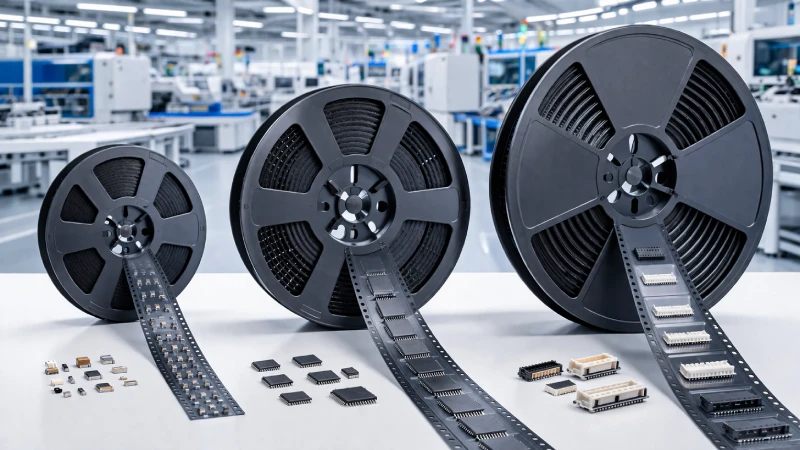
Plastic reel size is usually defined by its outside diameter. The most common sizes are 7-inch, 13-inch, and 15-inch reels.
| Reel Diameter | Common Tape Width | Typical Components |
|---|---|---|
| 7 inch (178 mm) | 8–16 mm | Resistors, capacitors, small semiconductors |
| 13 inch (330 mm) | 8–44 mm | ICs, connectors, larger SMT packages |
| 15 inch | 24–56 mm | Long, heavy, or wide components |
A 7-inch reel is usually chosen for low-volume production or small components. It is easier to handle and works well for sample runs or prototype orders.
A 13-inch reel is the industry standard for most production environments. Because it holds more tape, it can contain a much larger number of components. This reduces line changeovers and improves machine utilization.
A 15-inch reel is normally used for large connectors, relays, or long components packaged in wide tape.
The reel diameter must match the tape width. An 8 mm tape can fit on a smaller reel, while a 32 mm or 44 mm tape usually needs a larger reel with more hub width and flange strength.
Choosing the correct size is not only about component fit. A larger reel can reduce downtime by increasing the number of parts available per reel. For high-volume SMT production, this often provides a better total cost than using multiple smaller reels.
Manufacturers that need complete packaging support often combine the reel selection with a full tape and reel packaging solution and a matching plastic reel for SMT components.
EIA-481 Standards for Plastic Reels
Most SMT plastic reels follow ANSI/EIA-481, the standard that defines tape-and-reel packaging dimensions. The purpose of the standard is to ensure that components packaged by different suppliers can run on the same SMT equipment.
Important reel features controlled by EIA-481 include:
- Reel diameter
- Arbor hole size
- Reel width
- Hub dimensions
- Tape winding direction
- Flange shape and strength
| Standard Feature | Why It Matters |
|---|---|
| Arbor hole size | Must fit the feeder spindle |
| Reel width | Prevents tape rubbing and damage |
| Winding direction | Ensures correct pick-up orientation |
| Flange strength | Prevents deformation during shipping |
If the arbor hole is incorrect, the reel may not fit the feeder at all. If the winding direction is wrong, the components may arrive at the pick-and-place head upside down or reversed.
EIA-481 compatibility is especially important when sourcing packaging from multiple suppliers. A reel that does not follow the standard may work in one factory but fail in another.
How to Choose the Right Plastic Reel for Electronic Components
The best plastic reel depends on the component, the carrier tape, and the production environment.
Start by checking the size and weight of the component. Small chips and passives usually work with standard PS reels. Large connectors or heavy components may need ABS or reinforced reels.
Next, consider tape width and pocket depth. A narrow 8 mm tape can use a smaller reel, while wide tape often requires a larger flange and stronger hub.
You should also confirm the feeder requirement. Many SMT lines are designed around 13-inch reels. If a smaller reel is used, operators may need adapters or more frequent reel changes.
ESD sensitivity is another key factor. If the component is a semiconductor, sensor, or IC, an anti-static reel is often required.
| If You Need… | Recommended Reel |
|---|---|
| Lowest packaging cost | Standard PS reel |
| Protection for sensitive ICs | Conductive ABS reel |
| Packaging for large connectors | Reinforced 13-inch or 15-inch reel |
| Small prototype run | 7-inch reel |
| High-volume production | 13-inch reel with maximum component count |
Finally, think about shipping conditions. If reels will be stored in hot warehouses or shipped long distances, stronger materials are usually worth the extra cost.
The best reel is not always the cheapest one. It is the reel that keeps the SMT line running without interruptions.
Common Plastic Reel Problems and How to Prevent Them
Even a well-designed tape-and-reel package can fail if the reel is not stored or selected correctly.
| Problem | Cause | Prevention |
|---|---|---|
| Reel warp | Weak material or high temperature | Use ABS reel and avoid hot storage |
| Flange cracking | Brittle PS material | Increase flange thickness or use stronger resin |
| Static damage | Non-conductive reel | Use ESD-safe reel material |
| Tape slipping | Incorrect hub design | Verify reel width and winding tension |
| Feeder mismatch | Wrong arbor hole size | Check EIA-481 dimensions before production |
Warped reels are especially common when products are stored in high-temperature environments or stacked too heavily during shipping. Cracked flanges often appear when brittle reels are dropped or handled roughly.
Static problems are easy to overlook because the damage may not appear immediately. Sensitive components may pass inspection but fail later in the field.
Preventive testing is usually less expensive than solving a production issue after the reels have already been delivered.
Plastic Reel vs Other Electronics Packaging Methods
Plastic reels are not the only packaging option for electronic components. Trays, tubes, and bulk packaging are also used.
| Packaging Method | Best For | Pros | Cons |
|---|---|---|---|
| Plastic Reel | High-volume SMT production | Fast automated feeding | Requires tape-and-reel setup |
| Tray | BGA, QFN, and large ICs | Better component protection | Slower automation |
| Tube | Long or through-hole parts | Low cost | Slower loading and feeding |
| Bulk | Low-value parts | Lowest cost | High risk of damage |
Plastic reels are usually the preferred choice whenever components will be used on automated SMT lines. Trays are more common for delicate ICs with many leads. Tubes are often used for through-hole parts or long components that do not fit easily into tape.
For irregular shapes or special handling needs, some manufacturers combine a custom reel with custom embossed carrier tape.
When Should You Use a Custom Plastic Reel?
A standard reel is suitable for most electronic components, but some products require a custom design.
Custom reels are often used for:
- Large automotive connectors
- Heavy industrial components
- Wide carrier tape over 44 mm
- Long components that need additional support
- Special SMT equipment with non-standard spindle sizes
A custom reel may include a larger flange diameter, wider hub, stronger material, or special ESD properties. Some manufacturers also request custom colors or company branding.
Custom reels are especially valuable when a standard reel causes repeated feeding problems. In these cases, changing the reel design can often solve the issue without changing the component or tape layout.
Final Thoughts
The plastic reel may seem like a simple packaging part, but it has a major impact on SMT performance, shipping reliability, and component protection.
When selecting a reel, focus on three factors: reel size, reel material, and EIA-481 compatibility. A properly matched reel reduces feeder problems, protects components during shipping, and keeps production lines running smoothly.
If you are unsure which reel is best for your components, request a packaging review from a tape-and-reel specialist. Matching the right reel with the correct carrier tape and cover tape is often the fastest way to improve packaging reliability and reduce manufacturing downtime.