
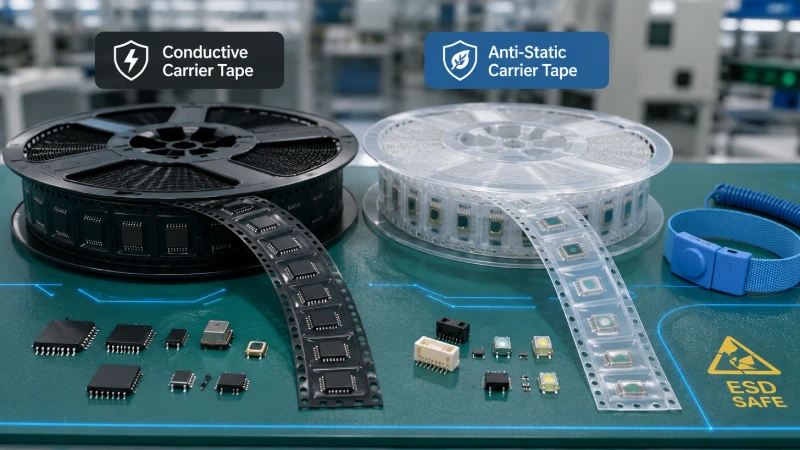
Choosing the right carrier tape material is not only about holding components in position. For many electronic components, the tape must also support safe handling, storage, transport, and stable SMT feeding. When components are sensitive to electrostatic discharge, buyers often need to compare conductive carrier tape and anti-static carrier tape before placing an order.
The difference can sound technical, but the buying decision is usually practical: How sensitive is the component? What level of ESD protection is required? Will the tape work smoothly with cover tape and SMT feeders? Is visual inspection needed? What is the acceptable cost level for the packaging project?
This guide explains the difference between conductive carrier tape and anti-static carrier tape in a buyer-friendly way, so electronic component suppliers, semiconductor companies, sensor manufacturers, and OEM sourcing teams can make a more confident packaging decision.
Why ESD Protection Matters in Carrier Tape Packaging
Electronic components can be affected by static electricity during many packaging and assembly steps. Static may build up during tape forming, component loading, reel winding, transport, cover tape peeling, or pick-and-place feeding. For some components, this may create quality risks, especially when the parts are highly sensitive or high-value.
Carrier tape is part of a complete tape-and-reel packaging system. It protects the component physically, controls its position, and helps it move through automated feeding equipment. When ESD risk is involved, the carrier tape material must also help reduce static-related problems.
However, buyers should avoid thinking that ESD protection depends only on the carrier tape material. Real packaging performance is also affected by the cover tape, reel, sealing quality, storage conditions, handling process, and SMT equipment. This is why material selection should be confirmed together with the full packaging application.
For components that need stable pocket fit and automated feeding, Jiushuo’s embossed carrier tape solutions can be designed according to component dimensions, shape, orientation, and packaging requirements.
What Is Conductive Carrier Tape?
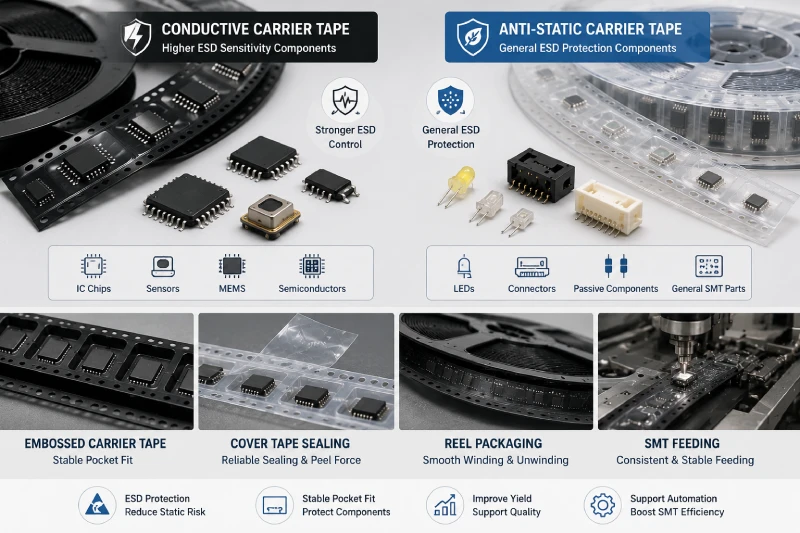
Conductive carrier tape is designed for stronger ESD control. In simple terms, it helps static charges move away more effectively than general anti-static material. This type of tape is often selected when the component has higher ESD sensitivity, higher value, or stricter quality requirements.
Conductive carrier tape is commonly used for semiconductors, IC chips, sensors, MEMS parts, and other sensitive electronic devices. These components may require a higher level of ESD-focused packaging because damage may not always be visible during inspection. A component may look normal but still have electrical performance issues if ESD control is poor.
From a buyer’s point of view, conductive tape is often chosen when the cost of component failure is much higher than the cost difference in packaging material. For example, if a rejected reel, unstable feeding process, or hidden quality issue could cause serious production losses, stronger ESD protection may be worth the investment.
That said, conductive carrier tape should not be selected only because it sounds safer. Buyers should confirm the actual material specification, ESD requirements, component sensitivity, and testing conditions. Conductive performance should be verified through supplier data or sample validation, not assumed by color or appearance.
If the component also has a non-standard shape, special orientation requirement, or strict pocket fit requirement, a custom carrier tape solution may be needed together with the correct material choice.
What Is Anti-Static Carrier Tape?
Anti-static carrier tape is designed to reduce static buildup during packaging, handling, and SMT feeding. It is widely used for electronic components that need ESD-aware packaging but may not require the stronger protection level of conductive material.
For many standard SMT components, anti-static carrier tape offers a practical balance between protection, cost, appearance, and feeding performance. It can be suitable for components such as LEDs, connectors, passive components, small modules, and many general electronic parts, depending on their sensitivity and customer requirements.
Anti-static carrier tape may also be preferred when visual inspection is important. Some anti-static materials can offer better visibility than darker conductive materials, which may help operators or automated inspection systems check component presence, orientation, or pocket condition.
Jiushuo provides anti-static carrier tape options for electronic components that require ESD-aware packaging while still maintaining practical tape-and-reel performance. For buyers, this can be a cost-effective choice when the component risk level is moderate and the packaging application does not require a fully conductive solution.
Conductive Carrier Tape vs Anti-Static Carrier Tape
The choice between conductive carrier tape and anti-static carrier tape is not simply “better” or “worse.” Each material has its own suitable application. The right choice depends on the component, ESD requirement, inspection needs, SMT process, and packaging budget.
| Comparison Point | Conductive Carrier Tape | Anti-Static Carrier Tape |
|---|---|---|
| Main purpose | Stronger ESD control for sensitive components | Reduces static buildup for general ESD-aware packaging |
| Typical use case | Higher-risk or highly sensitive electronic components | Standard electronic components with moderate ESD needs |
| Common components | ICs, semiconductors, MEMS, sensors, sensitive modules | LEDs, connectors, passive parts, general SMT components |
| Material behavior | Helps dissipate or drain static more actively | Helps reduce static accumulation during handling |
| Cost level | Usually higher | Usually more cost-effective |
| Visual inspection | May be darker or less transparent | May offer better visibility depending on material |
| Best for | High-value, sensitive, or failure-critical parts | Common components needing practical ESD protection |
| Buyer reminder | Confirm specification and testing data | Confirm whether protection level is enough |
For many buyers, the most important question is not “Which material is the strongest?” but “Which material is appropriate for this component and process?” Over-specifying material may increase cost unnecessarily, while under-specifying material may increase packaging and quality risk.
Which Components Usually Need ESD-Focused Packaging?
Many electronic components can benefit from ESD-focused carrier tape packaging, but the required protection level is not always the same. Some parts may need conductive carrier tape, while others may perform well with anti-static carrier tape after proper validation.
Components that often require ESD-aware packaging include IC chips, semiconductor devices, sensors, MEMS components, LEDs, optoelectronic parts, crystal oscillators, power electronics, automotive electronic components, and medical electronic components.
IC chips and semiconductors are usually more sensitive, so conductive carrier tape may be considered when the application requires stronger ESD protection. Sensors and MEMS components may also require careful material selection because they can be small, delicate, and sensitive to both electrical and mechanical stress.
LEDs and optoelectronic components often need protection against static, but visibility and orientation control may also be important. In these cases, anti-static carrier tape may be suitable if it meets the component’s protection requirements and supports stable inspection.
Connectors, terminals, and passive components may not always need the same ESD protection level as semiconductors, but they still require stable pocket fit, clean handling, and reliable SMT feeding. For these parts, material selection should be considered together with pocket design.
How Component Type Affects Material Choice
Different components create different packaging challenges. A small IC chip may require strong ESD protection and accurate pocket control. A sensor may need both ESD-aware material and protection from movement inside the pocket. A connector may be less ESD-sensitive but more difficult to position because of its shape. A larger module may require deeper pockets, stronger tape structure, and careful reel matching.
This is why carrier tape material should not be chosen separately from pocket design. Even if the material is correct, poor pocket fit can still cause component rotation, tilting, jumping, or feeding interruptions. The component must sit securely inside the pocket while still being easy for the pick-and-place nozzle to remove.
For components with irregular shapes, special height, sharp edges, fragile surfaces, or strict orientation requirements, Jiushuo can support custom carrier tape design based on drawings, samples, and packaging requirements. This helps buyers match the material, pocket structure, and feeding process more effectively.
What to Confirm Before Choosing Carrier Tape Material
Before choosing between conductive carrier tape and anti-static carrier tape, buyers should confirm several practical details.
First, check the component’s ESD sensitivity. If the component supplier, customer, or OEM has clear ESD packaging requirements, those requirements should guide the material selection. If no clear requirement is available, sample testing and supplier consultation become more important.
Second, review the component type, size, weight, shape, and surface finish. Small semiconductors, tall sensors, fragile LEDs, stamped metal parts, and irregular connectors may all require different pocket structures. Material selection alone cannot solve fit or feeding problems.
Third, confirm whether visual inspection is needed. If operators or inspection systems need to see the component clearly inside the pocket, the appearance of the carrier tape material may matter. Some conductive materials may reduce visibility, while some anti-static materials may provide better inspection convenience.
Fourth, check the cover tape requirement. Carrier tape and cover tape must work together. Poor sealing or unstable peel force may cause feeder interruptions, flying components, or difficult peeling during SMT production. For this reason, buyers should also consider compatible cover tape when selecting carrier tape material.
Fifth, confirm reel size, tape width, packaging quantity, storage conditions, and SMT feeder compatibility. These details help the supplier recommend a packaging solution that fits both component protection and production efficiency.
Do Conductive and Anti-Static Carrier Tape Affect SMT Feeding?
Yes, carrier tape material can affect SMT feeding, but it is only one part of the complete feeding system. Stable SMT feeding depends on pocket dimensions, tape flatness, tape stiffness, cover tape sealing, peel force, reel winding quality, and component fit.
For example, if the pocket is too large, the component may move or rotate inside the cavity. If the pocket is too tight, the component may be difficult to pick. If the cover tape peel force is unstable, the feeder may experience interruptions. If the reel is wound poorly, the tape may not run smoothly through the machine.
This means a conductive or anti-static material should be selected together with the full tape-and-reel design. A well-designed embossed carrier tape can help support stable positioning, smoother feeding, and better protection during transport and assembly.
For buyers, the best approach is to share component drawings, samples, datasheets, and SMT requirements with the supplier before mass production. This helps reduce the risk of choosing a material that is correct in theory but unsuitable for the actual packaging process.
Cost Considerations: When Is Conductive Tape Worth It?
Conductive carrier tape usually costs more than general anti-static carrier tape because of its material characteristics and performance requirements. For high-value or highly sensitive components, this additional cost may be reasonable. If one damaged batch or production issue could create expensive losses, stronger ESD-focused packaging may help reduce risk.
Anti-static carrier tape is often a more cost-effective choice for standard electronic components. When the component has moderate ESD sensitivity and does not require stronger conductive protection, anti-static material may provide a good balance of protection and packaging cost.
The lowest tape price is not always the lowest total cost. Poor material selection may lead to rejected reels, unstable feeding, component damage, customer complaints, or production delays. Buyers should compare the packaging cost with the value of the component and the risk of failure.
A good supplier should not simply recommend the most expensive material. The better approach is to review the component application and recommend a suitable material based on actual packaging needs.
How Jiushuo Helps Buyers Choose the Right Carrier Tape
Jiushuo supports electronic component suppliers, semiconductor companies, sensor manufacturers, and SMT packaging teams with carrier tape solutions for different packaging applications. Depending on the component requirement, Jiushuo can help evaluate anti-static carrier tape, embossed carrier tape, custom pocket design, and cover tape matching.
For components requiring ESD-aware packaging, Jiushuo’s anti-static carrier tape can be considered for suitable applications. For components requiring stable pocket fit and automated feeding, Jiushuo’s embossed carrier tape solutions can be customized according to component dimensions and packaging needs.
If the component is non-standard, fragile, tall, sensitive, or difficult to position, Jiushuo can also develop custom carrier tape based on drawings or samples. To improve sealing and feeding reliability, matching cover tape can also be selected as part of the complete packaging system.
The goal is not only to choose a material, but to create a carrier tape solution that supports component protection, ESD control, transport safety, and SMT feeding stability.
Need Help Choosing Conductive or Anti-Static Carrier Tape?
If you are not sure whether conductive carrier tape or anti-static carrier tape is better for your component, Jiushuo can help review your packaging requirements and recommend a suitable direction.
To get a more accurate recommendation, you can provide component drawings, datasheets, sample photos, physical samples, dimensions, weight, ESD requirements, tape width, pocket requirements, and SMT feeding conditions.
With the right material, pocket design, cover tape matching, and reel packaging, your components can be better protected during storage, shipment, and automated assembly.
FAQ
What is the main difference between conductive carrier tape and anti-static carrier tape?
Conductive carrier tape is usually selected for stronger ESD control, especially for sensitive electronic components. Anti-static carrier tape helps reduce static buildup and is often suitable for general ESD-aware packaging applications.
Is conductive carrier tape always better than anti-static carrier tape?
No. Conductive carrier tape may be better for highly sensitive or high-value components, but anti-static carrier tape can be more practical and cost-effective for many standard electronic components.
Which carrier tape should I choose for IC chips and semiconductors?
IC chips and semiconductors often require stronger ESD-focused packaging. Conductive carrier tape may be preferred, but the final choice should depend on component sensitivity, customer requirements, and testing confirmation.
Can anti-static carrier tape be used for SMT components?
Yes. Anti-static carrier tape is commonly used for many SMT components when the required ESD protection level, pocket design, and cover tape compatibility are suitable.
Does carrier tape material affect pick-and-place stability?
Yes, but material is only one factor. Pick-and-place stability also depends on pocket size, component fit, cover tape peel force, reel winding, and feeder compatibility.
What information should I provide before ordering ESD carrier tape?
You should provide drawings, samples, dimensions, weight, component type, ESD requirements, SMT feeding requirements, and packaging quantity. This helps the supplier recommend the right carrier tape material and pocket design.