
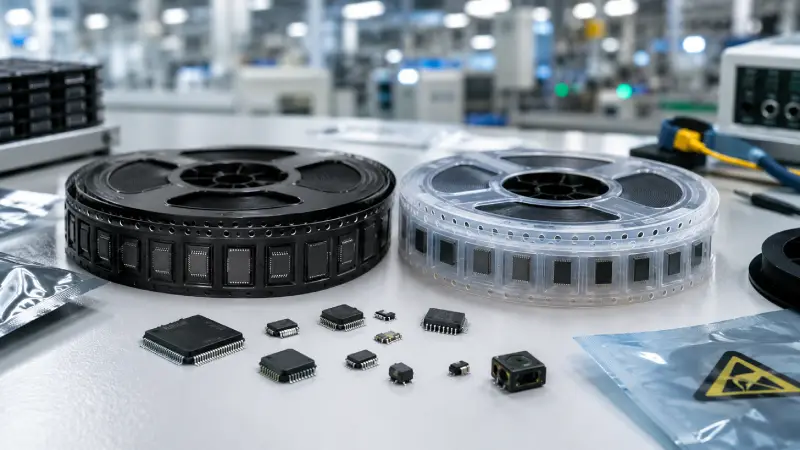
Choosing the right carrier tape is not only about tape width, pocket size, or component orientation. For semiconductors, ICs, sensors, LEDs, and other ESD-sensitive components, the electrostatic behavior of the tape material can also affect packaging reliability, handling safety, and downstream SMT performance.
In electronic component packaging, buyers often compare conductive carrier tape and anti-static carrier tape. Both are used to reduce electrostatic risk, but they are not the same. Conductive carrier tape is usually selected for stricter ESD protection requirements, while anti-static carrier tape is often used when buyers need practical static control with better cost efficiency.
For semiconductor buyers, IC suppliers, sensor manufacturers, and SMT packaging teams, the best choice depends on the component’s ESD sensitivity, packaging environment, customer requirement, and production budget. This guide explains the practical difference between conductive carrier tape and anti-static carrier tape, so you can choose a suitable ESD carrier tape for your components.
Why ESD Protection Matters in Tape and Reel Packaging
Electronic components can face ESD risk during many steps: component loading, tape and reel packaging, inspection, storage, transportation, cover tape peeling, and SMT feeding. Even when the component pocket is correctly designed, static buildup may still create handling risk if the material is not suitable for the application.
This is why buyers should not choose carrier tape only by appearance or price. For ESD-sensitive components, the carrier tape material, cover tape compatibility, reel packaging, humidity, handling process, and SMT production environment should all be considered together.
It is also important to avoid overclaiming ESD performance. No carrier tape alone can guarantee complete ESD protection in every packaging environment. The right tape should be selected based on component sensitivity, supplier testing data, customer specifications, and sample validation before mass production.
If you are comparing different packaging options, Jiushuo’s full range of carrier tape solutions can support different component sizes, pocket designs, and ESD-related packaging requirements.
What Is Conductive Carrier Tape?
Conductive carrier tape is designed to provide stronger electrostatic control than standard plastic carrier tape. It is usually made from conductive or carbon-loaded plastic materials. Because of this material structure, conductive carrier tape is often black or dark in appearance.
In practical sourcing terms, conductive carrier tape is commonly selected for components with stricter ESD requirements. These may include semiconductor ICs, chips, precision sensors, MEMS devices, and other components that are sensitive to electrostatic discharge during handling or automated assembly.
The main advantage of conductive carrier tape is that it can offer stronger ESD-focused performance when the component or customer specification requires it. However, it is usually more expensive than standard or anti-static carrier tape. It may also require closer confirmation of material properties, surface resistance range, pocket cleanliness, cover tape compatibility, and feeding performance.
Buyers should not select conductive carrier tape only because it “sounds safer.” If the component does not require that protection level, the higher cost may not be necessary. The better approach is to check the component’s ESD sensitivity level and confirm whether conductive material is required by the customer, EMS factory, or internal quality team.
What Is Anti-Static Carrier Tape?
Anti-static carrier tape is designed to reduce static generation and help lower ESD risk during packaging, storage, and SMT handling. Compared with conductive carrier tape, it is often used for components that need ESD-aware packaging but may not require the highest level of conductive protection.
In many real purchasing cases, anti-static carrier tape offers a practical balance between protection, cost, and production usability. It can be suitable for many electronic components, including LEDs, connectors, small modules, some sensors, passive components, and general SMT components. However, suitability still depends on the actual component sensitivity and customer requirements.
Jiushuo provides anti-static carrier tape options for electronic components that need practical static control in tape and reel packaging. For buyers who need better ESD handling than standard carrier tape but want to control packaging cost, anti-static carrier tape is often a useful option.
Still, anti-static does not mean “suitable for every ESD-sensitive component.” Buyers should confirm the material type, surface resistance range, production environment, and whether the tape is compatible with the required cover tape and SMT feeding process.
Conductive Carrier Tape vs Anti-Static Carrier Tape: Key Differences
| Comparison Point | Conductive Carrier Tape | Anti-Static Carrier Tape |
|---|---|---|
| ESD protection level | Usually selected for stricter ESD-focused packaging | Helps reduce static generation and handling risk |
| Typical material behavior | Conductive or static-dissipative depending on formulation | Anti-static or static-dissipative depending on material |
| Common appearance | Often black or dark due to conductive additives | Appearance may vary by material and supplier |
| Typical applications | ICs, semiconductors, MEMS sensors, precision components | LEDs, connectors, modules, passive parts, general SMT components |
| Cost level | Usually higher | Usually more cost-effective |
| Buyer decision factor | Better for high-risk or strict ESD requirements | Better for moderate ESD needs and cost-sensitive projects |
| Supplier confirmation | Surface resistance, test method, material data, pocket design | Anti-static performance, material type, cover tape compatibility |
| Best fit | High-sensitivity or high-value components | ESD-aware packaging with balanced cost and performance |
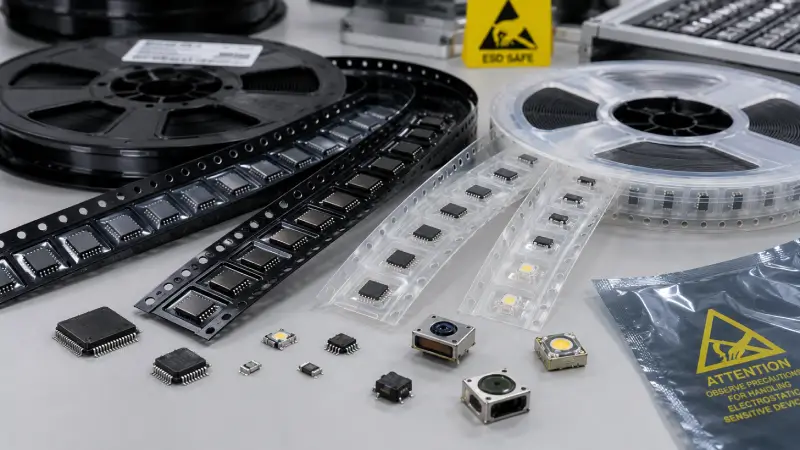
The most important difference is not just the name of the material. The practical difference is the level of ESD risk the tape is expected to manage. Conductive carrier tape is usually used when the component is more sensitive or the packaging specification is stricter. Anti-static carrier tape is often selected when the buyer needs reliable static control without the extra cost of conductive material.
Which Components Usually Need ESD-Focused Carrier Tape?
Different components have different ESD sensitivity levels. Buyers should avoid using one tape type for every project without checking the actual risk.
Semiconductor ICs and Chips
Semiconductor ICs and chips often require stronger ESD control because they may be more sensitive to electrostatic discharge. For these components, conductive carrier tape may be preferred, especially when the customer has strict packaging requirements or the device value is high.
However, not every IC automatically requires the same tape material. Buyers should confirm the customer’s packaging specification, surface resistance requirement, and approved material type before ordering.
Sensors and Precision Components
Sensors, especially MEMS sensors, optical sensors, pressure sensors, and precision electronic components, may require ESD-focused carrier tape. These parts may also need accurate pocket design to prevent movement, tilting, or damage during packaging and SMT feeding.
For sensor packaging, buyers often need to consider both ESD control and mechanical protection. A custom pocket design may be just as important as the material itself.
LEDs and Optoelectronic Components
LEDs and optoelectronic components are often packaged with anti-static materials because static control is important during handling and assembly. In many cases, anti-static carrier tape may be sufficient, but this depends on the component type, brightness bin control, packaging environment, and customer requirements.
If the LED is high-value or used in a stricter quality environment, buyers should ask the supplier whether stronger ESD-focused material is needed.
Connectors, Modules, and Small SMT Components
Connectors, small modules, and other SMT components may not always require conductive tape, but many still benefit from anti-static carrier tape. For these parts, the buyer often needs a balance between ESD handling, stable feeding, and reasonable packaging cost.
Anti-static carrier tape is commonly used when the component needs ESD-aware packaging but does not have extremely strict conductive material requirements.
High-Value or Failure-Sensitive Components
Sometimes the decision is not only based on technical sensitivity. If a component has a high unit value, strict customer acceptance standard, or high failure cost, buyers may choose a stronger ESD carrier tape solution to reduce packaging and handling risk.
In this case, the tape decision should be discussed with both the supplier and the quality team before mass production.
How to Choose Between Conductive and Anti-Static Carrier Tape
The simplest way to choose is to start from risk level, not price.
If the component is highly ESD-sensitive, expensive, or used in semiconductor packaging with strict requirements, conductive carrier tape may be the safer choice. If the component needs practical static control but does not require conductive material, anti-static carrier tape may be a more cost-effective option.
Buyers should also consider the full packaging and SMT environment. For example, storage time, humidity, operator handling, cover tape peeling force, pick-and-place speed, and customer inspection requirements can all influence the final tape choice.
Pocket design is also important. For many ESD-sensitive components, custom embossed carrier tape is used because it can form accurate pockets based on the component’s shape, height, and orientation. A good pocket design helps reduce component movement, improves feeding stability, and supports better protection during transportation and SMT assembly.
In many projects, the best solution is not simply “conductive vs anti-static.” It may be anti-static embossed carrier tape, conductive embossed carrier tape, or another customized structure depending on the component and production requirement.
What Buyers Should Confirm Before Ordering
Before ordering conductive carrier tape or anti-static carrier tape, buyers should confirm several practical points with the supplier.
First, provide the component drawing, 2D or 3D dimensions, sample parts, and required orientation. The supplier needs this information to design the pocket size, depth, pitch, and feeding direction.
Second, confirm the ESD requirement. If the customer has a surface resistance range, test standard, or approved packaging material list, share it before production. This helps avoid using a material that looks suitable but does not meet the actual requirement.
Third, check the tape width, pocket pitch, sprocket hole specifications, and packaging quantity per reel. These details affect SMT compatibility and production efficiency.
Fourth, confirm cover tape compatibility. The carrier tape and compatible cover tape must work together to provide stable sealing and suitable peeling force. If the peeling force is too high or too low, it may affect SMT feeding or component protection.
Fifth, request samples before mass production. Sample testing helps buyers check pocket fit, component movement, sealing condition, peeling performance, and feeding stability. For ESD-sensitive parts, sample validation is especially important.
Finally, ask whether the supplier can provide relevant material information or test documentation. This does not replace your own approval process, but it gives your quality team useful data for evaluation.
Jiushuo Carrier Tape Options for ESD-Sensitive Packaging
Jiushuo supports electronic component suppliers, semiconductor-related buyers, sensor manufacturers, and SMT packaging teams with customized carrier tape options.
For components that require practical static control, Jiushuo’s anti-static carrier tape can help reduce static-related packaging risk while keeping cost under control. For components that require accurate pocket design, Jiushuo’s embossed carrier tape can be customized according to component size, shape, height, and feeding requirements.
Buyers can also review Jiushuo’s broader carrier tape solutions to compare different tape types and packaging options. For complete tape and reel packaging, carrier tape should also be matched with suitable cover tape to ensure sealing stability and smooth SMT feeding.
The best tape choice should be confirmed through component information, ESD requirements, samples, and customer approval. Jiushuo can help review your component drawing, packaging environment, and production needs before recommending a suitable option.
Need Help Choosing the Right ESD Carrier Tape?
If you are not sure whether your component needs conductive carrier tape, anti-static carrier tape, or custom embossed carrier tape, Jiushuo can help evaluate your component size, ESD sensitivity, packaging quantity, and SMT feeding requirements.
Share your component drawing, sample photos, tape width requirement, and ESD packaging specification. Jiushuo can recommend a suitable carrier tape option for sampling and mass production.
FAQ
What is the main difference between conductive carrier tape and anti-static carrier tape?
Conductive carrier tape is usually selected for stricter ESD-focused packaging, while anti-static carrier tape helps reduce static generation and handling risk. The right choice depends on the component’s ESD sensitivity, customer requirements, and production environment.
Is anti-static carrier tape enough for IC packaging?
It depends on the IC and the customer’s packaging specification. Some ICs may require conductive carrier tape, while others may use anti-static carrier tape if testing and customer approval confirm that it is suitable.
When should I choose conductive carrier tape?
Conductive carrier tape is usually a better choice for highly ESD-sensitive components, high-value semiconductor parts, precision sensors, or projects with strict ESD packaging requirements.
When is anti-static carrier tape a better choice?
Anti-static carrier tape may be better when the component needs ESD-aware packaging but does not require the stronger protection level or higher cost of conductive tape. It is often used for general SMT components, LEDs, connectors, and modules.
Can embossed carrier tape be anti-static?
Yes. Embossed carrier tape can be made with different material options, including anti-static materials, depending on the component type and packaging requirements.
What information should I send before ordering ESD carrier tape?
You should send the component drawing, dimensions, sample photos, ESD requirement, tape width, pocket direction, pitch, cover tape requirement, packaging quantity, and any customer specifications. This helps the supplier recommend the right carrier tape material and pocket design.