
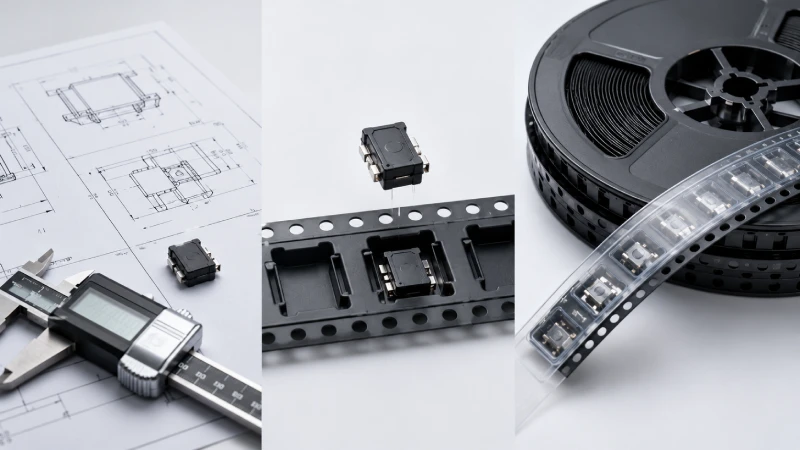
When an electronic component has a new shape, unusual dimensions, exposed terminals, a sensitive surface, or a non-standard package, an existing carrier tape may not provide the required fit or protection. In these situations, the packaging should be developed around the actual component.
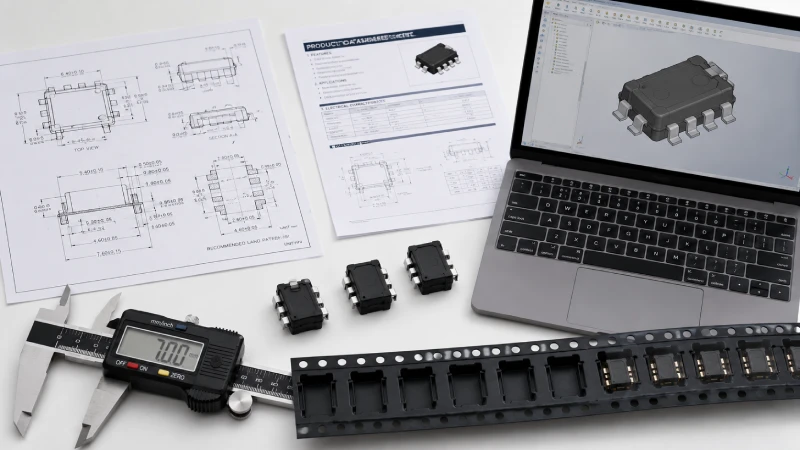
For electronic component manufacturers, OEM sourcing teams, SMT packaging buyers, and component distributors, the project can usually begin with a component drawing, datasheet, 3D model, or physical sample. The supplier then reviews the component, recommends a material, develops the pocket layout, matches the cover tape and reel, produces a sample, and prepares the approved configuration for mass production.
Buyers do not need to define every pocket dimension before sending an inquiry. A qualified supplier can review the available information and recommend a suitable custom carrier tape solution.
What Can Be Used to Start a Custom Carrier Tape Project?
A project can begin with several types of component information. The more accurate the information is, the easier it is to reduce revisions and move toward sample production.
Component Drawing
A detailed drawing should ideally show maximum length, width, and height, dimensional tolerances, terminals or pins, raised features, sensitive surfaces, and preferred orientation. The drawing revision number should also be included so the supplier designs around the correct production version.
Component Datasheet
A datasheet may provide the package type, nominal dimensions, weight, construction material, and handling recommendations. It is useful for initial evaluation, although more information may be needed if it does not show maximum tolerances or the full component profile.
3D Model
A 3D file can clarify asymmetrical parts, multiple height levels, flexible terminals, and complex shapes. It helps the supplier understand where the component should be supported and which areas should remain free from contact.
Physical Component Sample
Physical samples are especially useful when drawings are incomplete or when actual production tolerances may affect the fit. They allow direct checks of dimensions, balance, surface condition, and loading behavior.
If an existing package is being replaced, buyers can also send the current carrier tape and explain problems such as excessive movement, flipping, scratching, bent leads, poor sealing, or unstable feeding.
Step 1: Submit the Component and Packaging Requirements
The first stage is the project inquiry. Buyers should send the available drawing, datasheet, 3D file, clear photos, or physical samples together with the main packaging requirements.
Useful information includes:
- Component name and part number
- Drawing revision
- Estimated sample and production quantities
- Preferred tape width, if known
- Reel diameter and quantity per reel
- Component orientation
- Manual or automatic loading method
- SMT feeding or transportation application
- ESD protection requirements
- Known packaging problems
- Required project schedule
Complete information helps the supplier identify risks early. Jiushuo can review the project details and confirm what is still needed before the design stage begins.
Step 2: Review the Component Size, Shape, and Handling Risks
The next stage is to evaluate how the component should sit inside the carrier tape pocket.
The goal is not simply to make the component fit. The pocket should keep it stable, correctly oriented, protected during transport, and accessible to automatic equipment.
The review normally considers maximum dimensions, tolerances, component weight, center of gravity, terminals, sensitive surfaces, safe support areas, preferred loading direction, pick-up position, and the risk of rotation or flipping.
A pocket that is too tight may make loading and removal difficult. A pocket that is too loose may allow excessive movement during winding, shipping, or feeding. The design therefore needs practical clearance while still controlling the component position.
Step 3: Select the Suitable Carrier Tape Material
Carrier tape material should be selected according to the component, ESD requirements, visibility needs, packaging application, and storage conditions.
PS is commonly used for many general electronic component packaging applications. PET may be considered when greater clarity, strength, or dimensional stability is required. PC can be selected for projects that need stronger mechanical performance.
For static-sensitive components, conductive or anti-static materials may be necessary. Black conductive tape is widely used where controlled electrostatic protection is required, while transparent material may be preferred when visual inspection is important.
Buyers should confirm whether the component is ESD-sensitive, whether inspection through the tape is required, and whether there are special storage, cleanliness, or environmental requirements.
Jiushuo can recommend a suitable material and produce custom embossed carrier tape according to the component shape, pocket depth, tape width, and application.
Step 4: Develop the Pocket and Tape Layout
After reviewing the component and material requirements, the supplier develops the pocket structure and tape layout.
Key considerations include:
- Component fit and loading clearance
- Pocket depth and support position
- Protection of terminals and sensitive surfaces
- Component orientation
- Tape width and pocket pitch
- Pick-up accessibility
- Feeding and winding stability
The pocket should limit unnecessary movement without gripping the component too tightly. For asymmetrical components, orientation features may be added to reduce incorrect loading. For tall or heavy components, the supplier should also consider how the component behaves while the tape is wound onto the reel.
The buyer may receive a tape drawing or design proposal at this stage. Component orientation, critical surfaces, tape direction, and other packaging expectations should be confirmed before sample production.
Step 5: Match the Cover Tape and Plastic Reel
A custom carrier tape must work with the selected cover tape and reel. A suitable pocket alone does not guarantee stable packaging if the other materials are mismatched.
Cover Tape Matching
The cover tape should be compatible with the carrier tape material and sealing method. Important points include seal consistency, peel force, clean peeling, resistance to opening during transport, and compatibility with SMT feeding equipment.
If peel force is too high, the tape may not open smoothly. If it is too low, the cover tape may lift during winding or shipping. Carrier tape and cover tape should therefore be tested together.
Plastic Reel Selection
The plastic reel should match the carrier tape width, required reel diameter, pocket depth, component quantity, and feeder requirements.
Buyers should confirm reel diameter, reel width, quantity per reel, hub requirements, and any storage or shipping restrictions. For a reliable tape and reel packaging solution, the carrier tape, cover tape, and reel should be evaluated as one system.
Project Stages and Buyer/Supplier Responsibilities
| Project Stage | Buyer Responsibility | Supplier Responsibility |
|---|---|---|
| Initial inquiry | Provide component files, quantities, application, and packaging expectations | Review feasibility and identify missing information |
| Component review | Confirm dimensions, revision, orientation, and critical surfaces | Evaluate size, tolerances, balance, and handling risks |
| Material selection | Confirm ESD, visibility, storage, and application needs | Recommend a suitable material |
| Pocket development | Review orientation and packaging direction | Develop the pocket and tape layout |
| Cover tape and reel matching | Confirm sealing preference, reel size, and equipment needs | Recommend compatible cover tape and reel |
| Sample production | Confirm sample quantity and test requirements | Produce carrier tape or complete packaging samples |
| Sample testing | Test fit, sealing, peeling, feeding, and protection | Review feedback and make adjustments |
| Mass production | Approve the final sample and specification | Produce according to the approved configuration |
Step 6: Produce and Evaluate the Carrier Tape Sample
After the design has been reviewed, the supplier produces a carrier tape sample. Depending on the project, the buyer may receive an empty tape section, tape loaded with sample components, tape sealed with cover tape, a small trial reel, or a complete packaging sample.
The sample should be evaluated under conditions close to the intended production use. Buyers should check whether the component loads smoothly, remains correctly oriented, has appropriate clearance, avoids contact with sensitive areas, and can be removed reliably.
The buyer should also evaluate cover tape sealing, peel force, feeder compatibility, and pick-and-place performance. A visual fit check is useful, but testing on the actual loading, sealing, feeding, or placement equipment provides a more reliable approval.
Why Sample Approval Matters Before Mass Production
Sample approval is one of the most important stages in custom carrier tape production.
Even an accurate drawing may not fully represent production tolerances, surface friction, weight distribution, loading behavior, or interaction with the buyer’s equipment.
Sample testing can reveal issues such as excessive movement, a component sitting too deeply, contact with a fragile terminal, unstable peeling, poor feeder performance, or an incorrect pick-up position.
Finding these issues during sampling is more efficient than discovering them after mass production. Buyers should approve the complete configuration, including carrier tape material, pocket design, orientation, tape width, pocket pitch, cover tape, sealing method, reel size, and quantity per reel.
Minor revisions after testing are normal and can improve the final packaging result.
Step 7: Finalize the Specification and Begin Mass Production
After sample approval, the final specification should record the component part number, drawing revision, carrier tape material, ESD level, tape width, pocket dimensions, pocket pitch, component orientation, cover tape type, sealing requirements, reel size, quantity per reel, labeling, and packing method.
Jiushuo then begins production according to the approved sample and specification.
Production checks may include pocket consistency, sprocket-hole position, tape flatness, dimensions, appearance, winding quality, reel fit, and cover tape compatibility. The approved sample should be retained as a reference for repeat orders.
What Buyers Should Prepare Before Requesting a Custom Carrier Tape Quote
To receive a more accurate quotation and project evaluation, buyers should prepare:
- Component drawing and revision number
- Datasheet or package specification
- 3D model, when available
- Clear photos and physical samples
- Maximum dimensions and tolerances
- Preferred component orientation
- ESD protection requirements
- Tape width and reel size, if known
- Quantity per reel
- Estimated sample and production quantities
- Cover tape or sealing preference
- Feeder and pick-and-place requirements
- Existing packaging problems
- Delivery destination and timeline
Buyers do not need to know every carrier tape dimension before contacting Jiushuo. A drawing, datasheet, or physical sample is often enough to begin the review and prepare a suitable sampling plan.
How Jiushuo Supports Custom Tape and Reel Packaging Projects
Jiushuo supports projects from initial component review through sample approval and mass production.
Support can include drawing and sample review, custom pocket development, PS, PET, PC, conductive, and anti-static material options, custom embossed carrier tape production, cover tape selection, plastic reel matching, sample production, trial packaging, and repeat production based on an approved specification.
Coordinating the carrier tape, cover tape, reel, and sampling process within one project can reduce compatibility problems and simplify communication.
Request a Custom Carrier Tape Evaluation
Do you have a new component, non-standard package, or existing tape-and-reel problem?
Send Jiushuo your component drawing, datasheet, 3D model, photos, or physical samples. The team can review the dimensions, handling risks, ESD requirements, carrier tape material, pocket design, cover tape, reel, and sampling needs before mass production.
Contact Jiushuo to request a custom carrier tape quotation or discuss sample production for your component.
FAQ
Can custom carrier tape be developed from a component drawing only?
Yes. A detailed component drawing or 3D model may be enough to begin the design. Physical samples are still recommended for irregular, fragile, or tolerance-sensitive components.
How many physical component samples should be provided?
The required quantity depends on the component and testing process. Several samples are usually useful for dimensional checking, pocket-fit evaluation, loading tests, and trial packaging.
Can Jiushuo match the carrier tape with cover tape and reels?
Yes. Jiushuo can recommend compatible cover tape and plastic reels based on the carrier tape material, sealing method, tape width, reel size, and packaging quantity.
Is sample production necessary for a custom carrier tape project?
Sample production is strongly recommended for new and non-standard components because it allows the buyer to test fit, orientation, sealing, peeling, feeding, and protection before mass production.
What should buyers test during sample approval?
Buyers should check component fit, movement, loading, orientation, surface protection, cover tape sealing, peel force, feeder compatibility, and pick-and-place performance.
Can the pocket design be revised after sample testing?
Yes. Pocket clearance, support areas, orientation features, tape layout, cover tape, or reel configuration can be adjusted based on the sample-testing results before final approval.