
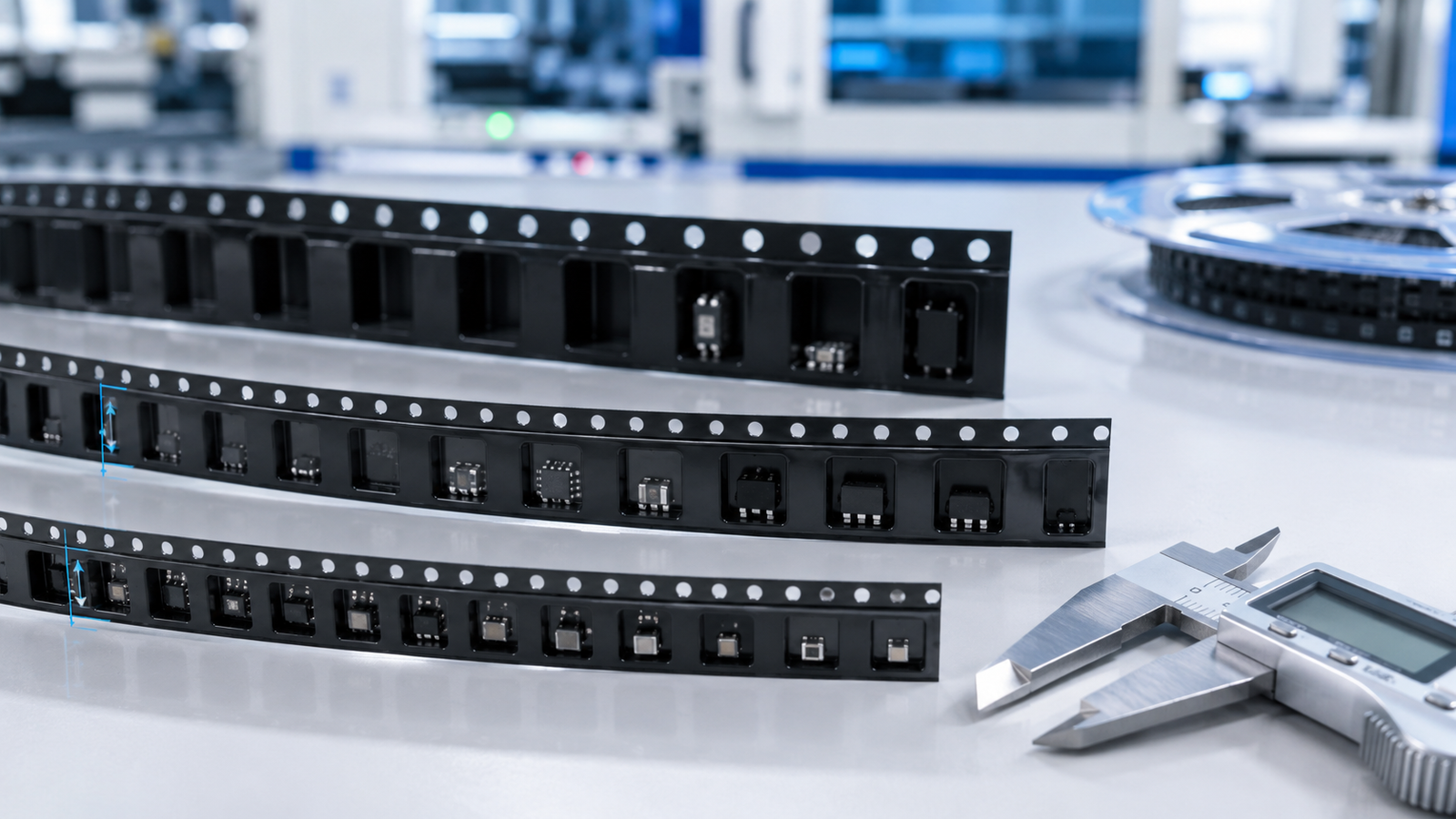
Carrier tape thickness is an important part of any carrier tape specification, especially for embossed carrier tape used in SMT packaging. It affects how the pocket is formed, how much support the pocket can provide, how well the component is protected during transport, and whether the tape can run smoothly through SMT feeders.
For buyers, the goal is not to choose the thickest material possible. The right carrier tape thickness should match the component size, weight, pocket depth, material type, cover tape sealing method, and actual production requirements. A tape that is too thin may deform easily, while a tape that is too thick may increase cost or create forming challenges. This guide explains how thickness affects real packaging performance and what buyers should confirm before placing an order.
Why Carrier Tape Thickness Matters in Embossed Carrier Tape
In embossed carrier tape, the pocket is formed from plastic material such as PS, PET, PC, conductive material, or anti-static material. The material thickness directly affects how the tape behaves during forming, winding, sealing, transport, and SMT feeding.
A suitable thickness helps the pocket maintain its shape after forming. This is important because each pocket must hold the component in a stable position. If the pocket walls are too weak, the component may shift, tilt, or sit unevenly. If the tape is too flexible, the reel may also experience deformation during winding or shipment.
For buyers, thickness should be considered together with the full carrier tape design. Tape width, pocket depth, pocket shape, material, pitch, cover tape, and reel requirements all influence the final packaging result. Choosing thickness only based on price or a general standard may lead to quality problems later in the packaging process.
How Thickness Affects Pocket Strength and Forming Stability
Carrier tape pocket strength is closely related to material thickness. In many cases, a thicker material can provide better rigidity and stronger pocket wall support. This is especially useful for larger, heavier, taller, or deeper components that need more stable protection during handling and shipment.
Pocket depth is one of the most important factors. A shallow pocket for a small component may not need the same material support as a deep pocket for a larger connector, sensor, module, or precision part. Deeper cavities usually require stronger forming stability because the pocket walls need to hold their shape after the material is heated, formed, cooled, and wound onto reels.
However, thicker is not always better. If the material is too thick for the pocket geometry or forming process, it may become more difficult to form clean pocket details. This can affect pocket accuracy, corner definition, and component fit. In some cases, an unsuitable thickness can cause uneven forming or inconsistent cavity dimensions.
A good carrier tape specification balances strength and processability. The tape should be rigid enough to protect the component, but still suitable for clean forming, stable sealing, and smooth SMT feeding.
Thickness-Related Factors and Packaging Impact
Carrier tape material thickness affects several parts of the packaging process. Buyers should evaluate thickness based on real component and production conditions rather than using one fixed thickness for all parts.
| Thickness-Related Factor | Packaging Impact |
|---|---|
| Component weight | Heavier parts may need stronger pocket support to reduce deformation or pocket collapse. |
| Pocket depth | Deeper cavities usually require better forming stability and stronger sidewalls. |
| Tape material | PS, PET, PC, conductive, and anti-static materials may perform differently at similar thickness levels. |
| Component size | Larger components often need stronger tape structure to maintain stable positioning. |
| Winding and transport | Suitable thickness helps reduce pocket distortion during reel winding and shipment. |
| Cover tape sealing | Tape rigidity and flatness can affect sealing consistency and peel performance. |
| SMT feeding | Proper thickness supports smoother indexing, stable movement, and better pickup accuracy. |
| Cost sensitivity | Thicker material may increase cost, so buyers need to balance protection and efficiency. |
This is why carrier tape thickness should be reviewed as part of the full packaging design. For custom components, it is often better to evaluate the component drawing, sample, pocket depth, and feeding requirements before confirming the final specification.
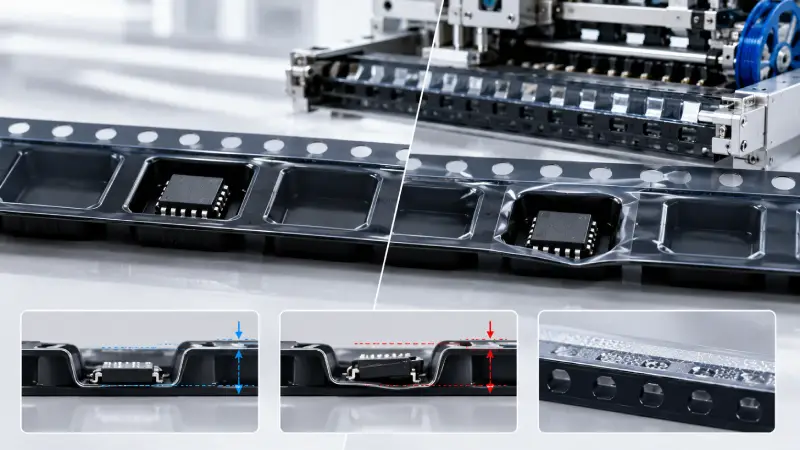
How Carrier Tape Material Thickness Affects Component Protection
Component protection is one of the main reasons buyers pay attention to carrier tape thickness. During packaging, storage, and shipping, components are not only sitting inside the pocket. They are also affected by reel winding pressure, vibration, handling, and transportation conditions.
If the carrier tape material thickness is too thin, the pocket may not provide enough support. The pocket walls may deform, and the component may move inside the cavity. For fragile or precision components, this can create risks such as scratched surfaces, bent leads, poor orientation, or unstable pickup during SMT assembly.
For heavier parts, the bottom and sidewalls of the pocket need enough strength to support the component without collapsing. For taller or irregular-shaped parts, the pocket must also maintain proper clearance so that the cover tape does not press against the component.
Thickness should also be reviewed together with ESD requirements. For electronic components that are sensitive to static electricity, buyers may need conductive or anti-static carrier tape. In these cases, material type and thickness should be considered together, because both influence the tape’s protection performance and forming quality.
Relationship Between Thickness and Cover Tape Sealing
Carrier tape thickness can also affect cover tape sealing. The sealing area must remain stable and flat enough for the cover tape to bond consistently. If the tape is too flexible, sealing pressure may not be evenly distributed across the tape surface. This can lead to inconsistent peel force or weak sealing areas.
When the carrier tape is properly selected and formed, the sealing surface is more stable. This helps the cover tape protect the components during transport and still peel smoothly during SMT feeding.
Buyers should avoid evaluating carrier tape and cover tape separately. A good packaging result depends on the compatibility between the carrier tape material, thickness, pocket design, cover tape type, sealing temperature, sealing pressure, and required peel strength.
For example, if the carrier tape is too thin and flexible, the sealing process may become less stable. If the tape is too thick or poorly formed, the sealing surface may not remain consistent. Either situation can create problems during inspection, shipment, or SMT production.
Thickness and SMT Feeding Performance
SMT feeding performance is another practical reason to choose carrier tape thickness carefully. During assembly, the tape must move through the feeder smoothly and consistently. The component must remain in a stable position so the pick-and-place machine can pick it accurately.
Unsuitable thickness may contribute to feeding resistance, indexing instability, pocket deformation, or unstable pickup. However, thickness is only one part of feeder performance. Tape width, sprocket hole accuracy, pitch, pocket design, winding quality, cover tape peel force, and reel condition also matter.
For SMT packaging buyers, the most important question is whether the tape can support stable production. A tape that looks acceptable during sampling but performs poorly during continuous feeding can cause downtime, component loss, or quality complaints.
This is why carrier tape thickness should be checked together with tape and reel packaging requirements. For mass production, buyers should consider trial runs, sample inspection, and feeder compatibility before confirming large-volume orders.
Common Problems Caused by Unsuitable Carrier Tape Thickness
When carrier tape thickness is not suitable for the component or packaging process, several problems may appear. These problems are not always visible at the beginning, but they can become serious during sealing, transport, or SMT feeding.
Common issues include:
- Pocket deformation after forming
- Weak pocket sidewalls
- Pocket collapse during winding or shipment
- Component movement inside the cavity
- Component tilt or poor orientation
- Inconsistent pocket depth
- Poor cover tape sealing consistency
- Unstable peel performance
- Feeding resistance in SMT equipment
- Unstable indexing or pickup position
- Higher rejection risk during inspection
- Unnecessary material cost if the tape is thicker than needed
For buyers, these problems can lead to more than packaging waste. They may cause delayed production, rejected reels, poor machine efficiency, or complaints from downstream assembly teams. That is why thickness should be confirmed early in the carrier tape specification process.
What Buyers Should Confirm Before Choosing Carrier Tape Thickness
Before selecting carrier tape thickness, buyers should collect the key information needed for proper evaluation. The more accurate the component and packaging details are, the easier it is to select a practical thickness.
Buyers should confirm:
- Component length, width, height, and weight
- Component shape and whether it has leads, pins, bumps, or fragile areas
- Required pocket depth and cavity structure
- Tape width and pitch
- Material type, such as PS, PET, PC, conductive, or anti-static material
- Whether the component is heavy, fragile, tall, or irregular
- Cover tape type and sealing requirements
- SMT feeder and pick-and-place requirements
- Packaging quantity and reel size
- Transport distance and storage conditions
- Whether sample testing is needed before mass production
For new products or non-standard components, a custom carrier tape design is often the safer option. Custom design allows the tape thickness, pocket size, pocket depth, material, and sealing method to be selected based on the actual component instead of forcing the component into a standard packaging structure.
How Jiushuo Supports Custom Embossed Carrier Tape Thickness Selection
Jiushuo supports different embossed carrier tape thicknesses based on material type, component size, pocket depth, and packaging requirements. Instead of recommending one fixed thickness for all projects, Jiushuo evaluates the component and packaging conditions to help buyers choose a more suitable structure.
For component manufacturers, SMT packaging buyers, OEM sourcing teams, and quality teams, this support can help reduce trial-and-error during packaging development. Buyers can provide component drawings, samples, dimensions, ESD requirements, and SMT packaging needs. Jiushuo can then help evaluate material selection, pocket design, carrier tape thickness, and cover tape compatibility.
Jiushuo’s embossed carrier tape solutions can be used for different electronic components that require stable pocket forming, reliable protection, and smooth feeding. For projects with special shapes or packaging challenges, Jiushuo can also support custom carrier tape development and related tape-and-reel packaging evaluation.
Need Help Choosing the Right Carrier Tape Thickness?
Carrier tape thickness should be selected based on real component requirements, not guesswork. The right choice depends on component size, weight, pocket depth, material, cover tape sealing, feeder compatibility, and transport conditions.
If you are developing packaging for a new component or facing pocket deformation, sealing, or SMT feeding problems, Jiushuo can help evaluate the proper embossed carrier tape structure. Send your component drawing, sample details, required tape width, pocket depth, material preference, and packaging quantity to get practical support.
For complete packaging support, Jiushuo can also help with tape and reel packaging and carrier tape with matching cover tape solutions.
FAQ
What is carrier tape thickness?
Carrier tape thickness refers to the material thickness used to produce the tape. In embossed carrier tape, thickness affects pocket strength, forming stability, component protection, cover tape sealing, and SMT feeding performance.
Does thicker carrier tape always mean better packaging?
No. A thicker carrier tape may provide better rigidity, but it is not always the best choice. The right thickness depends on component weight, pocket depth, tape material, forming requirements, sealing method, and feeder compatibility.
How does embossed carrier tape thickness affect pocket strength?
Embossed carrier tape thickness affects how well the pocket walls and bottom area support the component. Suitable thickness helps reduce deformation, maintain pocket shape, and keep the component in a stable position during transport and SMT feeding.
Can carrier tape thickness affect cover tape sealing?
Yes. Carrier tape rigidity, flatness, and forming quality can affect cover tape sealing consistency and peel performance. That is why carrier tape and cover tape should be evaluated together during specification confirmation.
What happens if carrier tape material thickness is too thin?
If the carrier tape material thickness is too thin, the pocket may deform, collapse, or fail to support the component properly. This can cause component movement, tilt, poor protection, or unstable pickup during SMT assembly.
How should buyers choose the right carrier tape thickness?
Buyers should confirm component dimensions, weight, shape, pocket depth, material requirements, cover tape compatibility, SMT feeder requirements, and transport conditions. For new or custom components, sample testing is recommended before mass production.
Can Jiushuo provide different embossed carrier tape thickness options?
Yes. Jiushuo can support different embossed carrier tape thicknesses based on component requirements, material selection, pocket design, and packaging conditions. Buyers can provide drawings or samples for evaluation before confirming the final specification.