

In tape and reel packaging, most buyers focus on the carrier tape itself and overlook the plastic reel that holds it. However, the reel has a direct impact on feeding stability, storage safety, shipping cost, and pick-and-place performance.
A reel that is too small can bend the carrier tape and cause feeding issues. A reel made from the wrong material may crack during export shipping. If the hub diameter or reel width does not match the feeder, the reel may not run properly on the SMT line.
For electronics manufacturers, semiconductor packaging companies, and SMT assembly plants, choosing the correct carrier tape plastic reel is just as important as choosing the tape itself. The right combination reduces downtime, protects components, and improves packaging efficiency.
This guide explains how carrier tape plastic reels work, which sizes and materials are most common, how to match a reel to your tape, and what mistakes to avoid when sourcing reels for SMT and semiconductor applications.
What Is a Carrier Tape Plastic Reel?
A carrier tape plastic reel is the spool used to wind loaded carrier tape and sealed cover tape after components have been packaged. Once electronic components are placed into the pockets of the carrier tape, the tape is sealed and wound onto a reel for storage, transport, and automated feeding.
The reel serves several purposes:
- Protects components from damage during handling and shipment
- Keeps the tape wound evenly to prevent tangling or deformation
- Allows the reel to fit directly into SMT pick-and-place feeders
- Makes inventory and production handling easier
The reel must be selected based on the width of the carrier tape, the total length of tape being wound, the height and weight of the components, and the feeder specifications used on the SMT line.
For example, a narrow 8 mm carrier tape containing chip resistors can usually be wound on a small reel. A wide tape containing connectors or semiconductor modules may require a larger reel with a stronger flange.
If you are not familiar with the role of the tape itself, you can first review the basics of carrier tape here:
For a broader overview of the full packaging process, see:
Tape & Reel Packaging Solutions
Why Plastic Reels Matter in Tape and Reel Packaging
Many packaging problems that appear to be caused by the carrier tape are actually caused by the reel.
If the reel diameter is too small, the tape may curve too tightly. This can deform pockets, shift components, or reduce sealing strength. If the reel material is too weak, the flange may crack during shipping and allow the tape to unwind.
Plastic reel selection affects:
- Feeding stability on pick-and-place machines
- Component protection during shipping and warehouse storage
- Space efficiency in cartons and export packaging
- Compatibility with SMT feeders
- Static control for sensitive semiconductors and ICs
| Poor Reel Selection | Correct Reel Selection |
|---|---|
| Tape slips or unwinds | Tape stays evenly wound |
| Reel cracks during shipment | Strong reel survives handling |
| Too much empty space in carton | Better packaging efficiency |
| Feeder jams or stops | Smooth SMT production |
| ESD-sensitive components are exposed | Antistatic reel protects devices |
A properly selected reel reduces machine stoppages and improves yield. In high-volume SMT production, even a small reduction in feeder interruptions can save significant labor and production cost.
The two most important factors are reel dimensions and reel material. Once these are matched correctly to the tape and component, the rest of the packaging process becomes much more reliable.
Standard Carrier Tape Plastic Reel Sizes
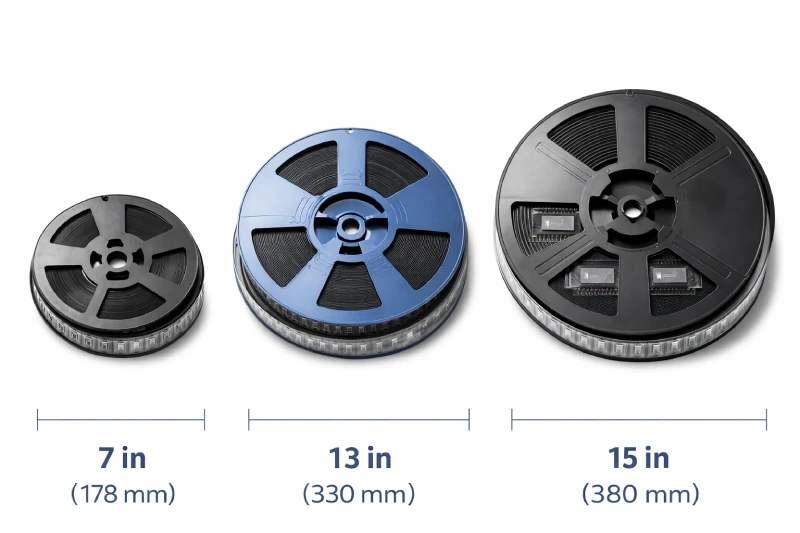
Most carrier tape plastic reels follow standard industry dimensions defined by EIA-481. The most common reel diameters are 7 inches, 13 inches, and 15 inches.
| Reel Size | Diameter | Typical Tape Width | Common Application |
|---|---|---|---|
| 7-inch reel | 178 mm | 8-16 mm | Small SMT parts, prototype runs |
| 13-inch reel | 330 mm | 8-56 mm | Standard SMT production |
| 15-inch reel | 380 mm | 24-88 mm | Large components and long tape lengths |
7-Inch Reel (178 mm)
A 7-inch reel is commonly used for small-volume production, sample orders, and narrow carrier tape widths. It is often selected for 8 mm or 12 mm tape carrying chip resistors, capacitors, diodes, or small ICs.
The main advantage of a 7-inch reel is that it is compact and lightweight. It reduces storage space and is ideal when only a short tape length is required.
However, because the diameter is smaller, it is not suitable for long tape lengths or larger components.
13-Inch Reel (330 mm)
The 13-inch reel is the most common standard used in SMT production. It supports a wide range of tape widths and can hold much longer lengths than a 7-inch reel.
Most standard pick-and-place feeders are designed around 13-inch reels. For this reason, it is often the default choice for continuous production and export packaging.
A 13-inch reel works well for tape widths from 8 mm to 56 mm and can be used for passive components, ICs, LEDs, connectors, and semiconductor devices.
15-Inch Reel (380 mm)
A 15-inch reel is generally used when the tape is wide or when a long tape length is required. It is common for large connectors, power modules, automotive electronics, and wide embossed carrier tape.
Because the diameter is larger, the tape bends less sharply. This reduces stress on deep pockets and large components.
When packaging wide tapes, it is also important to use a reel that matches the tape width precisely. Custom wide reels are often needed for larger packages.
If your components require wider or deeper pockets, a custom embossed tape design may also be necessary:
For standard formed pocket solutions, see:
Common Materials Used for Carrier Tape Plastic Reels
The reel material affects strength, cost, impact resistance, and ESD protection. The most common materials are polystyrene, polycarbonate, and conductive or antistatic plastic.
| Material | Strength | Cost | Best For |
|---|---|---|---|
| Polystyrene (PS) | Medium-Low | Low | Lightweight SMT parts |
| Polycarbonate (PC) | High | Medium-High | Heavy reels and export shipping |
| Conductive / Antistatic Plastic | High | High | Sensitive ICs and semiconductor devices |
Polystyrene (PS)
Polystyrene is the most economical material for plastic reels. It is widely used for lightweight SMT components and low-cost production.
The advantage of PS is that it keeps packaging cost low. However, it is more brittle than other materials. If reels are dropped or exposed to heavy pressure during shipping, the flange may crack.
Polycarbonate (PC)
Polycarbonate is much stronger and more impact-resistant. It is a better option when reels must survive long-distance transportation or when the tape contains larger, heavier components.
Although PC reels cost more than PS reels, they often reduce losses caused by broken packaging.
Conductive and Antistatic Plastic
For semiconductors, ICs, LEDs, and other ESD-sensitive devices, conductive or antistatic reels are recommended.
These reels help prevent electrostatic discharge from damaging the components while they are being transported or fed through the SMT line.
When packaging static-sensitive devices, the reel should be combined with matching antistatic carrier tape and cover tape.
You can learn more about ESD-safe packaging materials here:
For conductive tape and sealing material combinations, see:
Conductive Carrier Tape and Cover Tape
How to Match the Plastic Reel to Carrier Tape Width and Length
Selecting the correct reel is not only about choosing a diameter. The reel must also match the tape width, total tape length, component height, and winding thickness.
A reel that is too narrow may pinch the tape and damage the pockets. A reel that is too wide wastes space and increases shipping cost.
| Tape Width | Recommended Reel |
|---|---|
| 8-12 mm | 7-inch or 13-inch reel |
| 16-32 mm | 13-inch reel |
| 44-88 mm | 13-inch or 15-inch reel |
Example 1: Small Passive Components
An 8 mm carrier tape used for resistors or capacitors can usually be wound on either a 7-inch reel or a 13-inch reel.
- 7-inch reel: short production run or sample order
- 13-inch reel: large-volume SMT production
Example 2: Connectors and Semiconductor Modules
A 44 mm or 56 mm carrier tape containing large connectors or semiconductor modules usually requires a 13-inch or 15-inch reel.
The larger diameter helps protect the tape pockets and prevents the components from shifting.
The reel should also match:
- Hub diameter
- Arbor hole size
- Reel flange width
- Feeder spindle requirements
When these dimensions are not compatible, the reel may not fit correctly into the pick-and-place feeder.
Common Problems Caused by the Wrong Plastic Reel
Even if the carrier tape is designed correctly, the wrong reel can still create packaging and production problems.
Reel Cracking During Shipping
Low-strength reels often crack when cartons are stacked or dropped during transportation. This is especially common in export shipments.
Once the flange breaks, the tape may unwind and damage the components.
Feeding Failure on SMT Machines
If the reel hub, arbor hole, or width does not match the feeder, the reel may wobble or fail to rotate smoothly.
This can cause feeder jams, skipped components, or unexpected line stoppages.
Carrier Tape Deformation
Using a reel that is too small forces the tape to bend too sharply. This can deform deep pockets and make it difficult for the pick-and-place machine to remove components correctly.
ESD Damage
Using a standard reel instead of an antistatic reel can expose sensitive semiconductors to electrostatic discharge.
This type of damage is difficult to see but can reduce product reliability and increase field failures.
Common warning signs include:
- Reel flange bends easily
- Tape does not wind evenly
- Components move inside the pockets
- Reel does not fit the feeder spindle
- Frequent SMT line downtime
How to Choose a Reliable Carrier Tape Plastic Reel Supplier
A reliable supplier should do more than simply provide a standard reel. They should understand the complete relationship between the carrier tape, cover tape, reel, and feeder.
Look for a supplier that offers:
- Experience in SMT and semiconductor packaging
- EIA-481 compliant reel dimensions
- Customization for diameter, width, hub size, and ESD properties
- Sample testing before mass production
- Matched carrier tape and cover tape solutions
- Export packaging experience
Suppliers with in-house tooling and engineering support are often more flexible. They can design a reel that matches unusual tape widths, deep pockets, or heavy components.
It is also valuable to work with a supplier that can provide the complete tape and reel system instead of selling only the reel.
For example, if you need both reel and sealing material, you may also need:
And if your project requires a full packaging solution instead of separate parts, you can review:
Tape & Reel Packaging Solutions
Conclusion
The right carrier tape plastic reel improves more than packaging appearance. It affects SMT feeding stability, shipping reliability, storage efficiency, and overall production cost.
When choosing a reel, focus on three key factors:
- Reel size and compatibility with tape width
- Reel material and required strength
- Compatibility with feeder dimensions and ESD requirements
For narrow tape and small components, a 7-inch reel may be enough. For standard SMT production, the 13-inch reel is usually the best choice. For large connectors, semiconductors, and long tape lengths, a 15-inch reel or custom reel may be necessary.
Choosing the correct reel reduces downtime, protects components, and improves the efficiency of your tape and reel packaging process.
Need help choosing the right carrier tape plastic reel for your components?
Contact our engineering team to receive a custom recommendation based on your carrier tape width, component size, feeder type, and production volume. We can help you select the ideal reel material, reel size, and matched tape-and-reel solution for your SMT or semiconductor packaging project.