
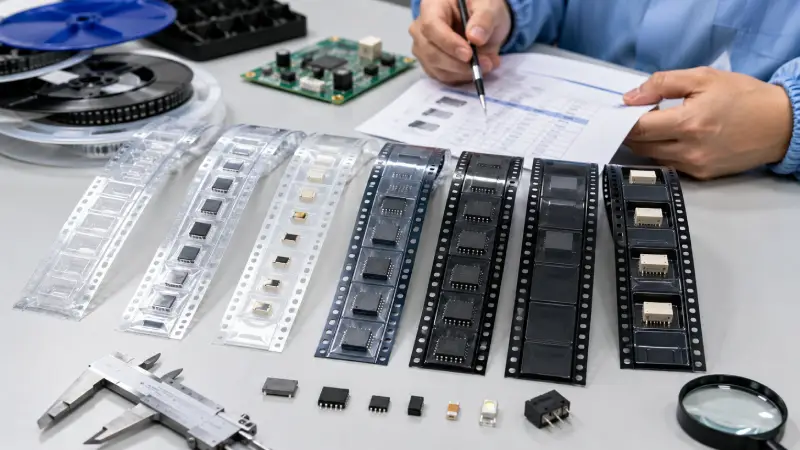
Choosing the right carrier tape material is an important step in electronic component packaging. For SMT packaging buyers, component manufacturers, distributors and OEM sourcing teams, the material is not only about cost. It also affects pocket stability, ESD protection, inspection visibility, sealing performance and feeding reliability during automated assembly.
In many projects, there is no single “best” carrier tape material for every component. A standard passive component, a sensitive IC, a transparent LED package and a larger connector may all require different material choices. The goal is to match the carrier tape material with the component’s shape, sensitivity, handling risk and production requirements.
This guide explains common carrier tape material options in simple B2B terms, including PS, PET, PC, ABS, anti-static carrier tape and conductive carrier tape. It is designed to help buyers understand the main differences before requesting samples or working with a supplier on custom embossed carrier tape.
Why Carrier Tape Material Selection Matters
Carrier tape is not just a strip of plastic used to hold components. It is part of the complete packaging and SMT feeding system. The material used for the tape affects how well pockets are formed, how stable the dimensions remain, how safely components are protected and how smoothly the tape runs through pick-and-place equipment.
For sourcing teams, material selection also affects cost control. A low-cost material may be suitable for standard components, but it may not be the right choice for sensitive, high-value or irregularly shaped parts. On the other hand, choosing a high-performance material when it is not needed can increase packaging cost without adding real value.
Good material selection should consider several practical questions:
Is the component ESD-sensitive? Does the buyer need transparent tape for visual inspection? Is the component heavy, fragile or irregular in shape? Does the tape need deeper pockets or stronger forming stability? Will the carrier tape be matched with heat-seal or pressure-sensitive cover tape?
These questions help narrow down the most suitable material option before sample testing and mass production.
Common Carrier Tape Materials
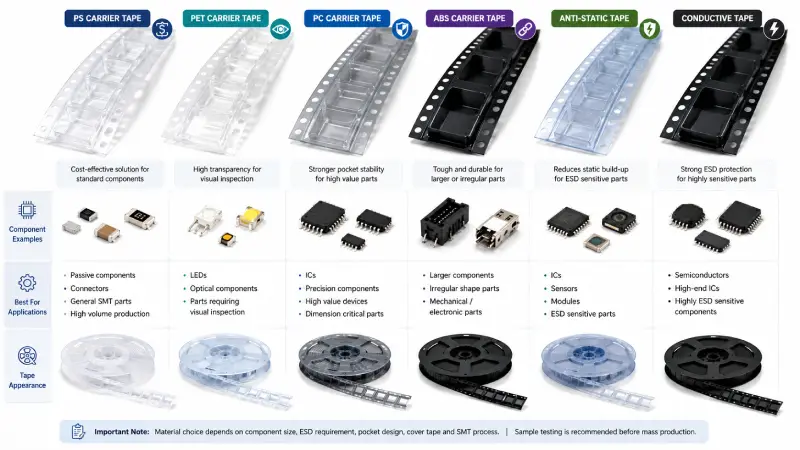
PS Carrier Tape
PS carrier tape is one of the most commonly used options for embossed carrier tape. It is widely selected because it offers a practical balance between cost, forming performance and general packaging stability.
For many standard electronic components, PS can provide enough pocket support and feeding performance. It is often used for passive components, connectors and general SMT parts where extreme strength or special ESD protection is not required.
The main advantage of PS is cost efficiency. For high-volume packaging projects, this can be important. However, buyers should still confirm whether the selected PS grade meets the component’s ESD, inspection and pocket stability requirements.
PET Carrier Tape
PET carrier tape is often selected when appearance, cleanliness and transparency are important. Compared with some other materials, PET can offer better visibility, making it easier to inspect components inside the pockets.
This makes PET a practical option for components where visual checking, optical inspection or clean presentation matters. It may be used for small components, LEDs, precision parts or products where buyers want clearer pocket visibility.
PET is not automatically the right choice for every transparent packaging requirement. Buyers still need to confirm forming performance, thickness, ESD properties and cover tape compatibility before final approval.
PC Carrier Tape
PC carrier tape is often considered when better strength, pocket stability and dimensional control are required. It can be suitable for higher-value components, sensitive devices or applications where stronger packaging reliability is needed.
For components that require more stable pockets, PC may provide better support than more basic material options. It can also be useful when the component shape or weight creates additional packaging challenges.
Because PC can be more expensive than standard materials, buyers should use it where the component value, quality requirement or handling risk justifies the added cost.
ABS Carrier Tape
ABS carrier tape is known for good toughness and forming support. It can be considered for larger components, irregular parts or products that require stronger pocket structure.
In some packaging projects, the main challenge is not only ESD or transparency, but whether the pocket can hold the component securely during winding, transportation and SMT feeding. ABS may be useful when a stronger pocket wall or more durable structure is needed.
For buyers handling connectors, mechanical electronic parts or larger components, ABS may be one of the materials to evaluate during sample development.
Anti-Static Carrier Tape
Anti-static carrier tape is designed to reduce static build-up during packaging, storage, transportation and feeding. It is commonly used for components that require ESD protection but may not need the stronger control level of conductive tape.
This option is often suitable for ICs, LEDs, sensors, modules and other electronic components with moderate static sensitivity. Buyers should confirm the surface resistance requirement and the actual ESD sensitivity of the component before selecting anti-static carrier tape.
Anti-static carrier tape can be available in different colors and material bases, depending on project requirements. The final choice should be based on both ESD control and forming performance.
Conductive Carrier Tape
Conductive carrier tape provides stronger ESD protection than general anti-static tape. It is commonly black and is often used for ICs, semiconductors, precision components and high-value electronic parts.
For highly ESD-sensitive components, conductive tape can help reduce packaging and handling risk. It is especially useful when the buyer has strict ESD control requirements or when the component supplier specifies conductive packaging.
However, conductive carrier tape is not always necessary for every component. If the component only requires moderate ESD control, anti-static tape may be enough. Buyers should avoid over-specifying conductive tape when the component does not need it, especially in cost-sensitive projects.
Carrier Tape Material Comparison Table
| Material / Option | Typical Appearance | Main Advantages | Common Applications | ESD Protection | Buyer Consideration |
|---|---|---|---|---|---|
| PS Carrier Tape | Clear, semi-clear or black | Cost-effective, widely used, suitable for standard packaging | Passive components, connectors, general SMT parts | Depends on grade | Good for cost-sensitive, high-volume orders |
| PET Carrier Tape | Clear or transparent | Better visibility, clean appearance, useful for inspection | Small parts, LEDs, visible inspection packaging | Depends on grade | Consider when optical checking or appearance matters |
| PC Carrier Tape | Clear, tinted or black | Stronger pocket stability and better reliability | Higher-value components, precision parts, sensitive devices | Depends on grade | Suitable when stronger dimensional control is needed |
| ABS Carrier Tape | Usually black or opaque | Toughness and good support for formed pockets | Larger components, irregular components, mechanical parts | Depends on grade | Useful when pocket strength is important |
| Anti-Static Carrier Tape | Clear, black or tinted | Reduces static accumulation and protects ESD-sensitive parts | LEDs, ICs, sensors, modules | Moderate ESD control | Good balance between protection and cost |
| Conductive Carrier Tape | Usually black | Stronger ESD protection for sensitive electronics | ICs, semiconductors, high-value components | Strong ESD control | Selected when ESD risk is a major concern |
This table should be used as a starting point, not as a final rule. Material availability, thickness, surface resistance, pocket design and forming results may vary by component. For new projects, sample testing is strongly recommended before mass production.
How Component Type Affects Material Choice
Different electronic components create different packaging challenges. The right carrier tape material depends heavily on what is being packed.
Small Passive Components
Small passive components usually require stable pocket dimensions and smooth feeding. For these parts, PS carrier tape is often considered because it is cost-effective and suitable for high-volume packaging.
If visual inspection is important, PET or clear material options may also be evaluated. For very small parts, the pocket design and forming accuracy are often more important than choosing a stronger material.
ICs and Semiconductors
ICs and semiconductors usually require careful ESD control. For these components, anti-static or conductive carrier tape is commonly considered.
Conductive carrier tape may be preferred when the component is highly sensitive or high-value. However, the final decision should follow the component’s ESD requirement, handling environment and customer packaging standard.
LEDs and Optical Components
LEDs and optical components may require both ESD protection and visual inspection. In some cases, buyers may prefer transparent or semi-transparent material so the component can be checked more easily inside the pocket.
PET or clear anti-static material may be considered depending on the component’s sensitivity and inspection needs. For LEDs, buyers should also pay attention to pocket fit, orientation and cover tape sealing performance.
Connectors and Irregular Components
Connectors and irregular components often need deeper pockets, stronger support and more customized forming. In these cases, ABS, PC or thicker PS options may be evaluated.
The material should support the pocket structure without causing feeding problems. For this type of component, buyers usually need custom carrier tape design instead of using a standard tape specification.
Larger or Heavier Components
Larger or heavier components place more stress on the pocket. The tape must hold the component securely during winding, storage, shipping and SMT feeding.
For these applications, material thickness, pocket depth and pocket wall strength should be reviewed together. A stronger material may help, but good pocket design is equally important.
Key Selection Criteria for Buyers
When comparing carrier tape material options, buyers should focus on practical packaging requirements instead of only comparing material names.
ESD Sensitivity
The first question is whether the component is ESD-sensitive. If yes, the buyer should confirm whether anti-static or conductive carrier tape is required.
For moderate ESD needs, anti-static tape may be suitable. For highly sensitive ICs or semiconductors, conductive tape may be more appropriate. Buyers should provide any surface resistance or ESD packaging requirements to the supplier.
Pocket Stability
Pocket stability affects how well the component sits inside the tape and how smoothly it feeds during SMT assembly. Components that are tall, heavy, fragile or irregular may require stronger material, thicker tape or a more customized pocket structure.
If the pocket is not stable, the component may tilt, move or become difficult to pick during assembly.
Inspection Requirements
Some buyers need clear tape so operators or inspection systems can see the component inside the pocket. PET, clear PS or clear PC may be considered when visibility is important.
However, transparent material may not always provide the same ESD performance as black conductive tape. Buyers should balance inspection needs with ESD control requirements.
Cost and Order Volume
For high-volume and cost-sensitive components, PS carrier tape may be a practical starting point. For higher-value or sensitive components, buyers may accept a higher material cost to reduce quality risk.
The best material choice should match the total packaging risk, not just the tape price.
Cover Tape Compatibility
Carrier tape material should also be considered together with matching cover tape. Sealing performance, peel force and feeding stability depend on the complete tape-and-reel packaging system.
A carrier tape material that forms well still needs to work properly with the selected cover tape. Sample sealing and peel testing can help confirm whether the combination is suitable.
What Buyers Should Send for Supplier Recommendation
To recommend the right carrier tape material, suppliers need more than a general component name. Buyers can speed up the process by sending complete component and packaging information.
Useful information includes:
- Component drawing or datasheet
- Component length, width and height
- Component weight
- Product photos or 3D files if available
- ESD sensitivity requirement
- Preferred tape width and reel size, if known
- SMT machine or feeding requirement
- Annual or batch order quantity
- Inspection requirement, such as clear tape or black conductive tape
- Required cover tape type or sealing preference
- Sample testing requirement before mass production
With this information, Jiushuo can review the component shape, packaging risk and SMT feeding needs before recommending a suitable carrier tape material, pocket design, tape thickness and cover tape option.
Jiushuo Custom Embossed Carrier Tape Support
Jiushuo supports custom embossed carrier tape for different electronic components, including standard SMT parts, ICs, LEDs, sensors, connectors, modules and irregular components.
Depending on the project, material options may include PS, PET, PC, ABS, anti-static grades and conductive grades. Jiushuo can help buyers evaluate material selection based on component size, ESD sensitivity, pocket depth, inspection requirement, order volume and packaging method.
For components that cannot be packed with standard tape, Jiushuo can develop custom pocket designs based on component drawings or samples. The goal is to help the component sit securely in the pocket, support smooth SMT feeding and match the right cover tape for stable sealing.
Before mass production, sample testing is recommended to confirm pocket fit, material performance, cover tape sealing and feeding stability.
Need Help Choosing the Right Carrier Tape Material?
If you are unsure whether PS, PET, PC, ABS, anti-static or conductive carrier tape is suitable for your component, Jiushuo can help review your packaging requirements and recommend a practical solution.
Send your component drawing, dimensions, ESD requirement, inspection needs and estimated order quantity. Jiushuo can support material selection, custom pocket design, sample evaluation and matched cover tape recommendations for your embossed carrier tape project.
FAQ
What is the most common carrier tape material?
PS is one of the most commonly used carrier tape materials because it offers a practical balance of cost, forming performance and availability. It is often suitable for standard SMT components and high-volume packaging projects.
When should I choose conductive carrier tape?
Conductive carrier tape is usually selected for highly ESD-sensitive components such as ICs, semiconductors and precision electronic parts. It provides stronger ESD control than general anti-static tape.
Is anti-static carrier tape the same as conductive carrier tape?
No. Anti-static carrier tape helps reduce static build-up, while conductive carrier tape provides stronger ESD protection. The right choice depends on the component’s ESD sensitivity and customer packaging requirements.
Which carrier tape material is better for visual inspection?
Transparent or clear materials such as PET, clear PS or clear PC may be suitable when visual inspection is important. However, buyers should also consider ESD protection, pocket stability and cover tape compatibility.
Can one carrier tape material be used for all components?
No. Different components have different size, shape, weight, ESD and feeding requirements. Material selection should be based on the specific component and confirmed through sample testing.
Should carrier tape material and cover tape be selected together?
Yes. Carrier tape and cover tape should be evaluated as one packaging system. Sealing strength, peel force and SMT feeding performance all depend on the compatibility between the carrier tape and cover tape.