

In modern SMT and semiconductor packaging, carrier tape quality directly affects component feeding performance, assembly efficiency, and production yield. Even a small defect in pocket dimensions, tape thickness, or surface conductivity can lead to misfeeds, component damage, machine downtime, or costly production delays.
For this reason, carrier tape inspection is an essential part of quality assurance throughout the manufacturing process.
Whether you are sourcing standard carrier tapes or developing a custom packaging solution, understanding the most important carrier tape inspection methods can help you evaluate supplier quality and minimize packaging risks.
This guide explains the key inspection techniques used by professional carrier tape manufacturers and quality control teams.
Why Carrier Tape Inspection Matters
Carrier tapes are designed to securely hold electronic components during transportation, storage, and automated SMT assembly.
Any inconsistency in the tape can affect:
- Component retention
- Pick-and-place accuracy
- Tape feeding stability
- ESD protection performance
- Sealing reliability
- Production efficiency
This is especially important when using specialized solutions such as anti-static carrier tape and custom carrier tape, where dimensional accuracy and material properties must meet strict customer specifications.
Many manufacturers perform inspections at multiple stages, including raw material verification, in-process production control, and final shipment inspection.
For companies unfamiliar with carrier tape structures, understanding the basics of a carrier tape is an important first step before evaluating inspection requirements.
Dimensional Inspection
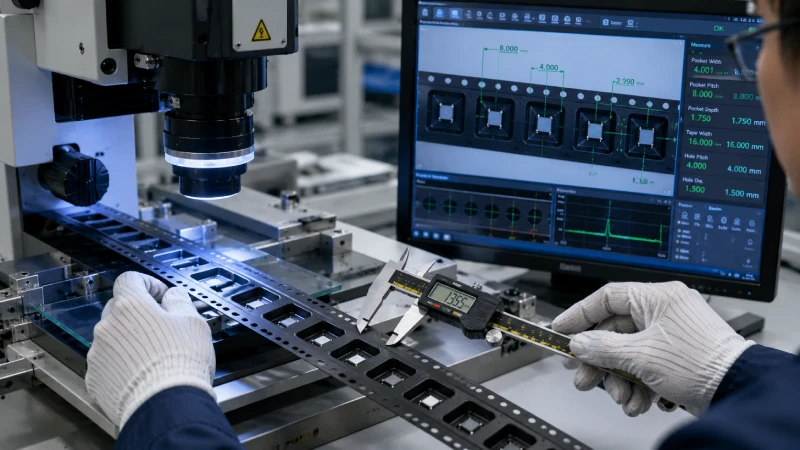
Dimensional inspection is one of the most fundamental carrier tape quality control methods.
The purpose is to verify that the tape complies with EIA-481 standards and customer specifications.
Key Dimensions Checked
Inspectors typically measure:
- Pocket width
- Pocket length
- Pocket depth
- Pocket pitch
- Sprocket hole diameter
- Sprocket hole pitch
- Tape width
- Overall tape thickness
Common measuring equipment includes:
- Digital calipers
- Optical measuring systems
- Vision inspection machines
- Profile projectors
- Coordinate measuring machines (CMM)
Even small dimensional deviations can cause feeding issues in automated pick-and-place equipment.
Pocket Accuracy Inspection
The pocket is the most critical feature of a carrier tape because it directly holds the electronic component.
Quality inspectors evaluate:
Pocket Shape Consistency
The pocket must match the component profile precisely.
Inspection checks include:
- Pocket geometry
- Corner radii
- Pocket symmetry
- Wall angle consistency
Pocket Depth Verification
Improper pocket depth may result in:
- Component movement
- Component flipping
- Cover tape interference
- Pick-up failures
Manufacturers often use automated optical measurement systems to verify pocket depth and dimensional uniformity across production lots.
This inspection is especially important for embossed carrier tape, where thermoforming precision determines pocket quality.
Visual Inspection Methods
Visual inspection remains one of the most widely used carrier tape inspection methods.
Operators or automated vision systems look for surface defects that may affect packaging performance.
Common Visual Defects
Inspectors check for:
- Burrs
- Cracks
- Scratches
- Deformation
- Contamination
- Dust particles
- Color inconsistency
- Surface dents
- Warping
Automated Optical Inspection (AOI)
Modern carrier tape manufacturers increasingly use AOI systems.
Benefits include:
- Higher inspection speed
- Improved defect detection
- Reduced human error
- 100% production monitoring
High-resolution industrial cameras can identify defects that may be difficult to detect through manual inspection.
Material Property Inspection
Carrier tape performance depends heavily on material characteristics.
Manufacturers inspect material properties to ensure long-term reliability.
Thickness Uniformity
Variations in thickness can affect:
- Pocket formation
- Cover tape sealing
- Feeding stability
Measurement tools include:
- Digital thickness gauges
- Laser thickness measurement systems
Mechanical Strength Testing
Tests may include:
- Tensile strength
- Elongation
- Flexibility
- Impact resistance
These tests verify that the tape can withstand transportation and automated assembly processes.
ESD Performance Inspection
For sensitive electronic components, electrostatic discharge protection is critical.
Manufacturers perform ESD testing on anti-static carrier tape products to verify conductivity and static dissipation performance.
Surface Resistance Testing
Typical measurements include:
- Surface resistivity
- Volume resistivity
- Static decay time
Common testing equipment:
- Surface resistance meters
- Electrostatic field meters
- Static decay analyzers
Why ESD Inspection Matters
Without proper ESD protection, components such as:
- ICs
- LEDs
- Sensors
- Microprocessors
may experience latent damage that is difficult to detect but can lead to field failures.
Cover Tape Peel Force Testing
One of the most important quality checks involves cover tape sealing performance.
The cover tape must:
- Secure components during transport
- Open smoothly during SMT assembly
Peel Strength Test
Testing measures the force required to remove the cover tape from the carrier tape.
Key evaluation criteria include:
- Consistent peel force
- Smooth peeling behavior
- No tearing
- No adhesive residue
Most manufacturers follow EIA-481 recommendations when conducting peel strength testing.
Improper peel force can cause:
- Component jumping
- Missing components
- Machine stoppages
- Feeding interruptions
Component Retention Testing
Component retention testing verifies that parts remain securely positioned inside the pockets.
Common Testing Methods
Manufacturers may perform:
- Drop tests
- Vibration tests
- Transportation simulation tests
- Shock resistance tests
These tests help ensure components remain stable during:
- Shipping
- Warehousing
- Reel handling
- Production line feeding
Retention testing is particularly important for high-value semiconductor devices and miniature electronic components.
Automated Vision Inspection Systems
Advanced carrier tape production facilities often use fully automated inspection systems integrated into manufacturing lines.
These systems can monitor:
- Pocket dimensions
- Hole positioning
- Surface defects
- Color consistency
- Tape alignment
Advantages include:
Real-Time Quality Monitoring
Defects can be identified immediately during production.
Higher Production Efficiency
Manufacturers can reduce scrap rates and improve process stability.
Traceability
Inspection data can be stored for:
- Quality records
- Customer audits
- Process optimization
Automated inspection is becoming increasingly common in high-volume SMT packaging environments.
Inspection Requirements for Custom Carrier Tapes
When developing a custom carrier tape, inspection standards become even more important because each design is unique.
Additional inspection criteria may include:
- Customer-specific pocket dimensions
- Component fit validation
- Trial packaging verification
- Feeding performance tests
- First article inspection (FAI)
Manufacturers typically produce sample tapes and conduct validation testing before mass production begins.
This helps ensure compatibility with automated assembly equipment and customer packaging requirements.
What Inspection Reports Should Buyers Request?
When evaluating a carrier tape supplier, buyers should request documentation such as:
Dimensional Inspection Reports
Including:
- Pocket measurements
- Hole dimensions
- Tape width data
Material Certifications
Verifying:
- Material composition
- Mechanical properties
- Compliance standards
ESD Test Reports
For conductive and anti-static products.
Peel Force Test Records
Showing sealing performance consistency.
Production Quality Records
Including:
- Sampling plans
- Inspection procedures
- Defect rate statistics
These reports provide confidence that the supplier maintains consistent quality control practices.
Conclusion
Carrier tape inspection is far more than a simple visual check. Professional manufacturers use a combination of dimensional measurement, pocket accuracy verification, material testing, ESD inspection, peel force testing, and automated vision systems to ensure packaging reliability.
For buyers in the SMT and semiconductor industries, understanding these inspection methods can significantly reduce sourcing risks and improve production performance. Whether selecting a standard carrier tape, sourcing an embossed carrier tape, evaluating anti-static carrier tape, or developing a custom carrier tape, comprehensive inspection procedures are essential for ensuring consistent quality and dependable component packaging.
By choosing suppliers with robust inspection capabilities and documented quality control systems, manufacturers can minimize defects, improve feeding performance, and achieve higher assembly yields across their production lines.