
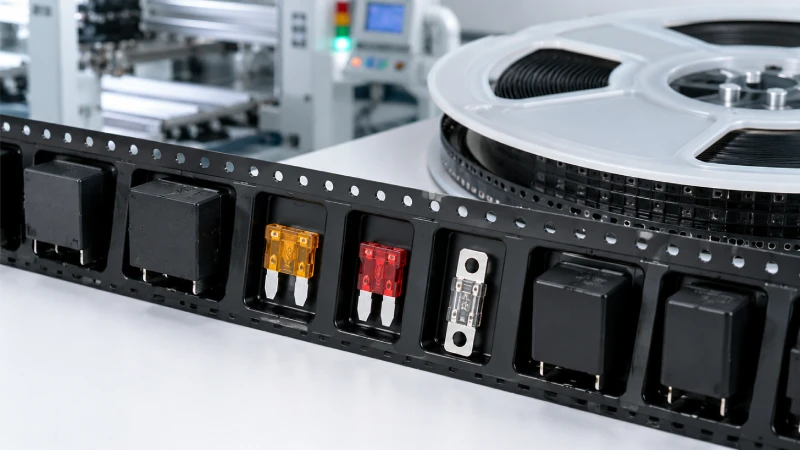
Relays and fuses are widely used in automotive electronics, power control systems, industrial devices, home appliances, and many electronic assemblies. Compared with small chip components, they are often larger, thicker, heavier, or less regular in shape. This makes packaging more challenging, especially when the components need to be delivered in tape-and-reel format for automated handling, inspection, or assembly.
For relay and fuse manufacturers, component distributors, and OEM purchasing teams, the main question is not simply whether the part can be placed into carrier tape. The real concern is whether the component can remain stable, protected, correctly oriented, and easy to feed during the whole packaging and handling process.
Jiushuo provides embossed carrier tape and custom tape-and-reel packaging components for relays, fuses, and other electronic components that require deeper pockets, stronger support, suitable cover tape sealing, and matching plastic reels.
Why Relays and Fuses Need Special Carrier Tape Design
Many standard carrier tapes are designed for relatively small and low-profile components. Relays and fuses are different. A relay may have a tall body, metal terminals, or a box-like shape. A fuse may have a cylindrical, rectangular, or irregular structure, depending on the application. Some automotive fuses, SMD fuses, micro relays, and protection components also require accurate orientation for downstream assembly.
If the pocket is too shallow, the component may sit too high and interfere with the cover tape. If the pocket is too wide, the part may move during transport. If the pocket is not shaped according to the component profile, the relay or fuse may tilt, rotate, or become difficult to pick during automated feeding.
This is why relay carrier tape and fuse carrier tape often require more attention than standard packaging for small passive components. The tape must hold the component securely without applying unnecessary pressure, while still allowing smooth unwinding, peeling, feeding, and picking.
Key Packaging Concerns for Relays and Fuses
Component Thickness and Pocket Depth
Relays and fuses are often thicker than many standard SMD components. This makes pocket depth one of the first points buyers should check. A shallow pocket may cause the component to protrude too much from the tape surface. This can create problems when the cover tape is sealed, when reels are stacked, or when the tape passes through a feeder.
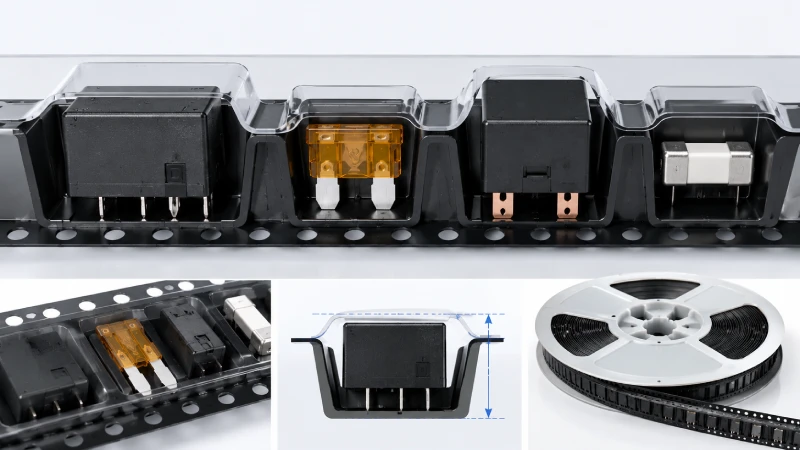
A suitable pocket depth helps the component sit lower and more securely inside the tape. It also creates better clearance between the top of the part and the cover tape. For taller components, a custom embossed pocket is often needed to reduce pressure and keep the component stable during packaging and transport.
Stable Orientation During Feeding
Relays and fuses usually have a specific direction. Terminals, pins, markings, contact points, or body shapes may need to face a certain way for inspection or assembly. If the part rotates inside the pocket, the next process may face feeding errors or manual correction.
Good carrier tape design helps control orientation. The pocket should guide the component into a consistent position and limit unnecessary movement. For buyers using automated feeding or pick-and-place systems, orientation stability is one of the most important reasons to choose custom carrier tape instead of trying to fit a relay or fuse into a standard tape.
Protection During Transport and Handling
Relays and fuses may pass through several handling steps before reaching the final assembly line. They may be packed, reeled, shipped, stored, unpacked, and loaded into equipment. During these steps, vibration and movement can cause scratches, terminal deformation, lead bending, or incorrect positioning.
A well-designed carrier tape pocket helps reduce free movement inside the cavity. It supports the component body and keeps sensitive areas away from unnecessary contact. This is especially important for relays with terminals or fuses with exposed metal parts.
For buyers, transport protection is not only about avoiding visible damage. It is also about reducing hidden handling risks that may cause feeding interruptions, inspection failures, or extra sorting work later.
Feeder Compatibility
Carrier tape must work with the customer’s feeding process. Even if the pocket fits the component, the tape may still cause problems if the tape width, sprocket hole accuracy, reel size, or cover tape peeling behavior does not match the feeding system.
Relays and fuses can be heavier than small components, so the tape-and-reel set needs to remain stable during unwinding and feeding. The reel should support the tape properly, and the tape should move smoothly through the equipment. For this reason, Jiushuo does not only consider the pocket itself, but also the complete tape-and-reel packaging combination.
Cover Tape Sealing
Cover tape plays an important role in relay and fuse packaging. It keeps the component inside the pocket during handling and transport. However, the sealing must be balanced. If the seal is too weak, the component may not be protected well. If the seal or peel force is too strong, it may cause feeding problems or unstable peeling.
For larger components, the relationship between pocket depth and cover tape sealing is especially important. The cover tape should not press heavily on the relay or fuse body. Jiushuo can help match suitable cover tape with the carrier tape to support secure sealing and smooth peeling.
Relay and Fuse Packaging Challenges and Carrier Tape Design Response
| Packaging Challenge | Why It Matters for Relays and Fuses | Carrier Tape Design Response |
|---|---|---|
| Larger component body | Standard pockets may be too narrow or shallow | Use custom embossed pockets with suitable width and depth |
| Thicker or taller profile | Cover tape may touch or press the component | Adjust pocket depth and top clearance |
| Heavier component weight | Components may shift during transport or feeding | Improve pocket support and reduce internal movement |
| Irregular shape | Poor fit may cause tilting, rotation, or unstable picking | Customize pocket geometry around the component profile |
| Terminals or metal contact areas | Leads or terminals may be bent or scratched | Design pocket support to protect sensitive areas |
| Orientation requirement | Wrong direction can affect inspection or assembly | Add pocket features that help maintain consistent orientation |
| Feeder compatibility | Poor tape movement can cause jams or missed picks | Match tape width, sprocket holes, reel size, and packaging format |
| Cover tape mismatch | Weak or excessive sealing can affect handling and peeling | Select suitable cover tape for secure sealing and smooth peel |
When Custom Carrier Tape Is Needed
Custom carrier tape is usually needed when a relay, fuse, or similar component cannot be safely packaged in a standard tape. This often happens when the part is taller, heavier, wider, or less regular in shape than common electronic components.
A custom solution is also recommended when the component moves inside the pocket, tilts during shipping, rotates during feeding, or has terminals that need better protection. In some cases, the issue is not obvious at first. A standard tape may appear usable during trial packing, but problems may appear during reel transport, cover tape peeling, or automatic feeding.
Buyers should consider custom carrier tape when they face any of the following situations:
- The relay or fuse is too thick for a standard pocket.
- The component has a tall body or uneven profile.
- The part shifts inside the pocket during transport.
- Terminals, pins, or contact areas need better protection.
- Orientation control is important for automated assembly.
- Existing tape causes feeder jams, unstable peeling, or missed picks.
- The project requires carrier tape, cover tape, and reel matching as one packaging set.
Jiushuo supports custom carrier tape development based on component samples, drawings, or packaging requirements. For buyers who are not sure whether standard tape is suitable, sample review and pocket design discussion can help reduce packaging risk before mass production.
Embossed Carrier Tape for Relays and Fuses
Embossed carrier tape is often a practical choice for relays, fuses, and other larger electronic components because it can create deeper and more structured pockets. Compared with flat or shallow packaging formats, embossed pockets can better support components with height, thickness, or special shapes.
For relay packaging, embossed carrier tape can help hold the body firmly while protecting terminals or contact areas. For fuse packaging, the pocket can be adjusted according to the fuse shape, whether it is rectangular, cylindrical, or another form. The goal is to keep each component in a stable position while allowing smooth feeding and handling.
A suitable embossed carrier tape design can support:
- Deeper pocket structure for thicker components
- Better control of component movement
- More stable orientation inside the tape
- Reduced risk of tilting or rotation
- Protection during shipping and storage
- Compatibility with tape-and-reel feeding systems
For buyers, the advantage is simple: the component is packaged in a way that fits its actual shape and handling requirements, instead of forcing the component into a generic pocket.
Matching Carrier Tape with Cover Tape and Plastic Reels
Relay and fuse packaging should not only focus on the carrier tape pocket. A complete tape-and-reel solution also includes cover tape and plastic reels. These parts need to work together.
Cover Tape Matching
The cover tape must seal the component securely inside the pocket. During transport, it helps prevent parts from falling out or shifting. During feeding, it must peel away smoothly without pulling the tape out of position or affecting component pickup.
For thicker components, the sealing clearance should be considered carefully. If the component is too close to the cover tape, it may create pressure or inconsistent peeling. A suitable cover tape helps improve packaging stability and feeding reliability.
Plastic Reel Matching
The plastic reel also matters, especially when the carrier tape is wider or the components are heavier. The reel must match the tape width, packaging quantity, and shipping requirements. A weak or mismatched reel may affect tape winding, storage, or transportation.
Jiushuo can help match carrier tape with suitable plastic reel options so buyers can receive a more complete tape-and-reel packaging solution. This is useful for component suppliers who need consistent packaging for delivery to OEM customers, distributors, or assembly plants.
Jiushuo Custom Tape-and-Reel Packaging Support
Jiushuo works with electronic component manufacturers, automotive component suppliers, distributors, and OEM purchasing teams that need reliable tape-and-reel packaging for non-standard components. Relays and fuses are typical examples because they often require more pocket depth, better support, and stronger packaging stability than smaller parts.
Jiushuo’s support can include:
- Custom embossed carrier tape for relays, fuses, and similar components
- Pocket design based on component size, height, weight, and shape
- Orientation support for automated feeding
- Cover tape matching for stable sealing and smooth peeling
- Plastic reel matching according to tape width and packaging volume
- Sample confirmation before mass production
- Practical packaging support for electronic component supply chains
For buyers, this means the packaging solution can be developed around the actual component and application. Instead of treating carrier tape as a simple consumable, Jiushuo helps make it part of the component delivery and assembly process.
How Buyers Can Prepare for a Carrier Tape Project
To make the quotation and design process smoother, buyers can prepare several basic details before contacting Jiushuo. These do not need to be overly technical, but they help the team understand the packaging requirement faster.
Useful information includes:
- Component drawing or datasheet
- Physical samples, if available
- Component length, width, and height
- Approximate component weight
- Required orientation in tape
- Expected tape width, if known
- Cover tape or reel requirements
- Packaging quantity per reel
- Downstream feeding or assembly requirements
If some information is not available, Jiushuo can still start with samples or basic component dimensions. The key is to understand how the relay or fuse should sit inside the tape, how it will be sealed, and how it will be used after delivery.
Need Custom Carrier Tape for Relays or Fuses?
If your relays, fuses, or other electronic components are too large, thick, or heavy for standard carrier tape, Jiushuo can help you develop a custom embossed carrier tape solution with suitable pocket depth, stable orientation, cover tape sealing, and reel matching.
Whether you are packaging micro relays, automotive relays, SMD fuses, protection components, or other electronic parts, Jiushuo can support your tape-and-reel packaging needs from sample review to production supply.
Contact Jiushuo to request a custom carrier tape quote for your relay or fuse packaging project.
FAQ
What type of carrier tape is suitable for relays?
Embossed carrier tape is commonly used for relays because it can provide deeper pockets and better support for taller or larger component bodies. The pocket can be customized according to the relay shape, height, terminals, and orientation requirements.
Can carrier tape be customized for different fuse sizes?
Yes. Fuse carrier tape can be customized based on fuse length, width, height, body shape, terminal structure, and packaging direction. This is useful for SMD fuses, automotive fuses, and other electronic protection components.
Why do relays and fuses need deeper carrier tape pockets?
Relays and fuses are often thicker than standard electronic components. Deeper pockets help the component sit securely inside the tape, reduce movement, and prevent excessive pressure from the cover tape.
How does carrier tape protect relays and fuses during transport?
A suitable carrier tape pocket helps hold the component in a stable position during shipping and handling. This can reduce shaking, tilting, scratches, terminal damage, and incorrect orientation before the parts reach the assembly line.
Does cover tape matter for relay and fuse packaging?
Yes. Cover tape is important because it keeps the relay or fuse inside the pocket during transport and storage. It also needs to peel smoothly during feeding. Poor cover tape matching may lead to weak sealing, difficult peeling, or feeding problems.
Can Jiushuo provide the full tape-and-reel packaging set?
Yes. Jiushuo can support custom embossed carrier tape, cover tape matching, and plastic reel matching for relays, fuses, and other electronic components. This helps buyers receive a more complete and compatible packaging solution.