
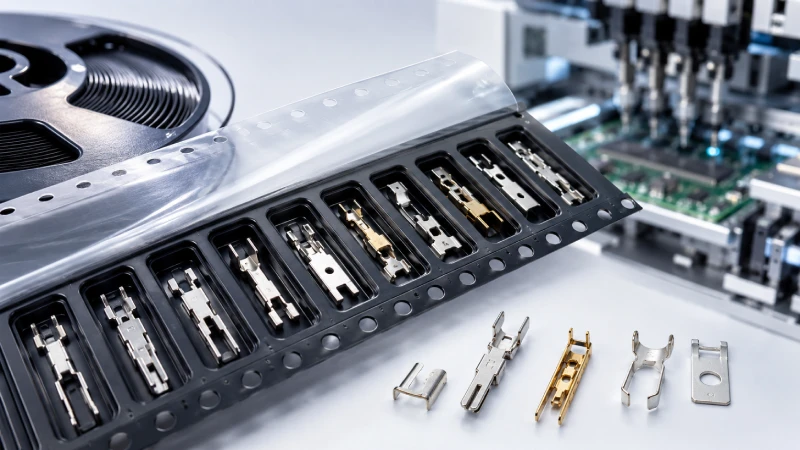
Precision metal stamped parts are widely used in connectors, terminals, electronic contacts, spring contacts, battery components, shielding parts, clips, brackets, and small hardware assemblies. These parts may look simple, but they can be difficult to package safely because many of them are thin, sharp-edged, irregular in shape, or easy to bend during handling and transportation.
For metal stamping manufacturers, connector suppliers, terminal producers, and electronics OEM buyers, packaging is not only about protecting parts during shipment. It also affects feeding reliability, inspection efficiency, and production readiness at the customer’s assembly line. When stamped parts arrive in bulk bags, trays, or poorly matched packaging, they may overlap, scratch, deform, or require extra manual sorting before use.
This is why many precision stamped metal components are packed in custom embossed carrier tape. A well-designed carrier tape keeps each part separated, controls orientation, reduces movement inside the pocket, and supports automated feeding for downstream production. Jiushuo helps customers design suitable carrier tape solutions according to part shape, size, material, edge condition, feeding direction, and packaging requirements.
Why Precision Metal Stamped Parts Need Custom Carrier Tape
Metal stamped parts often have shapes that are very different from standard electronic components. Some parts are long and narrow. Some have hooks, tabs, bends, spring structures, contact points, or uneven profiles. Others are very thin and light, which makes them easy to shift or overlap during transportation.
If these parts are packed loosely, several problems may happen. Thin parts can bend under pressure. Sharp edges may scratch other parts or damage packaging. Small contacts and terminals may stack together and become difficult to separate. Irregular parts may rotate or flip, making them unsuitable for automated feeding.
For buyers, these problems create real production risks. A part that looks acceptable after stamping may become unusable after poor packaging. A terminal that is delivered in the wrong orientation may slow down assembly. A spring contact that moves too much inside a package may suffer surface marks or deformation.
Custom carrier tape is designed to reduce these risks. Instead of using one general packaging method for many different parts, the carrier tape pocket can be shaped around the actual stamped component. This helps each part stay in a stable position from packaging to shipment to feeding.
Common Metal Stamped Parts Packed in Carrier Tape
Carrier tape is commonly used for many small and medium-sized precision metal parts, especially when the parts need to be supplied in an organized format for automatic assembly.
Typical examples include connector terminals, electrical contacts, spring contacts, battery contacts, metal clips, small shields, grounding parts, brackets, frames, and small precision hardware components. These parts are often used in connectors, automotive electronics, consumer electronics, sensors, communication devices, battery modules, and industrial control products.
For terminal and connector suppliers, carrier tape for terminals can help improve the way small metal parts are delivered to customers. Instead of sending bulk-packed parts that require manual separation, tape and reel packaging provides a cleaner and more production-friendly format.
For OEM buyers and assembly teams, carrier tape also makes incoming material easier to manage. Parts can be stored on reels, loaded into feeders, and presented consistently during automated handling. This reduces unnecessary repacking and helps improve assembly workflow.
Key Packaging Challenges for Metal Stamped Components
Sharp Edges and Burr Risk
Many stamped parts have sharp edges, corners, slots, or small burrs. Even when the stamping quality is good, the part edge may still create friction against the packaging material. If the pocket is too tight or the material is not suitable, the part may scrape the pocket wall or damage the cover tape.
A custom pocket design should consider the part’s edge condition and contact areas. The goal is not to make the pocket overly tight, but to hold the part securely while reducing unnecessary friction. Suitable material selection also helps improve packaging stability.
Thin Parts and Bending Risk
Many terminals, contacts, and small metal shields are thin and light. They may bend if they are pressed by other parts, cover tape, or external force during transportation. This is especially important for parts with functional contact areas, spring structures, or small raised features.
Carrier tape can help by giving each part its own pocket. The pocket depth, support points, and cover tape matching should be considered together. A good design keeps the part stable without applying too much pressure on sensitive areas.
Irregular Shape and Unstable Positioning
Unlike square chips or standard rectangular components, stamped metal parts often have irregular outlines. They may include slots, hooks, tabs, curves, or bending features. If the pocket does not match the part shape, the component may tilt, rotate, or move inside the pocket.
For this reason, custom carrier tape is often more suitable than standard tape. The pocket can be designed according to the part outline and key positioning points, helping maintain a consistent direction.
Orientation and Feeding Reliability
For automated feeding, orientation is very important. If a stamped part rotates inside the pocket, the feeding machine may not pick it correctly. If the part flips, the assembly line may stop or reject the part. This creates downtime and extra inspection work.
Carrier tape can be designed to control the part’s feeding direction. Pocket shape, pocket clearance, part support, and cover tape sealing all affect orientation stability. For parts used in connector assembly, electronics assembly, or automated insertion, this is one of the most important packaging goals.
Stacking and Movement Inside Pockets
Small metal stamped parts may stack or overlap if they are packed loosely. Even inside a pocket, movement can still happen if the pocket is too large or the part is not supported properly.
A better pocket design separates each part and limits unnecessary movement. This helps reduce scratching, bending, and feeding errors. It also improves the visual presentation of the part when the customer opens the reel.
Stamped Part Risk and Packaging Solution
| Stamped Part Risk | Packaging Problem | Carrier Tape Solution |
|---|---|---|
| Sharp edges or burrs | Parts may scratch the pocket, cover tape, or nearby components | Select suitable tape material and design pockets with controlled clearance |
| Thin metal structure | Parts may bend, warp, or deform during handling | Use custom pocket depth and support areas to reduce pressure |
| Irregular part shape | Parts may rotate, tilt, or shift inside the pocket | Create a pocket profile based on the part outline and key contact points |
| Small terminals or contacts | Parts may stack, overlap, or become difficult to pick | Use individual pocket separation and stable positioning |
| Surface-sensitive parts | Scratches or marks may affect appearance or function | Reduce movement and match cover tape sealing strength |
| Feeding direction requirement | Wrong orientation may cause line stoppage | Design pockets for consistent orientation and reliable feeder presentation |
How Custom Embossed Carrier Tape Improves Packaging Performance
Custom embossed carrier tape improves packaging by giving each metal stamped part a defined position. This is especially useful for small parts that are hard to handle manually or parts that need to be delivered in a specific direction.
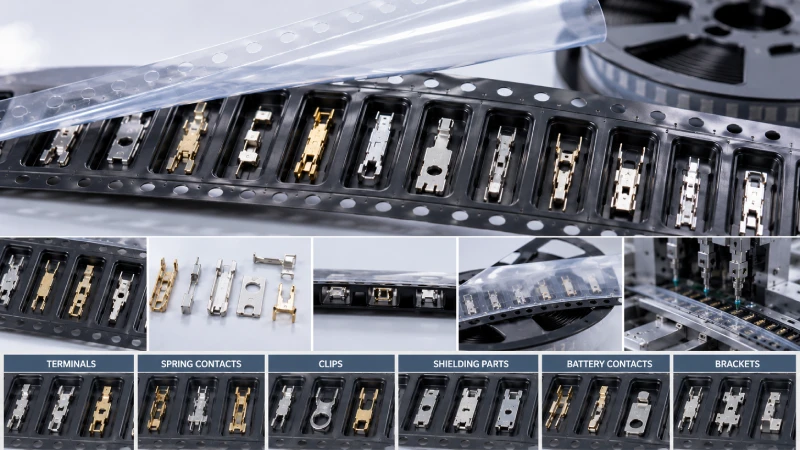
First, the carrier tape helps reduce movement during shipment. Each part is placed in its own pocket, so it is less likely to collide with other parts. This can reduce scratching, bending, and surface damage.
Second, the pocket helps maintain orientation. For stamped terminals, contacts, clips, and spring parts, the feeding direction may need to be consistent. A custom pocket can help keep the part facing the right way.
Third, carrier tape supports automated feeding. When parts are supplied in tape and reel format, they can be used more efficiently in automatic assembly, inspection, or packaging lines. This helps customers reduce manual handling and improve production flow.
Fourth, carrier tape improves product presentation. When an OEM buyer or assembly plant receives a reel of neatly packed metal parts, the packaging looks more organized and professional. This can also improve confidence in the supplier’s quality control.
For metal stamping suppliers that want to serve electronics, automotive, connector, or precision hardware customers, custom embossed carrier tape for stamped parts can become an important part of the final delivery solution.
Important Design Factors for Stamped Metal Part Carrier Tape
Pocket Shape
Pocket shape is one of the most important design factors. A stamped metal part may have a simple flat profile, or it may include bends, slots, hooks, and contact points. The pocket should be designed to support the part in a stable way without forcing it into an unnatural position.
For example, a long terminal may need side support to prevent rotation. A small spring contact may need enough space for its raised structure. A metal clip may need a pocket shape that prevents it from flipping during transport.
Pocket Depth
Pocket depth should match the part height and structure. If the pocket is too shallow, the part may press against the cover tape. If the pocket is too deep, the part may move too much or become difficult to pick.
For thin stamped parts, the design should avoid unnecessary pressure. For parts with spring features or raised contact areas, the pocket should provide enough space to protect the functional shape.
Material Selection
Material selection depends on the part shape, weight, edge condition, static control needs, and shipping environment. Some metal stamped parts may require stronger pocket support. Some may need anti-static or ESD-related packaging. Others may need a material that balances forming stability and cost.
Jiushuo can help review part samples or drawings and recommend suitable carrier tape material based on the actual packaging requirement. The goal is to create a packaging format that is stable, practical, and suitable for production use.
Cover Tape Matching
Cover tape is also important for stamped metal parts. If the cover tape seals too weakly, parts may move or fall out. If it seals too strongly or presses too much on the part, it may affect thin or raised structures.
Proper cover tape matching helps balance protection and smooth peeling. For automated feeding, the cover tape should open consistently so the parts can be picked or processed without interruption.
Tape and Reel Packaging for Automated Feeding
Many precision metal stamped parts are used in automated production environments. This is common in connector manufacturing, terminal assembly, electronics production, battery component assembly, and automotive electronics.
In these applications, packaging format affects production efficiency. Bulk-packed parts may require manual sorting before feeding. Tray-packed parts may take more space and may not suit every automatic line. Tape and reel packaging provides a more continuous and organized format.
With tape and reel packaging, parts are placed into pockets along a carrier tape and sealed with cover tape. The tape is then wound onto a reel for storage, shipment, and feeding. This format helps improve handling efficiency and supports automatic presentation of each part.
For buyers, this means less manual preparation before production. For suppliers, it means a more professional delivery method that can better meet OEM or assembly plant requirements.
Jiushuo’s Custom Carrier Tape Support for Metal Stamped Parts
Jiushuo supports custom carrier tape solutions for precision metal stamped parts, including terminals, contacts, spring contacts, clips, shields, brackets, and small hardware components.
The process usually starts with part drawings, 3D files, or physical samples. Jiushuo reviews the part size, shape, thickness, edge condition, surface requirements, and feeding direction. Based on these details, the team can recommend a suitable carrier tape structure, pocket design, material, and cover tape solution.
For irregular stamped parts, Jiushuo focuses on stable pocket positioning. For thin or delicate parts, the design should reduce pressure and bending risk. For parts that require automated feeding, the pocket should support consistent orientation and smooth presentation.
Jiushuo can also help with sample testing before mass production. This is important because small changes in pocket size, depth, or support area may affect how the part sits inside the pocket. Testing helps confirm whether the packaging works well for shipment, storage, and feeding.
By combining custom pocket design, material selection, cover tape matching, and tape and reel packaging support, Jiushuo helps customers move from part production to production-ready packaging.
Quotation Checklist for Metal Stamped Part Carrier Tape
To receive a faster and more accurate carrier tape recommendation, buyers should prepare the following information before requesting a quote:
- Part drawing or 3D file
- Physical samples, if available
- Part length, width, height, and thickness
- Part material and surface finish
- Sharp edge or burr condition
- Required feeding direction or orientation
- Quantity per reel
- Carrier tape width requirement, if already known
- Cover tape requirement, if already known
- ESD or anti-static requirement
- Packaging standard or customer specification
- Trial sample or mass production schedule
Providing these details helps Jiushuo recommend the right pocket design, tape material, cover tape matching, and reel packaging format faster. For special stamped parts, samples are especially useful because they allow the packaging design to be checked against the real part shape and handling behavior.
Request Custom Carrier Tape for Your Metal Stamped Parts
If you need carrier tape for terminals, contacts, springs, clips, shields, brackets, or other precision metal stamped parts, Jiushuo can help develop a suitable packaging solution based on your component and production needs.
Send your drawing, sample, or packaging requirement to Jiushuo for review. The team can support custom pocket design, material selection, cover tape matching, and tape and reel packaging for automated feeding and shipment.
Whether you are a metal stamping manufacturer, connector supplier, terminal producer, or electronics OEM buyer, the right carrier tape can help reduce packaging risk, improve feeding reliability, and deliver parts in a cleaner, more production-ready format.
FAQ
Can carrier tape be used for thin metal stamped parts?
Yes. Carrier tape can be customized for thin stamped metal parts by adjusting pocket depth, support areas, and cover tape matching. This helps reduce bending, stacking, and unnecessary movement during packaging and transport.
What types of metal stamped parts can be packed in carrier tape?
Common examples include connector terminals, electrical contacts, spring contacts, battery contacts, metal clips, shielding parts, small brackets, and precision hardware components used in electronics and automotive applications.
How does carrier tape prevent stamped parts from moving inside the pocket?
The pocket can be designed according to the part outline, height, and stable support points. A suitable pocket shape helps limit rotation, tilting, and movement while still allowing smooth feeding.
Is cover tape important for metal stamped parts?
Yes. Cover tape helps keep parts inside the pockets during storage and shipment. It should be matched with the carrier tape and part structure to provide proper sealing strength and smooth peeling during automated feeding.
Do I need to provide samples for custom carrier tape design?
Samples are recommended, especially for irregular, thin, sharp-edged, or difficult-to-position parts. Drawings and 3D files can support the initial design, but physical samples help confirm the actual fit and packaging performance.
Can Jiushuo support tape and reel packaging for terminals and contacts?
Yes. Jiushuo can support custom carrier tape design, material selection, cover tape matching, and tape and reel packaging for terminals, contacts, springs, clips, and other precision stamped metal parts.