
Introduction
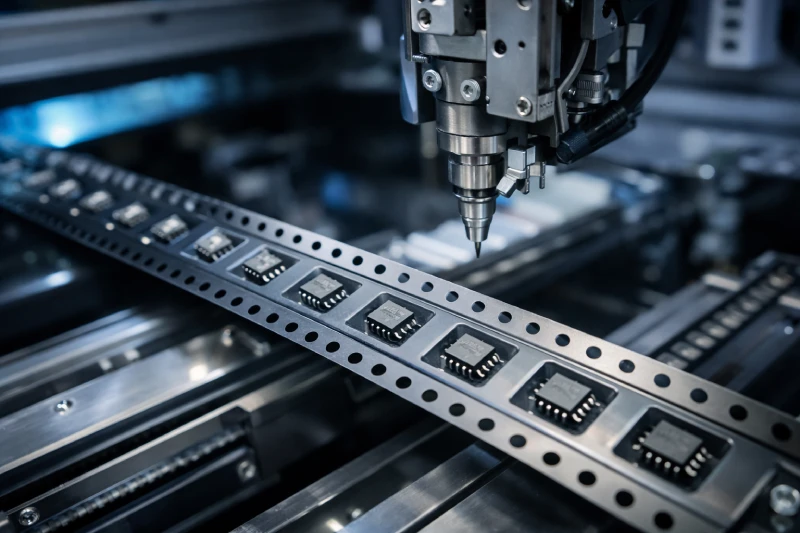
In modern electronics manufacturing, even a tiny static charge can silently damage sensitive components. This is where antistatic carrier tape plays a critical role. Used in tape and reel packaging, it helps protect electronic parts from electrostatic discharge (ESD) during storage, transportation, and high-speed SMT assembly.
From IC chips to LEDs and precision connectors, ESD-sensitive components require controlled environments to maintain performance and reliability. Without proper protection, static buildup can lead to latent defects, reduced yield, and costly failures.
In this guide, we’ll explain what antistatic carrier tape is, how it works, how it compares to conductive tape, and how to choose the right solution for your application.
What Is Antistatic Carrier Tape? (Definition + Function)
Antistatic carrier tape is a type of embossed plastic tape designed to hold and transport electronic components while preventing static charge buildup. It is widely used in automated SMT (Surface Mount Technology) processes where components are fed into pick-and-place machines.
Unlike ordinary plastic materials that can accumulate static electricity, antistatic carrier tape is engineered to dissipate charges gradually, reducing the risk of electrostatic discharge.
Key functions include:
- Preventing static charge accumulation
- Protecting sensitive components from ESD damage
- Ensuring stable component positioning during feeding
- Maintaining consistent performance in automated assembly
In standard tape and reel packaging systems, antistatic carrier tape works together with cover tape and reels to form a complete protective solution.
👉 If you need a broader overview, you can also explore our guide on carrier tape fundamentals.
Why ESD Protection Is Critical in Tape and Reel Packaging
Electrostatic discharge is one of the most common and underestimated risks in electronics manufacturing. Even voltages as low as 100V can damage semiconductor devices, often without visible signs.
Common ESD risks in packaging:
| Risk Source | Impact |
|---|---|
| Friction during handling | Static charge buildup |
| Low humidity environments | Increased ESD risk |
| High-speed SMT feeding | Component instability |
| Plastic material contact | Charge accumulation |
The biggest challenge is that ESD damage is often latent. A component may pass initial testing but fail prematurely in real-world use.
This is why ESD-safe packaging—including antistatic carrier tape—is not optional but essential in industries such as:
- Semiconductor manufacturing
- LED production
- Automotive electronics
- Consumer electronics
How Antistatic Carrier Tape Works (Technical Mechanism)
Antistatic carrier tape does not eliminate static electricity instantly. Instead, it is designed to control and dissipate electrostatic charges over time.
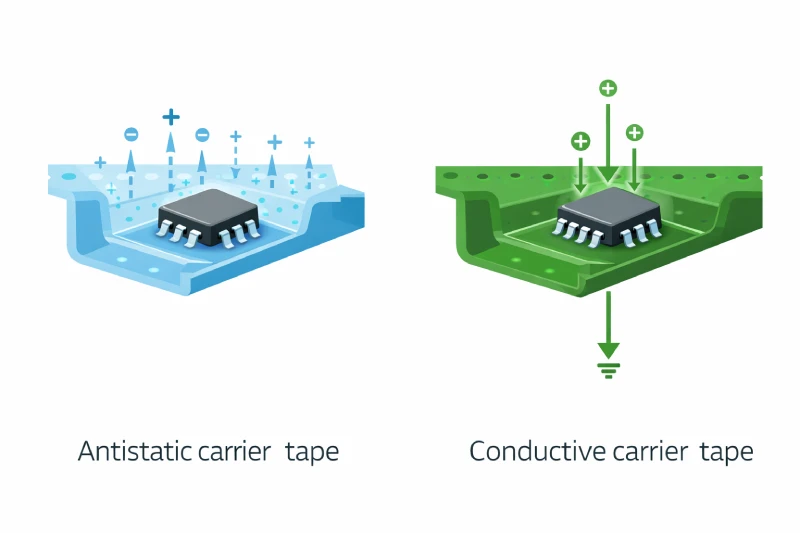
Key technical characteristics:
- Surface resistivity: Typically between 10⁹ and 10¹¹ ohms
- Charge dissipation: Gradual discharge rather than immediate conduction
- Material modification: Achieved through additives or coatings
When static charges are generated (for example, through friction during feeding), the antistatic material allows these charges to spread and dissipate safely, preventing sudden discharge events.
This controlled behavior is critical because:
- Sudden discharge (as in conductive materials) can damage components
- Complete insulation (as in non-treated plastics) allows dangerous buildup
Antistatic carrier tape provides a balanced solution between these extremes.
Antistatic vs Conductive Carrier Tape: Key Differences
Choosing between antistatic and conductive carrier tape is one of the most important decisions in ESD-safe packaging.
Comparison Table:
| Feature | Antistatic Carrier Tape | Conductive Carrier Tape |
|---|---|---|
| Surface Resistivity | 10⁹–10¹¹ Ω | <10⁵ Ω |
| Function | Prevent charge buildup | Immediate discharge |
| ESD Protection Level | Moderate | High |
| Typical Applications | IC, LED, passive components | Highly sensitive semiconductors |
| Cost | Lower | Higher |
Key takeaway:
- Use antistatic carrier tape for general electronic components where static control is required but not extreme
- Use conductive carrier tape for highly sensitive semiconductor devices where immediate discharge is necessary
Making the wrong choice can either increase costs unnecessarily or expose components to ESD risks.
Materials Used in Antistatic Carrier Tape
The performance of antistatic carrier tape depends heavily on the base material and the method used to achieve antistatic properties.
Common materials:
- PS (Polystyrene):
Most widely used due to cost efficiency and good forming properties - PET (Polyethylene Terephthalate):
Better mechanical strength and dimensional stability - PC (Polycarbonate):
High-performance option for precision applications
Antistatic treatment methods:
- Additive-based (mixed into material)
- Surface coating
- Permanent vs temporary antistatic solutions
Each combination affects durability, resistivity stability, and long-term performance.
Standards and Specifications (EIA-481 & ESD Requirements)
To ensure compatibility and reliability, antistatic carrier tape must meet industry standards.
Key standards include:
- EIA-481:
Defines carrier tape dimensions, pocket spacing, and reel specifications - ANSI/ESD standards:
Define acceptable resistivity ranges and testing methods
Important parameters:
- Pocket dimensions and tolerances
- Tape width and pitch
- Surface resistivity compliance
Following these standards ensures that the tape performs consistently in automated SMT systems.
Common Applications of Antistatic Carrier Tape
Antistatic carrier tape is used across a wide range of electronic components:
Typical applications:
- Integrated circuits (ICs)
- LEDs
- Passive components (resistors, capacitors)
- Connectors and small modules
These components are often processed in high-speed production environments, making consistent ESD protection essential.
How to Choose the Right Antistatic Carrier Tape
Selecting the right carrier tape is not just about material—it requires a structured evaluation of your application.
Step-by-step selection guide:
1. Component sensitivity
- Highly sensitive → consider conductive tape
- Standard components → antistatic is sufficient
2. Production environment
- High-speed SMT lines require stable material performance
3. Material selection
- PS → cost-effective
- PET → better stability
- PC → high precision
4. Compatibility
- Must match cover tape and reel system
- Ensure proper peel force and feeding performance
👉 For customized solutions tailored to your components and SMT process, explore our custom antistatic carrier tape solutions.
This ensures optimal protection, consistent feeding, and reduced production risk.
Common Problems and Solutions in Antistatic Carrier Tape
Even with antistatic materials, issues can still occur if the system is not properly designed.
Common problems:
1. Static buildup still occurs
- Cause: unstable material or environmental factors
- Solution: verify resistivity and humidity conditions
2. Component jumping or misalignment
- Cause: static + mechanical mismatch
- Solution: optimize pocket design and material
3. Abnormal peel force
- Cause: mismatch with cover tape
- Solution: adjust sealing conditions
These issues highlight the importance of selecting not just the right material, but the right complete packaging system.
FAQs
1. Is antistatic the same as ESD-safe?
Not exactly. Antistatic prevents charge buildup, while ESD-safe includes broader protection measures.
2. What resistivity is considered antistatic?
Typically between 10⁹ and 10¹¹ ohms.
3. Can antistatic tape replace conductive tape?
Not for highly sensitive components—conductive tape provides stronger protection.
4. Does humidity affect performance?
Yes. Low humidity increases static risk significantly.
5. How is ESD performance tested?
Through surface resistivity and charge decay testing.
Conclusion: When Should You Use Antistatic Carrier Tape?
Antistatic carrier tape is an essential solution for protecting electronic components in tape and reel packaging. It provides controlled static dissipation, ensuring safe handling and reliable SMT processing.
For most general electronic applications—such as ICs, LEDs, and passive components—antistatic carrier tape offers the ideal balance between performance and cost.
However, choosing the right solution requires a clear understanding of your component sensitivity, production environment, and material requirements.
👉 If you’re evaluating options or facing ESD-related issues, working with an experienced manufacturer can help you achieve stable, reliable results. Explore our ESD-safe carrier tape options to find the right fit for your application.